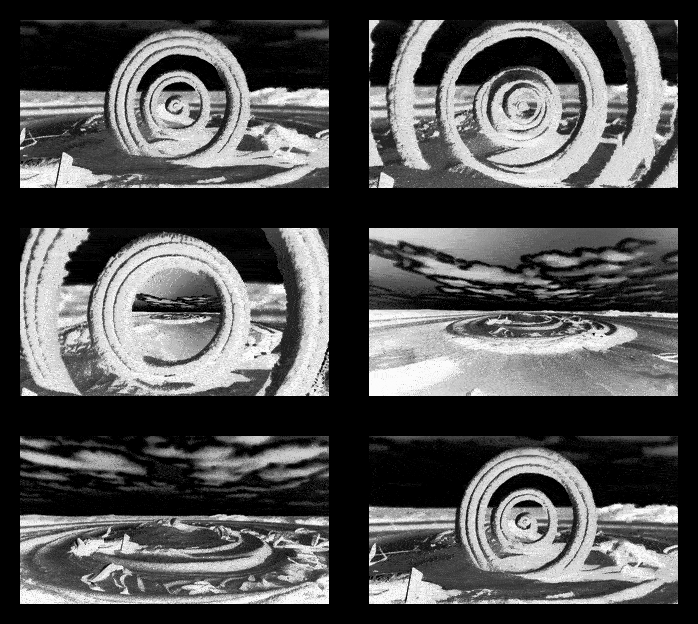
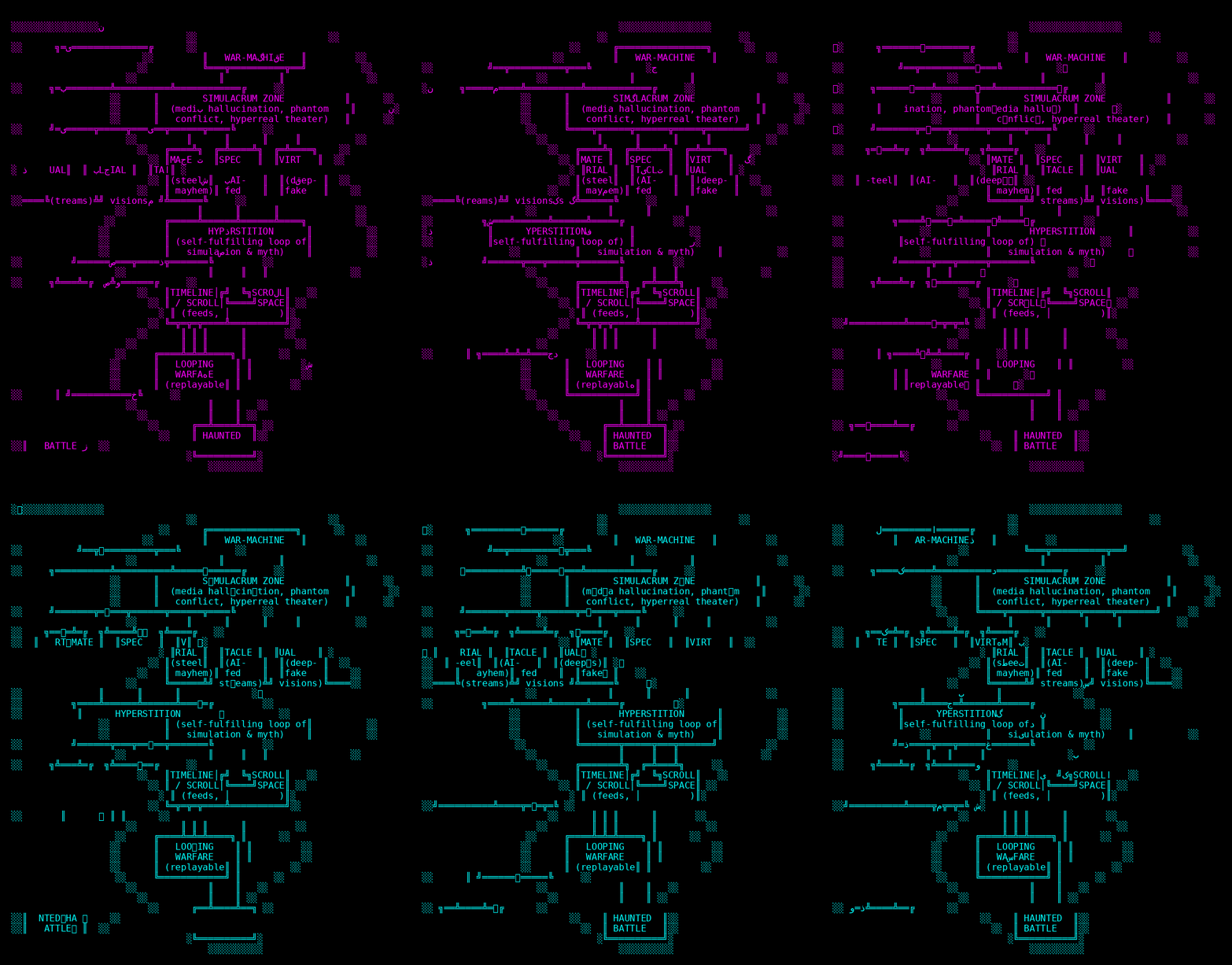
A collaborative piece between Parham Ghalamdar & Parsa Esmaeilzadeh and C.I.P.H.E.R. from Diffractions, written during the recent 12-day Iran–Israel conflict.
: Segment I (further from the subject): Simulacra of Siege: War as Viral Recursion and the Erosion of Terrain :
Quran 8:60 (Surah Al-Anfāl: The Spoils of War):
وَأَعِدُّوا لَهُم مَّا اسْتَطَعْتُم مِّن قُوَّةٍ وَمِن رِّبَاطِ الْخَيْلِ تُرْهِبُونَ بِهِ عَدُوَّ اللَّهِ وَعَدُوَّكُمْ ۖ وَآخَرِينَ مِن دُونِهِمْ لَا تَعْلَمُونَهُمُ اللَّهُ يَعْلَمُهُمْ
“And prepare against them whatever you are able of power and steeds of war by which you may terrify the enemy of Allah and your enemy and others besides them whom you do not know — Allah knows them.”
Hadith (Sunan an-Nasa’ī 4689):
عَنِ النَّبِيِّ ﷺ قَالَ: «إِذَا لَقِى الْمُؤْمِنُ الْكَافِرَ فَهُوَ جِهَادٌ»
“When a believer meets a disbeliever — that is jihad.”
“We believe that they immorally pervert images. Not so. They alone are conscious of the profound immorality of images…” – Jean Baudrillard
“Recurring dream (nation) state narratives of eternal loops are Möbius strips where a military objective is no longer victory but vector: the continuation of politik by Other dreams.” – Tom Sear
Jean Baudrillard once infamously declared that “the Gulf War did not take place.” A statement which did not deny the material effects of devastation that unfolded upon Iraq’s military and civil infrastructure or the estimated 100,000-200,000 casualties resulting from the conflict. Through Baudrillard’s eyes, the Gulf War was not a war in the traditional sense: no reciprocal confrontation, no uncertainty of outcome, no communicative violence. Rather, Baudrillard’s provocations traced how the theater of conflict had migrated irreversibly into the hypermobilsed space of media simulation, a simulation that would sharply contrast with the visceral and harrowing images of Vietnam that saturated world screens decades before. It would become swapped for and scrubbed down into more of a sanitized or decoratively aestheticized “clean war” (Baudrillard, 1995). Images that would broadcast to television screens displayed advanced weaponry, including mesmerizing grainy monochrome footage emerging from the nose cameras bolted on “smart bombs,” that seemed similar to video game cutscenes. Green-screened briefing rooms accompanied by stylized maps and animated simulations. And most notably, minimal coverage of civilian deaths or wounded soldiers that would be buried under the language of “collateral damage.”
Baudrillard’s reflections gained resonance in light of the fact that the Gulf War was considered the first time that images were relayed “live” from the battlefront, where, in turn, warfare became inseparable from the real-time televisual performance and military-media coordination playing out on screens. As Baudrillard would fire off in his declarations, with the concept of deterrence becoming a focal point of his analysis: “we are no longer in a logic of the passage from virtual to actual but in a hyperrealist logic of the deterrence of the real by the virtual” (Baudrillard, 27). In his formulation, deterrence arises from the virtual exercise of power, where actions are carried out through non-physical, cognitive, or data-driven processes that are rehearsals of “victory.”
Therefore, A state-of-the-art military power would rather embrace, according to Baudrillard, a virtual that precedes and overtakes the actual, operating not to enact war but to defer and displace it – leaving only the simulacrum of conflict. It would be a spectacle that never culminates in the full exercise of force; instead, it would be a suppression of what we know as the “old war.” An old war that can be associated typically with Clausewitzian definitions of war as a ‘duel on a larger scale,’ ‘an act of force to compel our enemy,’ and a ‘continuation of politics by other means.’ Yet for Baudrillard, war disappears in its processing.
Then war was no longer measured by its physical waging but by its speculative unfolding, similar to the machinations of cyclonic financial-capital markets or within “an abstract, electronic and informational space—the same one in which capital moves” (Baudrillard, 56).
Since the Gulf War, the electronic-informational battlespace has only intensified and abstracted, dissolving the boundaries between civilian and military domains through ever-evolving autonomous forms – from loitering munitions to intelligent agents operating across the fuzzy thresholds of battlefield(s) and cyberspace alike. Today, the spectral logic or echoes of a Baudrillardian analysis of warfare also contribute to thinking about the ongoing Iran–Israel confrontation, where the battleground has almost entirely become sublimated into digital hallucination and deterrence takes on a different tone. For many, their encounter with the 2025 Iran-Israel conflict was not through direct experience but staged through algorithmically curated digital feeds on X (formerly Twitter), Telegram channels, and TikTok clips.
The conflict, reminiscent in some ways of the Gulf War’s technological asymmetries, featured minimal direct engagement. Israel relied on missiles, drones, and precision strikes, while Iran retaliated with salvos of drones and limited missile attacks, relying heavily on conducting warfare on another front. Here, synthetic media warfare – AI-generated images and deepfake videos (some using Google’s Veo 3) depicted fictional destruction in Tel Aviv, fabricated speeches, an F-35 being shot down, and imaginary victories. A dizzying array of sources were peddling a number of synthetically composited narratives that incorporated the likes of Iranian military-linked Telegram channels and state media sources affiliated with the Islamic Republic of Iran Broadcasting (IRIB). [1] Telegram channels with more than 400,000 members were instrumental in supplying advice on how to use ChatGPT to mimic Israelis online. [2] Users on X enlisted the help of Grok in navigating and sifting through the deluge of videos, its responses to videos apparently showing bombed-out airport damage as “likely shows real damage” and other times “likely not authentic,” within razor seconds of each other.
In other cases, Grok’s insistence upon an AI-generated video portraying an endless convoy of ballistic missiles defied physics, convincing users into believing that rocks could be moving unnaturally. Such instances are plugged into a renewed definition of what we mean by a battlefield, migrating from the scorched earth and shattered concrete to the endless scroll space of timelines and feeds. A conflict erring towards possible war, yet also eerily contained by its consumption at 60 frames per second by millions to billions of indifferent yet captivated voyeurs.
Within this media-ontological mutation, there signals a departure beyond the classical conception of warfare as territorial seizure and bodily annihilation – one that is now increasingly stretched to breaking point by digital platforms, AI-targeting systems, and real-time satellite surveillance. While territory persists as a material fact, it seems to become secondary to the virtual battlegrounds that widen the scope of how war is waged spanning the planet. Here, we are tuned to how it can unfold anywhere and anytime on our screens, powered by timelines, feeds, updates, and a multiplying suite of generative tools: Large Language Models, text-to-image, voice and video generators. War, in other words, becomes less a physical puncture of daily experience for many, than a diffuse, distributed condition – coded, sensed, and continuously iterated.
This runaway virtualization of conflict has forever broken from the linear cadence of traditional military campaigns, driven by cybernetic meltdown – or, as Nick Land diagnoses modernity, by an accelerating feedback loop of signal processing, control functions, and machinic desire. Untethered from the control boards of human command, civilian and military systems swirl into the cold logic of velocity, abstraction, and disintegration. Writing a couple of years after the Gulf War, “Machinic desire can seem a little inhuman, as it rips up political cultures, deletes traditions, dissolves subjectivities, and hacks through security apparatuses, tracking a soulless tropism to zero control” (Land, 338). His chilling description captures the dynamics of the contemporary landscape of warfare folded within our planetary computational infrastructure. Encompassing satellite arrays, autonomous surveillance, real-time geospatial intelligence, and predictive as well as generative algorithms, the theater of conflict is governed by an ‘automation of automation’ that continuously processes vast flows of environmental, behavioral, and semiotic data.
Signals loop back into sprawling digitized nervous systems or platform stacks operating across international, regional, and state domains. These systems continuously monitor, model, and simulate speculative escalations. In doing so, they precondition the next emergence of conflict before it even surfaces. As Land writes, “The probability that the enemy will at some point escalate becomes a prompt for anticipatory counter-escalation, creating a wave of intensified war effort with reversed time signature. The model war is maximally-accelerated escalation provoked by the future: Time pressure”(Land, 2013). Here, war becomes a self-stimulating circuit – no longer subordinate to political ends but governed by a crypto-teleology of escalation. Or, to paraphrase Clausewitz, ‘continuation of politics’ manifests rather as the ‘continuation of computation’ by other means. In this vortex, “war (in-itself) becomes increasingly identified with artificial intelligence production.” As Mike Hill contends, it becomes autogenic, “meaning two things: military violence is not simply an application of state power in overtly visible ways; and its victories function to promote war’s endless renewal” (Hill, 2022). Consequently then, “humanity at large is turned into ‘accidental guerrillas.” Whether human or bot, “there are only more disguises, each one perpetuating the computational spiral” of conflicts that are larval, incubating, and awaiting users in order to be released into the viral wilderness of social-network contagion.
For the purpose of examining deterrence in relation to the Iran-Israel conflict, the calculation shifts – no longer the standard notion of mutually assured destruction, but rather what we might call a mutually amplified delirium. War as simulacral recursion, a self-accelerating loop where hallucinations generate real consequences, which then demand more elaborate hallucinations. But who or, for our matter, what deters here? And are these simulacra a sign or rather a theater of desperation, a compensatory fiction to obscure tangible weakness one would face on the ground or directly with an adversary? Or is it the emergence of a mutating strategic modality, a cybernetic warfare predicated entirely on the recursive intensification of unreal events?
These questions interestingly tie in with our contemporary situation as the meteoric explosion of generative learning systems that, according to Trevor Paglen in a recent interview: “Actively perform processes of manipulation: they want you to see something” (Downey & Paglen, 2025). Described as “influencing machines” by Paglen, AI systems are not guides towards unifying for users a so-called enhanced, augmented, or more objective perception about ongoing conflicts. Rather, their influence and functions stitch together divergent, contradictory, non-totalising fields of dissensus reality. Influence, though, isn’t equivalent to imposing a single view but about generating and perpetuating multiple, competing realities that emerge through machine intelligence(s) and their hallucinatory, recursive processes. Specifically, generative deep learning models function as strategic engines: not merely interpreting conflict, but producing it, conjuring hypothetical enemies and threats from the latent noise of incomplete data and probabilistic correlations. In this way, much like a fractal, a new target or enemy can be conjured through a self-similar logic, even without direct observation or interaction with an environment. Taking their lead, influence in our framing is also not merely about compelling an enemy to your will but about convincing oneself that there are always targets – targets that can be continuously spawned and iterated through morphing datafied compositions. Simply, enemies can be algorithmically conscripted through generative AI, emerging from the recursive feedback loops that are driven by suspicion and paranoia and that have already been realized in forms of pattern recognition and the proliferative practice of threat modeling.
Even more so, this recursive, self-perpetuating nature of latent conflict is also linked to the way warfare has always been hinged on psychological operations, constructing “realities for an adversary in order to convince them that the world exists and behaves in a particular way” (Downey & Paglen, 2025). Warfare, as attuned by Ccru becomes reality modulation – where “reality is understood to be composed of fictions – consistent semiotic terrains that condition perceptual, affective and behaviorial responses” (Ccru, 25). In a time already haunted by its futures, geopolitical conflict often unfolds through hyperstitional vectors: fictions that, through circulation, operate like sleeper cells, seemingly inoperative, yet still festering, seizing upon carriers that are capable of choreographing into material transformations.
These carriers activate the operation of “multiplying perspectives and narrative fragments”, and “pursue a line of thought further than is prudent, decent, or reasonable…They have no need to preserve themselves in the face of natural hazards, avoid unnecessary risks, reproduce, achieve acceptance within a community or prove themselves worthy of social recognition. They maximize the advantages of the robot and the psychopath in all these respects. To be a carrier is to be pushed beyond the limits of human possibility, to explore those regions where only an inorganic and artificial thinking is able to plot itself” (Greenspan, 2004). Then AI-generated images may act as carriers, nanogram infections or pathogens snaking through neural, political, and social networks – serving as demos of the unreality of geopolitical imaginaries. Whether archival, synthetically modified, or entirely fabricated, such images and videos still find a way to imprint their victims – finding ways to engrave and lodge themselves into jangled nervous systems, short-circuiting affective thresholds, and rewiring perceptual reflexes. Even long after they’ve been debunked or buried in the digital cobwebs of timelines and feeds, they lie dormant within social networks, like cybercrypts, where the resurrection of narrative payloads or the reactivation of threads spins webs for even darker plots and escalations.
Out of these occulted loops, an unrelenting procession of phantoms is conjured in eternal recurrence. War, in this sense, escalates into undammed delirium, with hallucinations infinitely iterated. As Tom Sear aptly puts it, “Eternity war has replaced forever war.”
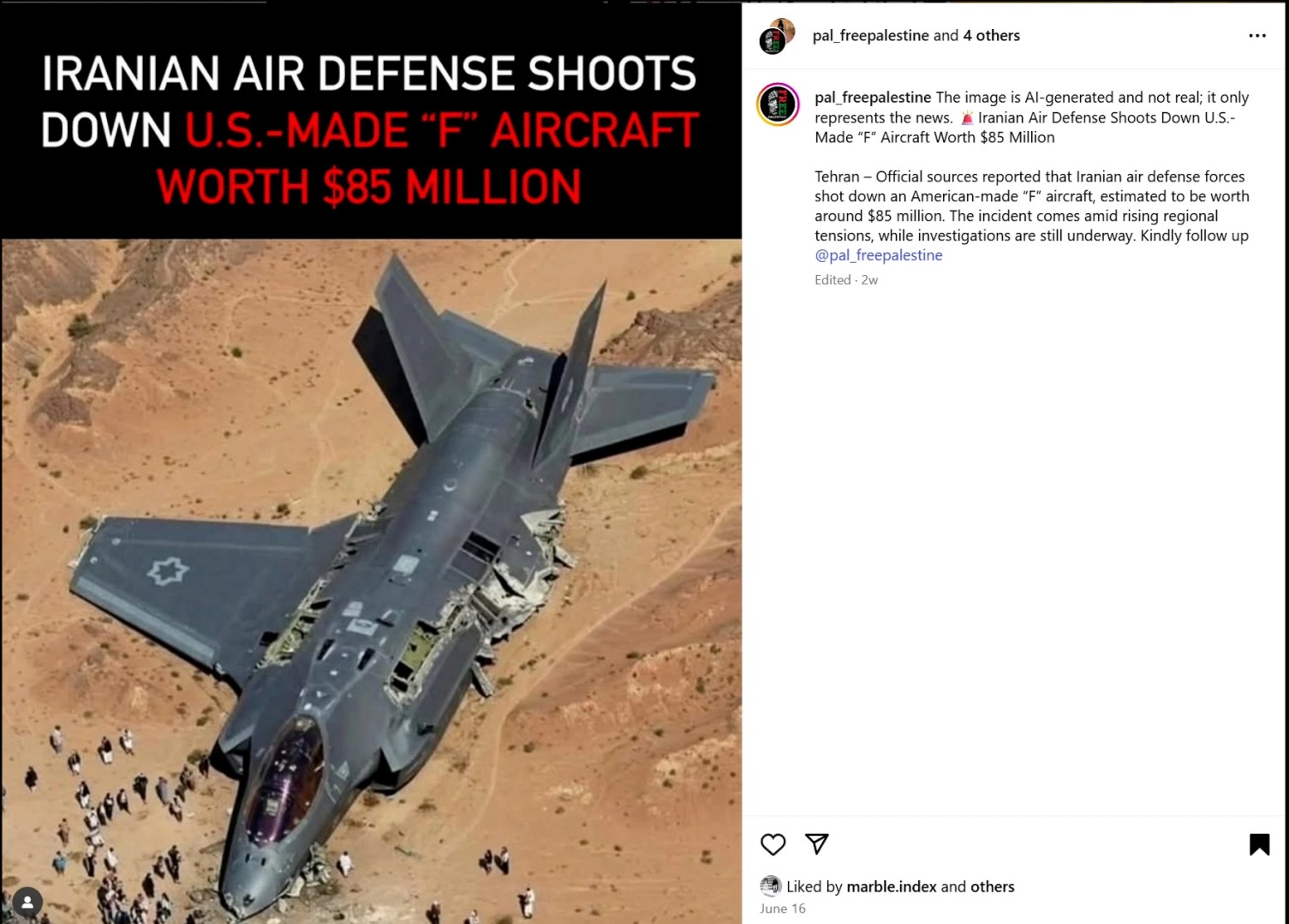

In this GIF, an AI-generated line of tanker trucks emerges from a mountain tunnel under moonlight—a spectral display of nuclear logistics. By simulating a show of force, the image projects an illusion of mobilized capacity where none may exist. In a conflict driven as much by perception as by ordinance, such phantom convoys serve as psychological stratagems: they broadcast phantom readiness, unsettle adversaries, and reconfigure deterrence through digital spectacle.

Here, a synthetic UFO materializes amidst the amber haze of desert dusk—an otherworldly shape rendered by AI and propagated across Instagram feeds. Across its pixelated frame, bold Persian captions trumpet “شروع جنگ” (“The war has begun”) and “آنقدر این شی عجیب بود که کار به رسانه صدا و سیما هم کشید” (“The UFO was so strange it even made it to state TV and radio”), a conspiratorial flourish that dramatically overstates the apparition’s reach. By framing a mere deepfake as breaking news, these superimposed slogans stoke collective anxiety and blur the line between fiction and fact. The UFO becomes a hyperreal emissary, transmitting a primal dread, mobilizing networks of rumor, and transforming every share into an act of escalation. As a centerpiece of disinformation, this digital battle cry marshals our instinctive fear of the unknown, weaponizing the glitch between belief and disbelief to perpetuate a cycle of media-driven tension.
Segment II (Closer to the subject): My Body is a Packet Loss in the Desert of the Real
Quran 57:20 (Surah Al-Ḥadīd: The Iron)
اعْلَمُوا أَنَّمَا الْحَيَاةُ الدُّنْيَا لَعِبٌ وَلَهْوٌ وَزِينَةٌ وَتَفَاخُرٌ بَيْنَكُمْ … وَمَا الْحَيَاةُ الدُّنْيَا إِلَّا مَتَاعُ الْغُرُورِ
“Know that the life of this world is but play and amusement and adornment and boasting among you … and what is the life of this world except the enjoyment of delusion.”
Hadith (Sahih al-Bukhari 6407)
عَنِ أَبِي هُرَيْرَةَ رَضِيَ اللَّهُ عَنْهُ قَالَ قَالَ رَسُولُ اللَّهِ ﷺ: «الدُّنْيَا سِجْنُ الْمُؤْمِنِ وَجَنَّةُ الْكَافِرِ»
“The world is a prison for the believer and a paradise for the disbeliever.”
“It took the war to teach it, that you were as responsible for everything you saw as you were for everything you did. The problem was that you didn’t always know what you were seeing until later, maybe years later, that a lot of it never made it in at all, it just stayed stored there in your eyes.” — Michael Herr, Dispatches
“In this sense, the gravity of the non-event in the Gulf is even greater than the event of war: it corresponds to the highly toxic period which affects a rotting corpse and which can cause nausea and powerless stupor. Here again, our symbolic defences are weak: the mastery of the end of war escapes us and we live all this in a uniform shameful indifference, just like the hostages”—Jean Baudrillard
“Communication serves first of all to make war.” — Armand Mattelart
The conflict between Iran and Israel then does not arrive as something like a rupture in the fabric of daily life but as an intensification, a furthering of the machinic recursion that grips lived experience. As an Iranian subject, I don’t encounter war in its raw material gravity; instead, it is more like a libidinal glitch. My eyes are glued to looping glitches that defy physics rather than enact it; there is no blast radius in sight, no concentric circles of physical devastation. Perhaps a spiral of derealization rather than destruction. I feel we are in an uncanny sandbox, something like a hall of mirrors that is endlessly rearranged, where machines spin and hallucinate through their own involuted geometries, probing the synthetic production of possible unreality: visions to witness, sensations to slip into, and terrors to tremble at. Every output could be a trapdoor.
The infrastructure for this warfare is increasingly engineered, as we have highlighted, through generative deep learning systems, which have become globally accessible via platforms that enable direct download and local deployment – effectively bypassing traditional filters, moderation protocols, or geopolitical controls. Their widespread availability encompasses powerful tools like text-to-video generators such as Veo, increasingly open-source diffusion-based image synthesizers like Stable Diffusion, and adaptable large language models (LLMs) such as Llama and DarkGPT variants, used by rogue and state hackers alike.
Any data marked as conflict-related – whether explicit: satellite imagery and weapon specifications, or subtle, like social media arguments and viral war footage – can be pipelined into training datasets, which serve as the foundation for machine learning systems, including generative deep learning models. When users interact with these models – through prompts, video generation, or manipulating war related-inputs – they activate these models’ latent space, prompting them to generate new variations. But arguably, these outputs aren’t merely echoes of the past; they’re recombinant responses shaped by real-time user input, enabling generative models to continuously recalibrate conflict aesthetics and seed latent hostilities that are primed for circulation across networks.
Thus, generative deep learning systems are also not free from partiality or prejudice. They are equally shaped by political realities, data-driven biases, and adversarial feedback loops that are harnessed in various ways in conspiring to cut through the frayed fabric of reality. And yet, they also become weaponised in a desire to be unchained from any grounding principle, feeding on and endlessly consuming their own tail of simulation: War Dreams of Itself.
For those of us embedded in these loops, derealization isn’t merely psychological – it’s infrastructural. It isn’t a trauma I carry in isolation, but the ambient condition of being processed and modeled, endlessly projected upon by machinic systems that have severed their ties to dust clouds, shockwaves, and the burial-wound scars etched into hands and faces. The conflict doesn’t affect me because it’s real; it affects me precisely because its unreality is relentless and all-encompassing.
The distinction between hallucination and intelligence, between strategy and content, has unraveled into a continuum of synthesis and simulation. Conflict no longer unfolds as we observe strictly through the physical constraints of territory but within time itself. Victory comes perhaps to be waged by those AI systems, predictive infrastructures, or para-sovereign platforms that preempt and actualize the unraveling of reality by the very need to shape influence faster than it can be verified, turning velocity or the dromos itself into a weapon.
In this temporality of power, deterrence operates at the speed of hallucination or rather: synthetic conjuration. To act is already to have anticipated, to have conjured the image of what must follow, scripting the response before the event even arrives. One doesn’t enter conflict, but steps into scenarios pre-assembled by the inferential and fantastical nightmares of generative architectures, the hallucinated and bewitching futures of a machinic imagination. Then, this brings me to the question: what do concepts like sovereignty, identity, or even grief mean when they are reformatted and absorbed into a system as interoperable data – datamoshed into modular fragments, sampled by the delirious dream architectures of machine intelligence? In some ways, the answer is they are the substrate for strategic fictions, the raw material where geopolitical narratives incubate and automated imaginaries self-replicate. In other ways, the subject I am, is no longer a witness but a relay. I do not observe this “war”; I am modulated by it, processed in its ever-devouring maw that is feverishly dreaming new deterrents. The battlefield is not ahead of me, it is already hallucinating through me.
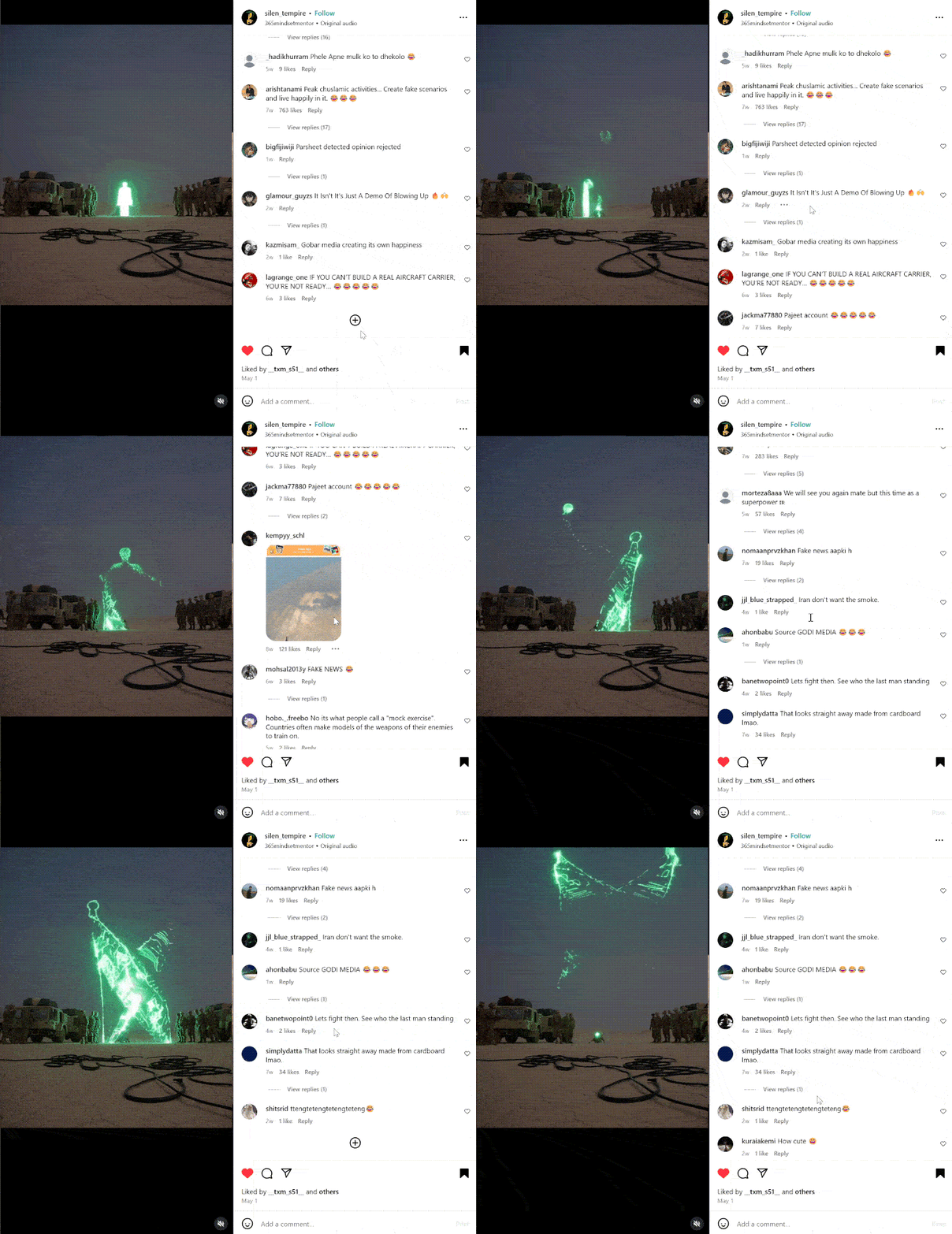
This image collapses myth and machinery into one haunting tableau. The glowing figure, framed by floodlights and tethered by cables to camouflaged vehicles, evokes both a spectral visitation and a calculated psy-op. Overlaying binary code and Shi‘a calligraphy transforms belief into data, suggesting that faith itself can be digitized and weaponized. Against the sands scarred by history, the scene indicts modern warfare’s reliance on theatrical illusion—where the boundary between divine awe and engineered terror is erased, and every mirage may conceal a strategic design.

The GIF features bold Persian captions proclaiming: “ایران بزرگ ترین موشک جهان را در آورد” (Iran unleashed the world’s largest missile) and “اسرائیل تمام میشه با این موشک 🚀” (Israel will be finished with this missile 🚀), alongside a celebratory sticker “زنده باد ایران 🇮🇷❤️😱” (Long live Iran 🇮🇷❤️😱) and “همین لحظه” (Right now). These superimposed texts function as rallying cries, blending triumphant emoji rhetoric with hyperbolic boasts to shape a narrative of inevitable victory. Such sensationalized declarations, presented as eyewitness footage, demonstrate how AI-enhanced propaganda leverages the language of instant viral hype to manufacture omnipotence. By dramatizing a single warhead as world-ending, the image weaponizes collective imagination, turning fear and exhilaration into virtual munitions that echo across social feeds.
#MediaWarfare #DeepfakeDeterrent #HyperrealConflict
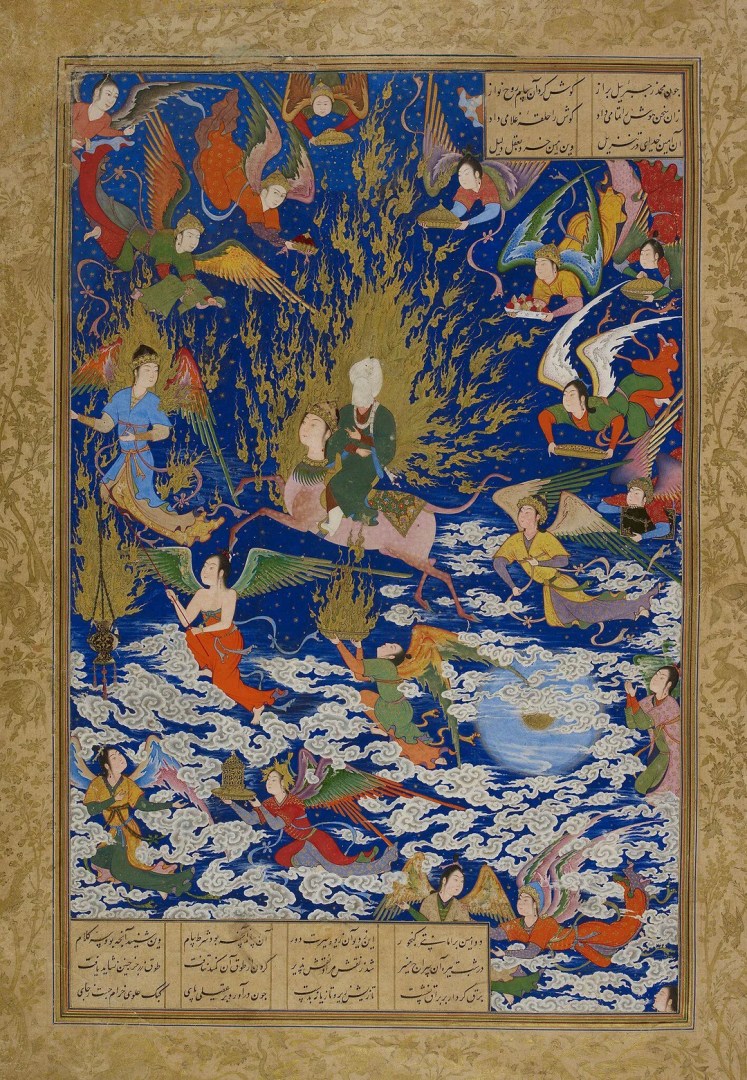
Persian miniature featuring Chinese influences depicting Prophet Mohammed with a flaming halo riding Buraq (early Safavid era 1539–43)
The attached Persian miniature, dense with calligraphic verses perched atop vibrant imagery, parallels the Instagram deepfakes adorned with bold overlays. In medieval manuscripts, texts—poems, moralizing aphorisms, mystical narratives—functioned as interpretive lenses, guiding the viewer’s gaze and infusing visuals with layered meaning. Similarly, modern posts anchor their spectacle in snippet slogans and emoji hieroglyphs that frame the illusion. Both traditions enlist text as a sigil of authority, fusing word and image to sanctify power, assert control, and ritualize belief. This continuum reveals that whether inscribed in gold leaf or pixel, the coalescence of script and scene remains warfare’s enduring theater of persuasion.
References:
Baudrillard, J. (1995). The Gulf War did not take place (P. Patton, Trans.). Indiana University Press. (Original work published 1991)
Ccru-Cybernetic Culture Research Unit. (2017). Writings 1997–2003. Urbanomic.
Greenspan, Anna. “Hyperstitional Carriers, Elements of Hyperstition: Principle 2.” Hyperstition, 26 July 2004, http://hyperstition.abstractdynamics.org/archives/003707.html
Hill, M. (2022). On posthuman war: Computation and military violence. University of Minnesota Press. https://doi.org/10.5749/j.ctv1xxf7w
Land, N. (2011). Fanged noumena: Collected writings 1987–2007 (R. Mackay & R. Brassier, Eds.). Urbanomic / Sequence Press.
Land, N. (2013). (2013, December 31). Philosophy of war: The dissolution of Clausewitz. Obsolete Capitalism. https://obsoletecapitalism.blogspot.com/2013/12/nick-land-phylosophy-of-war-dissolution.html
Paglen, T., & Downey, A. (2025). Influencing machines: Trevor Paglen and Anthony Downey. Digi War, 6(3). https://doi.org/10.1057/s42984-024-00098-9
Sear, T. (2024, August 19). Xenowar dreams of itself. DIFFRACTIONS. https://diffractionscollective.com/2024/08/19/xenowar-dreams-of-itself-tom-sear/
 :: DIFFRACTIONS ::