
Simon O’Sullivan is a theorist and artist working at the intersection of contemporary art practice, performance, and continental philosophy. He has published widely in these areas, often in relation to Deleuze and Guattari and, more recently, in relation to fictioning and myth-work.
His most recent works are On Theory-Fiction and Other Genres (2024), From Magic and Myth-Work to Care and Repair (2024), and (written with David Burrows) Fictioning: The Myth-Functions of Contemporary Art and Philosophy (2019).
His collaborative art practice—with David Burrows, Alex Marzeta and Vanessa Page, sometimes with and others—comes under the name Plastique Fantastique, a ‘performance fiction’ that involves an investigation into aesthetics, subjectivity, the sacred, popular culture, and politics produced through performance, film and sound work, comics, text, installations, and assemblages. IMT Gallery in London represents Plastique Fantastique, who have performed and exhibited widely in the UK and abroad.
DIFFRACTIONS: Looking back on your journey, what pivotal moments, whether personal, intellectual, or artistic most profoundly shaped your path? Were there particular mind-states, sonicscapes or thoughtscapes that ignited your creative and philosophical work? Moreover, your work has been associated with the Ccru, and you have stated that attending two of the Virtual Futures conferences at Warwick University in 1995 and 1996 significantly impacted your academic trajectory and interest, which has since crystallised into theory-fiction. Could you unpack how the sensoryand conceptual delirium of these spaces was catalytic in shaping your work on fictioning?
SIMON O’SULLIVAN: It depends on how far back you want to go. Recently I’ve been reflecting on how my experiences with Table-Top Roleplaying Games and playing out on the North Yorkshire Moors as a young teenager have shaped my academic path and my subsequent interest in fiction/fictioning. Certainly, those experiences play into my most recent book, From Magic and Myth-Work to Care and Repair. And then there’s also my experiences with what might very broadly be called rave culture—and especially free parties—in the 1990s whilst at Cardiff and then Leeds. Again, this had a key determining effect on my trajectory in all sorts of ways, including community—or being part of a scene—and, well, experimenting with different forms of consciousness or modes of being. And then, yes, my encounter with the Ccru—another scene—and attendance at the two Virtual Futures (VF) events you mentioned was also highly formative. I’ve unpacked the latter more in my recent book On Theory-Fiction and Other Genres, where there’s a section on ‘scenes as theory-fiction’ that goes into what it was at those VF events that was so inspiring.
In brief, I think it was how the counter-cultural somehow dovetailed directly with the academic (which was a new thing for me—the bringing together of two worlds, as it were), but also the way the whole event of those conferences, especially VF 95, felt very much of the future (so the VF conferences were themselves like a hyperstition, although I only really understood that later on). I had bought a copy of Deleuze and Guattari’s A Thousand Plateaus in the early 90s when doing my own MA in Critical and Cultural Theory at Cardiff University, but it was encountering a very particular activation of that text at the spaces and places of VF that also really engaged me. As far as that goes, my encounter with Nick Land was especially important (as it was for so many others), although, in fact, I had first met him (and Sadie Plant) at a conference on Bataille in Leeds—upstairs at the Packhorse pub—in the early 1990s.
There are other pivotal moments in my academic/artistic trajectory (and that might be said to have led to my work on fictioning), for example, my involvement with Buddhist practice or, indeed, my connecting up more directly to contemporary art when I arrived in London to take up a job at Goldsmiths (where I moved after my PhD and first teaching job in Leeds). More recently—in terms of pivotal moments—it’s been my experiences with group work and myth-work that have been important, especially in relation to landscape, performance and community. And then there are also, of course, various artworks, texts, etc., that have operated as triggers. I’ve mentioned A Thousand Plateaus, which was an important book for me in many different ways. In terms of fiction, Russell Hoban’s Riddley Walker has also been very important. As far as art goes, I’d highlight the practice of my twin brother, Tom O’Sullivan, which has always been—and continues to be—an inspiration.

DIFF: As a founding member of Plastique Fantastique with David Burrows, your work conjures fictional human and inhuman avatars, manifesting across a range of mediums, including assemblages, drawings, diagrams, writing, comics, tarot, video, and ritualised performances that animate new mineral, animal, human, and machine creatures. Your group embraces the idea that mythopoesis “is a collective enunciation,” even when there is only one member present—as you (all) put it, “we are always the group.” Can you reflect on your evolution as a practice?
SOS: Well, the origins of Plastique Fantastique go back to the move to London, which was just at the end of the 1990s, or, possibly, in 2000. I met up with David, who I had known from my undergraduate days at Reading University in the mid/late 1980s. I visited his studio, we talked—he showed me some work—and asked if I’d like to write a catalogue essay for a show he had coming up at the Chisenhale gallery in London. He’d recently left the art collective Bank, and, I think, this was his first showing of a bunch of solo work. I said I would, but that I’d write as if a fictional group had made all the work (which is an idea that occurred to me when I saw his work), hence ‘Plastique Fantastique’ and my writing of a kind of manifesto.
A little later David suggested we activate the fictional group, which we did, first in a comic (for a show at East, Norwich), then in performances, installations, more comics, etc. It was really, however, with the arrival of Vanessa Page and Alex Marzeta that the group began to have a sense of membership and cohesion. The story of the group’s evolution—who came in, who stepped out, what we concerned ourselves with at different times, etc.—would take a bit more time and space to map out, but you can get a bit of a sense by looking at the Plastique Fantastique website, which is chronological and has works, etc., up to around 2020. I’d say, very briefly, that early on we were concerned with working on an edge between ritual and performance—and with summoning various entities or avatars.
Back then we experimented with a mix of the past/residual culture and more future/technologically mediated culture. The performances were quite chaotic and intense. Transformative in a way. There was also a phase of more storytelling or, at least, playing with (and performing) narrative (especially Science Fiction and more-than-human stories). More recently, Plastique Fantastique’s main output consists of sonic fictions—essentially songs that often mix folk elements with technologically produced sounds—but performance, along with a sense of community and collectivity, remains important. Throughout there’s been the use of masks and props—and scripts or ‘protocols’—to activate everything (or perform the fiction). Additionally, there are technological machines and devices, including sonic and audio/visual equipment.
Again, I’ve written a bit more about my own experiences in—and reflections on—the group in both the recent books I’ve already mentioned. Plastique Fantastique really is a kind of collective fiction—or ‘performance fiction,’ as we call it—that those of us involved step into at different times in order to, well, summon things or channel things, or simply experiment and perform. One of the most rewarding—but also challenging—things about being in a group (for me) is that it can work against individualism and in Plastique Fantastique’s case, against artistic individualism, which for myself, and I think David too, is a bit of a trap—or a dead end anyway. Plastique Fantastique has been more or less a constant companion to my more scholarly work, although I’m less closely involved now. It’s also been a place where various ideas could be played out or, indeed, where other ideas have been generated.
DIFF: Another dimension of your work has orbited around the diagram. You’ve contended in other works that “A diagram, especially as drawing, often leads ahead of conceptual thought. It operates as a probe prior to any consistency (this, we might say, is the diagram as sketch).” Or that, “The diagram here is a strategy of experimentation that scrambles narrative, figuration—the givens” (O’Sullivan, 2012; 2016). Could you plot for us how the role of ‘the diagram’ informs your theoretical practice?
SOS: There’s a lot to respond to there and it’s complicated by the fact that my take on diagrams and diagrammatics has changed over the years. That first quote is from my book On the Production of Subjectivity (or, at least, refers to my take on diagrams in that book), where it describes a kind of method of experimentation and synthesis. The basic idea there was to reframe conceptual material diagrammatically and then experiment by bringing different diagrams together, seeing what that allowed (as if they had all been laid flat on a tabletop). The diagrams in that book arose from close readings of various thinkers and then a lot of black/whiteboard diagrams sketched out in various pedagogical settings. The other quote—maybe it’s from my first book Art Encounters Deleuze and Guattari?—refers to the diagram as a strategy for breaking with representation, in this case by introducing something random or from an outside (this is Deleuze’s understanding of the diagram in his book on the artist Francis Bacon).
The diagrams in Fictioning arose more from the collaboration with David. Here, again, diagrams became a method for ‘imaging’ concepts, but also for ‘metamodelisation’, Guattari’s name for the bringing together of different theoretical/analytic models. More generally, I think for David and myself—in Fictioning—we were interested in how a diagram can speculatively operate to map out the contours and coordination points of worlds to come. David has developed a lot of this work in his own recent collaboratively written book, Drawing Analogies.
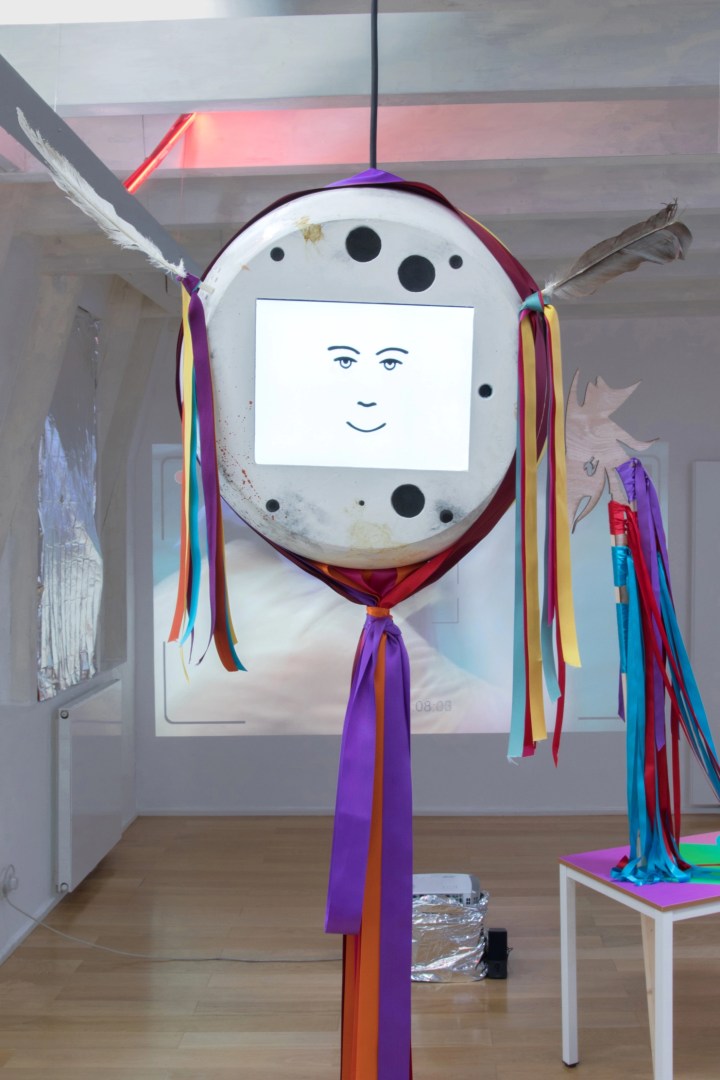
DIFF: Turning to another mainstay of your work with David Burrows, particularly the concept of fictioning, which you have explored in depth in your recent tome Fictioning: The Myth-Functions of Contemporary Art and Philosophy. I’d like you to unpack this key concept further. You’ve defined fictioning in multiple contexts, even conceiving of it as a “kind of weaponisation of fiction per se.” Given your multitude of definitions, can you weave how fictioning ties into the specific threads of mythopoesis, myth-science, and mythotechnesis explored within your 2019 book with co-author David Burrows, Fictioning: The Myth-Functions of Contemporary Art and Philosophy?
SOS: The ‘weaponisation of fiction’ idea was to foreground the way fiction can have a real effect on—or can intervene in—a given world or set up, especially when it is embodied or instantiated in some way in that world. This, very broadly, is our definition of fictioning. It connects with Deleuze’s ideas of fabulation and how art can summon its people. Or, at least, fictioning in its mythopoetic sense involves this conjuring. This has long been a key idea for me: that art is not necessarily made for an audience—or subjectivity—already in place, but in order to draw something forth (hence the future-orientation). With myth-science, fictioning became a way of thinking through different perspectives on the world or even onto other worlds. The term—myth-science—is taken from Sun Ra, who mobilized both the far future and ancient past in his exploration of a radically different perspective on Black subjectivity (and the mobilisation of a different narrative).
We also explored this idea of different perspectives through looking to various anthropological resources, including Viveiros de Castro, whose idea of perspectivism was crucial to that section of the book. Finally, with mythotechnesis we were interested in an idea of fictioning as involving human-machine collaboration. So how these collaborations are fictioned in art practice or Science Fiction writing (for example), but also how the collaborations themselves operated as a kind of fictioning too. Perhaps it’s worth adding here that our book was an experiment really—and, crucially, a collaboration.
What I have just said—and throughout our conversation—regarding Fictioning, both the concept and the book, represents my perspective. I think David might have a different one or would certainly highlight other themes and resources (the same goes with what I’ve said about Plastique Fantastique). A collaboration is interesting because you produce something that is ‘of’ you and not of you at the same time. Something you couldn’t have done on your own, but which, of course, you had a hand in. It means—I hope—that that particular book is more open to being used in different ways, untethered as it is from individual authorship. It’s more like a project somehow. Of course, all this also means it was challenging to write, as we discussed and sometimes argued over every sentence in that book.
DIFF: Expanding further, another strand of your work builds and bridges intriguing constellations between figures such as Thomas Metzinger, Austin Osman Spare, Robert Smithson, and Yayoi Kusama. Their own respective approaches or methods act as engines for the development of practices that “produce depersonalisation and dedifferentiation (or self-obliteration or vacuity)—that is, a blindness of a kind—in order to suspend phenomenological and epistemic conditioning and register reality as a negative of appearance” (Burrows & O’Sullivan, 78). This ties into what Robert Smithson asserts in his work Incidents of Mirror-Travel in the Yucatan: “the true fiction eradicating the false reality.” Could you illuminate how these distinct thinkers and artists, through their unique engines, converge upon this shared objective of depersonalisation to unveil a ‘true fiction’ that displaces ‘false reality’?
SOS: David and I are both involved in contemporary art, so it’s these practitioners—alongside theory/philosophy—that are our resources. To a certain extent it’s also that field that we speak to. That’s part of the reason for the diverse selection of figures. Another is related to metamodelisation. We were attempting to produce encounters between different practices and figures to see what might be possible or might be opened up (I guess this might be described as a kind of artistic take on theory/philosophy).
So, for example, with Smithson/Kusama and Spare/Metzinger, it was about looking at the different theories and practices of these individuals (each of whom had foregrounded themselves in our work and research for different reasons), but also at the ‘larger’ resonances and interferences between artistic practice, magic, and neuroscience (for example). In terms of depersonalisation specifically, again at stake was working out what practices might allow a side-stepping of typical reality (including the fiction of the self), so as to see what else might be possible. I think this also relates to some of the work we did in Plastique Fantastique, especially early on (in relation to the side-stepping of the self or the production of collective fictions, for example).
DIFF: Another thinker your work interweaves is Francois Laruelle, whom you engage to untangle the implications of his thought concerning technology and mythotechnesis. Where does Laruelle and non-philosophy concern itself with fictions or what he calls ‘philo-fictions’’? You also affirm non-philosophy forges a way to think about “aesthetic practices in more general terms, in relation to what Guattari once called the production of subjectivity (and the expanded ethico-aesthetic paradigm that is implied by this)” (Burrows & O’Sullivan, 323). Could you elaborate on how Laruelle’s ‘philo-fictions’ and non-philosophy contribute to this expanded ethico-aesthetic paradigm, particularly as it relates to Guattari’s concept of the production of subjectivity and your conception of mythotechnesis?
SOS: Again, these are very large and complex questions that I can only deal with very superficially here. To start with, both David and I felt there was something inspiring and important about non-philosophy when we first encountered it, something that was allowing other things to come through. It was especially the idea that conceptual resources could be refigured as fictions that caught our attention and thus how they could be manipulated in some ways (hence the connections to what I’ve already said about diagrammatics). We found the whole ‘decapitation’ of Philosophy (with a big P) very compelling—and the shift from various hierarchies to a more horizontal plane of interaction and experimentation very liberating (and it was something which resonated with our own ongoing work in our writing and with Plastique Fantastique).
Laruelle writes about philo-fictions in different places, but a key resource for us was his writings on non-philosophy and non-photography. The point about aesthetic practices in general—and the connections with Guattari—arose from some solo work I did on Laruelle prior to Fictioning and my sense that there might be a ‘non-art’ practice that paralleled non-philosophy and that this might also involve a break with certain hierarchies and a kind of repurposing of art’s resources. It seemed to me this might well have connections or resonances with Guattari’s aesthetic paradigm and especially his ideas of a third post-capitalist assemblage (that he lays out in Chaosmosis).
So, to return to a theme I’ve already mentioned, I was gesturing here towards what I thought might be a productive metamodelisation between Laruelle and Guattari. The connection to mythopoesis might be that such a metamodelisation calls for a subjectivity—or non-subjectivity—yet to come. In terms of non-philosophy and mythotechnesis, well, it might be that there is a residual humanism in Laruelle that privileges a non-reductive sphere of experience or intuition. Certainly, human intelligence is not the same as machine intelligence. But I think, more broadly, David and I would side with N. Katherine Hayles and Luciana Parisi in terms of positioning human-machine co-evolution as not necessarily negative or in terms of working with technology rather than against it (but certainly against dominant codes and capitalist logics).
DIFF: In the Postscript of your recent book, On Theory-Fiction and Other Genres, you sketch your thoughts on Large Language Models (LLMs) and, more generally, the role of Artificial Intelligence as ‘machine writing,’ which you understand as a particular kind of human–machine collaboration or what you and David Burrows term ‘mythotechnesis.’
Could you elaborate on where you situate LLMs within this framework? How do you challenge the common habit of comparing human and machine intelligence while instead highlighting the complex statistical intelligence of LLMs and their important impact on changing how we think about machines? Furthermore, even though your book primarily concerns writing, in what potential ways have you observed AI effectuating and reimagining the terrain of fictioning?
SOS: Like all technology, LLMs involve control but also contain possibilities of and for resistance and experimentation. In the case of LLMs, it’s especially the glitches, mistakes, and cryptids that are thrown up that seem exciting and open towards something interesting. Machine intelligence is, as you suggest, different from human intelligence—LLMs are stochastic parrots, mimic machines really—but this does not mean they are uninteresting. Crucial here is also who owns these machines or is in control of their programming and thus also the ends they are directed towards. There is also, of course, that diversity of other non-human intelligences that already surround us. The key here, it seems to me, is to recognize and value this ecology of different non-human intelligences (animal, plant, machine) and to foster further connection and collaboration (so, mythotechnesis, broadly understood). The shift in our social imaginary that these machines and our collaboration with them bring about is profound, not least in the way they foreground that we are part of the ecology of different intelligences I’ve just mentioned and certainly not enthroned above them. Finally, in terms of LLMs and fictioning, my sense is that some work here can be caught in a kind of Science Fiction genre (I’m especially thinking of image generation)—side-stepping genre is a key interest of mine—but that there are increasingly interesting experiments that involve collaboration with AI so as to open up other possibilities and image-worlds (so, fictioning broadly construed). A caveat here is that the same technology can also produce banality and a form of flatness. This is a topic for a further conversation, but there is something here around the way AI and the algorithmic turn more generally can involve an homogenisation that is itself part of our latest form of capitalism.
REFERENCES
Burrows, D., Cussans, J., Kenning, D., & Yacoob, M. (2025). Drawing analogies: Diagrams in art, theory and practice. Bloomsbury.
Burrows, D., & O’Sullivan, S. (2019). Fictioning: The myth-functions of contemporary art and philosophy. Edinburgh University Press.
Deleuze, G., & Guattari, F. (1988). A thousand plateaus (B. Massumi, Trans.). Athlone Press.
Guattari, F. (1995). Chaosmosis: An ethico-aesthetic paradigm (P. Bains & J. Pefanis, Trans.). Power Institute.
Hoban, R. (1980). Riddley Walker. Bloomsbury.
O’Sullivan, S. (2005). Art encounters Deleuze and Guattari: Thought beyond representation. Palgrave Macmillan.
O’Sullivan, S. (2012). On the production of subjectivity: Five diagrams of the finite-infinite relation. Palgrave Macmillan.
O’Sullivan, S. (2016). On the diagram (and the practice of diagrammatics). In K. Schneider & B. Yasar (Eds.), Situational diagram (pp. 13–25). Dominique Lévy.
O’Sullivan, S. (2024a). From magic and myth-work to care and repair. Goldsmiths Press.
O’Sullivan, S. (2024b). On theory-fiction and other genres. Palgrave Macmillan.
 :: DIFFRACTIONS ::