An interview with Rhea Myers.
Rhea Myers is an artist, hacker, and writer based in British Columbia, Canada, originally from the UK. She makes art to understand the world, mutually interrogating technology and culture to produce new ways of seeing the world as it unfolds around us. Since 2014, she has used the blockchain as a medium for embodying, critiquing, and moving beyond the anxieties of post-financial-crisis society.
Inspired by the histories of conceptualism and net art, Rhea has worked with digital imagery and computer code and produced theory, critique, and fiction as the blockchain art world has gone from the imagination to the mainstream. She didn’t invent NFTs, though. Twice.
Rhea’s art has gained international recognition. It is exhibited globally, sold at prestigious auction houses like Sotheby’s, and collected by renowned institutions such as the Albright Knox Gallery in the US.
:: :: :: [https://rhea.art/art/] :: :: ::
DIFFRACTIONS: Can you speak to your personal arc and journey? Your work weaves together a number of threads: philosophical, conceptual art, Free and Open Source Software, cryptographic systems, and the interrogation of self-identity are also bound up with your practice. What were some formative moments, artists or encounters for you?
RHEA MYERS: Ever since I was a child, I’ve wanted to understand the world despite it making no sense to me. It felt like everyone else had a secret rule book or instruction manual for society that someone had forgotten to give me a copy of. So I embraced playing with rule systems that created spaces of relative certainty and simplicity—role-playing games, making art, writing software, using alternative copyright licenses, wrangling cryptography. I can see people raising eyebrows at the idea that any of those are simple, but they are nothing compared to understanding other people.
Because of the artists you mentioned and the popular culture of the time, I went to art school in the 1990s to make that sense by making art with computers. As a result, during the dot.com boom, I lucked into being able to work in tech to support my family while still making art. And did not sleep very much as a result. I focused on obscure technologies so my lack of a computer science degree wouldn’t count against me when applying for jobs (this was totally intentional). I viewed this as a decades-long embedded anthropology study. The experience has informed my art by making sure I’m both intimately familiar with and not naive about the imaginary of technocapital.
The pivotal development for me as an artist was coming to understand cultural reference as representation and composition of it as critique. What Maya B Kronic called “aboutness”. Warhol’s use of mass media and his synthesis of Neo-Dada and Colour Field painting inspired me as I read obsessively through the catalogue of his MoMA show in Sixth Form art class. Jeff Koons’ alignment with capitalism and kitsch to critique race, class, and gender; Art & Language’s indexical materialist art criticism embedded in art itself; and Julian Opie’s similarly project-based work stretched my ability to think about art and its production when I was at art school. Philosophically, by the end of art school, I liked Paul Virilio, Jean Baudrillard, Manuel DeLanda, and Nelson Goodman. If you look closely at my writing, you can see me finally giving in and getting into Deleuze & Guattari via the Ccru around the same time that I got into crypto. It’s important to me that I’m never illustrating my theory or writing apologetics for my art. The work is always the work. I follow the ideas where they take me, into the best medium for realizing them, whether that’s a hand-drawn image, a technical standard, or a data visualization of my brain.
DIFF: Could you discuss your initial entry into the world of cryptography and cryptographic systems? Were there specific books or influential titles that sparked your interest, or was there a particular moment that activated your curiosity about the nature of cryptography? Were there any specific concepts or cryptographic primitives that catalyzed your journey?
RM: As a kid, I had an Usborne book on Cold War “Spycraft” , which featured various simple encryption systems, and I was fascinated by the puzzle book “Masquerade”. Still, I’m actually terrible at logic puzzles, so it was more the idea of it than the experience of failing to solve it. That all came in use later when I was working with Marguerite DeCourcelle on her awesome crypto puzzle trails.
I knew about PGP in the 1990s and struggled with it when I was working on Free Software projects, but it was Bitcoin that sparked my interest in public-key cryptography. I had started using PK cryptography without a deep understanding, so I needed to catch up. Dropping high school math at age 16 hadn’t helped. The only math I’d done after that was on my MA course, which skewed towards computer graphics, so working through RSA and ECC was painfully slow for me. But eventually I got a feel for the shape of them.
I relied on many, many blog posts, Wikipedia articles, and the Springer textbook “Understanding Cryptography”. Later, “Mastering Bitcoin”, “Serious Cryptography”, the Princeton “Bitcoin and Cryptocurrency Technologies” book, and “The Manga Guide To Cryptography” all helped me understand different aspects more deeply. Culturally, “Blockchain” by Melanie Swan, the “Let’s Talk Bitcoin” and “Art on The Blockchain” podcasts, “Crypto Anarchy, Cyberstates, and Pirate Utopias”, “The Cryptographic Imagination”, and “A Cultural History of Early Modern English Cryptography Manuals” all gave me a much better understanding of cryptography in its cultural context.
My core interest in contemporary digital cryptography is the cultural and philosophical resonances of its use of trapdoor functions to achieve both absolute concealment and absolute identity in public-key cryptography and cryptographic hashing. That same technology can both hide and prove who you are and what you are saying, and you can use it to register the existence of a secret message that you can later reveal. Bitcoin uses this to establish an absolute order of events, to establish time or history, by tying transactions together with cryptographic signatures, and then to secure that order using proof-of-work hashing. Cryptoeconomics starts here, and working with and against its economic rationality continues to be a source of inspiration for me.

DIFF: Timothy May wrote of the “specter of crypto anarchy” haunting the modern world. Today, that specter seems to have shapeshifted. From your unique vantage point at the intersection of art, code, and politics, what do you see that specter having become? Is it the ghost of a failed revolution, or a new kind of institutional monster we don’t yet fully recognize?
RM: The terms of the debate around cryptography were set during the reign of Queen Elizabeth I and have not changed since (see “A Cultural History of Early Modern English Cryptography Manuals”). Rhetoric around encryption involves huge numbers, secret cries for help, the security of flourishing trade, the threat of malevolent actors hiding in the shadows, and the clash between the state’s power and individuals’ rights. We re-litigate it every few generations, and May was writing during the 1990s “crypto wars”, which the cypherpunks ultimately won. We are living in their world now. HTTPS, Signal, Tor, encrypted hard disks and backups, cryptographically authenticated software, this is all cypherpunk technology.
The part of the cypherpunk project that remained incomplete after the 1990s was their dream of a currency and property that exist without the state or any other central body being able to interfere. Satoshi Nakamoto completed that with Bitcoin, producing an economic solution to a computer science problem in a political project. We still don’t live in a crypto-anarchist social order, I think we have missed the window for that if it was ever open (my short story “Bad Shibe” is about a world where we didn’t), but we do live in a social order less at risk of closure due to the crypto-anarchist spaces of freedom within it.
May’s spectre has become an egregore. I’m amazed at its tenacity in the face of regulatory uncertainty and VC capture. We need it now more than ever. Thirty years since the crypto wars, and fifteen since the launch of Bitcoin, the state is once again bleating about having to make your personal communications less secure because otherwise you might use them to kick puppies. It’s beyond frustrating to see people who understand that we face ever-increasing threats to our self-determination from the state still trying to make careers in pointing and laughing at cryptocurrency as something with no uses outside of “crime”.
DIFF: I’d like to ask about “Secret Artwork”, a piece that, in 2018, created a perfect paradox: an artwork that is simultaneously ownable as a token yet fundamentally unknowable in its content. Looking back at that moment from our current context saturated with profile-picture projects and speculative assets, how does the piece’s critique of ‘ownership’ resonate?
Does it feel more prophetic now? And personally, having laid bare this core tension early on, what has been your reaction to seeing the market largely ignore this philosophical problem in favor of commercial application? Secondly, in a more philosophical and aesthetic tone, is “Secret Artwork” therefore a more truthful representation of ‘an object’ than a painting we can see? By creating a machine/artwork that formalizes a secret at its heart, could you say that you made the universal hiddenness of things or the fact that all objects withhold their full reality explicit and even profitably clear?
RM: “Secret Artwork” is based on the Art & Language group’s “Secret Paintings” of the 1960s, which parodied the pretensions of the conceptual art of the time. I’d been blindsided by an actually existing blockchain artworld coming into being – “rare art” and NFTs – and this was my satirical response to its question of what the artwork was in relation to the token. If you don’t know what you are buying when you buy an NFT, here’s an NFT where you don’t know what you are buying.
Philosophically, it’s not an attempt to create a monad or an object-oriented-ontology object, although I’m flattered that it admits those readings. It conceals something specific and finite as the result of a conscious act by a human being. Philosophical or theological inaccessibility of the entirety of something is a general by-product of our limitations as finite beings in an infinite universe. We are in the realm of the artist’s intent here, though. Regarding which, if a painting is an artwork that can be seen from a single viewpoint and a sculpture is one that can’t, “Secret Artwork” is a sculpture. But if a sculpture is an artwork that can be seen after regarding it from multiple viewpoints, it is not a sculpture either. I vaguely remember the name being deliberately about this kind of thing.
I didn’t realize it at the time, but it’s also the start of my subconscious screaming at me through the art. My project of understanding the world and my place in it had been lacking a fairly crucial piece of information about who I actually was from the very start, and could even be seen as a distraction from thinking about that. By the time this period of work got to “Certificate of Authenticity,” I’d realized I’m trans.
Looking at “Secret Artwork” some years later, I’m still very proud of it, but it feels a little naive. I’m not sure how it’s really different from owning blue-chip art buried in a freeport. Or shares in Apple before a keynote. Expanding the space of property to cover ever more unknown things isn’t exactly resistant to the idea of property. And because of that, I think it functions even better as a critical object for contemplation. The nocoiner right-click-save dunk on NFTs was informative because it was absolutely, 100%, one hundred and eighty degrees, precisely wrong about what you buy with both NFTs and artworks. That realization should cascade out into a more general critique of property under fiat law and the psychology of its propaganda rather than being a way of laughing it off. “Secret Artwork” just so happens to make explicit that wherever you right-click on the screen, you’re not going to be able to download what the artwork claims the art actually is.
All of that said, I’m very relaxed about artists being able to make more of a living thanks to NFT sales. What concerned me was the perverse incentives of resale fees, which rewarded artists for short-term churn rather than long-term investment by collectors in their careers. That seems to have just about shaken out now. Likewise, if people want to own cultic masks on the blockchain, I think PFPs are a good way of doing that. PFP projects, having to work through what people think they are buying versus what the law says, and whether their images are even copyrightable, have contributed to our understanding of how the concept of ownership relates to cryptographic control over something with real stakes. So in terms of ownership and its critiques, I do think we’ve seen some, but we can do much more.

DIFF: Also, in your “Portents” white paper, the project identifies Bitcoin block hashes that appear to reference future Ordinals, it frames the discovery of these predictive hashes as a ‘double-loop of time.’ Is the project’s primary goal to make a literal claim about a breach in causality, or is it an artistic and philosophical provocation designed to force us to re-narrativize the blockchain’s past, to see if we can treat a random, statistical inevitability as a meaningful oracle, thereby creating prophecy through the act of interpretation itself? Could it be the role of an artist-archaeologist to unearth and interpret them?
RM: “Portents” is a fictitious cult doctrine or conspiracy, presented as artwork. It is meant to be compelling rather than true. It is about the experience of belief, which is something alien to me. The code and the math are real, but the whitepaper’s argument that it is a proof of time travel or of prophecy ignores the fact that it’s very easy to find the digits of small numbers, such as Ordinals, in larger numbers, such as Bitcoin block hashes. If you can forget that, and the paraphernalia of persuasiveness that “Portents” assembles like a good crypto project is designed to help you do so, even if only for a moment, then it feels like it might be true. “Portents” is constructed as something that you can feel yourself believing in if you choose to forget that you know this for a moment. Crypto projects have to create that kind of belief to succeed.
Ordinals are kind of already a reinterpretive artist-archaeologist, anchoring significance in what was previously noise, or possibly their institution. What I absolutely love about Ordinal Theory is how it presents itself as a discovery within Bitcoin rather than as something additional to it. Ordinals exploit the surplus value of Bitcoin’s code. It surfaces the latent secondary meanings of features of the operation of Bitcoin as a cryptocurrency, and anchors additional meanings to them. Block heights, epochs, and Satoshi indexes. These all exist within the Bitcoin system but are not significant to its consensus, to its operation as a cryptocurrency. It’s a kind of hermeneutics that starts with the weakness of the Bible Code but builds on that to create something with certainty secured by the strength of cryptography and the appreciable share of the planet’s computing resources that Bitcoin uses.
“Portents” is also this experience of learning about Ordinals rendered aesthetic. Retrospectively, this is a period where I was interested in communicating experiences to the viewer that a simple depiction wouldn’t capture to my satisfaction. This desire to produce subjectivity, to use the viewer’s subjectivity as the medium of the artwork, evolved into ironizing the production of subjects in my most recently released work.
Random oracles are a thing in cryptography theory that I would like to misuse for art. And I am interested in how meaning emerges from that kind of random meaninglessness (signal from noise, information entropy from heat entropy). One way it does so is through what Deleuze called “dark precursors”: essentially, pareidolia that the pattern-finding parts of our minds cannot unsee once seen. You can easily understand how Ordinals are a perfect example of that, of the process of semiogenesis.
DIFF: In “Self-Identifying,” you’ve created programs that act as autonomous agents (written in PostScript), generating their own cryptographic identity and signing their own being into existence. This presents a powerful metaphor for a ‘self-sovereign’ digital entity. Yet, as the artist, you wrote the initial code that dictates this entire process. Is the ultimate subject of the work the illusion of autonomy you’ve masterfully crafted, or do you see your role as a kind of ‘prime mover’ who has created a new form of life, thereby ceding a degree of your own authorship to the logic of the code itself?
RM: The cypherpunk political subject is an individual with a cryptographic key who can sign their digital communications to establish their authenticity. The programs in “Self-Identifying” are allegories for that subject. They prove they have something to say by creating generative art; they demonstrate their existence by printing their own source code (they are “Quines”); and, as you point out, they are self-signing. If they are not cypherpunk subjects, it’s difficult to explain why without appealing to some very un-cypherpunk ideas of personhood.
Invoking generative art gives us that tradition’s arguments about whether we cede authorship over the output of code or not. But yes, the code ultimately doesn’t write or run itself. None of us are entirely self-created. We all come from somewhere; there are always some previously existing materials that we use to create ourselves. Becoming isn’t all or nothing, though. The programs’ infinitesimal amount of individuality and freedom exists in the narrow space of variation in their output. Even if I, as their author, know that they will draw a blue square, I don’t know what the signature on that will be. And the ones that draw bitmaps or vector curves are much less predictable.
The project was initially called “Self-Signing Triangles”, but it quickly grew beyond the triangles. And yes, it could have been called “Self-Sovereign”. The concerns of anchoring a name to something on the network not controlled by a third party are very crypto-anarchist, although anarchists should not seek to be rulers. It ended up being called “Self-Identifying,” which, despite the hallucinations of some political extremists, simply means getting the state bureaucracy to correct their records regarding you without requiring you to appeal to the authority of a third party. Tying the project to that was irresistible because the programs assert their uniqueness—one definition of identity—and generate their own cryptographic keys from their source code—two more definitions—rather than appealing to an external source of validation.

DIFF: Your 2023 work, “The Ego and It’s 0wned” performs what seems like a necessary but dangerous détournement. It uses the NFT, a primary tool of digital enclosure and quantification, to assert a raw, subjective ‘I am here,’ specifically against the objectifying logic the technology embodies. For a trans-subjectivity as you emphasise this act feels like it mirrors a fundamental real-world dilemma: the struggle for visibility within systems that often grant it only through the lenses of fetishization or commodification. My question is about navigating this inherent risk: How do you prevent the ‘smooth data visualization’ of your intimate EEG data from functioning, within the art market economy, precisely as a fetishized object, a neatly ‘captured trans subjectivity’ for collectors? In short, how do you ensure the defiant statement ‘I am here’ isn’t immediately answered by the market with, ‘Yes, and now you are mine’?
RM: TEAI0 deliberately fails to resist the market as a commodity. It’s designed to get sucked into the vents. Its “I am here” relies on the market exploiting it for its ongoing existence. I always liked that old Jeff Koons quote: “exploit yourself.” The limits of freedom within the market may be the ability to shape some of the terms of your exploitation. To minor modulations of your pricing signals. To realizing your highest price.
This was like MYSOUL in the sense that I was using blockchain representation and commodification of something regarded as ineffable and opposed to hyper-financialization. It was different in that I could take society’s distaste for NFTs as a found object and use that directly to signify that the act of making and selling the work was meant to be morally wrong. At least on some level, and as part of its operation.
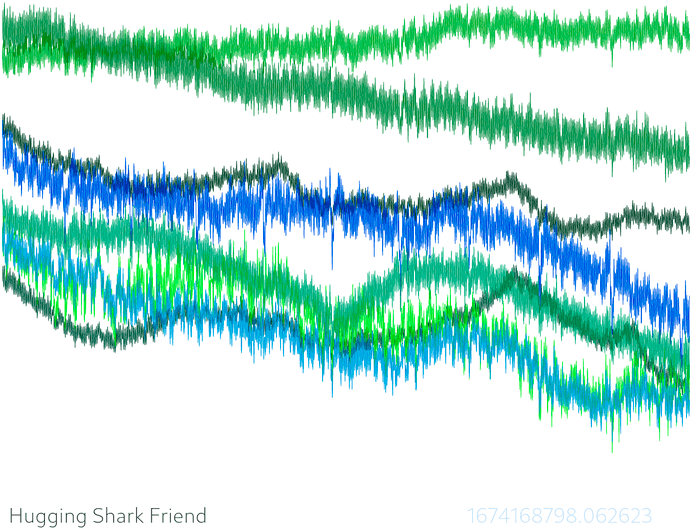
The first piece from the series that sold was the one of a kiss. The buyer is lovely, but it still felt weird – that really was me kissing my wife. The one of me injecting estrogen subcutaneously is, again, really me doing that. If you can read EEG data, you can see me tensing up in expectation of pain from the needle, then relaxing when I haven’t hit a nerve. I gave one of my friends the one where I am hugging a stuffed IKEA shark. That’s a Rorschach test for whether the viewer is familiar with extremely online transfem culture or not.
Where resistance comes in is that the aesthetics don’t add up. Which means that you can’t unreflectively consume the artwork, whether you own it or not. That affects what owning it means. The actions I perform in the series with electrodes carefully stuck to my scalp are cliches rather than a spontaneously authentic, newly represented way of being. An EEG is not actually more intimate than a photograph of a sexual act, for all I joked about this being my “Made In Heaven”. Information aesthetics won’t give you access to the contents of someone’s mind in the way that Neuralink might. Without a frame of reference to evaluate them against, they are decorative, mere entertainment. The entrance to the rabbit hole is in what the artwork doesn’t do. It’s in its negative space. I do that a lot.
DIFF: After creating works that so powerfully critique the ownership of the unknowable, the colonization of time, and the datafication of the self, where does an artist go from there? Is your current work a further deepening of this critique, or are you exploring modes of existence and expression that might operate outside these systems of capture you’ve so masterfully outlined?
RM: I’m feeling bad about not doing more “protocol art”, so I may dig back into that. I thrived on the constraints of early smart contract systems, though, so less constrained systems are harder for me to work with creatively. My current projects are recognizable from the work we discuss here. I tend not to discuss them because they sometimes don’t come to fruition—there are some sketches for a project called “uphold provide curve install fatigue kitten” on my Instagram that are taunting me, for example—and because the institutions I collaborate with tend to like a big reveal.
There’s a cultural and political urgency to 2025 that I’m acutely aware I need to rise to, though, and that does sadly involve questions of ownership, of datafication, of selfhood. History gives artists these tasks. It’s essential to prevent totalitarian social closure, and artmaking is a good way to do that, even when it feels like I should spend all day, every day, as some sort of activist. My lived, or at least watched, historical frame of reference for this is the aesthetics and strategies of Prime Minister Thatcher versus rave culture at the turn of the 1990s. There are, very obviously, better ones—but I have misplaced my TARDIS at the moment.
I’ve largely steered clear of AI, not for moral reasons (train and run your own models, join a union, use blockchain timestamps) but because I know so many awesome artists doing amazing things with AI already, I don’t think it would be the best use of my time to try to catch up to them. I do use LLMs to fuzz ideas, though. Their hallucinations align well with elements of my working process.
I don’t believe there is an outside to value capture for art, a dark forest we can flee into and hide from capital. If we want a public but secret, uncommodified but discretely produced artistic culture, then possibly the best historical examples are mystery cults. We can tell that they worked because we don’t know much about them. Which may be a problem for many existing artworld actors.
Representing value allows it to be captured. Value that can be captured will be captured, and it takes value to capture value. This means that existing pools of capital have a stronger gravitational pull than individuals trying to escape them. We live in Katamari Damacy, not The Three-Body Problem.
Despite all of this, we can still create autonomous zones ahead of the processes of value capture. The fact that blockchain, of all things, continues to produce them gives me so much joy.
REFERENCES
Antonopoulos, A. M. (2015.). Mastering bitcoin. O’Reilly Media.
Aumasson, J. (2017.). Serious cryptography. No Starch Press.
Ellison, K. (2019). A cultural history of early modern English cryptography manuals. Routledge.
Levine, A. B. (Host). (2019-2022). Let’s talk bitcoin [Audio podcast].
Ludlow, P. (Ed.). (2001). Crypto anarchy, cyberstates, and pirate utopias. MIT Press.
Mitani, M., Sato, S., Hinoki, I., & Verte Corp. (2018). The manga guide to cryptography. No Starch Press.
Narayanan, A., Bonneau, J., Felten, E., Miller, A., & Goldfeder, S. (2016). Bitcoin and Cryptocurrency Technologies: A Comprehensive Introduction. Princeton University Press.
Paar, C., Pelzl, J., & Güneysu, T. (2024). Understanding cryptography: From established symmetric and asymmetric ciphers to post-quantum algorithms (2nd ed.). Springer.
Rosenheim, S. J. (2020). The cryptographic imagination: Secret writing from Edgar Poe to the Internet. Johns Hopkins University Press.
Swan, M. (2015). Blockchain: Blueprint for a new economy. O’Reilly Media.
 :: DIFFRACTIONS ::
