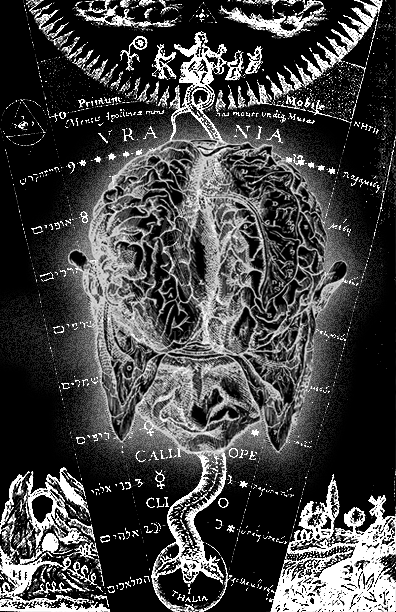
In the darkly mesmerizing “MOIETIES,” Elytron Frass conjures five intertwining narratives, each a sinuous thread in a tapestry of alternate gnostic realities. The narratives have readers navigate through a labyrinthine web that negate and intersect in a feverish dance of disclosure and concealment.
The author D.A.R.G., provides a dispatch from his tenebrous odyssey through the enigmatic corridors of Frass’ opus, while also dissecting the author’s psyche in an interview that delves beneath the surface of his cryptic creation below.
I. A Writ in Multiple Dimensions
While we may rightfully set aside any disputes regarding form versus content, a work forces us to give an account of anything outright unusual. In the case of Elytron Frass’ Moieties, the form stands out to the eye. It is a book with false beginnings and false endings. But we are getting ahead of ourselves.
To begin with, the book is meant to be read from the leftmost page to the middle of the book, and from the rightmost page, again, towards the middle. Accordingly, the pages are numbered from 1 to 46, from the left to the middle, and from the right to the middle. These two narratives do not explicitly complement or bifurcate. In the footnotes, we find an observer’s commentary, presumably that of scientists occupied with the live vivisection of the main storytellers.
More challenging to classify are the scribbles, mantras, and symbols written along the margins. When these consist of text, pages with matching numbers on both sides of the middle of the book must be found to read it in complete form. Not that doing so will give you any semblance of understanding of what they are all about, as they remain as cryptic as one would expect of the ramblings resulting from a mystic trance.
The most salient references, for those who can see them, are made about Gnosticism and Alchemy. As befits an original artist, they are used and transformed to fit a particularized vision, rather than being transplanted and used to advance the narrative as a template. Those who wish to fall into these rabbit holes are more than welcome. Others may yet choose to gloss over the references as opaque illuminations on a manuscript, seeing them as figures on a wall pointing the way further in.
As we move in, the aura of the work envelops us. We become aware of a quiet, claustrophobic existence, out of time. Each work of literature, or art in general, provokes spatial sensations to be associated with it. It also has more general sensory characteristics. These are derived through the choice of words, whether nouns, verbs, or adjectives. The preference for the location of description, too, will define the sensations associated with the written work.
The collection of word choices in a written work are points of connection between the nervous system of the writer and that of the reader. A writer who constantly describes a character’s tactile sensations will tightly wrap the reader’s consciousness around the imagined organism. Bouncing among images of innards, abstract flights, and acts of cruelty often cutting open bleeding wounds, Elytron Frass drags the reader into a silent world of punctuated suffering.
Elytron Frass, conscious narrator, cruel extractor of pain essence, thus bids you suffer in the shoes of the main characters, L&R, or R&L, each telling a fiction of self and the other. To him move your nightmares, and to him is owed your distress, as he wantonly gnaws on the marrow of your bones. He is the Gnostic Demiurge of this world which will only be braved by the suicidal tendency too enamored with pain to terminate its existence.
II. Return to Innocence
Each person reading MOIETIES will have their own impressions to prioritize. It will happen that what is novel will catch the eye, and excite the passions, than anything else. It is debatable whether seemingly superficial aspects such as playful excitement are inferior to thought-out and researched interpretations.
Once the components of the several narrative lines of MOIETIES are understood, there is a period of adjustment. As with anything new that requires skill, the reader will feel a little clumsy going through the processes, making the hand and eye motions necessary to follow what has been laid down. Thereafter, familiarity with the process allows one’s attention to follow in rhythm and pacing. Reading now becomes an elaborate dance of hands and darting eyes.
The movement of the eyes from one side to the other, the knowledge that a certain person will be found in a certain physical location not just in the book, becomes a game. Soon, the reader is having fun with the process. One is a child once more, albeit a child walking into a terrain of inconspicuous predation.
We feel like Alice in Wonderland, suddenly dropped in this alien world. But here we do not explore a world in which our experiences have a continuous sequence. Instead, we jump from head to head, from brain to brain. The book is a portal under our command; we can travel it again and again as we will, and however we wish to. We are invited to play.
III. A Lurking Evil
Ever present in the child, unadmitted and excused as this might be, lies the tendency for gratuitous evil. Something of a voyeurist, each of us might be called, we spy on the mental suffering and physical torture of the characters in MOIETIES. We believe ourselves to be safe and insulated until we become aware of something staring at us from behind our brains. Would that we knew what this alien presence was. It is either summoned up with the reading of MOIETIES, a devil invited in and welcomed through the door of consciousness, or a shadow consciousness we become aware of when reading MOIETIES. Soon enough, it is more than fun and games. Soon, it is not fun at all. The reading of this book, you will find out, has dire consequences.
One consequence of reading MOIETIES is that you might never feel alone again. It continues to sit there, this dark presence. It smiles, even without a mouth, as we divulge knowledge of its existence. MOIETIES was but a tool, a lever to pry open the fontanelle of your cranium you once thought forever sealed. What fusion or battle of souls you choose to carry out will be your decision alone after you read MOIETIES in careful detail.
IV. The Pastimes of Divinity
MOIETIES reveals the reader as a child, and yet an infinite devil. We are as Krishna, possessing and wreaking havoc, for his fun and pleasure, beyond all damnation, impervious to criticism or retaliation. We see the world flourish, self-torture, and wither away. Not without a smile.
Smiling does not mean we take it lightly. If anything, it is the divine capacity for the opposite. Nothing is taken lightly. Yet, everything is taken in. Nothing sways us even though we feel everything deeply. The conjunction of opposites in each one of us. Each of us can do this because the universe itself is contained within each drop of water and grain of sand.
The experiential relevance of MOIETIES can be found, if the reader is so inclined, in the fusion of entomology and Gnosticism. Elytron Frass certainly makes a strong case for each through creative representation. There is plenty of evidence of how small creatures affect our lives, alien bodies, and others that have lodged themselves permanently in our bodies and on which our survival depends.
If the reader were otherwise inclined, MOIETIES can also lead to a separation of consciousness and being. Hints of this can be found in Zen and the philosophy of Martin Heidegger. But mere hints do not come close to the fragmenting experience of pure consciousness bouncing rapidly from one personality to another, and then to a third, only to return to the familiar one.
V. Possibilities
The direction of consciousness that Elytron Frass takes in MOIETIES is that of dispersion, of fragmentation. One would like to allude to intelligence operation’s efforts, such as MK-Ultra, to enact a ritualistic and programmatic process through which embedded narratives could be used to take control of a person. Descriptions of the latter can be found in the books of Fritz Springmeier. However, going down that rabbit hole might prove too dangerous for the average reader. It might be safer to make literary comparisons. Take Jodorowsky and his anarchist Jungian method. Strong archetypes are encountered in the inner and outer worlds — because the inner and the outer are the same — which are ultimately only reflections of the beholder’s mind. The world is not just covered with a layer of interpretation, but the covering is all we can ever hope to know. Becoming aware of how we paint the fabric of reality is the best we can ever hope to do. Jodorowsky, after Jung, sees how choosing to take the symbols and faces we paint on that canvas in the most honest and useful way, as a mirror of ourselves, can be most edifying.
Jung was merely describing the traditional storytelling methods, turning what had been unconscious for generations of artists into a conscious proposition for the world. That is, in potential. What comes after, both through experimentation and attempt, is the forceful separation of the human soul through trauma and symbolism. Symbols, of course, are the only thing the whole of the mind-body complex understands. Hence why the specific sensory verbs and adjectives used in a written work matter.
The deliberate engineering of mind according to studied principles was given the name of cybernetics. According to eminent linguist and creator of black propaganda for the Allies during World War II Gregory Bateson, the development of cybernetics was the most important event of the 20th century, alongside the disastrous Treaty of Versailles. That is, not just to the “Western World”, but to the world.
By now, we have artificial intelligence protocols assessing the flow of feelings and reactions of billions of humans. They can now pinpoint the influences of world events, artistic media releases, and so on, on collective humanity. Your mind is not your own, your thoughts are not your own. Your husk probably, most probably, houses more than one personality. One not altogether acknowledged or remotely known to you.
MOIETIES, on the one hand, allows the reader to become aware of such multiplicity and, potentially, of the type of parasitic presence in the reader’s mind. It also points to more variations of a method. At some point, the surrealists and dadaists experimented with bringing together minds to create written works. In the other direction, painters have since then and to this day experimented with creating visual works from different personalities lodged inside their bodies, with astounding results. See the work of Kim Noble for a notable instance in recent times.
What remains is a questioning of the nature of consciousness. Not of mind. For we know the mind is the nervous system itself reacting. And the brain is but a concentrated hub within the greater nervous system. As far as can be understood, the body is only known to us through the nervous system. But our capacity to switch modes of being on command — that does not belong here. The ability to adopt the previously unknown as our own, and thereby morph the sense of being, distorting body and mind, hints at our true nature.
We believe, dear reader, that MOIETIES constitutes such a hint. A door, if you will, which makes the road easier and smoother, in a way, but no less disturbing. Many doors will become visible to you when you read it. The number of detours you decide to take is up to you, but you will end up coming back, so that you may continue, toward an end that never comes.

VI. The Illocution Chamber: An Interview with Elytron Frass
D.A.R.G.: Where did the idea originate to give your book multiple clashing dimensions?
EF: In late 2022, I was traveling through Central America, and I came across my very first and only sighting of a gynandromoph. For the uninitiated, a gynandromoph is a rare phenotypical phenomenon, where one animal, typically an insect, will exhibit both male and female gender qualities and physical features. The gynandromoprh which appeared to me was an Odontolabis, most likely Odontolabis cuvera, more commonly known as the golden stag beetle. I’d released a graphic novel entitled, Vitiators (Expat Press), earlier that year and wasn’t sure where to go next, creatively. So, I was both killing time and digging for fire in the Guatemalan jungle, and there it was, basking on the ground by a large tree, just a few yards from the ecolodge where I’d been staying. The male side was perfectly delineated from midline to left and had a typical, hornlike, oversized mandible, which is characteristic to males; yet, from midline to right it was perfectly female, having a significantly stubbier mandible and overall head segment. I was in awe, not just because I’m a bit of an entomology nerd, but because it appeared to me like divine inspiration. Where my mind went from there was purely conceptual: I had flashes from gnostic apocryphal scripture, an asymmetrical Ishtar retooling her clitoris into a phallus, paradoxical separations through alchemical surgeries liberated from sanctions and ethics, immortal Siamese twins incising themselves down their middles—slice after slice, regenerating like flatworms. Being an author, I lusted for an immediate literary perversion of what I’d been witnessing. So, what other means did I have than to transubstantiate that bifurcated morphology into a book?
D.A.R.G.: The three narrative planes on which the story simultaneously takes place (gnostic realisms, clinical observations, and conjunct mystic pronouncements) never explicitly interleave. How do we reconcile them?
EF: Well, that’s just part of the devilish ‘go-fuck-yourself’ about it. My books tempt you to play with them so that they might, in turn, toy around with your senses. Moieties, like our glorious forked-tongued Devil, ultimately wants to leave you with lasting, conflicting emotions and intellectual conundrums, yet also with an invaluable certainty that things are unreconcilable between body and mind, glory and violence, beauty and ugliness, and between erotic attainment and annihilative desire—but, most of all, between form and content.
D.A.R.G.: Roberto Bolaño once proclaimed the era of pure narrative dead and long behind. Are games of form the way forward or anywhere else in literature?
EF: Bolaño is not one of my personal go-to references, but the whole narrative of the ‘death of the narrative’ (or the death of anything, really) is just something clever to say. It raises eyebrows, and if you’re the first of your craft to claim death to whatever that craft is, then you’re patted on the head, given a B+ on your scholarly assignment, or further associated by a footnote in some article on Medium. Death is the only thing that isn’t real within this simulation. If I’m to say anything about both narrative and form, it’s that they’re exemplars of undying opposition. The forms and narratives that fellow contemporaries tend to pursue are corpses on their forty-thousandth resurrection, and they still won’t go the fuck to bed. Nonetheless, we’re stuck with this two-party system of form versus content where…I don’t feel like Moieties fits in exclusively with either and rather arrives from its own tailored esoteric philosophy outside of that greater literary debate. Like a deviant alien mimic, it plays both sides just to edge itself into ever-shifting BDSM rituals. It doesn’t care what academic pedagogy says you should or shouldn’t do to prove its thesis. Given that each of Moieties’ loosely connected parables can be seen as if compiled from sources within various, alternate, gnostic realities, believing in what you are reading requires a reverse conversion from the normalized (or neutered) play of archetypal opposites. There’s no other way I want you to read it.
D.A.R.G.: Could the three aforementioned narrative planes be equated to subject, object, and pure consciousness?
EF: Yes, indeed; in the distinct tales that make up the left and right body texts, for example, Moieties focuses on a masculine subjective voice and a feminine subjective voice—with both characters’ stories spiritually converging at the novella’s midline. Those tales had to be told in first person perspective to best demonstrate their subjective natures. From the left side of the book to its midline, the unnamed male assassin we follow mistakes fate for destiny while attempting to forcefully merge with his divine feminine opposites. Then, from the right side of the book to its midline, the unnamed female character we follow must quench a deeply religious lust for her half-brother only through being held before Yaldabaoth’s maw from the sacrament of their consummation.
D.A.R.G.: Are the characters L & R, explored throughout the footnote sections, part of your/our brain, or female and male aspects of human nature and individuals, or do they stand for anything at all in your mind?
EF: Well, to connect this more to what you were hinting at in your previous question, L & R, or R & L, occupy the plane of the object as its subjects. Therefore, we as readers can only observe the dehumanizing experiments being done unto them rather than get inside of their heads. The footnotes are clinical, cold, and rather impenetrable for this symbolic purpose. The left and right sides of the book itself, including all respective contents, are what I perceive as functioning similarly to the left and right sides of the anatomical mind (or, more accurately, antiquity’s understanding of it) when made to endure an omnipresent schism. And more importantly, yet I won’t answer this: are Subjects L & R, who we observe on the left sided footnotes, the same as Subjects R & L, who we observe on the right?
D.A.R.G.: MOIETIES requires so much manhandling it makes one think of the object’s perishability. Bringing the reader closer to the book as a hands-on or tactile object heightens and expedites the book’s inevitable deterioration. Is MOIETIES a desecration of the book as a sacred item, and so an attack on the cult of book collectors?
EF: As far as I’m concerned, a book should always be the sub in the relationship. The book as an unmolested object becomes something more perverse than it already is unless it is subjugated—so we should immediately strip it of the dignity of its dust jacket, dampen and dogear its pages, and snap its spine back until the cover cards are humiliated into a kiss. You can’t just cage or shelve it, you gotta intimately damage it.
D.A.R.G.: There is a bringing together of Gnosticism, a religion of utter transcendence, and the most representative multicellular parasitism in the imagery of MOIETIES. How do they come together for you? Are there answers or metaphors to allude to? Would you give us at least playful hints, leads spiraling out of control for the hungry reader?
EF: Moieties is entirely self-exploration through customized Gnostic filters. Being pseudonymous (semi-anonymous, truly), I prefer both to allude to as well as to deflect from any particular revelations of self through these means. It’s the way that people, like me, who are compelled to remain in the shadows, have evolved just to ration their personal experiences with others. The mysteries of what exactly I was going through when I split my brain into two halves to compose this must remain veiled. I’ll never let anyone in on those secrets. Readers will never be granted that passage into my reality. My works are all they’re permitted to know me by.
D.A.R.G.: MOIETIES appears tortured, and it feels like the product of self-cruelty, like driving razors into skin, emotionally. Must literature ask the writer to inflict damage on himself to find a worthwhile theme, to squeeze authenticity for the world?
EF: I do love your analogy and won’t attempt to outdo it. However, I will say that literature which doesn’t ask, no, which doesn’t demand its author to inflict damage upon themselves lacks the edge needed to galvanize readers out from their routine autism comas. It’s a lame breed of artist who strives to make their work neutral, or, worse, mundane, or so ambiguous that the work isn’t merely anemic but stunted. I think the literary imagination is shrinking—diminishing at every turn of the pale simulation, rendered vacuous, weak, and infectious with meme and vaporwave rot. I strive to be vulnerable throughout the process of writing and editing, to better channel or draw out my negative memories—to encode my ugliest impulses and my most tender emotions. These are my curses. And everything I write is cursed, to whomever reads this, on purpose. No matter how fever-dreamlike my stories might be, or how eccentric my replies to inquiries become, they must always be anchored by necessarily harmful metaphysical intentions. Thus, that author-to-reader transference of feeling becomes an incurable nexus of hexes.
D.A.R.G.: In each of your public works, the design itself plays a role. Not just in the sense of how cover art reflects or complements the intention or an interpretation of a work, but in a functional sense. It may be the format you present things, as lists or questions to be interacted with, or in the form of a comic book, and now with MOIETIES, in utilizing margins and footnotes, as well as bidirectional reading, to divide the various mental dimensions and directions playing a part in the story. Is there a conscious progression from work to work, and if so, is there present a philosophy of design? We are conscious that in raising this question we are extracting something you might want to keep wholly private and secret, yet we dare ask about anything regarding the visual arrangements and preferences you have displayed, whether any methodology is present.
EF: I’ve said this elsewhere in other words, but I firmly believe that if we’re not making physical art-objects that are impossible to digitize, then, as artists, we’re simply becoming complacent to a relinquishment of the autonomy to challenge and subvert an imminent hyper-technological epoch. With that said, books especially should be made with such a vengeful design philosophy that they don’t only justify their existence within the digital age but compellingly push back against it with uniquely concrete utility and interactivity. My first book, while not nearly refined as Moieties is, was the first work I’d made under these personal guidelines. This mission statement above, under the auspices of an erotic-grotesque esoterica, is a conscientious throughline.
D.A.R.G.: Concerning the reading of MOIETIES, you have been very open about welcoming differing interpretations and ways of approaching it. Each reader creates between themselves and the author, a unique work, existing within a metaphysical space beyond physical grasp. Is this what Elytron Frass, arguably one more projection of a darkened consciousness, hankers after, with works that appear insistent not on bridging the gap between reader and writer, but of engineering disastrous spatial tensions between said reader and a theater of nightmare?
EF: In a word: yes. Time is more precious than blood, and I thank you for yours, and, most of all, for your keen understanding.
D.A.R.G. writes for Y P E R I O N. He is the author of Gradus ad Phlegethon, a treatise on the dark spirituality and musical method of black metal music.
Elytron Frass (https://twitter.com/Elytron_Frass) is the pseudonymous author of both Liber Exuvia and Vitiators. His latest book, Moieties, can purchased at https://subtlebodypress.com/store/p/moieties