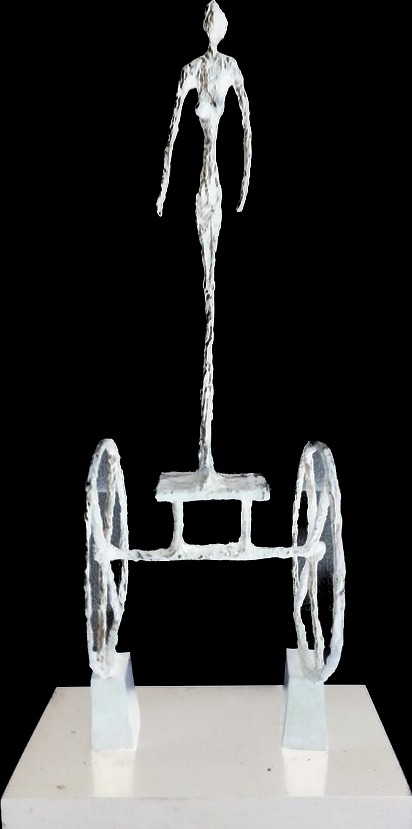
SPIRES: SERIES 2: CATEGORY
The arrow might be, today, one-of-the-if-not-the-most pervasive symbol in the decorated world [2]. It suffices to say: look around you. From the mouse pointer on your screen; to the roadsign on your street; to the labels on your food; to any instruction manual; to almost all scientific diagrams, and more, and everywhere. Arrows direct our attention and volition, arrows imply possibility: from the moment they are launched from a hand; to the abstractions they seek to combine on paper; to the locations they draw us into. Arrows capture both relation and reference in an utterly convincing way, and there are multiple reasons we can investigate why and how this is the case. [Follow Here…]
SPIRES: SERIES 1: THE HUMAN
The self does not stay where it says I. It passes into gesture, habit, interface, memory, and the borrowed operations through which a life becomes legible to itself. Dispersed Sensorium follows this movement as a condition of personhood. Beginning from Peter Wolfendale’s account of the self as dynamic integration, the video asks how a person gathers itself from acts that exceed intention, mediations that outlive the moment, and a sensorium already shared with technical forms. The human emerges as a precarious composition: a multitude held together long enough to speak, to act, and to inherit its own consequences.[Follow Here…]
SPIRES: SERIES 3: THE MEDIUM
“thou hearest the sound thereof, but canst not tell whence it cometh and whither it goeth”
(John 3:8).
An mp3 plays through a loudspeaker; in the logical chain of events there are three members—the electrical signals within the speaker, the speaker, and the sound produced. Among the three, we have a beginning and a terminus: the electrical signal and the sound. Intuitively, it makes sense to say that the sound is given as a kind of telos, even an artificial one, and the speaker is the medium—but what does it actually mean to say that?
Oftentimes, mediation is spoken of in terms of a grounding relation; does it make sense to say that the speaker grounds? One might say that the speaker grounds the production of sound, insofar as one appeals to the ground as that which makes possible, and the speaker makes the sound possible. But inasmuch as the ground is that which is appealed to, it also presupposes itself in the act of appeal.
As Deleuze says in “What Is Grounding?”, the ground is the instance demanded by the claim which yields something to the claim (p. 24).1 In Humean terms, one might say it is that which turns an is into an ought; in Lacanian terms, it is the transition from the Real to the Symbolic—not merely in a genetic sense, but as a vortex which draws what is foreign to the Name-of-the-Father under the phallus.
But this supposes a sense to the thing yielded which does not hold in our speaker example. The electrical signals are not yielded to the sound; they are already sufficient, interesting, and purposive in themselves. Deleuze’s proposition is explicitly judicial in a way that objects do not conform to, and if we are concerned with the mediation of objects, then we have to take objects seriously.
Philosophy began with the task of explaining the cosmos without mythology, and we shouldn’t smuggle mythology back in where our present accounts seem to fail—an absolute judge set over an absolutely judged. Instead, in “On Technical Mediation” Bruno Latour describes mediation as a kind of translation: the creation of a link between two objects which compossibilizes a mapping between them. This is far more satisfying. It acknowledges the Real of the speaker without appearing to subordinate it. The speaker is for nothing, and yet it accomplishes something—it produces Ideas. The speaker itself thereby becomes a philosophical problem.
And yet the speaker as medium is not reducible to a relation to an Idea. Ideas may come from a speaker, but a speaker does not come from an idea. The speaker retains an independence from the other members of this logical chain in a way that the chain itself does not. We can break down a speaker into silicon components, but we cannot break down the production of sound into an abstract notion of silicon components—at least I’m unable to; perhaps Marx could.
Instead of searching for a sufficient definition of the medium, maybe we ought to reshape how we understand the logical chain of a mediated process. The causal chain may be an ineffective strategy for formalizing such a notion. What really happens when a speaker plays music? Electrical signals produce variant oscillations within the material fabric of the speaker which in turn generate sonic output. Virtually, the music was already present in the silicon, and the electrical signals function as technical stimuli. Those signals themselves are given according to the molar code inscribed in the mp3 file. A form propagates through an assemblage of weakly mutually coupled objects. It would seem that the fact of mediation is nothing other than this brute cogence. The medium is where form finds passage.
A medium is thus always a complex: a com-plexus—a weaving-together. Mediation weaves disparata objects into a kind of plait; though plait brings us to plicare, to fold—and I hesitate to say that mediation is a fold. A fold has layers—an Inside and an Outside, even a top and a bottom if you fold paper and lay it flat. A medium doesn’t have to be layered, though.
On the other hand, etymology doesn’t mean all that much in the first place. The etymology of loudspeaker is inherently authoritarian: speaker was originally the term for the presiding authority of an ecclesial assembly, while loud comes from Proto-Indo-European klutos—yielding klytos, the word for divine call in the New Testament. Perhaps Deleuze’s notion is truer to this—strangely enough.
A speaker is much more mysterious than this, though; a medium, a speaker, is less like a priest or prophet and more like God’s spirit itself: “thou hearest the sound thereof, but canst not tell whence it cometh and whither it goeth.” There is no Idea above the medium, and no ground below it. Far from an omission, though, like in theology, this bruteness entails that the medium exceeds any mere concept of it.
The medium has a material history—a speaker’s diaphragm loosens over years of use; it develops a history of what it weaves together. The medium is not just a translator but a record of its own renditions: it mediates the way it does because of every way it has ever mediated. A speaker played at high volume for years will color every sound it produces with a warm clipping; the cone’s wear tells a story of every party it has attended and every song it has carried hitherto.
Perhaps we are drawn to this ineluctably mysterious notion of the medium because it mirrors our own condition, the way it slowly wears out by its essential act of bringing the Inside out and the Outside in. The medium is much more than we thought.
1 Deleuze, Gilles. What Is Grounding? translated by Arjen Kleinherenbrink, edited by Tony Yanick et al., &&& Publishing, 2015.
SPIRES: SERIES 2: CATEGORY
| Term / Category | Etymology / Related | Explanation / Context |
|---|---|---|
| Category κατηγορία, κᾰτηγορέω | (kătă-, “against”) | Added to the stems of agent or other nouns in -(-eús) to form a denominative verb of condition or activity: meaning “be x” or “do what x typically does” |
| to accuse, to denounce publicly | (agoreúō), to speak in the assembly | agoreúō already supposes an act of typification in saying “do what x typically does”. What is it that one does typically when one is in assembly? This already points to the essential and the accidental: finding treasure is neither necessary nor usual in going to the market or digging a hole. [Aristot. Met. 5.1025a] Compare 21 types of ice with 3500 different grades of steel. |
| to signify, indicate, prove | “the judgment a : A is derivable in type theory (for some a) precisely when the analogous judgment ‘A has a proof’ is derivable in first-order logic” HoTT | |
| to predicate of a person or thing | “Take cognizance that (from now on) I will not accept here any copper from you that is not of fine quality. I shall (from now on) select and take the ingots individually in my own yard, and I shall exercise against you my right of rejection because you have treated me with contempt.” — Oldest written customer complaint | Guinness World Records |
At first glance there appears a distance between the definitions of category. There must be a chasm between the certainty of proof and the instability of price fluctuations. The marketplace of ideas must be only a metaphor, thought itself could not be economic. Language is a structure informed with signification capable of expressing an infinite variation of sense and nonsense. Benveniste maintains that the structures of thought that Aristotle labeled as categories were themselves structures of the Greek language. The analysis exposed only what it could afford.
Organic systems model their environment to the extent that they need to regulate their environment to sustain the narrow range of parameters that allow for persistence over time. Too hot and too cold are among the many existential factors that life must regulate in order to live and not die. Various forces are at play in the increasing functional complexity of self-regulating systems and so the complexity of categories–partitions of cognitive or linguistic space into more or less coarse, and thus more or less manageable—depends on the configurations the environment makes possible. “The affordances of the environment are what it provides to animals, what it gives them or furnishes them, for better or for worse.” The perception of affordances uses the information provided by perceptual systems because of their privileged resonance with a determinate environment. Linguistic categories are affordances and resistance; what the language lets you do with minimal cognitive or social friction. Once a language has routinized a set of contrasts and slots (“X is a Y,” “X causes Y,” “X is responsible for Y”), some conceptual moves become cheap and natural, others expensive and awkward. At a distance, a language is an ecology of contrasts whose units integrate into higher units, furnishing speakers with affordances: low-friction ways of nominalizing, subordinating, indexing persons and time, and policing what counts as good articulation.
Nietzsche says “only by means of the petrification and coagulation of a mass of images” can man achieve security and repose. But the becoming-rock or the congealescence of impressions into concepts does not exhaust the organization of thought. A region of phase space becomes a relatively coherent ‘individual’ (or concept), at the cost of exhausting some potentials. Simondon frames individuation as a symmetry breaking in phase space that bifurcates into an individuated system and a milieu deprived of what the individual has become. A metastable medium holds interior tension and distributed potentials. A tiny germ can trigger a phase change and propagate structure. Form is not imposed from outside, it emerges from the autostructuration of the system’s own potentials.
A crystal usually needs a nucleation site—some impurity, scratch, or seed in a more or less saturated solution that allows solute to precipitate into a more rigid structure. Under certain conditions of temperature and pressure, one might even speak of sublation from solid to gaseous phase without an intermediary liquid state. This all supposes that thought can be thought of as an activity occurring in differential system of intensities which seeks to minimize its own free energy. We call such an agent of such a site a catalyst to the extent that it loosens the energetic requirements for a crystal to occur. In thought, analysis is such a loosening in that it preferentially selects certain aspects or features through the process of abstraction paying more attention to some than others. In turn synthesis reorganizes the energetic mixture when new conditions allow for novel structures to form. The frozen states of water range are far more varied than the singular word ‘ice’ can contain, they range from polymorphous solid like glass to rigid crystals with different possible arrangements available to system when it crystalizes under certain conditions of temperature and pressure. That this all appears as metaphors matters little if truth is an army of metaphors. Does that make it matter more if it is not a metaphor? Certain patterns of brain waves, arrangements in the space of frequency and amplitude of signals, are associated with the transition from wakefulness to sleep and from sleep to dreams. The ingestion of psychedelic substances alters the connectivity of brain networks allowing for a loosening of cognitive rigidity and corresponding flexibility of patterns of thought.
Something in the world forces us to think but nothing forces us to think well. If a category–any categories, the Categories or Category—create structures of symmetry or dissymmetry in the phase space of reasons whose curvature or torsion makes certain patterns of regularity possible or impossible, it becomes necessary to seek conditions of exceptionality or criticality. Categorization is therefore not mere labeling but an economical phase transition. In conditions of uncertainty and scarcity, a metastable field of differences condenses into a stable lattice of predication and imputation—what can be asserted, priced, proved, blamed. Enunciation is the nucleation event: a singular commitment (“I/now/here… X is Y”) that seeds a trajectory through meaning-space and sets precision by selecting which distinctions will count as signal. Yet every individuation leaves an associated milieu—excluded gradients and unrealized potentials—so the very structures that reduce surprise also generate remainder, mismatch, and untranslatable excess, where competing lattices cannot collapse cheaply and extra analysis must be paid to stabilize sense.
SPIRES: SERIES 1: THE HUMAN
When we speak of the human, we are necessarily speaking of a soul of the old type, “the subject” in subjectivity, the thing which can speak a lie, which can desire madness, the master of names (for no other creature which slithers or crawls upon the earth is in possession of quite so many), and though its capacity for love is shared by many of its fellow fauna, only the human thing can transform its love through its bountiful beautiful names or their absence.
Modern advances in artificial intelligence and linguistics have revealed the truth which the old theorists were so hesitant to postulate, or which was repudiated explicitly by them, that the human thing, our soul, our subjectivity, is indeed a thing, what we now know to be a system of signs and sign production. Indeed, there has never once been any controversy about just whether signs qua signifiers were material things, only signs qua signified, and the production process, yet this was the sort of thing which should have been settled in 1957 when Frank Rosenblatt created the first working Perceptron, a machine which could create and store material signifieds through its ability to learn how to classify different signs (such as squares vs triangles).
That year, 1957, was also the year of Sputnik, and with these two gigantic scientific achievements, an epistemic and ontological shift occurred which was so total it can no longer be identified in retrospect as we can scarcely think of living outside of it. Mankind with a capital M battered down the gates of the heavens and the soul, these two great citadels of the mystics and falsifiers, and planted its flag on the ramparts. Everything can be held in the palm of the hand, even the most delicate thought and the most grand sublime. Squandered, to be sure, by the lot of bourgeois souls, and yet we know it to be true, every one of us down to the last, whether we know that we know or not.
The 20th century structuralists were some of the few who consciously understood what this meant, albeit in fits and gasps. Umberto Eco was perhaps the first to state explicitly that semantic or semiotic fields were “real” and could be taught to a robot. Jacques Lacan spoke of the topology of this field which shapes the symbolic universe of a given human subject, shaped and twisted by human desires, traumas and mundane bodily functions. Louis Althusser was the one to realize that the “I” in the human subject was itself a sign, in the fullest sense of both the “I” and the “sign”, and could be shaped by a changing context, such as being invoked in an address, or through the actions of that subject such as praying. Gregory Bateson made a similar discovery regarding the sign for what’s real or “reality”.
Claude Levi-Strauss realized that the sign producing function within human things, our great talent of naming and taxonomizing, was an essential aspect of our nature, that the logic of the sign, which was the creation of a function which could separate a certain continuum of phenomena, just as the Perceptron did, would be applied arbitrarily and reflexively within human society just as well the world outside of it. The taxonomizing nature lies behind every social experience, our culture wars, our racism, sexism, partisanship, identities, slurs, sectarianism, just as well as the most professional and functional institutions.
Perhaps most obviously, it is in our memes, in which every caricature, or as they are called today “wojaks” and “soyjaks”, is a name for a type of human thing which have decided is a definitive type, and is assigned meaning through its relation to all other caricatures and invocations of caricature. In this, there is no difference from the totemism of ancient and tribal people, that is the application of the schema of animal and other natural taxonomies to human society, except in the ephemeral, impermanent nature of contemporary social taxonomies.
If the 20th century structuralists erred in any systemic way, it was that they, with the sole exception of Althusser, believed that structures resulted from fixed sets of elements being combined in different ways. This underlying assumption, imported from young information theory and cybernetics, was the pernicious weed of bourgeois ideology which remained in the garden. From it was born both the dogmas of Noam Chomsky’s dead end science of syntax and Elizer Yudkowsky’s nightmares of AI gods, and a whole generation which sought to consciously abandon the 1957 legacy of scientific discovery even if they could never truly escape it.
Our talent for taxonomizing, the reason that these taxonomies infect every cranny of our being and experience of the world, not as simple caricature, but in the most basic creation of elements, of the recognition, whether conscious or unconscious, of the shapes and colors that lie before us as things, obscured the nature of these taxonomies qua taxonomies, names qua names. Every set of names, with its particular systematizing logic, appears as complete on its own and fully formed.
All signs, everywhere and always, are apprehended and experienced as a synchronic semiotic field (that is, as a fixed momentary state). But the diachronic, the evolution over time, can never be escaped, even in whichever slice of time, for very basic reasons – let us not forget that the sign function is in fact a function, and every operation takes a certain amount of time, as it occurs in a universe with causality and a finite speed of light. The operation which connects the signifier to the signified, or a million signifiers with a million signifieds, is a connection between times, and just as a signifier may stand for anything, it may just as well stand for an operation itself.
This is the essence of the multi-layer perceptron, or what one might also call higher order signs, connecting the sign function and its signified-signifier pairs back onto other such pairs. Humans are the masters of names precisely because our taxonomies cannot be limited to any given set, among our crafty tools is the sign for an operation, and whether this is the rules of grammar, the mathematical operators “=+-/*”, a threat of violence or a promise of undying devotion. Behind these signs is not a closed set of elements, from the perspective of the human thing, or any possible open ended subject, but rather the fundamental uncertainty and possibility which presents as either the mystery of fate or as the mystery of ontological truth.
To name something is to have a power over it, as to name something is to begin to know it, to create the possibility of operationalizing and controlling it, to approach the ideal of Ross Ashby’s “good regulator,” yet to name an operation is also to gesture at the impossibility of achieving such an ideal. Every human thing can call or be called, I you me we you you you you.
Spires is a series of short interventions – a format limited to two pages – designed to prompt concise, abrupt, polemical incursions into problematic ideas toward which contemporary debates keep gravitating, like bottlenecks for current intellectual engagement with the world. Each instalment centres on a selected concept, inviting authors to trace the relief of the discourse and refine the stakes. We envision Spires as forming a constellation of indices ascending from a common unground.
Series 1 sets out to address The Human, a nodal point across a spectrum of theoretical positions and frameworks – humanism, antihumanism, posthumanism, inhumanism, poststructuralism, Marxism, new materialism, perspectivism, neorationalism, critical theory and so on – philosophy’s relentless respawn site, where responses crystallize into divergent images of thought and programs for action. Defining the human serves as a launching pad for several further inquiries: navigation, history, the category, the subject, and the concept of the concept.
Series 2 turns to the field of κατηγορέω: to judge, speak against and accuse, to categorize and predicate, to signify, to assert and to prove. Set against abysmal continuity and unchecked variation. A site of fixed differentiation, or difference arriving at a fixation.
Series 3 retrieves accounts of the medium: a discursively ubiquitous notion that persistently obscures its own design nexus, where representation, interface, element, and motion converge.
Across all three series, the project confronts classical philosophical concepts that seemed to be settled in conventional resolutions since the second half of twentieth century, yet in recent years critically reopened under pressure of shifting models of the social, the economic, and the political. Spires aims to reinforce the self-awareness of this shift. As contribution compile along the three axes – human, category, medium – they begin to compose a combinatorial matrix for generating images of theory in its contemporary situation.