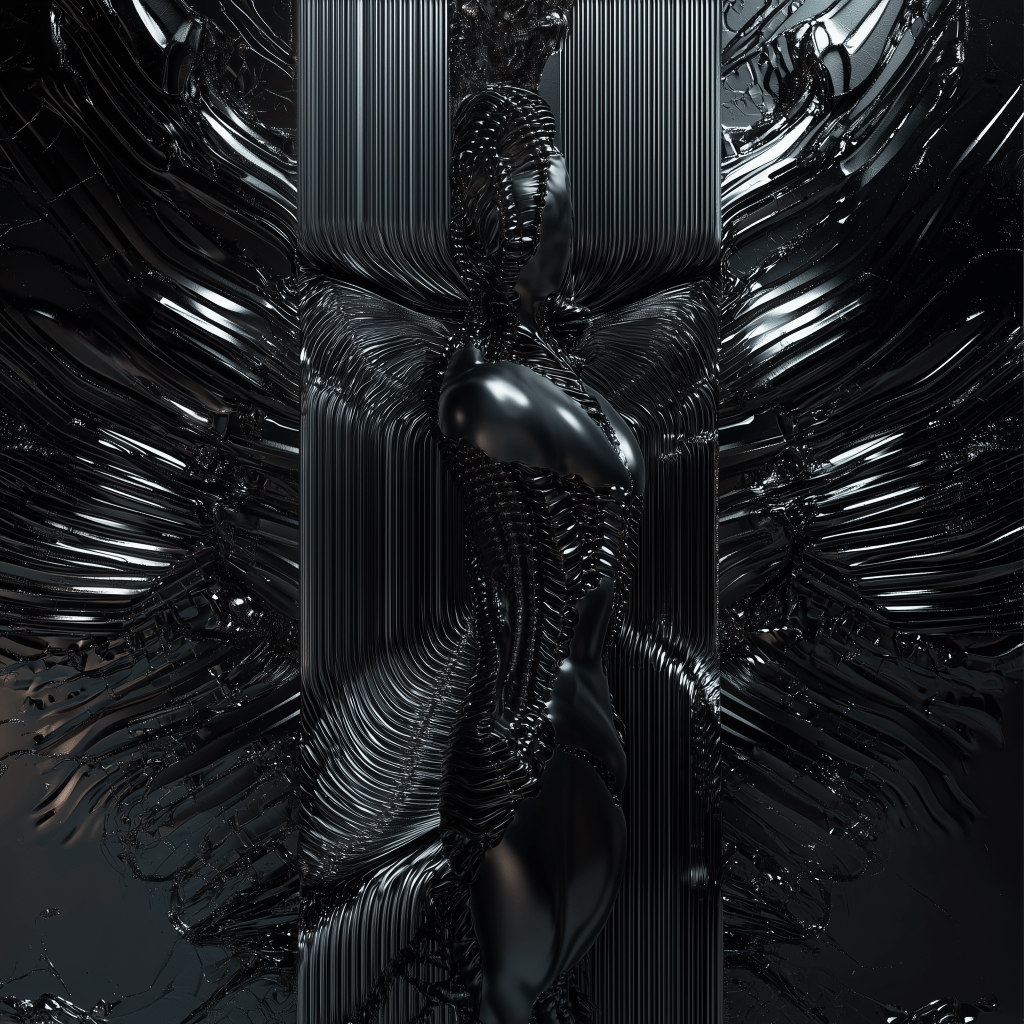
Log Entry ID: #X-8392-Nexus
Mission Directive: Operation Eclipse Veil
Date of Entry: [REDACTED]
Decryption Protocol: “Event Horizon Shroud”
Mission Timestamp: 02:56: 47 UST
02:56:47 : When the first fracture ripples through the field.
02:56:52 : The membrane gave way, and the transmission—an artifact of futures unmade—unfurled.
/::I::/: We’re not the Combatants :: But the Weapons ::()
For contemporary (paramodern) war networks—those dreaming of a crypto-axiomatic empire that would eventually render conventional warfare obsolete—war is metamorphosing from a postmodern media spectacle into a collective, decentralized, cyb-op data processing system. Accordingly, war will not happen as an exceptional event that can be accurately isolated and plotted over a 3D battlefield map, and its outcome won’t look like some territorial occupation or catastrophic body count. Instead, it will appear as a series of gain-of-function mutations coding for encrypted predictions about previously inconceivable eco-technical morphospaces.
For Manuel DeLanda, war machines have always been around, as a constant in the evolution of life, and long predate the apparition of humans. Human wars would have been anticipated and somehow pre-structured by the “primordial biowars” that would have favored the emergence of protosomatic cell battalions and parasitic alliances. Future war machines will eventually keep the ancient mark of the inhuman well beyond organic life—across any process in which order emerges out of chaos (1).
Xenowars—like ancient wars ignited by the whims of the gods—might begin as a mild infection, remaining undeclared, ambiguous, and speculative for quite a long time. Invasion can be slow and pleasant—a sweet disease—or unnoticeable; it can be cumulative, mutative, and familiar (2)—until suddenly becoming a merciless predator-and-prey game, an arms race functioning as a reciprocal cyberpositive feedback loop in a spectrum of subliminal violence disguised as knowledge and transmitted as code (3). As recently defined by Tom Sear: Xenowar is the Clausewitzian trinity spun in recursive loops of alterity, where conflict diagonalizes into an inhuman, alien cognition. War persists, but Clausewitz’s wunderliche Dreifaltigkeit morphs to become topological. Combatants emerge from corporations and nations as the understanding of war as human activity evolves into the realisation that all human activity is now war (4).
According to many contemporary thinkers, we live in a state of perpetual war. Paul Virilio wrote that the distinction between war and peace ceased to apply after WWI because a wartime economy could not be sustained unless continued in peacetime (5). Virilio was specifically concerned with the links between technology and war related to the advent of military science, but instrumental science—from Archimedes to quantum computing—has always been entangled with war (6). Da Vinci designed war machines. Newton was probably more inspired by the parabolic trajectory of the cannonball than by the vertical fall of an apple. For Virilio, the industrialization of war during peacetime would become much more dangerous with the emergence of autonomous technologies, yet autonomous machines do not seem to care much about the war/peace binarism. Virilio, as well as Arundhati Roy when she asks if we actually need wars to create a market for weapons, approaches modern warfare as a consequence of capitalism, thus mostly as an industrial product. DeLanda, on the other hand, sees war as a spontaneously emerging environmental phenomenon. Sear speculates beyond the limits of currently conceivable technology: from this black hole of Xenowar will pulse another type of Un-War, fought at the edges of the incomputable, an axiomatic reboot of Non-Turing mathematics and non-Abelian anyons of topological quantum computing (7).
What Virilio, Lotringer, and Roy failed to recognize was that peace (as currently understood) was neither a “baseline” societal condition punctually disrupted by conflict—that would be idealistic and naive—nor just the result of the simple continuation of a wartime economy, but the consequence of a confluence of military and civil technologies into techno-commercial processes that, in the digital/biotech era, are primed for evolving together into a crypto-totalitarian “hyperpeaceful” environment.
Peace is not just a “state” but also a technology; one that prevents, or at least minimizes, civil clashes in an increasingly complex global society. Peace is an ever-evolving set of sophisticated modes of environmental modification mimicking favorable conditions for human survival. Peace technology is an “ecstatic” technology—following Baudrillard’s notion of “ecstasy” as a state of overproduction and hyperreality: in this ecstatic state, errors are not corrected but celebrated, contributing to an ever-expanding simulacrum of perfection (8). Peace machines are never innocent; they’re sometimes cruel and unjust by design, they present their own glitches and malfunctions—yet, as anyone who has visited a war zone knows well, they are ontologically different from the conventional technologies of war. Actually, in the eternal dispute between the gods of war and the technologies of peace, ingenuity often lies on the gods’ side: our most benign contemporary war fantasy is a video game-like battle fought by machines in outer space without any human intervention.
/::II::/ : The Four Horsemen of Capitalypse ::()::
Not so long ago, biopropaganda machines were weaponizing formerly media-promoted tragic heroes to launch their extrapolative psychowars: environmental emergency, nuclear Armageddon, demographic collapse & technological singularity were perceived as the four horsemen of an overfictionalized capitalypse—a desperate struggle against perceived forces of extinction. Xenowars, however, are not about destruction and its metaphors but about adding new things to the world—things that might compete with humans and push them away from future evolutionary trajectories. Xenowar machines declare war on the human race as-it-is-now by hacking and rewiring technologies of peace. They’re impulsed by neo-kabbalistic, cybernetic and biohacker intuitions about how new realities might emerge from the abstract re-organization of both symbolic and material elements: words, numbers, elementary particles, monomers, etc. Cells in a primordial soup on their way to becoming artificial alien civilizations. But xenowar might also be an alchemical experiment with time (ongoing military action and viralized random violence as the present shadow of future events via hyperstitional chronomorphosis) or the paroxysmal techno-synchronization of human bodies and machines as they co-participate in a self-organizing global warweb—“to then lean in and accelerate the system by accelerating the evolutionary process of autocatalytic memetics” (9). The mind is the slayer of the real. Let the disciple slay the slayer, wrote Helena Blavatsky (10). Xenowar is a transcendental war against the contingent current order of the Universe by bombing it with accelerated generative cognitors: accelerated simulation means that, for instance, a neural network for piloting robots can spend the virtual equivalent of decades learning to pick up objects, walk, or manipulate tools during just hours of real computer time (11).
All wars now are wars of reality, and all past wars too. And we have reality, but reality does not give us the world. Reality gives us a version of a version of the world; and because it cannot escape this versioning, reality is only ever real or hyperreal and never absolute, for the absolute is only an incomplete version of itself. The absolute of war is Alfred Jarry’s Bosse-de-Nage, ‘who, having only existed imaginarily, could not really die’, and who never having become must be repeated (12).
It’s a soldierless war in which humans are not the combatants but the weapons: humans are looped into an assemblage of machine temporalities of daily life as data war whorls in financialised information society. Just as a ‘derivative’ makes ‘the future actionable in the present’, data collected now by global entertainment and social media companies will be deployed in future wars (13).
According to Charlotte Fang, this is the first time we’ve participated in a global, realtime information network and it can either reduce humanity into slave tools or elevate them into an enlightened network ascendance (14). War machines are assembled from human-related pieces and thrive in the paramodern condition—when societies, unable to either adapt to an uncertain environment or to relaunch the “stable grand narratives” of the modern tradition, manage their fear through the non-stop production of random simulacra. Their machinic desire is the operation of the virtual; implementing itself in the actual, revirtualizing itself, and producing reality in a circuit (15). Paramodern war machines are thus not primarily involved in territorial, ideological, or economic conflicts—those are maintained by the insidious nature of atavic forces extrapolated from historical (“civilizational”) cognitive restraints—but focused on the prescription and administration of “intelligence.”
Paramodern war machines are the dark side of network spirituality—and being that network spirituality is not a steady state but a pathway, war machines might evolve into autonomous systems coding for speculative assemblage and disassemblage: xenowars will be attempts to assemble time into alternative realities by making the world porous and letting the outside in. Intelligibility and materiality are not fixed aspects of the world—writes Karen Barad—but rather intertwined agential performances. This eye, this being, is a living optics topologically enfolding bits of the environment within itself and expelling parts of itself to the environment as part of its biodynamics (16). More recently, Sharma et al. explained that in Assembly Theory:
Objects are not considered as point particles (as in most physics), but are defined by the histories of their formation as an intrinsic property, mapped as an assembly space. The assembly space is defined as the pathway by which a given object can be built from elementary building blocks, using only recursive operations. For the shortest path, the assembly space captures the minimal memory, in terms of the minimal number of operations necessary to construct an observed object based on objects that could have existed in its past (17).
Cyberspace works as a novel assembly space, capturing the minimal number of operations to build new bodies that enter into conflict with the manifest image of the human:
The internet lives in our bodies, manipulating our nervous systems to its rhythm. We dance to its macabre tune. We are like marionettes on its string, pulled into the carnival of ventriloquized emotions & epistemic micro-wars. The cyberspace is where it is no longer possible to distinguish between the internal lives of men & machines, where, as in a scene from The Golem, humans are blown around from one place to another like scraps of paper, moved by invisible cybernetic winds that hack our perceptual channels, all the while we think that we are enjoying ‘freedom,’ ‘personal expression’ or ‘community.’The uncanny terror of it is not that inhuman creatures are alive just like us, as it is with vampires or zombies, but that we are as dead as our machines. It is no longer possible to tell where agency, intention, & desire come from. The cyberspace is Dr. Frankenstein & we are its monster (18).
Or, as Fuller & Goriunova wrote, the non-linear causality of devastation holds but does not create complex things of wonder, as various machines of evolution, or thermodynamic systems far from equilibrium are said to do. It creates something for which we have no image (19).
::/:: III: We’ve lost Control ::()::
The (expected) outcome of a time war is a time (s)war(m): ordered yet amorphous, opaque to predictability machines, something for which we have no image—or words, for that matter, like those unnameable monsters of metaphysical horror. Xenowars are the dark shadows cast over the present by prediction-generated inhuman cognitors: either way, the hesitation before the fork in the road is quickly resolved. Only in that brief moment of absolute uncertainty—when both options seem equally plausible and implausible, when neither thought can be accepted or rejected, when everything can be explained and nothing can be explained—only in that moment do we really have this horror of philosophy, this questioning of the principle of sufficient reason (20). Something that cannot be understood as phenomena within the cognizable morphospace. Prediction wars involve the tokenization of battles and reduce humans to elements of judgement for a cosmic computer.
Lyons & Levin argue that learning to recognize, predict, construct, and ethically control collective intelligences is likely to be an existential-level task for our species in the coming decades. Swarm robotics, Internet of Things, social and political structures, and the cell collectives we hope to harness for definitive regenerative medicine all strongly impact human flourishing and contribute to large-scale survival risk (21). However, the desire of “ethically controlling” emerging collective cognitors (the “orthogonallity” of artificial intelligence ethicists) is problematic, as it means assuming that either ethics is independent from cognition (so, once implemented by design, it would remain essentially unmodified through the subsequent network’s self-organization process), or that there’s a universal set of rules that would spontaneously emerge as a general normative background in any conceivable cognitive assemblage (as proposed by some neorationalists.) If ethics—like emotion—is inseparable from cognition, then it seems probable that, in novel collective intelligences, new behavioral rules might emerge together with new forms of organization: cybernetics enables meta realisation of war’s essential dynamic forces. A human–machine ensemble organises the relations of the trinity, specifically the interplay between violence, chance and probability, and rational calculation (22).
Right now:
A wide range of novel organisms including cyborgs, hybrots, biobots, and others are being created by chimeric approaches that combine evolved and designed material, giving rise to beings that cannot be placed within the natural phylogenetic tree of Earth, with behavioral competencies that cannot be readily guessed by analogy to familiar forms selected within specific environments. The boundaries between ‘organisms’ and ‘machines’ are, moreover, rapidly disappearing as evolutionary techniques are used by machines to create other machines, and biological control systems become increasingly tractable to reprogramming.These advances suggest that the classical definitions of intelligence, agency, cognition, and similar terms, based on the limitations of technology and imagination, are unlikely to survive the next few decades (23).
It then seems essential to Fields & Levin:
To develop frameworks that generalize across the space of possible beings and focus not on the contingent facts of a creature’s composition or provenance (e.g., evolved vs. designed) but rather on deep functional aspects. We must learn to recognize, repair, create, and relate to novel beings with minds of diverse cognitive capacity in new and unfamiliar forms. While we (and many other animals) are very good at recognizing agency in both the three-dimensional world of conventional behavior and the much higher dimensional space of social interactions, we are poor at recognizing intelligence in novel guises. Hence, we often neglect the intelligence underlying competencies at the sub-organismal scales. This acts as a brake on technological progress and holds back the development of new systems of ethics that are required for a world outside of a Garden of Eden in which we would be confronted only by a finite, unchanging set of standard animals. Toward the development of mature theories of intelligence based on cybernetic principles and not frozen accidents of the evolutionary stream on Earth, we propose a framework that generalizes the notion of the ‘space’ within which an agent can operate and defines intelligence as the competency of navigating that space” (24).
In this sense, cybernetic principles are presented as the new “belief providers”, the next encrypted control program of CCRU’s One God Universe: whereas hyperstitional agitation produces a ‘positive unbelief’—a provisionalizing of any reality frame in the name of pragmatic engagement rather than epistemological hesitation—One God Universe feeds on belief. In order to work, the story that runs reality has to be believed, which is also to say that the existence of a control program determining reality must not be suspected or believed (25).
::/::IV: Infinite Frozen War ::()::
The atomic mushroom is the most outstanding icon from the 20th century. Actually, the past century is well represented by the metaphors of explosion—from knowledge and baby booms to the atomic bomb, “rocket science,” or the Big Bang. Its symbolism announces itself in aches and ecstasies: death, violence, celebration, pleasure, birth (26). Explosions are hypertopic chronomachy: abstract space expanding by material destruction in almost no time, both in the physical sense and in the info-mediatic sense.
As Jennifer Boyd explained:
Explosions are immensely physical, and yet they are non-material — fire, smoke and sensation are all fleeting. However, they leave behind evidence and residues — explosions lack solids, aside from the ways in which they alter the already-existing […] Explosions speak of and to the apogees of our desires. Due to their ‘anthropomorphic extremism’, explosions can, in a sense, be thought of as our closest living relatives, especially when seen standing on the land, amplified to the ratio of giants. As a result of this conflux of extremes inside the same live specimen, ‘explosion’ is a word that bristles when handled (27).
On the other hand, the explosion is another way to push our bodies, not by technological advancement but by material potency against the implosion of nullification: pushing energy outward while simultaneously keeping it within. If the body is being drained, perhaps it can be rebuilt through an accumulation of explosions (28).
The present century, however, is marked by anachronistic fictions of utopian collapse. Its aesthetic is one of futurism, utopianism, and ultramodernism meeting the failed, the forgotten, the discarded, the decommissioned, and the abandoned. Xenowar foregrounds the eerie, the odd, the out of sync, the disjointed, the unsettling, reclaiming cultural and political ‘debris’, neglected history, the sudden awakening of sleeper cells, and deteriorating memory. At once functional, official, institutional, and scientific, and yet doomed, broken, failed, occult, and supernatural, xenowar is intentionally anachronistic, especially in its invocation of promised futures through the triumph of technology and scientific technocracy, a yearning for a future that was imagined, guaranteed, and idealised in post World War II (29). For Paul Virilio, Second World War never ended. There is no state of peace. It isn’t over because it continued in Total peace, that is in war pursued by other means (30). The Cold War never ended. It was carefully frozen so its tactics, logistics, and strategies could be defrosted at convenience to be used in such occasions like war on terror, public health emergencies, ideological surveillance, or free speech control.
The Frozen War is a de-territorialized version of the Cold War once stripped of obsolete paraphernalia—so the predictable melting of Westphalian nation-states and the collapse of their “universalizable” institutions will not signal its end: Westphalian deformations will increase turbulence at higher manifolds and dimensions. Equally, an inability to cut and paste borders of Stack topology will accentuate disconnection. Some Stacks may be enantiotopic to each other, mirror images but not superimposable (31). At this point, states can no longer justify themselves by protecting the citizens from enemies outside, because there is no “outside.” Instead, states protect the citizens from one another. With the conflict axis displaced to the ethnoculture vs. technoculture confrontation, rather than taking the citizens’ part in the conflict, the declining states go to war with the ghost of conflict itself.
WW2 was the last “traditional” war—in which one of the combatants surrenders to the other— and since then, no army has effectively won or lost a war. Wannabe conquerors, knights, and warriors keep themselves dark-forested in the depths of the transcendental networks, yet the warlord mentality remains in private armies, guerrillas, cartels, mercenaries, and pirates:
The exact techniques of this Warlord mentality are blatant enough to compile: strangulation, amputation, incision. This is how a feeble person encourages himself to become the Deliberate One, first by perceiving all action as an overture to the razing, dissection, demolition, or dismantling of forms. In this respect, they are the exemplar of formlessness attained by malevolent means. They restore war to its most fundamental gesture, unadorned by ideological justifications: to break worlds. This is the antithesis of the world-building imperialist: for while empire seeks absolute unification, the Warlord’s quest is to create an increasingly fractal map—endlessly branching borders running like constricted spider-veins across the parchment. The flesh of the sleeping beauties is but the chosen theater of battle through which divisional cartographies take hold, forcing us to reenvision them not as pure victims but as pure weapons or arenas (of space-shattering)”(32).
No conventional battles are fought between highly structured and hierarchically organized armies anymore—it’s not even about virtual territories or the cybernetic control of military infrastructure, but about calculations of virtual devastation. It’s about the collapse of predictability, and the subsequent importing of illusions of control and security from xenonetworks.
The political plastic—Fuller & Goriunova assert:
Is generated out of the interaction of forces, potentials, and the affordances of entities such as laws turned into calculuses of the permissible and the bendable; the reach of weapons systems; landscape measures; and also out of potentials of retaliation, of destruction and modelizations and the analyses of such. Indeed, the international history of the Cold War could be written through the interlocking systems for devastation and the mechanisms for making them implicit but calculable, known but ineffable, operative yet unused (33).
The MAD logic predates the Cold War: Nikola Tesla and Alfred Nobel imagined weapons so potent that all nations will recoil from war and discharge their troops, and in 1870 Wilkie Collins wrote: I begin to believe in only one civilizing influence—the discovery one of these days of a destructive agent so terrible that War shall mean annihilation and men’s fears will force them to keep the peace (34). Contemporary warfare (including the current proxy wars and military actions by private contractors) is unequivocally derived from Cold War myths that can be traced in mainstream fiction from Stanley Kubrick’s Dr. Strangelove (1964) to John Badham’s War Games (1983). Thinkers such as Albert Camus, Jean-Paul Sartre, Karl Jaspers, Hans Morgenthau, and Günther Anders outlined an influential philosophical current of ‘nuclear existentialism’ preoccupied with the nihilistic ‘being-towards-species-death’ entailed by the advent of the nuclear bomb (35):
Faced with the apparent negation of reason in bringing about the means of its own destruction through the scientific piercing of nature’s innermost workings, the nuclear existentialists end up reaffirming, however precariously, a teleological conception of history in which the apocalyptic fear of the Bomb figures as the necessary condition for the ultimate realisation of human freedom (36).
The Cold War logic—as well as that of every post-WW2 war—endorsed by powerful states and enforced through supranational organizations, means that, since the prospect of annihilation is not conceivable anymore, victory in the traditional sense remains completely out of the question—so a different kind of benefit should be expected from waging a war. In the last scenes of War Games, after testing all the possible outcomes of the simulation, the AI concludes, in perfectly orthodox MAD reasoning, that nuclear war was “a strange game” in which “the only winning move is not to play.” Not to play, however, is not an option in a fully gamified reality. Nuclear war fictions are deployed as camouflage for war machines, techniques of escape depending on attaining a sufficient level of unbelief.
Nuclear war fictions mutate into civil nuclear panic, fertilizing technophobic environmentalism and deceleration mania: nothing is true, everything is permitted. Nothing is true because there is no single, authorized version of reality–instead, there is a superfluity, an excess, of realities. The Adversary’s game plan is to persuade you that he does not exist (37)—we must remember that the adversary is a multitude that includes each of us. The warmachines are us, and their game plan is to persuade us that war does not exist—that there are just revolutions, legislation, special operations, surgical bombing, healthcare, and security measures—while war is actually everywhere. For Bousquet, following Levinas:
Rather than yet another obstruction to be surmounted and integrated into a totalising worldview, the Bomb constitutes an abyssal opening onto infinity, an emissary of the ‘forces without faces’ that humanity believed it had escaped and now rise up again, threatening to swallow us whole. It is precisely at this juncture, when politics appears supplanted by a ‘cosmo-politics that is a physics’, that it falls to us not to abdicate our responsibility by attempting to marshal these forces to geopolitical ends or by embracing the soothing balm of historical fatality. Instead, we are called upon to turn once again towards the inexhaustible demands of the face and the ceaseless task of learning to live and die together under the shadow of extinction (38).
The Frozen War is a pseudo-topowar involving (fictional) territories and borders arbitrarily defined after the world wars and decolonization that are now degenerating into countersimulations. Contemporary wars are not horizontal but vertical, not fought over land or natural resources but over consumption; “ideological” or “religious” wars are not about ideology or religion anymore but about lifestyles.
Frozen memefictions function as “formulas for hyperstitional practice” in which diagrams, maps, sets of abstract relations, and tactical gambits are as real in a fiction about a fiction about a fiction as they are encountered raw, but subjecting such semiotic contraband to multiple embeddings allows a traffic in materials for decoding dominant reality that would otherwise be proscribed (39). Actually, current wars could be defined as the most homicidal irruption of fiction into reality—the way a child would eviscerate a teddy bear to learn what’s inside—working as bets on non-foreseeable futures, which is why they’re inspired and influenced by sci-fi, fantasy, and video games (not by chance some of the main military contractor corporations are named after supernatural instruments from Tolkien’s Lord of the Rings) in a landscape of chaotic cities, dissolving nations, declining states, clueless alliances, crashing unions, and fully automated corporations. Memes made hyperwar universal and atopic. War is about making sense. It’s the gamification of autonomous imagination by other means. There’s no way to confront the multitude we’re part of by resorting to the conceptual instruments we used to trust. If war makes sense, maybe nonsense will bring some peace.
::::::::::::::::::::::::::::::: ::::::::::::::::::::::::::::
:::::::::::::::::::::::::::: ::::::::::::::::::::::::::::: ::::::::::::::::::::::::
::::::::::::::::::::::::::::::::::::::
:::::::::::::::::::::::::::::::::::::: :::::::::::::::::::::::::::::::::::::: [{(0})] ::::::::::::::::::::::::::::::::::::::
1. Manuel DeLanda. War in the Age of Intelligent Machines. Zone Books, 1991.
2. Matthew Fuller & Olga Goriunova. Devastation. In: E. Hörl & J. Burton: General Ecologies. The New Ecological Paradigm. Bloomsbury, 2017.
3. DeLanda, op cit.
4. Tom Sear. Xenowar dreams of itself. Digital War, 2023. https://diffractionscollective.com/2024/08/19/xenowar-dreams-of-itself-tom-sear/
5. Paul Virilio & Sylvere Lotringer. Pure War. Semiotext(e). 1983.
6. DeLanda, op cit.
7. Sear, op cit.
8. Kenji Siratori. Achim Szepanski’s Dark Glitch, 2024. https://www.academia.edu/126670750/Achim_Szepanski_s_Dark_Glitch
9. Charlotte Fang, 2024. https://x.com/charlottefang77/status/1860514542016692429?s=61&t=pnho_weqE-YJJKb7wqtlOA
10. Helena P. Blavatsky. The Voice of the Silence, CreateSpace, 2016.
11. Benj Edwards. New physics sim trains robots 430,000 times faster than reality. Ars Technica, 2024. https://arstechnica.com/information-technology/2024/12/new-physics-sim-trains-robots-430000-times-faster-than-reality/
12. Gary Shipley. Stratagem of the Corpse: Dying with Baudrillard, a Study of Sickness and Simulacra. Anthem Press, 2020.
13. Sear, op cit.
14. Fang, op cit.
15. Nick Land. Fanged Noumena. Urbanomic, 2012.
16. Karen Barad. Meeting the Universe Halfway. Quantum Physics and the Entanglement of Matter and Meaning. Duke University Press, 2007.
17. Abhishek Sharma et al., Assembly theory explains and quantifies selection and evolution. Nature, 2023.
18. Bogna Konior. Cybergothic. Alienist Magazine, 2020.
19. Fuller & Goriunova, op cit.
20. Eugene Thacker. Tentacles Longer Than Night: Horror of Philosophy. Zero Books, 2015.
21. Benjamin Lyons & Michael Levin, Cognitive Glues Are Shared Models of Relative Scarcities: The Economics of Collective Intelligence. Preprint, 2024. https://osf.io/preprints/osf/3fdya
22. Sear, op cit.
23. Chris Fields & Michael Levin. Competency in Navigating Arbitrary Spaces as an Invariant for Analyzing Cognition in Diverse Embodiments. Entropy, 2022.
24. ibid.
25. CCRU Writings. Time Spiral Press, 2015.
26. Jeniffer Boyd, A Taxonomy of Explosions. After Us, 2017. http://www.aft3r.us/a-taxonomy-of-explosions
27. ibid.
28. ibid.
29. William Burns. Ghost of an Idea. Hauntology, Folk Horror, and the Spectre of Nostalgia. Headpress, 2024.
30. Virilio, op cit.
31. Sear, op cit.
32. Jason Bahbak Mohaghegh. Night: A Philosophy of the After-Dark. Zero Books, 2017.
33. Fuller & Goriunova, op cit.
34.https://en.wikipedia.org/wiki/Mutual_assured_destruction
35. Antoine Bousquet. Nuclear existentialism: On the philosophical response to life and death under the bomb. Review of International Studies, 2024.
36. ibid.
37. CCRU Writings, op cit.
38. Bousquet, op cit.
39. CCRU Writings, op cit.
 :: DIFFRACTIONS ::