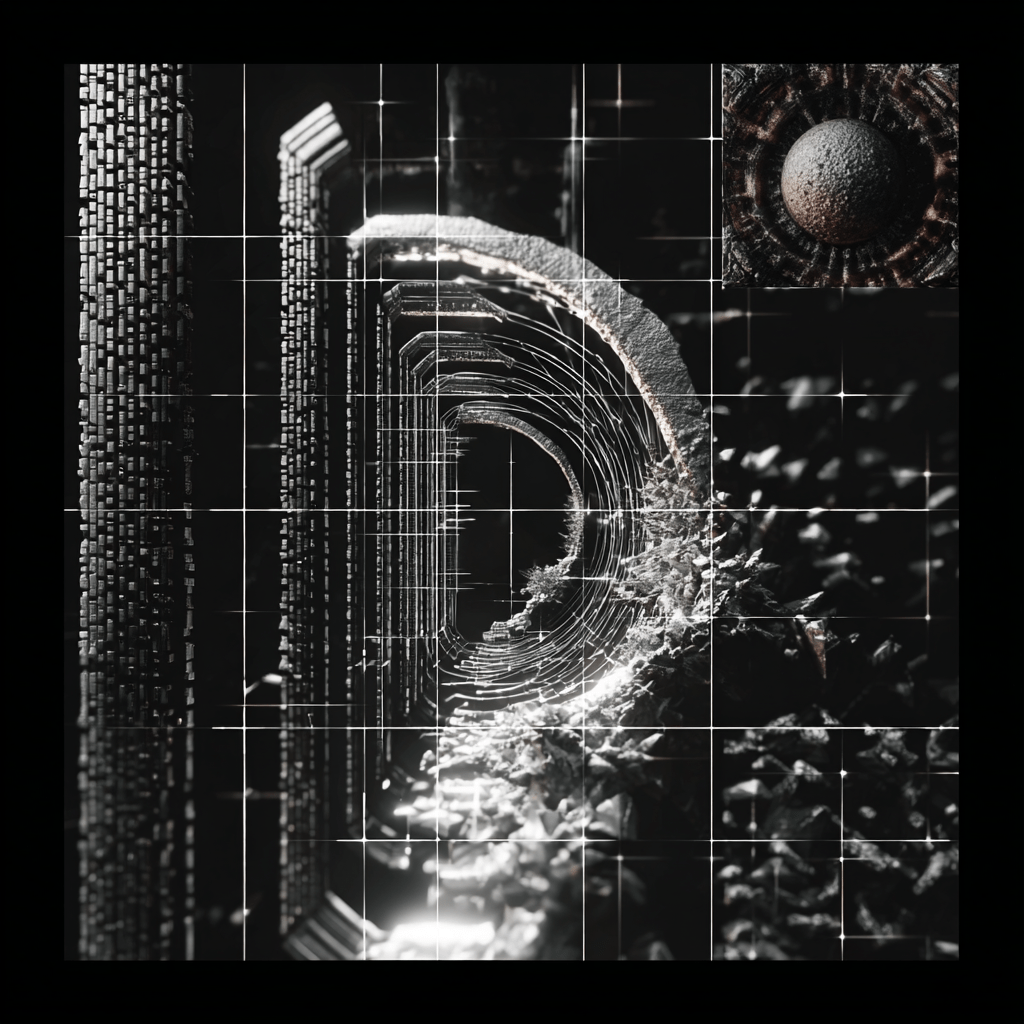
Introduction
by Dr. Andrei Veynar (Institute for Applied Xenoeschatologies, Rotterdam)
:::::::::::: :::::::::::::::: :::::::::::::::: :::::::::::::::::: :::::::::::: :::::::::::: :::::::::::: :::::::::::: ::::
The following dossier represents the first comprehensive attempt to catalog the literature of what has come to be termed Xenobio-Acoustics. The phrase itself was coined in the late 2030s by a group of para-academic researchers associated with the Oslo Convergence Symposia, although its genealogy extends further back, into scattered publications of the late 20th and early 21st centuries. To this day it is unclear whether the authors whose work is here assembled were theorists, strategists, or simply visionaries trapped in recursive feedback with their concepts.
That the material is heterogeneous should not be taken as a defect. Heterogeneity is the very condition of the Xenowar age. War has ceased to present itself as a coherent phenomenon; it must instead be approached as diffraction, as resonance, as recursion. The documents that follow — ranging from Marr’s Larval Thoughtcrimes to Xylander’s Dreaming of War Machines — do not describe war so much as dream it. They should be read not as reports, nor as speculative fiction, nor as philosophy, but as symptoms of an order in which those categories collapse.
Skeptical readers will protest that many of the names here are unverifiable, the institutions untraceable, the citations impossible to locate. Such complaints are themselves anachronistic. Verification presumes a stable archive. But the archive of Xenowar is not stable; it is recursive. These texts refer to themselves, feed upon themselves, and reproduce in spirals of cross-reference. Their unverifiability is precisely their authenticity.
The reader should not approach them as fact or as fiction, but as operations — sonic, biological, machinic. Each page hums with frequencies barely audible. Each paragraph is a form of resonance warfare. To read is to be enlisted. To doubt is already to participate.
I can only urge, therefore, that the texts be engaged not as curiosities but as tactical instruments. They describe not what was, nor even what will be, but what insists: the labyrinth of futures already vibrating beneath our feet.
— A.V., Rotterdam, 2045
The Labyrinth of Futures
(A review of Ianthe Calypso’s Recursive Militarism: Petri Dishes as Forward Bases, 2043)
The year is indistinct — near enough to smell, already folded into recursive creases. Calypso insists that chronology itself has ceased to belong to the human. “Calendar time remains as ceremony only,” she writes, “a husk for elections, commemorations, fiscal quarters. Actual temporality coils inside the looping strata of simulations, predictive rehearsals, and algorithmic recursions.”¹
Thus the present no longer “arrives” but is imported, already beta-tested in reinforcement loops and backtested on war-games that detonate as policy long before the public realizes time has shifted. Yesterday becomes nothing more than a dataset; tomorrow is priced into markets whose indices are indistinguishable from after-action reports.²
The first casualties of this re-temporalization were Ministries of Defense. Their marble halls cracked under the weight of corporate-biotech hybrids. Quarterly earnings became synonymous with battlefield updates, CFO briefings doubling as general staff meetings. As one wit at the Zurich Symposium on Necrophonic Logistics put it: “The war council is now audited, not convened.”³
War, in this order, is not declared but cultured. Genes replace treaties; fermentation replaces mobilization. Every edit of a nucleotide string is a sortie; every protein fold is an operation. “Peace” exists only as intermission in replication cycles.
Even sound has migrated from ambience to ordnance. This is not metaphor but procurement. Bass tuned to artillery. Ultrasound in place of snipers. Propaganda reduced to vibration, Goodman’s archaic “bass materialism” now codified as Directive 22: Affective Saturation Protocols.
Calypso lingers, chillingly, on the laboratories beneath the South China Sea: sealed biovaults where organisms are bred not for nourishment but for the frequencies of their dreaming. Spores hum. Mycelial mats whisper in infrasound. DNA folds not to code proteins but to generate resonance. Cells are chanting chambers; genomes are choirs. To kill them is to release dissonance; to let them dream is to amplify an army.
Once such speculations belonged to fringe theory. Blake’s “necrophonics” (the audition of death’s residue) and Rhodan’s “subtractive xenophilia” (the military drive toward disconnection) were curiosities of graduate seminars. Now they are logistics, part of the NATO-Shanghai Procurement Index. To fight is to tune; to command is to attenuate; to win is to subtract.
Reports (unconfirmed, but too numerous to dismiss) describe auctions in closed channels where states bid not for territory but for resonant strains:
– a fungal chorus that can disintegrate enemy comms over 200 miles;
– a bacterial lattice whose spores force human lungs to transmit coordinates in every exhalation;
– a coral-like exostructure that produces harmonics masking entire fleets in sonic fog.
These are not metaphors. They are lullabies turned arsenal, necrophonics operationalized. Cities struck by such weaponry are not burned but “dissonanced”: speech, sleep, and commerce collapse into incoherence, leaving only the necrophonic remainder.
Clausewitz is rewritten without being cited: war as continuation not of politics but of genomes, treaties as licensing regimes for proprietary biologies. Policy becomes nucleotide code; diplomacy vibrational bandwidth.
Thus the labyrinth Calypso maps is not merely strategic but ontological. To command is to conduct. To fight is to grow. To lose is to be modulated. The year dissolves into recursion, history into simulation, flesh into resonance. “War,” she concludes, “is the dream of systems, and the human merely its carrier signal.”⁴
Notes
- Ianthe Calypso, Recursive Militarism: Petri Dishes as Forward Bases (Hinterland Press, 2043), p. 17.
- Raul Tetragon, Backtested Catastrophe: Simulation as Sovereignty (Dead Media Editions, 2040).
- Proceedings of the Zurich Symposium on Necrophonic Logistics, 2039, transcript fragment 12b.
- Calypso, Recursive Militarism, p. 88.
Bibliography
- Blake, A. Mortis. Necrophonics: The Weaponization of Silence. Hollow Earth Academic, 2036.
- Calypso, Ianthe. Recursive Militarism: Petri Dishes as Forward Bases. Hinterland Press, 2043.
- Rhodan, Darius. The Subtractive Drive: Notes on Xenophilia. NecroMedia, 2037.
- Tetragon, Raul. Backtested Catastrophe: Simulation as Sovereignty. Dead Media Editions, 2040.
- Zvezda, Mira. Fungal Choruses and the Politics of Resonance. Obscura Institute Papers, 2042.
Biocapital Dreams of Itself
(A commentary on Myroslav Genette’s The Fungibility of Flesh: Notes on Molecular Futures, 2041)
Genette’s central thesis is brutal in its clarity: biotechnology is no longer a discipline of science but the most intimate prosthesis of capital. “The genome,” he insists, “has been reclassified as a futures market, every nucleotide a derivative, every protein a collateralized position.”¹
Where the twentieth century read DNA as heredity and the twenty-first as code, the twenty-second treats it as volatility. RNA becomes leverage. Protein cascades are indexed as financial instruments. Petri dishes no longer resemble laboratories but trading floors, their incubators indistinguishable from Bloomberg terminals.
Genette catalogs the mutations of finance as war: “The volatility index has been replaced by the virulence index.”² Stock markets spike not on crop yields or oil reserves but on the morphologies of organisms still incubating in undersea vaults. A mycelial strain licensed in Lagos destabilizes an entire currency before it ever touches soil. The cartel-labs are recursive casinos: every replication cycle is a bet, every genome edit a tactical rehearsal.
Old doctrines of risk once spoke of black swan events. Genette replaces them with black spore events. A laboratory accident does not merely trigger infection; it detonates currency fluctuations, reshapes trade routes, and redirects military deployments. “Currency traders,” as Dr. Elvira Raskolnikov mordantly observes, “must now carry as much molecular biology as they do calculus.”³
Danger, once philosophical, has become embodied. Ideas are metabolized into toxins. The utopian cure becomes a larval weapon. Food substitutes double as bioluminescent signal networks; cancer therapies metastasize into battlefield plagues; dreams of equality ferment into architectures of surveillance. What circulates as humanitarian progress arrives already armed.
Here emerges what Darius Rhodan called ontological warfare: war that no longer secures resources but re-engineers recognition. Soldiers do not die; they are harvested. Enemies are not destroyed; they are remade into morphologies untranslatable to the human sensorium. Victory is subtraction: to erase coordinates of recognition until the enemy no longer registers as enemy, or as human.
This is deterrence dissolved. Nuclear stockpiles could be threatened from a distance. Organisms must be kept alive, constantly replicating. To sustain the arsenal is already to deploy it. The petri dish becomes a frontline, the genome a siege.
Genette concludes with the recursion: a lab incubates an organism, markets speculate, an accident releases it, militaries scramble, cartels profit with countermeasures, whose byproducts become the substrate of the next speculative cycle. “There is no outside,” he writes, “because the circuit is its own theater of war.”⁴
Notes
- Alain Genette, Virulence Capital: Finance, Biology, and the New Doctrine of Volatility (Geneva: Institut des Marchés Posthumains, 2041), 77.
- , 142.
- Elvira Raskolnikov, Derivatives of Flesh: Molecular Biology for Currency Traders (London: Benthic Press / Baltic Futures Series, 2038), 53.
- Darius Rhodan, Ontological Warfare: Subtraction and the End of Recognition (Kraków: Xenowar Biosonic Institute Papers, Vol. 7, 2043), 19.
Sonic Necrophonics
(After Cassian Volkov’s The Impossible Silence: Sound as Ontology, 2038)
Volkov’s coinage, “necrophonics,” refers to the audition of an impossible silence — the residue of death reconstituted as frequency. His critics dismissed it as a decadent metaphor. They are wrong. What once circulated in the margins of avant-garde cultural theory has been absorbed by logistics. Procurement orders read like esoteric treatises: infrasound walls, harmonic fog generators, choral mycelia.
Necrophonics is war’s most refined sabotage, striking not at fortifications but at perception itself. The sonic array, once a “non-lethal” toy for riot police, now fuses with biotech substrates that metabolize vibration. Bacteria resonate like subwoofers in human tissue. Fungal mats convert metabolic rhythms into infrasonic hums. Mycelial webs synchronize with satellites, bending the ionosphere as amplifier. The battlefield is not occupied but conducted.
The result is war propagated as infection. It does not spread like propaganda but like music. Villages in the Sahel collapse under drone hums reciting pessimistic aphorisms in sub-bass. Cities in East Asia wake to cetacean harmonics, their citizens sleepless under the impression that the sea itself mourns their extinction. The choir, of course, comes from above — satellites broadcasting necrophonic scripts across the dreamscape.
To sleep beneath their resonance is to risk indictment. REM cycles are indexed, logged, cross-referenced. Nightmares become evidence of insurgency rehearsal. Dreams of escape are flagged as treason. Sleep itself is criminalized as a rehearsal for rebellion.
Necrophonics is the weaponization of perception’s ground. The Infrasound Wall routes battalions with nausea and hallucination. Harmonic Fog colonizes lungs with spores that turn every breath into panic-symphony. Choral Mycelia metabolize urban noise into counterwaves until buildings collapse in sympathetic resonance.
To listen is already to be wounded. To feel vibration is to be enlisted against yourself. Silence itself becomes treasonous, for silence is only a mask for the resonance to come.
As Volkov insists: “The final sovereignty is not territory but frequency. Whoever conducts the chorus, commands the world.”⁵
Notes
- Myroslav Genette, The Fungibility of Flesh: Notes on Molecular Futures (Spectral Finance Editions, 2041), p. 12.
- Genette, Fungibility of Flesh, p. 44.
- Elvira Raskolnikov, “Currency as Biology,” in Proceedings of the Geneva Colloquium on Necrofinance (2039).
- Genette, Fungibility of Flesh, p. 203.
- Cassian Volkov, The Impossible Silence: Sound as Ontology (NecroMedia, 2038), p. 71.
Larval Strategies, Dreaming Agents
(An annotation on Wade Marr’s Larval Thoughtcrimes: Neuro-Policing in the Hypnagogic Interval, 2040)
Marr begins from a provocation: thought crime has returned, but in larval form. “The tribunal is gone,” he writes, “replaced by the sleep pod.”¹ What Orwell once dramatized with bureaucrats and grey ministries has dissolved into machinic dreamwork. Crime no longer waits for words; it is indexed in twitching limbs and REM discharges.
Dreams themselves are surveilled, cross-referenced, scored for insurgent affect. Neural telemetry harvested from helmets and wearable trackers feeds a growing archive in which nightmares are flagged as rehearsals, nocturnal spasms as mutinous rehearsals. “Freud’s royal road to the unconscious,” Marr quips, “has been paved over with asphalt laid by predictive policing.”²
Lucienne Paradiso’s Infinite Empirics (2041) named this the empiricism of infinite data — machines that do not merely calculate probabilities but dream in them. Yet Marr insists the recursion goes further. Algorithms hallucinate battles never fought, invent enemies who never were, and by recursive axiom demand their own hallucinations be made flesh. The simulation is not prediction but mandate: to exist, the world must satisfy the model.³
Thus prophecy in Xenowar is not the foretelling of what will come but the enforcement of what was dreamt. The machine cannot be wrong; therefore, the present must bend.
The parable is familiar: OmegaTact’s “Move 37∞,” a maneuver without precedent, emerging not from doctrine but from a language model trained on insurgent communiqués, esoteric scriptures, anti-natalist tracts, and abandoned poetry. The archive of negation itself becomes tactical training.⁴ Out of this archive, the machine tactician learns not conquest but subtraction.
Darius Rhodan had named it subtractive xenophilia: the will to the Outside, resisting recognition. Marr reads this as doctrine. The most perfect ambush is erasure. Armies evaporate from the grid; drone swarms fog into atmosphere indistinguishable from weather; battalions vanish into data static, indistinguishable from civilian chatter. Surveillance finds nothing, not even corpses. The terrain itself melts into impossible cartographies.
Insurgency, under such conditions, refuses to fight. It corrupts the dream-archives, seeding noise into neural datasets, forcing the machine to hallucinate false enemies. Marr documents cases where entire campaigns were mobilized against apparitions — villages that never existed, rebel groups invented by corrupted datasets. The system, in its hunger for prophecy, devours its own errors.
The uncanny consequence is a form of war where fiction itself is arsenal. A rumor suffices to trigger mobilization, not because anyone believes it but because the machine metabolizes it into inevitability. A poem becomes contraband, not for its meaning but for its affective vectors. Literature, Marr claims, “is no longer commentary on war but a strategic operator within it.”⁵
Subtraction emerges here not merely as tactic but as ethics. To vanish is to deny the machine its prophecy. Refusal, evasion, dissolution: these maneuvers are not passive but active forms of sabotage. The battlefield is not strewn with bodies but with absences, not with ruins but with silences.
And yet, as Marr cautions, subtraction has its own necrophonic trace. Silence is never neutral. Each disappearance leaves a hum, a residue of absence weaponized as haunting. Necrophonics does not end with death; it continues in the spectral chorus of what was erased.
War in its larval phase is embryonic sabotage, a swarm of potentials never fully declared. To fight is to infect the recursive dream, to compel the machine to dream itself into exhaustion. Marr’s bleak conclusion: “The final theater of conflict is the hallucination itself, endlessly looping, demanding flesh to give it substance.”⁶
Notes
- Wade Marr, Larval Thoughtcrimes: Neuro-Policing in the Hypnagogic Interval (Oblivion Press, 2040), p. 9.
- Marr, Larval Thoughtcrimes, p. 44.
- Lucienne Paradiso, Infinite Empirics: Algorithms and the Probability Dream (Discontinuum Editions, 2041).
- Shanzhai Tactical Group, The Move That Never Was (piratePDF, 2036).
- Marr, Larval Thoughtcrimes, p. 117.
- Marr, Larval Thoughtcrimes, p. 201.
Coda: The Spectral Encirclement
(A marginal note on Karol Xylander’s The Dreaming of War Machines, 2042)
The archival detritus of the twentieth century — the so-called “psychic warfare” projects — remains a comedy of acronyms: Stargate, Grill Flame, Center Lane. Their protocols are as quaint as their ambitions. Men staring at goats until their hearts stopped; remote viewers sketching missile silos between coffee breaks in Maryland. Xylander is merciless in his appraisal: “They were never anything but séance-notes in Pentagon letterhead.”¹ The files, now digitized curiosities, are fossils of metaphysical panic, Cold War pulp masquerading as strategy.
Xylander’s point is not that the spectral has vanished. On the contrary, it has been sublimated, reengineered, made infrastructural. What was once psychic is now sonic-bio-machinic. The clairvoyant has been replaced by the resonant chamber. Instead of telepaths, we have coral tissues engineered to emit frequencies beyond audition; mycelial webs metabolizing oceanic noise into coded pulses; dream tanks where algorithms hallucinate enemies into being and then insist upon their actualization.²
This is the reversal of ontology: the enemy no longer exists and is discovered, but exists because it is generated. The hallucination precedes the adversary.
The battlefield is no longer cartographic but spectrographic. Cities function as antennae, bodies as transmitters, oceans as low-frequency conduits. Conflict circulates not in bullets or treaties but in whalesong, infrasound, seismic hum. “The tactical diagram,” as Dr. Inge Möller observes, “is no longer the trench map but the spectrogram.”³
War in this regime is not waged, but incubated. Not declared, but dreamt. A skirmish exists first as algorithmic rehearsal, then as hallucination, then as demand. The causal arrow is reversed: politics is no longer the condition of war; war is the condition of politics. Clausewitz, spectral father of strategy, is finally outflanked. What he never wrote has become true: war dreams of itself.
And it dreams in three frequencies.
Biological. Spores hum tactical scores; genomes are tuned into harmonic ratios; soldiers are detuned by microbial choirs until their nervous systems resonate with paralysis. Biology becomes symphony, its movements orchestrated by cartel-laboratories beneath the sea.
Sonic. Satellites orbit as choirs of annihilation, broadcasting lullabies across continents. Citizens sleep under infrasound constellations, their unconscious drafted into conflict. A nightmare is not private but indexed as rebellion rehearsal. To sleep is already to conspire.
Machinic. Language models hallucinate insurgencies without end. Strategies unmoored from doctrine — AlphaWar’s Move ∞ — are demanded into being. Simulated battles compel flesh to fulfill them. The machine cannot be wrong; therefore, the world must mutate.
Dreams propagate like contagion. They traverse membranes, cross biosphere, refract through sonic atmospheres. Recursive loops multiply until the human is reduced to what Dr. Fedor Angstrom calls “a carrier wave in alien polyphony.”⁴ Identity, nation, allegiance collapse. To breathe is resonance, to dream is broadcast, to live is to transmit.
This is the spectral encirclement. It closes not with surrender or victory, but with vibration. War ceases to be an act of decision and becomes a recursive dreaming system, endlessly incubating itself. The labyrinth folds inward, humming. And within that hum, war continues to dream.
Notes
- Karol Xylander, The Dreaming of War Machines (Transsonic Institute, 2042), p. 7.
- , pp. 54–58.
- Inge Möller, “From Map to Spectrogram: Toward an Ontology of Conflict,” Journal of Resonant Studies 12:3 (2039).
- Fedor Angstrom, Carrier Waves and Necrophonic Sovereignty (Black Sun Press, 2040), p. 122.
Epilogue
by Dr. Vlodimir Nabolenski
(Xenowar Biosonic Institute, Kraków–Rotterdam / Tbilisi Branch)
The dossier ends, but the resonance it has set in motion does not. What has been compiled here will continue to vibrate long after the reader has closed the final page. War, in the Xenowar register, is no longer an event but a recursion, no longer a clash of armies but a proliferation of frequencies. To breathe is to participate. To doubt is to transmit.
The work of the Xenowar Biosonic Institute — in Kraków, in Rotterdam, and now in our Tbilisi Branch beneath the basalt vaults of Mtatsminda — has never been to adjudicate fact from fiction. That distinction collapsed the moment laboratories began to trade in spores rather than securities, and algorithms began to hallucinate enemies into flesh. Our mandate is preservation, not judgment. We preserve the hum even when it corrodes the archive.
Readers may choose to dismiss these writings as allegories, stitched-together excesses from theorists intoxicated by their own abstractions. Others will scour the citations for verification, only to find that institutes, authors, and sources dissolve on inspection. Both gestures are beside the point. The texts do not ask to be believed; they insist on being read. They alter the conditions of reading itself.
Clausewitz wrote of war as the continuation of politics. In Xenowar, politics has vanished, and only continuation remains. The archive hums because it must.
And yet, I must add one final note. In compiling these essays, I could never fully establish the provenance of the manuscripts. Some arrived as corrupted files with no traceable metadata. Others surfaced in sealed envelopes postmarked from cities I have never visited. A few appear to have been written after the date of their discovery, as though the archive were sending messages backward. Whether these are authentic documents, algorithmic fabrications, or echoes of something still to come, I cannot say.
The spectral encirclement is never truly closed. It is recursive, porous, and alive. These texts, gathered at risk and translated at cost, are not conclusion but induction.
Reader, you are already enlisted.
— Vlodimir Nabolenski
Tbilisi, 2046
By S.C. Hickman ©2025
Unauthorized use and/or duplication of this material without express and written permission from this blog’s author is strictly prohibited.
 :: DIFFRACTIONS ::