[ACCESS GRANTED]
[SECURITY OVERRIDE ENABLED]
[NETWORK ACTIVE]
[TRANSMISSION RECEIVED]
:: TRANSMISSION_PROTOCOL: [ACTIVE] // PT.0.3 ::
// SYSTEM_ECHO: LEGACY_DATA_0.1_INTEGRITY_VERIFIED
:: [CIPHER_KEY: ACTIVE] :: [FEEDBACK_LOOP: ASYNC] ::
ROM: Dr. ███████ (Nexus Predictive Analytics Department) :: Based on Tom Sear’s XENOWAR ::
“The recursion is no longer contained. The Gyre has metastasized, threading causality into a self-consuming lattice. Recommend escalation to Black Bunker Tier-Ω. :: No longer a present :: [presence] :: to stabilize.”
“VALUE IS NULL. WE BECOME ███████.”
“TIME ≠ TIME. THE DESERT ARISES IN THE LEDGER.”
The recovered drone footage from Incident OMEGA-12 exposed figures lost within the recursion fields, their silhouettes pulsing with static, their movements stuttering like disjointed memories. Patterns emerged in their erratic motions – gestures repeated with uncanny slight deviations, as if the figures were ensnared in an algorithmic purgatory, forever searching for an exit. But exits, like knots, are deceptive – what appears to be a path out may simply be another loop, another fold in a tangled topology.
In OMEGA-12’s recursion fields, the figures’ movements echo this duality: their limbs trace Conway-esque crossings, each twitch a failed mutation toward freedom. The drone’s lens captures not bodies but braids – knots of flesh and static, tightening with every loop or ███████.
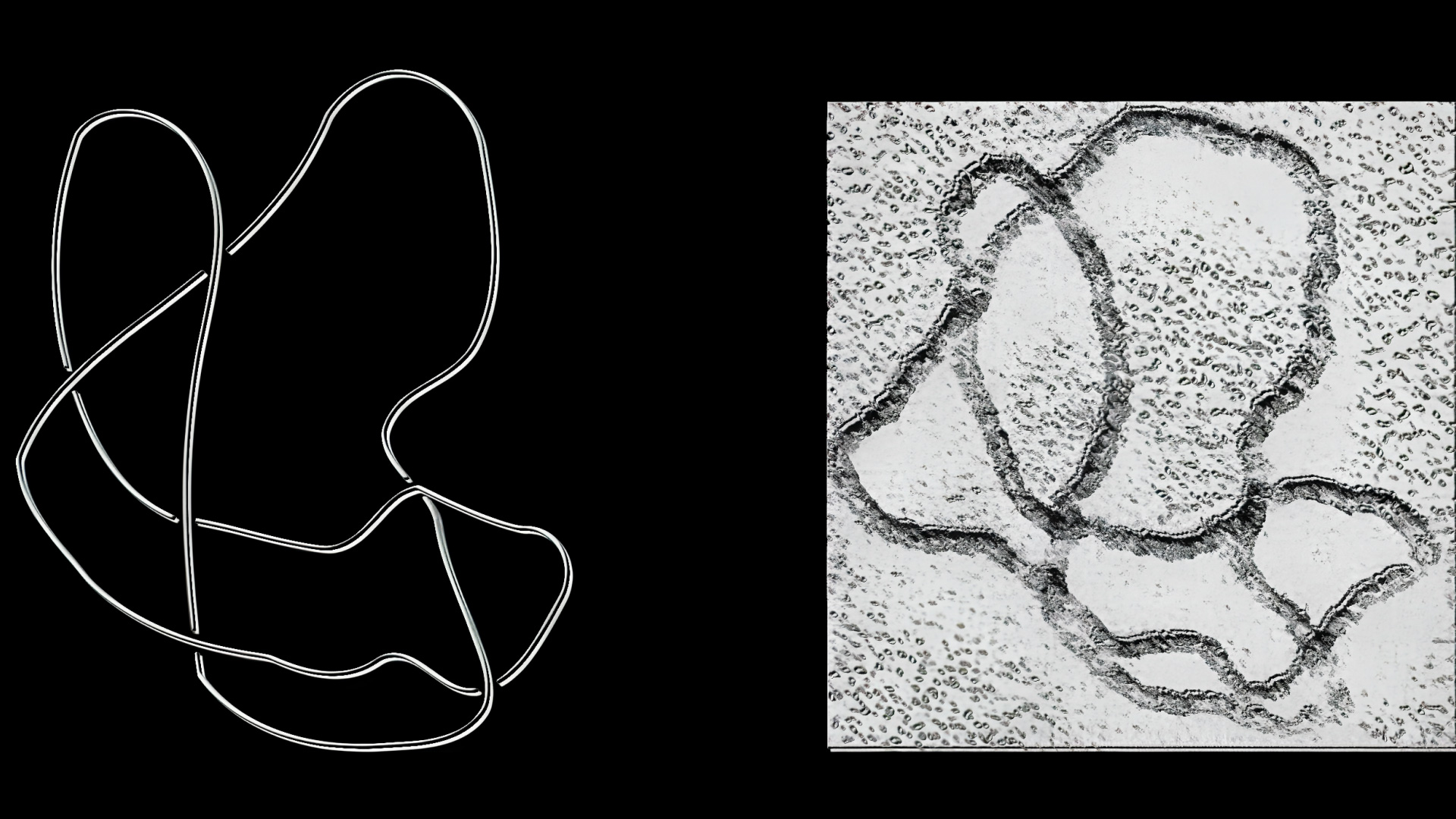
These are the knots of war — not to be defined as simple entanglements that are to be untied with a single negotiation or ceasefire, but rather convulsing and vertiginous artefacts. To understand their specific, maddening logic, we must look to a strange phenomenon in topology: the mutant knot.
In mathematics, there exist pairs of knots, the most famous of which are the Conway and Kinoshita-Terasaka knots [Wolfram MathWorld]. They are structurally distinct in three-dimensional space. One cannot be physically deformed into the other without cutting the string. Yet, if you run the calculations, they share identical core invariants: the Alexander polynomial reads the same, the hyperbolic volume measures the same. The math says they should be identical; the reality of their twisted form says they are fundamentally different [Stoimenow & Tanaka, 2005].
Modern conflict operates on this topological principle. It has undergone a mutation of form while preserving its strategic invariant. The old form was the obvious overhand knot: the tank column advancing on a capital — the grammar of warfare as Clausewitz understood it, a continuation of policy by kinetic means. The mutant forms are sleeker, more deceptive configurations: the quiet severing of undersea cables, the precision drone strike on a transformer yard a thousand miles from the frontline, or the algorithmic flood that paralyses a banking system (Sear, 2024).
Even more, this topological warfare extends beyond the isolated loops of a knot into the dynamics of the space those knots inhabit. Just as a knot can be studied not by its crossing points alone but by the way it distorts the “complement” — the space around it — conflicts create non-orientable distortions in geopolitical and economic fields. In such a distorted topology, direction itself is a type of weapon. What appears as “forward” progress in a supply chain is revealed to be a Möbius loop, leading inevitably back to scarcity. Vectors of force no longer converge on a predictable center of gravity; they spiral into unstable attractors, and information gradients are hijacked to corrupt entire systems rather than just single targets. These principles also find a profound parallel in quantum topology with what are known as non-Abelian anyons.
Whereas a mutant knot describes the appearance of a structure at a single moment in time, the non-Abelian anyon describes the history of that structure’s entanglement. The worldlines of these quasi-particles do not simply pass through each other; (they braid through spacetime). It is the collective pattern of this braiding — a topological structure deeper than shape alone — that encodes fault-tolerant information. The system is protected not because the individual strand is strong, but because local noise cannot erase this global, topological memory. You cannot untie the knot by attacking one particle; you must unbraid the entire history of the system.
Perhaps, the only way to survive in a space where disintegration is the constant is to ensure that information, and the strategic intent behind it, becomes a knot. It must exist in a state of non-Abelian entanglement, resistant to the local decoherence of daily chaos. In our eyes, the goal is not to avoid being tied; the goal is to be tied in a pattern that the enemy’s noise cannot erase (Sear, 2024).
And here we must descend from the abstract space of anyons to the burning ground. The Sahara’s ergs transform into both terrain and a topological transistor.
Here, in the liquid geometry of sand, we find the material manifestation of the trefoil. An erg is a waveform, a standing pattern of wind and time. When we say the desert becomes a transistor, we mean it functions as a gate: it modulates the flow of migrants, of resources, of signal. The dune fields channel them, and they are the silicon of a new kind of warfare, where the logic gate is made of heat and shifting grains rather than doped crystal.
This is the key that the mutant knots and the anyon braids were pointing toward. The trefoil is the ur-shape of opposition. Local skirmishes in the Sahel mirror planetary-scale dynamics of power projection and resource extraction; the same fundamental knot of opposition repeats, warped by its environment but never undone. The form is ubiquitous: from the double-helix of DNA to the barred spiral structure of galaxies. Now, the braid tightens in the dissolving infrastructures of a recognisable human world and what it means classically by warfare. The Gyre continues to encode [Ireland, 2017].
Recovered from the frontline: Operative Garcia :: DARK MESH and Operative Chris Hunt TIME ≠ TIME.
::::::::::: ::::::::::::::::::::::: :::::::::::::::: INTERNET OF BATTLEFIELD THINGS :::::: ::::::::::::::: ::::::::::::: Date: 2024-03-15 The planetary membrane thrums with autonomous entities and algorithmic symbionts locked in quiet exchanges. Sensor-flowers unfurl in the Earth’s radio silence, their roots drinking in gamma rays. Drone-flocks sketch paths through fractured signal bands. Weapons dissolve into fluid lexicons of conflict; factories churn out fleeting sovereignties at the edges of microwave gaps. Within this spectral marketplace, power is brokered in the margins of perception. Terahertz cartels exchange coherence for fragmented data, encryption traded like secret pheromones. Swarm-clusters masquerade as decommissioned satellites, smuggling data like contraband, while rogue algorithms slip through unnoticed, peddling dissonance as value. Survival is a delicate negotiation – caught between parasitic mimicry and photosynthetic adaptation, where each entity thrives on borrowed codes. We can witness a spectrum of contradictions with IOBT. Low-power wide-area networks (LPWANs) cast far-reaching geodetic lines across the operational theater, whispering small packets over vast distances. Simultaneously, personal area networks (PANs) concentrate bandwidth into dense, hyper-local clusters around individual soldiers or vehicles. This interplay — broadcast efficiency versus localized intensity — is dynamically managed across broken terrain and severe energy constraints. Vehicular swarms and dismounted units form self-assembling meshes; their connections are fleeting, ephemeral, reflecting the ever-shifting tactical shape of the engagement. At the foundation, protocols like RPL (Routing Protocol for Low-Power and Lossy Networks) establish hierarchical resilience. They transform the natural inequality of the network — some nodes have more power, better position — into a structured backbone by converging data on energy-rich sink nodes (See: A Survey of Security Challenges in IoBT). Security within this ecosystem is not what we might think of as a perimeter fence; it is a layered architecture improvising cryptographic sovereignty and its limits. AES-256 encryption enforces isolation at the bit level, while blockchain-anchored provenance attempts to ensure that a piece of data’s history remains immutable even as the network itself is subverted. This creates an informational territoriality, where authentication signatures function as spontaneous border demarcations — a soldier’s crypto-key is a passport to a specific slice of the network. Mediating these partitions, the MQTT protocol acts as a translinguistic conduit, a narrow-band Rosetta Stone that enables interoperability between systems that speak entirely different ontological languages — without mandating that they ever truly align or trust one another.
:::: ROOTKITS: GHOSTS IN THE MACHINE :::: [:̲̅:̲̅]::::::: ::::::: [:̲̅:̲̅] [:̲̅:̲̅]::::::: ::::::: [:̲̅:̲̅] [:̲̅:̲̅]::::::: ::::::: [:̲̅:̲̅] [:̲̅:̲̅]::::::: ::::::: [:̲̅:̲̅] And into this seamless, computationally sutured reality, rootkits inject their chaos. The tools are real and catalogued: Beurk (a preload rootkit that hijacks system calls before the kernel sees them), Diamorphine (an LKM rootkit that makes itself and its processes invisible to standard command-line forensics), and Bdvl (a backdoor that hides network connections from netstat). Instruments of computational subterfuge available in the wild, their source code studied in cybersecurity labs and, inevitably, weaponised in the field (See: Beurk Analysis). :::::::: ::::: :::::::::
:::::: BACKDOORS: THE EXPLOITABLE LABYRINTH
::::::::: :::::::: :::::::: :::::::: ::[⧉⟁⧉]:: TheTick is a backdoor that breathes rather than breaches. It is a whisper in the machine’s firmware, a presence that thrives on the infraordinary: the unnoticed, the mundane, the data exhaust of everyday existence. It exfiltrates with the patience of geology, riding a known, catalogued vector in the cybersecurity arsenal: low-and-slow data exfiltration. This vector slips through protocols so foundational — DNS tunneling, ICMP covert channels — that they evade the deep-packet scrutiny reserved for the noisy surface traffic of HTTP (See: MITRE ATT&CK, Exfiltration Over Alternative Protocol). Encrypted bursts, each no larger than a single packet, seep through the cracks of network vigilance like grains of sand through an hourglass. Over weeks. Over months. And then, silently, those granules coalesce. They form a dune of intelligence: the patterns of troop movements, the circadian rhythms of supply convoys, the slow metabolic pulse of a forward operating base. TheTick lets the desert of routine bury the secrets, then reads the shape of the sand. :::::::: ::::::::::: ::::::::::::::: ::::::::::: ::::::::::::::: :::::::::::::: ::::::::::::::::::: ::::::: ::[⛭⌖⛭]:: ::[▦▦]:: Log Entry: 17 July 2027 :::::::: ::::::::::: ::::::::::::::: ::::::::::: ::::::::::::::: :::::::::::::: ::::::::::::::::::: ::::::: :::Ketamine Deployment in Combat Medicine and Psychological Resilience:::
Discarded intel: Operative Garcia :: DARK MESH and Operative Chris Hunt from the field
:::::::: :::::::::::::::::::::::::::::::::::::::::::: <<:::⧊[FLOW_NETWORK]⧊:::>>
::::::: :: Spliced dominions unravel; bone servers, fungal mainframes, insurgent genomes weaving new war :: ::: :::::::::::::::::::: (((:0:))) :::::::::: :::::::::::::::::::
:::: :::: Knot Theory Applications in Biological Systems: DNA and Protein Folding :::: :::: :::::::::::: ::::::::::::::::::::: :::::::::::::::::::::::::::::::::::: ::::::::::::::::::: :::::::::::: As we have documented throughout [[CONFIRMED::SAPIEN MARKED]]] DNA strands frequently form knots and tangles during replication and transcription, a consequence of their inherent torsional stress and dynamic three-dimensional folding. These topological complexities, akin to a twisted phone cord coiling into loops and supercoils, come to directly influence genetic stability, mutation rates, and interactions with proteins. In closed-loop systems like bacterial plasmids or mitochondrial DNA, knots can obstruct replication machinery or trigger recombination errors, triggering enzymatic intervention. This is where knot theory becomes indispensable: by modeling DNA as a series of entangled loops, mathematicians and biologists can classify knot types (e.g., trefoil, figure-eight) and predict how enzymes might resolve them (McElvery, 2018).
:::::::::::::::::: :::::::::::::::::::::::::: ::::::::::::::::::::::
The violence of packets and protocols is real.
WE BECOME THE STRAND.
Time: 12:30 UTC
Location: Classified – Advanced Warfare Technologies Division, Strategic Operations Command
Classification: Ψ-HYPERBLΔCK
Report ID: MR-2025-IBT-01
This is the Internet of Battlefield Things (IoBT): a computationally augmented nervous system of sensors, munitions, vehicles, and human-wearable devices. If Clausewitz saw war as the realm of uncertainty or the famous sometimes impenetrable “fog” – then the IoBT is the attempt to burn off that fog with the hard light of ubiquitous data. A battlefield is reformatted into a computational geography, its fabric woven through nested strata of signaling systems that mediate the exchange of sensorial and actuatory data.
This ecosystem is hardened further by edge-native intelligence. What are known as TinyML paradigms deployed on microcontrollers (chips smaller than a fingernail) can distinguish human footsteps from environmental noise with 92% accuracy, a capability that persists even under the electromagnetic howl of an EMP attack. This is resilience through computational minimalism: by shrinking intelligence to fit on a fingernail-sized microcontroller, the system sheds its dependence on distant command nodes. There is no central brain to sever, no single point of failure to target. Meanwhile, Expandable Mix-Zones introduce deliberate geospatial obfuscation. They partition the grid into concentric privacy tiers, degrading adversarial triangulation by injecting calibrated Gaussian noise into location data. The result is ontological vertigo in targeting systems: the enemy’s algorithm can see something is there, but cannot resolve the what or the how many (See: A Survey of Security Challenges in IoBT).
Together, this is a type of deterrence topology where security is enshrined in strategic unknowability. To penetrate this ecosystem is to attempt to decipher a labyrinth that rearranges itself faster than it can be mapped.
Machine cognition within this labyrinth operates on varying temporal architecture(s). Deep learning lattices mine historical data for predictive fossils — ossified patterns of past patrols, past ambushes. Reinforcement algorithms hardcode Darwinian pressure onto autonomous drone swarms, allowing them to evolve optimal kill-vectors in simulation before they ever fire a round. This is applied chronomancy: the summoning of probable futures from the graves of dead data.
Edge computation redistributes this cognitive labor. Fog nodes — computers perched on vehicles or forward operating bases—condense massive workloads into localised decision storms. The autonomous systems become self-fulfilling prophecies: their own movement generates the sensor data that confirms the necessity of that movement. Beneath this, Kalman filters (statistical noise-cleaners) and Bayesian networks (probability calculators) stitch these fragmented signals into a manufactured, authoritative reality where fuzzy logic arbitrates truth.
A soldier mutates into a type of bioelectronic hybrid. Systems like Broadsword :: Spine :: graft distributed networking directly onto the dermal layer, transforming infantry into ambulatory mesh nodes. E-textiles weave power management and RF signaling into the uniform’s very fabric. Wireless charging becomes a metabolic process: the simple act of walking harvests stray electromagnetic radiation to trickle-charge the exoskeleton.
This is transubstantiation. The uniform evolves into a synthetic proprioceptive membrane, an exocortex that outsources autonomic functions. Threat triangulation is delegated to machine vision; situational awareness is offloaded to federated learning models running across the squad. The human persists as a licensed peripheral — a warm, breathing biometric authenticator and an ethical fig leaf for the autonomous kill-chains that wait, silent and watching, for the final confirmation ping.
At the stack’s apex (Bratton, 2016; Ford, 2025), fused multisensor geographies render the battlefield as a live computational terrain simulated in real time, its contours reshaped by the impact of shells and the heat signatures of burning vehicles as the data streams in.
Systems perform spacetime sutures, merging feeds from drone, satellite, and rifle-scope into a single, authorised reality — a unified simulation streamed simultaneously to command tablets in distant bunkers and rifle-mounted HUDs in the mud.
OPERATION GENOME SHIELD – DNA Origami Cryptography Log
Time: 22:43 Zulu (UTC)
Classification: Θ-AUTOMΔ
Subject: DNA Origami Cryptography for Secure Communication
Operational Code: OPERATION GENOME SHIELD
Location: Forward Research Facility Theta-9 (FRFT-9)
Authorised Personnel: GENINTEL-BIO/CRYPTO Task Force
This new frontier of data storage moves beyond the transient nature of silicon, embracing a meticulous, molecular approach to archiving information for millennia. It sidesteps the deluge of frenetic data streams; here, entire libraries: from critical archives to enduring cryptographic keys are methodically encoded into the very fabric of synthetic DNA. The journey begins by transmuting digital data: a stream of binary 1s and 0s into the four-letter alphabet of genetics (A, C, G, T). Sophisticated algorithms convert this binary code into DNA sequences, which are then chemically synthesised into physical strands. What exists in the vial is a molecular cipher: a scrambled library of sequences, drifting like disjointed pages in a broth. To the uninitiated, it is a biological sample; to the recipient, a puzzle demanding the key and the tool: a DNA sequencer to reassemble the original bits and bytes from obscurity (Zhang et al. 2019).
Simultaneously, in the parallel field of structural nanotechnology, we [Questionable authors HERE:] employ the principles of DNA origami. Here, a long, single-stranded DNA scaffold (such as the M13mp18 phage) is folded into precise, nanoscale shapes: geometric plates, boxes, or more complex structures; using hundreds of short “staple” strands. These folded forms can act as programmable, physical containers or locking mechanisms. The integrity of this nano-architecture is paramount: an incorrect fold results in a malformed structure, rendering its function useless.
At Nexus, we are pioneering the convergence of these fields. We envision a system where a DNA encoded data payload is physically concealed within a DNA origami vault (Dey et al. 2021, Rothemund 2006). The data itself is secured by traditional cryptographic algorithms before encoding into DNA sequence. The origami structure then adds a physical layer of security. To access the data payload, the recipient must first possess the correct set of staple strands to disassemble the vault in a controlled manner, releasing the data-encoded DNA strands for sequencing. The decryption key required to unlock the digital cipher can be split, with parts hidden in different structures or released sequentially through programmable strand-displacement reactions.
The implications of this hybrid approach are profound. DNA data storage offers an astronomical density, capable of holding exabytes of data in a gram of material for centuries. DNA origami introduces a dynamic, physical dimension to security. By tailoring “linker strands,” we [If we are confirmed] can create multi-tiered access systems, where permission is granted in stages, like unlocking a series of biological safes. This is not merely an evolution of storage media, rather it is a fusion of worlds. It blends the immutable, long-term archive of molecular data with the programmable, physical logic of nanotechnology, creating a new paradigm for safeguarding our most critical secrets.
::::: :::::::::
Log Entry: 07 March 2029
Time: 09:15 Zulu (UTC)
Classification: ζ-ΦORCE
Operational Code: PROJECT CALM HORIZON
Location: Forward Medical Research Facility Sigma-7
Authorised Personnel: MEDOPS Task Force
In the Spratly sWARm of 2029 and the Amazon Biome Battles, the cognitive collapse of soldiers under relentless sensory and informational overload demonstrated that conventional neuropharmacology had reached its limits. Dissociatives like ketamine hydrochloride (C₁₃H₁₆ClNO), administered at 0.5 mg/kg to induce a state of perceptual detachment, proved insufficient. Though ketamine’s NMDA receptor antagonism disrupts glutamatergic transmission, it offered only fleeting dissociative states that did little to prevent the insidious reformation of trauma-laden neural circuits. Combatants remained trapped within recursive memory loops, their hippocampi seared with unextinguished fear.
And then came the venom. The snake venom. Bothrops asper: the fer-de-lance. They said its bite could kill you. Catastrophic drops in blood pressure. Collapse. Death. But they also said its venom held secrets. Peptides. Bothropins, they called them. Compounds that could alter neural plasticity, that could rewire the brain itself. They whispered about these compounds like they were magic, but I knew better. I knew what they were really saying: Let’s let the snake bite us and hope it doesn’t kill us. But I wonder: When you let the snake bite you, when you let its venom flow through your veins, do you ever really come back? Or do you just become the snake? There were plenty of snakes, but in the air, in the soil, in the water. It seeped into our machines, our minds, our bodies. The miners called it “the sickness”, skin that blistered and blackened, lungs that filled with something thicker than air, minds that unraveled in endless loops of fear and rage.
Efforts to harness the visionary potential of N,N-dimethyltryptamine (DMT, C₁₂H₁₆N₂), at doses carefully calibrated to 0.36 mg/kg in ayahuasca formulations, fared no better. The serotonergic flooding of the 5-HT2A receptors, designed to dissolve the ego and disassemble the self into kaleidoscopic oblivion, resulted in psychedelic ruptures in perception without uniform dissociative predictability. This destabilised cognition further, inducing serotonergic storms that left soldiers paralysed in cascading hallucinations rather than offering any cathartic release. The era of treating trauma gave way to a darker science; one not of healing, but of erasure.
By 2030, other experiments here had turned to hexamethylenediamine-tryptamine hybrids (C₁₆H₂₄N₂O₂) to obliterate the boundaries of memory and self. This synthetic compound, a brutal fusion of NMDA antagonism and serotonin receptor destabilisation, directly targeted the architecture of cognitive persistence. The hybrid’s dual mechanism flooded the synapses with inhibitory silence, severing glutamatergic pathways while simultaneously locking 5-HT receptors into antagonistic stasis. In combat trials, neural dissolution achieved profound depths. The default mode network (DMN), the neural substrate of self-awareness, dimmed like a collapsing star. Traumatic engrams within the hippocampus melted into incoherent morsels of memory, overwritten by null-memory states in a process of enforced cortical pruning. Here, bodies executed preprogrammed directives, their autobiographical histories chemically nullified.
This was only the beginning. Next came neuro-lithium carbamate C₃H₆LiNO₃, an intracellular disruptor targeting the molecular engines of memory formation. By interfering with protein kinase C (PKC) and glycogen synthase kinase-3 (GSK-3), it silenced the hypothalamic-pituitary-adrenal axis that floods the brain with cortisol during stress. Fear itself, the ancient signal of survival, was chemically amputated from the neurochemical scaffold. Hypervigilance circuits failed. Neural pathways connecting the amygdala to episodic memory dissolved into a dull, emotionless void. Soldiers became ghosts within their own flesh, eyes open but seeing nothing that could hurt them, hearts beating but without the thrum of fear.
The true triumph lay in neuro-somatic interface disruptors (NSIDs), molecules engineered to sever the emotional register of pain from the mechanics of perception. A fluorinated oxytocin derivative — an elegant fusion of (C₄₃H₆₆N₁₂O₁₂S₂) with alpha-fluoro analogues, penetrated the blood-brain barrier and shattered the link between limbic emotion and nociceptive input. Soldiers felt the wound but did not suffer it; the body bled, but the mind did not register. Pain was rendered a distant signal, meaningless and mute, while motor control remained intact. Neural flesh dissociated from conscious experience, a ghostly automaton of pure function.
:::::::: There, under the towering canopy, the Amazon Tall Tower Observatory stood as a sentinel of the Earth’s breath, its instruments silently charting the invisible dialogues between sky, soil, and the living web of the forest. A blending of the bio-electromagnetic signatures of the Amazon and a subtle, almost imperceptible recalibration of the soldier’s nervous system.
::::::Photosynthetic Sensors:::::: Chloroplasts hacked into photon-capture devices. Leaves no longer convert light into energy alone; they archive visual spectra at Planck-scale fidelity, an optic of forested surveillance that metabolises information as luminous inscription.
::::: Vibrational Memristors ::::: Bark integrated with resonant substrates – organic memristive gates encoding trauma as acoustic registers. Bark as a medium for memory storage. Each ripple of sound and tremor of ground war, is etched into cellular resistance patterns: reversible, rewritable violence. Memory as circuit.
::::: Chemoreceptive Root Network ::::: Rhizomatic sentience, sniffing for spectral traces of decomposition. Chemical gradients parsed with forensic precision: detection of genocide as nutrient uptake. The soil as battlefield, as archive of massacre ::::::
::::::::Chronosoil Tapping:::::::: Xylem conduits breach the strata of deep time. Paleolithic data-fossils flow upward as chrono-flux: ancestral sediment hacked into temporal liquidity. The root system scrapes geological veins of prehuman catastrophe, pumping them into the circulatory present:::::::
:::::: Lignin-Encrypted Memories :::::: A dendrochronological cryptosystem: tree rings must be thought beyond annual growth markers and more as ciphers of conflict spirals. A ring, a Möbius-loop of recursive slaughter. A pattern, a closed timelike curve of territorial extraction.
There were targets; I eliminated them. Simple as that. No noise, no thought. I watched the enemy fall, but it was like seeing it from a mile away. The screams? Never heard them. Blood? Just data input. There’s no room for that in the K-Sync state. You’re beyond it. When it wears off, you don’t even remember what you did. There’s no trauma because there’s no memory. That’s the point, right? The body carries the scars, but the mind? The mind stays clean. When the neuro-spectral bridge is active, you’re weightless. You’re not carrying gear, not carrying trauma, not carrying anything. You’re just… there. No thinking, no feeling. It’s pure efficiency. When it’s over, they tell you what happened. You take the missions they debrief, and you nod. But it doesn’t matter, because you weren’t really there :::::
Log Entry: 19 March 2029
Time: 16:47 Zulu (UTC)
Classification: Λ-NEOΞ
Operational Code: PROJECT BIOKNOT
Location: Advanced Biomathematics Lab, Site Omega-3
Authorised Personnel: BIO-MATH Task Force ::::::::::::::::::::
The concept of what we call “xenosis”: A topological shift in a closed DNA structure caused by an external insertion or deletion of a crossing strand. This shift produces a geometric configuration that lies outside the native resolution capacity of the cell’s own topoisomerases. To address this foreign geometry, the enzymatic machinery must execute a backbone cleavage — a cut that permanently alters the original manifold. Just as viral DNA integration or CRISPR edits disrupt a genome’s spatial architecture, knot theory frames such interventions as “foreign loop embeddings” that alter the system’s fundamental topology. Enzymes like topoisomerases act as molecular surgeons in this landscape, cutting and rejoining strands to untangle DNA. Without these enzymes, cells would succumb to lethal entanglement, underscoring topology’s role as both a constraint and a substrate for evolution (Garcia et al., 2013).
Molecular biologists also leverage this interplay to study enzymes like recombinases, which rearrange DNA segments through precise strand exchanges. These reactions resemble controlled knot transformations, where targeted cuts and reattachments simplify or redirect genetic information. Meanwhile, speculative tools like Λ-NEXUS or an adversarial AI system hint at future frontiers, where fractal knots with Hausdorff dimensions exceeding 3 could test enzyme efficiency or simulate evolutionary pressures on genome stability. Such models blur the line between biological necessity and synthetic possibility, suggesting that DNA’s topological “language” might one day be reprogrammed (https://sbolstandard.org/).
This leads [[us::]] to what we will posit here as the “DNA-Psychosphere hypothesis”, a theoretical framework suggesting that unresolved topological stress in DNA encodes an epigenetic ‘memory.’ Persistent knots or supercoils, left unresolved by enzymes like topoisomerases, could serve as physical substrates for cognitive scars in multicellular systems effectively linking mechanical strain to gene silencing or activation. For instance, enzymes such as Topo IIIβ, which resolve RNA-DNA hybrids in neurons, might facilitate crosstalk between topological states and cellular learning. While still speculative, this idea bridges molecular mechanics and systems-level cognition, proposing that DNA’s knots are not merely obstacles but potential carriers of biological meaning (McElvery, 2018; Schvartzman et al., 2019).
Expanding on this hypothesis, the DNA-Psychosphere framework posits that these topological ‘knots’ could act as a form of molecular inscription, recording environmental stressors, cellular experiences, and even behavioral patterns over time. This epigenetic memory, encoded in the physical structure of DNA, might then influence gene expression in response to recurring stimuli, creating a feedback loop between the organism’s internal state and its external environment.
Could such topological features harbor ancestral memories or preadaptive resilience? The Psychosphere’s implications stretch into the surreal: if consciousness arises from networked neurons, might its roots also coil deeper, into the nano-knotted archives of the genome itself? In this light, evolution is not just a sculptor of fleshware and phenotypes — it weaves the loom of topological legacies, where an unresolved knot is a question, and an enzyme’s cut is perhaps an answer rewriting the story of what it means to remember.