
Keywords: Contingency, Discrete/continuous, Syntax, Platforms, Models, Laruelle, Language, Architecture
“to write [and de-sign] is to research chance”
Georges Bataille
Model(s)
The idea of ‘nature’—or its models—arises from the need to impose form, however provisional, on what exists. To construct nature is not to fake the Real, yet it is a necessary self-reassuring act. We shall introduce (nature) as the generic base—to be accepted first—that establishes the conditions/axioms for a plurality of models to emerge and co-inhabit, horizontally and inclusively, the future. Modeling practices (inductive, deductive, abductive) are necessary for a contemporaneity that must navigate the unknown in-complicity. Neither faith-without-reason nor reason-without-belief can give rise to a more plural, eco-logical mode of thought. This foundation requires adherence to one axiom: that a priori, there is nothing but a generic identity—one that holds multiplicities as equality-without-difference. Forms of togetherness are to be built upon such a foundation, by empowering communal and cooperative forms of modelling, and by building open frameworks. It is neither by manipulating spells, retreating into a space beyond reason, nor enclosing ourselves purely within rationalized black boxes that we will craft a common-reason. Plural acts of world-building, speculation, and the constitution of an-archives of traces are tools to gradually diverge from a contemporaneity otherwise destined to adhere to the autocatalytic logic of profit maximization without compensation, the blunt cancellation of creative expression, and the systematic disabling of critical fiction.
The building of complex models is all we do, implicitly and explicitly. It is explicitly necessary for grasping earth-systems’ functioning and our futures. How to create a model, and how to make models coexist? How might the inductive recursivity of the ‘formal’—with its fragmentary modulations—and the solipsistic core of ‘natural’ language—with its monolithic discretizations—achieve complementarity despite their alien properties? Models are operational infrastructures. They require totalizing real-time data synthesis to compute systemic processes, reconfigure logistics-bound networks, coordinate resource allocation from nature’s dwindling reserves, and mitigate accumulating toxicity. This is how modeling wages war against extinction.
We also need its nemesis. To choose the continuation of the human-as-open-project is to demand organic emergence—that which fractures the rigid enclosures amplified by formal systems’ recursive insularity. We need structure, yet simultaneously require its rupture—a hole encoded and knitted into its very fabric—to counter the autophagic nature of current LLM models. This hyper-formalisation leads to systemic entropy — cannibalizing its own structures, ideas, and energies. It becomes unable to sustain and engage with externalities and to think the unthought (or to suffer from it via Lyotard), thus unable to regenerate, adapt, or evolve into a radically different form. To prepare for the Open, we must embrace Janus’ twin faces: rigorous systemic formalization coexisting with designed divergence—engineering topological holes where structure generates its own transformation.
Thus, the paradox: how can a system transcend itself? How can it generate openings capable of foregrounding and setting forth new models from within existing ones? How to design models that are resilient and that decentralise the very agency of change? How to retain structural continuity whilst keeping the possibility of discontinuities/holes, the possibility of being “open” to (true-)change, absolute contingency? Rethinking the signifying-act requires re-conceptualising the knot of signification, diagramming it, where a semiotic trauma resides. We shall discover other forms of fractal novelty, not the postmodern desire to be singular—the imperialistic necessity of one(-self)’s exaltation—but forms of chance to be other, constructed for queer spaces to emerge, for the inception of xenomorph thoughts, or angels…to live on synthetic-natures, ideologies yet to be dreamed of. Ultimately, we must begin with this question: what is a model and what is its syntax, and what does it take for a model to truly “change”—transforming its framework?
Syntax
How might we choreograph collective emancipatory divergence—a coordinated breaking from governing rules—while avoiding semiotic fragmentation? The main question we are addressing in this text is, as Stiegler frames it: “how to re-establish a true process of transindividuation with digital, reticulated tertiary retentions, and to bring about a digital age of psychic and collective individuation”[1]? In other words, how to construct an archival form of organization to inscribe what Jameson calls “archeologies of the future”[2], and with them, the possibility of new worlds?
This brief essay bears traces of Manfredo Tafuri’s position[3], which stated that design demands more than syntactic updates. Collective emancipation requires a head-on reconstruction. Let’s just say that questions of design, as a practice of emancipation, are questions about the nature of language, and how through language we model nature and ourselves re-iteratively. To be “otherwise” is to collaboratively manipulate agency to emancipate our nature, collectively participating in the game of modelling, we constitute and inhabit trajectories for “worlds” to emerge. We don’t only need to discuss concepts but language, the medium of expression. A syntax-based discourse because life is made of semiotic fragments, life —as digital and physical events— is grounded and consumed through a language of bits. This language-machine produces presences already pre-formatted: captured, indexed, and dismembered for exploitation. Places and objects, in their digitally-physical hybridity, are churned through irreversible discretization processes—monetization being just one among many.
To exercise agency within the strange duality of parallel worlds requires mastering analog and digital, meaning acquiring the art of weaving and forging meaning between physical and virtual extensions. We must create models that dissolve the commodity-form of objects, forging instead meta-objects: formalized emergences born from the arduous labor of collective action. Distinct games allow one to play out different models of chance, change and transformation. Through critical analysis one must be able to discern what are the models allowing more degrees of collective freedom, and try to aim at them. Our aim is not to re-ground models in the production of singular novelty, but to articulate how emergent, emancipatory creativity might be collectively engaged and developed. Aiming at collaborative transformation, a specific type of syntax shall be embraced, one operating on particular types of spaces or modes of forming (which can be both physical and/or digital).
Thus our thesis: enough with singular acts and forms of novelty, collective transformation is to be enabled and managed through a system that is formal (as in digitally scripted) and multi-scalar, with granular, “discrete” blocks allowing synchronic and diachronic processes of collaborative construction, and the coordination and transformation of forms through instructions. We propose to embrace a block-based syntax that allows concepts to emerge through common decision-making through platforms. These are spaces that are necessary for any formalism, and most importantly, are capable of translating into tangible visual clues (manipulable) the reality of the model for the vast majority. This is for concepts to be made by multi-agents, with various levels of intensity, of abstraction, and possibilities of expansion. What syntax is to be employed for allowing confrontation and discontinuity, spaces imbricated, yet subtracted from information’s redundancy and decay —entropy?
Signs of Otherness
When one designs, one implicitly carries within the (implicit or explicit) choice of one’s language, and that language models/alters/copies/clones events of the so-called “given” (the actual, as it is modelled). Given a semiotic ground within which design is situated and performed, of which one is more or less aware, a designer projects an Idea[4] (of transformation). To design is to confront the primordial question: How does one model the Idea of change itself? This demands successive choices: Which semiotic operators? Which conceptual frameworks? Which languages—both to inhabit and to resist—when engaging the very grammar of reality. As a designer, but as a writer as well, one is concerned with the designation of an instance that expresses itself whilst constituting the conditions of its own presentation, which is to say, registering yet challenging the actual epistemological categorisation, breaking it whilst remaining meaningful for it. Then, how do I invent an Idea that is not shackled to the “given”, what system could be absolute and at the same time open to its own contingent transformation?

Collapse I.
Collapse II.
One looks at poetry and philosophy to find the most radical positions outlining absolute forms of “true events”, systems that keep open in different form the possibility of contingency, of transformation[5]. Either with formal or natural systems, we keep desiring to state the points or conditions at which the system could transform, exceed, expand, or end in a liberating contra-diction. Where does “chance” reside? Is it everywhere? In the molecular divergences of immanent becoming (as the process philosophers would have it), or is it instead in events that emerge without cause and without relations as the mathematical Maoist ontologist declared? [6] Such an ontological divide grounded in the different beliefs that absolutise either one or the other structures of expression, either diachronic contingency through formalism or synchronic chance through creative and multi-scalar naturalism. Either “chance” is grounded by creative impulse and rendered philosophically in a natural language that flattens the difference between form and content, or it is constructed formally, yet needing natural language to be discussed [7]. As designers, can we ever fully decide “what syntax” has more ontological fitness to model and project a new world? Is there ever an absolute syntax, given that design, qua practice, ultimately collapses any ideal statement into a material situation? As writers-for-the-open, we resist such absolutism—forever torn between formal and natural languages, between phenomenological translation and logical construction, perhaps even condemned to their adversarial embrace. We play with them in order to model a system that is structurally yet constructively in-complete, absolute and inconsistent at the same time (ontologically speaking). Here we stand, always needing to “decide”[8] the model to employ, deciding to chase how to solve the paradox: how to erect structures while simultaneously undermining their foundations to prevent absolutization. This is the obsessive labor of building while sabotaging the very constraints that enable building; the fevered pursuit of constructive contingency.
Enough with absolute statements. Rather than introducing “chance” ontologically we should ask, what is to create the condition of change within today’s semiotic infrastructure? What is design agency (as a field obsessed with change) given that any operation is enmeshed in the formal continuity of planetary infrastructure? How to destabilise or open new spaces of action, given that a formal system, within which communication and any form of production is engraved, requires a structural continuity for which every “discontinuity” is (formally) unacceptable as it is unreadable? How is it possible to generate difference and not differentiation? How to do so without either making difference a by-product of the ego or subjecting difference to being an effect maximising mere functionality, but ultimately without losing the potential to organise differences in a commonly shared infrastructure?
The defining paradox of post-postmodern design—for those who dare to operationalize ‘change’—reveals itself thus: Change requires concepts that are partly made of/as “empty signifiers”, signs that don’t belong necessarily to the categorisation of the given and birth the conditions of their own existence. At the same time, we require spaces of collective synthesis and co-creation—thus any empty signifiers need to signify something whilst thriving to remain in a given collectivity. The problem, as Ernesto Laclau outlines in “Emancipation(s)”, is that of “an empty signifier [which] is, strictly speaking, a signifier without a signified. This definition is also, however, the enunciation of a problem. For how would it be possible that a signifier is not attached to any signified and remains, nevertheless, an integral part of a system of signification?”[9] The riddle, in other words, is the following: if design is a field dedicated to the constitution of transformation, of naming the new by creating a hole in the fabric of nomination, how could design generate collaborative terrains of novelty and not singular inceptions, yet whilst escaping the framework of the “superstructure”? Does the concept of ’empty signifiers’ retain meaning when the field of nomination is computationally determined—a top-down regimented system governed by macro-operators for whom exceptions are formally inadmissible?
The field of design is thus trapped in a paradox: it must resist the exhausted 20th-century temptation of ‘the unknown and the shadow’—those disjunctive dissipations—and instead orient itself toward projective construction. How might design simultaneously exercise collaborative construction and radical divergence from the given—forging new collective imaginaries while dismantling inherited frameworks?
In the training years we were positively dismembered by Bataille’s poetics of waste, excess, and anti-architectural rebellion [10]. We believed in the emancipatory power of fragmentation —among many, the absolute denial or Dada. The post-structuralist telos metamorphosed in the 1980s into digital tropes; complex geometries kept being crafted as designers wandered abstract ateliers, never attaining the true ‘labyrinth’ [11]—that structure without hierarchies, existing outside signification. Three to four decades later, design by digital mystics with abilities of choreographing forms qua multitudes of bits (swarms of empty-signifiers) is explicitly showing signs of weariness— there are many digital postmodernists in disguise.
In recent decades, these hunters of contingency—designers seeking consistent yet open systems—have turned to formalism in pursuit of another kind of ‘chance’: to create structures that avoid collapsing into new totalizations, that strive to erase the author’s marks along with their biases, norms, and givens. Computational naturalists asked: how could one script an “open” system, a structure that expands, allowing contingent drives to swerve outwards, forcing the system out from its formal intrinsic limitations? Thus, emergent behaviours of various provenance were tested, dissipative systems and entropic patterns were developed computationally in the hope of retaining “openness”, a prerequisite or fairness. Models learning from “nature”[12] were made and interesting projects developed using information algorithmically in order to efface the author and retain chance. Regardless of the finesse of computationally-stochastically made operations, we partly failed in realising the true chance is not form or (open) patterns, and that the openness one must aim at is instead the mastery of collective formalism. Formal, computational language allows higher order of abstraction: how could we utilize such language to build multi-scalar models open to collaborative change, and so to true contingency? How could such contingency be collective and so partially constructive and not dissipative and singular?
Given the condition of actuality, the asemic meta-modern game, namely the poetics of solipsistic contingency, has little transformative power. There isn’t enough emancipatory agency through such a posture. The “outside” —that art and poetry, but also design, attempted to summon and manipulate aesthetically, is fully embedded in the machinery of production, and singular novelties vanish quickly or collapse onto themselves, catalysing further capitalisation-exploitations. We know now that a poetics of singular disruption has no real power in constituting emancipatory diversions. Stances (philosophical or compositional) that enact absolute singular excesses or withdrawals, are unable to collectively create the conditions of swerving communally-oriented novelty. The “game of chance,” as many philosophers called it, must be re-conceptualised, as the language of contemporaneity cares nothing about singular forms of contingency, solipsistic wanderers that get phagocytized by systemic management as soon as they are constituted. Could we model the possibility of chance with a system that transcends the formal conditions that happen to constitute its given functions? Can we design structures that maintain operational consistency while embedding temporal corruptibility—systems that are paradoxically inconsistent enough to permit transformation, even to the point of programmed self-collapse?
How to define a formal system able to transgress its formal structures, so that it could virally transform in time, generating the conditions for new systems to emerge? Rephrasing Jameson in the famous “cognitive mapping”[13] text, how to instantiate a form of decoherence of/from the actual system, at the same time as generating a society that, having renounced the mechanism of the market, can cohere? One should start by defining the aim of such an experiment: to design and envision forms of creation and modes of expression, of collaboration and of compensation, modes that map and generate alternative forms of life within the inescapable real(-ity) of meta-capitalism. It is a question about creating spaces for integrative exceptions and expansions. We are aiming at transformative change qua systems of true contingency: a system made of systems, a multi-scalar base that has level consistency but also structural discrepancies and inconsistencies that can be analysed, redirected, redesigned… for chance not to emerge and end in chaosmotic entropy, but for it to be collectively choreographed, sustained, as a series of constructive encounters.
Emancipation as Multi-scalar Abstraction
Molar fields authoritatively subject molecular domains, immobilizing the future—producing caged, impaired Lebensformen and carcinogenic modes of agency. Epistemological entropy increases, immobilising action, it increases due to the lack of material and digital coordination—the absence of an infrastructure able to choreograph and make co-exist a variety of fields of sense. We speak and we create ad nauseam fanciful solutions but we don’t truly know how to sustain collective vectors of emancipation. We need collaborative frameworks allowing transitive operations between sets, strings written with different registers/rules/signs, allowing constructive translations, integrations that manage to take into account the polysemy and heterogeneity of expressions. Only such forms emerging would be echoes of true contingency. Platform-design is what we aim at, though before unpacking such a statement we must discuss what syntax we need in order to speak and collectively create. Designers are to understand that there’s no other way forward but to necessarily learn how to creatively encode, formally, the phenomenon within the Concept, to hybridise the former with the latter and vice versa, collectively. It is through such a process that an event of change could emerge. We could say that different inferential systems have their own abilities in representing and constituting change—of creating vectors of transformation and expansion—we must say, however, that games constructed by formal languages surpass the situated and very singular framings and expressions made of natural and phenomenologically grounded (emotional, subjective, etc.) expressions. These situated, singular framings of natural experience cannot be as readily compounded or built upon.
Formalism allows deeper forms of abstraction, and fosters collaborative practices to emerge, and to bypass critically (and ethically) the enveloping of oneself, the “transparent model”[14]. Given that the logic of the word-function is purely iterative-and-digital (functions and series), if design is interested in constituting true models of change—of generating non-regressive “function collapse” able to necrotize the unequal foundations operating actuality—then design must start by collectively embracing a type of formalism allowing co-ordinated actions. Any creative gesture should index the grammar of what exists to expose, deconstruct, and repurpose its logic. When this logic is discrete and iterative (as in planetary digital infrastructures), when its grammar and accumulation are quantitative by design, when the system itself becomes the operative substrate for all grafted digital-physical matter, then the language and expression of design and art, to be effective and not only affective, cannot but be a discrete and formal one. A discrete and formal framework, not for designing discrete instances, but to forge relations between fragments of things that possibly belong to various domains.
This is a call for the multi-scalar computational proliferation of fields of sense, one allowing constructive disjunctions. We need a formal syntax that keeps explicit the granularity of data for managing transitive operations across scales and mediums. We need platforms as the locale, the infrastructure for blocks of meaning-and-form to be uploaded. We need a block based system for the co-existence and plurality of systems. We need to express change through a language allowing the local and the global to be reiteratively re-topologized, at different rhythms, for coordinating and systematically hybridising set of materials coming from different authors, to create intersubjective sets, multiplicities with different rules of formation.
The choice of such syntax is for an ecology of multi-scalar affordances to be managed, allowing emergent, additive [15] and subtractive operations of blocks (parts, not complete “figures”). Non-entropic fields of sense, platforms/games, should be designed to prototype alternative forms of presence and domains of meaning, communal logics that resist consummation: information and chronic decay. Fields of sense linking hyper-spectral subjectivities must be designed in order to form a non-regressive resistance; to resist the dissipative tendency of information loss, a loss happening due to information-industrialisation, its inaccessibility, its metamorphic over- abundance and unbalanced spread. “Fields”, digital or otherwise, must be conceptualised to “[…] lead to a process of transvaluation, so that the economic values and moral devalorizations to which nihilism gives rise when it becomes unbridled capitalism can be ‘transvaluated’ by a new value of values, which is to say, by negentropy”[16], Stiegler says. Designing platforms for allowing collectives to take decisions, for decentralised blockchained [17] consensus, to assess and analyse collectively behaviours/desires and material production/availability, to determine how to redistribute/reallocate resources, and to decide in real time how to shape the community to come.
Reprogrammable Kolkhoz – The possibility of an absolute and absolutely open tectonics made by a reduced number of parts.
What about physical space? Shouldn’t a world-space generated with more sameness be more desirable? Wouldn’t it consume fewer resources? How could molecular sameness not end in totalitarian imposition of form? How to create a system with limited particle differentiation, yet able to diversify and participate in the generation of molar transformation? We are introducing the “discrete,” a syntax allowing multimodal interventions and open heterogenous forms computationally arranging a limited set of parts.
“What is to be done?” Neither a return to the generic grid, a Stalinist commune of imposed sameness, nor to the postmodern city of total singular growth, capital emancipative consumption. Neither a return of complete sameness nor a return to a fabric of singularities. In the age of impulsive differentiation, we demand a discrete return to sameness. The “discrete” charm of discretely computed repetition of block(s)(-chain) emerges when parts are enmeshed in-relation — sameness and difference at the same time. Computational heterogenous-sameness is demanded by an eye tired of either seeing the “city” (digital and physical territories, the planet) consumed frenetically by the capital craze for difference or a city voluntarily left growing formlessly in and by itself, as noise. We must start to design the “cosmopolis” of the planet to come, “terraforming” space-ship earth not as a totality but as a model made of discrete communities in co-relation; co-existing (with)(in) difference. Why a “discrete” approach? Because it allows a constructivist approach, a structural aesthetic. Discreteness for the co-existence of multiple syntaxes. With discrete notations we perform a modulation (of a continuous wave) through constellations made of discrete sets of singular notations working with multi- scalar interlocking logics: an architectural serialism of consistent multiplicities, of rhythms and melodies. Discrete sets made of discrete blocks could have their own axiomatic open logic (they are non-figurative “wholes”) whilst having transitive properties allowing communication across scales; it is a multimodal and multi-user approach.
Discrete because it is consistent and logical, whilst allowing non-linear growth. It is economical as it preserves the possibility of repetition, of pre-fabrication. Discrete because from processes of fabrications to subjectivities— everything could be broken down into “events” that need to be enumerated. From a brick to subjects, for collaborative purposes they should be made components dedicated to larger collectives. This is a constructive requirement: subjects need to lose their potential, imaginary boundlessness to enforce themselves into part of larger parts. Models built with explicit discrete syntax are chosen because with them we are able to manage enormous quantities (and forms) of data. Discrete syntax allows subsequent operations of refinement, also it forces creators to decide explicitly the appropriate scale of computation[18]. Games could be molecular or as extensive as territorial construction[19], models could have different logics but must work with blocks that have explicit transferable properties, so to allow transitive, collaborative and trans-scalar operations.
We need to design protocols and spaces for negotiation for establishing the explicit relation between sets and subsets, blocks operating at different scales that generate heterogeneity within homogeneity —singularity without singular authorship. Blocks must be crafted to address the needs of communities in the making, allowing the management of a more equitable future. “Discrete” to forward projects committed to planetary functions; to think of earth as a mereology-of-mereologies, in which a project is neither fully a singular entity nor does it fuse with the “whole”; a project declares its own “form” by negotiating explicitly with the community of other “forms” (systems). This is what we have been committed to at our lab [20]: planet earth must be designed with systems allowing post-Westphalian models able to move tactically within national interests, and strategically beyond them. We need both mobility within the state and trajectories outside of it to be able to affirm and legitimise alternatives form of life, different modes of “presence” grafted in trans-national networks.
Earth’s organic and inorganic resources must be translated into co-owned terrains, aiming at living together in the fairest possible mode. Thus we must design not only physical terrains but also platforms allowing us to computationally manage the functioning of the planet, to re-distribute equally its mineralised “energies” and to recast for environmental reasons our collective desires. Managing collectively the patterns of transformation requires analytical operations made on platforms, fearlessly qualifying and quantifying collective actions [21], making explicit catalogues of values, grammars of relations, to correlate things and scales synthetically whilst preventing totalizing tendencies.


Platforms of Co-Existence
To imagine and construct the possibility of the new, one has to possess the ability of naming what does not exist; today one also needs the ability of creating the spaces for collectively being and speaking, before naming, such unknown. The issue of where the space of signification is engraved in the forms of language we inhabit, as language, the tool (locally crafted) through which the model of the world has morphed into a collective trans-temporal domain, a potentially global and interconnected model, paradoxically one today without true collectivity. Natural language withdraws and transforms, due to its endless manipulations and permutations, reformatting as it gets spoken by infinitesimally fast operations of discretisation. Language as presence has dissipated long ago, silently at first, to leave space for pandemic tweets, protozoic masses virally swarming emancipated on the net, leaving remnants of semiotic presences emaciated by information industrialisation that takes anything spoken, lived, and reprocesses it through automated computational protocols.
As Stiegler stated it, “[b]y short-circuiting the protentional projections of psychic and collective noetic individuals, by phagocytically absorbing the milieus associated with them, and by sterilizing the circuits of transindividuation that are woven between them through their individual and collective experiences, by doing all this, algorithmic governmentality annihilates the traumatypical potentials of any protentions that might bear the possibility of neganthropological upheavals. Such is computational nihilism in the contemporary Anthropocene.”[22] The issue, witnessed from the moment of the constitution of real-time planetary communication, is one of an incremental disparity between the one that can speak and the one(s) that forced to listen, which is also a disparity between who could decide what to remember and the ones unable to access their form of archival and exteriorization.
The hyper-digital leaves few with the agency to constitute the archives of the future. Few have the tools and the cognitive ability to willingly live as hyper-spectral agencies, forms swinging creatively between the physical and the digital extensions. Thoughts, together with matters of the world, get discretized and encrypted into information milieu, digital strings of code, chained and restituted to thought after passing through formatting — augmenting both positively and negatively the expansive artifactual system of retention and pretension. Processes of collective abstraction carry forward an emancipatory potential: thought’s meltdown of the “given”, cognitive dissonances, and neuro-divergent threads are vectors pulled forward by technological expansion and recursive torsion. The hyper-digital opens the human to chronic alternation—“templexity”—but also to something else: communal augmentation through the collective mastering of abstraction.
“Achieved cognitive mapping will be a matter of form”[23], Fredric Jameson reminded us, and form is a matter of abstraction, of formalisation. We must accept the emancipative power of abstraction, but we need to analyse and redirect the unequal distribution of infrastructural resources controlling-constituting-expanding language. Certainly we can’t simply naively hope for a “return” to a past via an anti-technics revolution, for reinstating an hypothetical anarchic state of nature—which never existed, due to the fact that the human is language, and that language is identity, division, and commandment—or a return to a less virtualized (planetary wide) and inter-subjective form of living.
There is no return, as there is no past outside technology. We write following Stiegler’s critical stance, not to drive a regressive turn against technics —as that would be a sterile, counterproductive stance given that thought is its technical capacity to project and store, as technics is first and foremost semiotic-logic structure in thought and its ability of projection into and abduction of “what is not”. The path forward is technological emancipation through abstraction: cultivating a kernel of interconnected collective intelligence designed for liberation – one intrinsically woven with negatively charged potentials. The way forward cannot be entrapped by a romantic gaze towards a non-existent past, the way forward is through a programmatic rewiring to re-channel the disruptive entropy liberated at each twist and turn by technics to enable more integrative models of collectivity. If there’s a space where this could be tested out, that is the speculative domain of design and art, which should work out radical ideas so as to deteriorate from within the negative coagulations made by unevenly distributed technical powers: to bring to life new interfaces of mediation, modes of connection and disconnection, alternative infrastructures of redistribution.
We need new concepts; not only that, we need alternative spaces where concepts could be made—platforms. Processes of abstraction and the construction of a digital infrastructure are vectors for dissolving a unitary sense of presence, for constructing forms of collectivity able to act and to have agency beyond self-entitled singularities; a model for real-time communal actions. This is a model to be built as an artificial myxomycete (physarum polycephalum) —on platforms. The “platform” one must construct is one that occupies interstitial spaces where digital emplacements of sorts could emerge, reminding us of the possibility of physical encounters, a space where both digital events and objects are displayed and maintained through an archival structure, a scaffolding lasting in time where physical events could be imported in stages, as data to be further manipulated and re-materialised. This is what we tried some time ago[24], to create a space that should last for a community to orient itself, to design modes for the “occupation of abstraction”[25]. Through the creation of platforms, artistic practices should be able to alienate themselves from the entrapments and subjugations performed systematically, they should create “objects” (concepts or material formations) that do not genuflect to the logic of financial valuation and cultural fetishisation. Concepts must make “objects” of codes and principles to materialise constructive pathways, spaces of ethical struggle allowing the germination of fairer futures.
There is no ethical role for design and art if they don’t have the ability to constitute forms of rebellion from the apparatuses of capture that currently elude any equitable system of redistribution . We need strategic plans coordinating communities living in both digital and physical places. We need platforms, union-like spaces allowing “creators” to coordinate actions, to subtract a fair amount of value form the market in order to redistribute it to themselves and to the community. Platforms, as collective but genetically autonomous spaces, should be designed as places for holding long-lasting interactions, knitting together spaces where physical and digital happenings could co-exist and be meaningfully read, distributed and re-utilised. With platforms art agency and production must be oriented towards maximising three axis: collaboration, integration, and emancipation.
We should embrace a conceptualism after conceptual-art that should aim at creating events and objects that could, after all material output gets removed, outline the essence of a process, a formal (as logical and mathematical) recipe that could be read, shared and reutilised. To do so, design requires creators and curators to work collaboratively for the construction of open and explorable archives, sets of nested spaces that, given the fragmentary system of communication and of production, should be able to organise in an additive and synthetic manner concepts and materials, components uploaded by different actors at different times, reassembled at later stages to be put in novel relations.
On platforms we might categorise the abstract materiality of concepts, exposing protocols of abstraction allowing different agents to formalise new concepts or to add upon existing ones, to subtract and multiply modes of-being and of-acting. Collectives shall emerge by collectively owning an archive-of-archives, a space for communal processes of orientation-manipulation. With platforms we need to map how we, our presence, as that of semiotic viruses, move instantaneously on wires in which alphabetic messages give way for more efficiency, speed, and productivity. We need to understand how to conserve agency, to get hold of and democratise new apparatuses of memorisation. We must aim at building digital (or hybrid) spaces enabling alternative “tertiary retentions”, as Stiegler said, with “all the polysemic and plurivocal thickness of which the hypomnesic trace is capable,” and “[…] we must build and implement systems dedicated to the individual and collective interpretation of traces—including by using automated systems that enable analytical transformations to be optimized, and new materials to be supplied for synthetic activity”[26]. We must map and diagram horizontal platforms for collective communication; such is a political project and a philosophical one. A new medium of collaborative models must be imagined and inhabited, for constructing a “second- third-fourth nature” with feathered feet… considering the complexities and contingencies of an indifferent environment, in which we are situated and to which we are bounded.
We should be inventing reiteratively our relation to such exteriority without anthropomorphising it, with the “fear and tremblings” of a parasite that has discovered that it is made of parasites and that what makes nature and itself is instability, metamorphosis –and the “open”. And for us, all that has been said is nothing if we are unable to subject ourselves and nature to a process of construction.
Postface: Function-Collapse [Models and Fictions]
The collective space for radical construction that platforms open relies on the commitment to a necessary background framework for which the (deep-)city and its silent, latent landscapes are a multi-spectral topology of digital and physical operators. The city [27] is wired infrastructure and “codes”, a generative and autocatalytic machine for sorting-refining-assembling actions and desires, a perpetual synthesis machine, jamming synchronically a heterogeneity of models(-of- models). Modelling the “deep-city” is modelling its nature, which requires the understanding that to design is to modelling (nature) and that the nature of thought is also a model to be made, both domains collectively constructed. There’s no nature; there’s fabrication through and through. The “deep-city” nature is embodied within extended “Nature”, which is considered here (in-itself less than “nothing”, and in actuality) a transformative ecology of models. Formal and natural “language” (games) access and project different versions/models of what there is. We seem constantly subjected to either take and absolutise one of the two terms: natural or artificial, analog or digital, sensual or formal. Yet no fundamental dualism exists—no matter how stubbornly our senses cling to its illusion.
The function collapses, transforming the given by modelling and through the critical role of fiction: two pathways for creating syntaxes that allow for both, the constitution of (a shared) structure and the divergence from it. Modelling means creating integrative spaces by co-mutilating inductive layers and subjective stances, which is to say, by the creation of abductive syntaxes, the deployment of hypothetical models that are neither totally deductive nor totally inductive, neither fully probabilistic nor totally determined sets. Abductive models are not fictional non-sense, they are built through collective data manipulation and transformation by processes of ethical narration and creative story-telling[28].
As Ranciere puts it, working through critical fiction[29] so that we could transcend objectively and communally the actual order (of numbers). The Function-collapse is not a rejection of computation—quite the opposite. It operates at higher levels of abstraction, at times transforming the given categories of the world. The collapse occurs by assuming the collective risk of intervention, it occurs when a function —initially in a superposition of several eigenstates —reduces to a single eigenstate due to interaction (an “observation”) with the external world. This is a game to be played iteratively, whereby there is nothing given and absolute in itself. We are bound to a voided ontology and the necessity of a constructive epistemology, for which there are models and there are decisions, and ontologically speaking any intervention is an assumption of risk, an act that discretises what is in-itself beyond nomination (“real”)[30].
Following from such premises, natural and formal language are tools for modelisation, the nature-of-nature and the nature of thought as revisable domains collectively constructed. Models are spaces for discussion and ideological expansion. It is a question of deciding, ethically and collaboratively, what a model could cover, of making explicit epistemologically what could be said and done with such and such model (both in natural and formal language), of “making explicit” through (reasoning and inferential) analysis the fact that any model is a projective translation that has limitations, biases, and genetic tendencies. We need to orient action, but “for the center […] to actually direct the orchestra, it needs to know who plays violin and where, who plays a false note and why,” Lenin wrote.
We must accept that we are bound to the impossibility of knowing the totality of who-what-why-when, formally and naturally speaking [31]. The furious search for constructing models open to contingent transformation should not deceive us into thinking that we will ever be able to define an open system of absolute contingency. Any model of transformation is based on syntaxes and rules, and so it is a model bound to the epistemological framework that is available at a specific actuality. We should embrace such limits and accept stoically the artificiality of the game. Beyond mimesis, we must construct commonality, forming rules for co-operative explorations, for planetary and ethical “games” to take place. We shall strategise with games, building planetary relations, embracing the fact that ontologically there is only one necessity, and that is the imperative of needing to design a trans-subjective home for the extension of life in time, extended life—ours and that of all species. Only so the (wave) function collapses, opening a new wave of positive radiations.

The function collapses through wormholes generated by communally crafted inputs—on a platform that serves as the infrastructure for planetary-scale design. And this is the reason for a block-based grammar: for making explicit what design has always tried to hide behind, the idiosyncratic rules of each particular game. This is not an imposition of top-down control, nor the coercion of ‘ideas’—quite the opposite. It is the formation of open, malleable patterns, designed to be continually reworked. It invites multiplicity, true commonality, and a transitive otherness into the process.
To embrace true contingency—not merely the ‘unexpected,’ but radical chance—means fusing oneself with a community of selves through ethical participation in the game of giving and asking for reasons. This is genuine design novelty: creatively rupturing boundaries, allowing otherness to spill in. The function collapses by transforming the semiotic super-structure, a rebellion that should start by thinking differently, and to think differently is to speak differently—fearlessly inventing semiotic practices to reevaluate what we consider with the terms “us” and “nature,” but also the “world.” Alternative models must weave together the digital and the analog, for seeing and operating both the inherently analog movements of inorganic and organic matter and the inherently digital logic of language, the very infrastructure through which we’ve modeled and translated ourselves.
We need to invent modes for relating the discontinuous to the continuous—weaving formal and natural language, sensing and abstraction. These twin signs and postures belong to thought qua knot, which must collectively master them. Swinging between—accepting that beyond the given lies only cunning reason’s will, operating on phenomenological ground yet torn by abstraction’s displacements. Only then can we, in the words of Aurélien Barrau, move “beyond continuity and discontinuity,” where “the horizon of the sayable and the ineffable opens.” Perhaps it is also a matter of learning to let the elytra float in order to make sense of a conjunctive duality at the threshold of historical taxonomies. The continuum and the discrete project two matrices upon the real, of which it is impossible to know which is the most precise or the most exact. More than choosing, the issue for today could consist in inventing an elsewhere at the heart of this very world, to invert the hierarchical schema and to relativize the in-self.”[32]
Federico Ruberto [aka William Sklog], 2020. Pixels’ selfhood sublimates into emancipated collective forms of meaninglessness formAxioms.
Notes
- Bernard Stiegler, “The Neganthropocene”, ed.,trans., Daniel Ross (London: Open Humanities Press, 2018), p.49.
- Fredric Jameson, “Ontologies of the present demand archeologies of the future, not forecasts of the past”. The passage is from “A Singular Modernity: Essay on the Ontology of the Present” (London: Verso, 2002), p.215
- Tafuri: “First among the intellectual illusions to be done away with is that which, by means of the image alone, tries to anticipate the conditions of an architecture “for a liberated society.” Who proposes such a slogan avoids asking himself if, its obvious utopianism aside, this objective is persuable without a revolution of architectural language, method, and structure which goes far beyond simple subjective will or the simple updating of a syntax”. In another passage: “No “salvation” is any longer to be found within it: neither wandering restlessly in labyrinths of images so multivalent they end in muteness, nor enclosed in the stubborn silence of geometry content with its own perfection. For this reason it is useless to propose purely architectural alternatives. The search for an alternative within the structures that condition the very character of architectural design is indeed an obvious contradiction of terms (Manfredo Tafuri, “Architecture and Utopia – Design and Capitalist Development”, p.181).
- On the radical powers of Ideas most philosophers have written. This text is indebted mainly to the qualification of Ideas given by Alain Badiou, Gilles Deleuze and François Laruelle. It is also partly influenced by Marxian theorists with Lacanian orientations for which an Idea, in its radical transformative potential could alway fall back imploding onto itself, by carrying a revolutionary seed it bears within itself its own subsequent apocalypse (see Guy Lardreau and Christian Jambet, “L’Ange. Ontologie de la révolution”).
- I spent years diagramming systems dedicated to the designation of “chance”, in natural or formal language. In the search I was influenced by the poets of liberation (post-modern designers avant la lettre): Stéphane Mallarmé on one side, Antonin Artaud on the other —formal and absolute, essential chance vs the chance found in deracinating the subject from within, in breaking the phenomenological conditions of the given. Many others, unnamable in this paper, were figures interested in mapping and creating the conditions that escape total capture, attempting to define (ontologically) the absolute conditions of change. Language has always
offered the conditions of emplacement and that of (its) transgression. Paradoxes, impossibilities, inconsistencies (etc.), all topological discontinuities allowed one to speculate about what cannot be said whilst saying it. This is why I find Graham Priest’s position extremely intriguing. To example on the topic see his “Beyond the Limits of Thought” (Oxford: Oxford University Press, 2002). - Speculative empiricists-ontologists (Deleuze) played the productive chance of series, the processual chance found swerving and hybridising, formal ontologists (Badiou) thought through the implication of Cantor and Gödel’s mathematical incompleteness. For the former, art is everywhere because creation is a desiring function of all there is. “What is” is an intensive field that emerges within a constellation of vectors, forces. An Idea, an artistic invention or any microscopical happening, is a phase-change operating with different gradients of intensity. Chance qua life is the molecular constitution of trajectories of sense escaping from their genetic conditions (the milieu, the situation, the environment). For the latter the art of chance is located at points of rupture. “What is” fundamentally is a fabric that is a consistent actuality formed upon an “inconsistent multiplicity” (mathematically “less-than-nothing”), a generic space where events of change emerge fissuring the given; art qua life “events” emerges as the true inception of pure novelty. An Idea, any idea committed to the formal inconsistency of all there is, and to the creation of “Events”, a political-artistic-amorous-formal change, a truth which is a revolutionary moment, a militant hole that breaks the given order of things. We don’t have here the possibility to carry the argument further due to the complexity and ramifications of such philosophical positions. I diagrammed conceptually the work of Alain Badiou (via Quentin Meillassoux’s “necessity of contingency”) and Gilles Deleuze, and a third author, François Laruelle during my PhD studies. The research was defended in 2019 with a thesis titled “Immanence and Contingency in Meillassoux, Deleuze and Laruelle. A Philosophical Inquiry on Signs, Models and Diagrams at the Edge of Natural and Formal Language”.
- This is an immensely complex topic, for the sake of this essay we must place aside such philosophical framings, together with their political consequences and critiques to try to contextualise such complex discourse within design practices.
- See the last chapter for references pointing to the work of François Laruelle and the (non-)philosophical yet ontological description of “decision”.
- Ernesto Laclau, “Emancipation(s)” (London: Verso, 1996), p.36.
- On Bataille anti-metaphysical architecture see Dennis Hollier, “Georges Bataille: Against Architecture”, trans. B.Wing (Cambridge: The MIT Press, 1992).
- On the Situationist’s emancipative “labyrinth” see Eric C.H. de Bruyn “Constructed Situations, Dynamic Labyrinths, and Learning Mazes: Behavioral Topologies of the Cold War”, in Grey Room (2019) (74): 44–85. DOI: https://doi.org/10.1162/grey_a_00263.
- Any algorithmic model remains a discrete model! Even when we try to learn from nature by modelling, our system remains tied to the preconditions set by us or by another system. The issue is that one is forced to discretise and re-sample the field of external nature -a field that is in fact always both discrete and continuous. Nature computed is altogether structurally and intrinsically different from “nature” sampled and observed. Synthesising nature is always a matter of discretizing “becoming”, by way of naming and assigning digits to points, or defining resolution limits, or the model’s extension. What is in fact nature scripted if not a flattened re-presentation and a semiotic construct? We (re-)present and discuss the model of “nature”, the model of nature available at each historical threshold, we sample it and we develop further models from it.
- Fredric Jameson, “Cognitive Mapping”, in Nelson, C. / Grossberg, L. ed., Marxism and the Interpretation of Culture (Champaign: University of Illinois Press, 1998), p.347.
- To expand on experiment testing practically and philosophically the concept of selfhood qua model see Thomas Metzinger, “Being No One: The Self-Model Theory of Subjectivity” (Cambridge, The MIT Press, 2004).
- See Morehshin Allahyari & Daniel Rourke, “The 3D Additivist Manifesto and Cookbook” (2017, accessed 2021.01.05 at https://additivism.org/cookbook).
- Bernard Stiegler, “The Neganthropocene”, p.38.
- See my essay, co-written with Mi You, g.DAO.inc published in “Lonely Vectors”, SAM – Singapore Art Museum. The text look at blockchain and the possibility of designing one as a sacrificial framework in which economy=ecology are computed.
- A discrete approach’s main property is its explicitness and formal transparency, it allows transitive operations and the integration of the public. “Blocks” means different resolutions. Blocks at macro scales (pixels) are used to discretize the information extracted from territorial analysis, to then manage and coordinate the efforts for the geo-engineering of this “space-ship” (as B.Fuller called it), to terraform a planet able not only to cope with environmental contingencies, but for us to find alternative modes of subsistence given the exponential growth of population (to manage material waste generated by it, entropy). Blocks at meta scales to reinvent architectural tectonics. Blocks at micro scales (voxels) to evaluate and create materials with innovative properties. An inspiring survey of block based design could be found here: Gilles Retsin ed., “Discrete Architecture in the Age of Automation” (2019. DOI: https://doi.org/10.1002/ ad.2406).
- As the Metabolists intuited, the city should remain open to molar and molecular scale, to processes of transformation, growth and decline.
- Together with our students we have plunged into the “discrete” at territorial scales (see http://www.formaxioms.com). At the lab we have been looking at territories as bits and functions, in transformation. We used space colonisation of various nature, wave function collapse algorithms, stochastic aggregations. At territorial scales we focus on aggregative strategy for a community to be self sustainable in time, to grow and shrink without losing its constitutive principles that form its form, controlling the processes of production and consumption shaping its metabolism. Functions based on discrete components that keep an axiomatic structure whilst allowing local adaptation. Projects are negotiated ecologies that need to make explicit the ideologies supporting them, and the associated grammar of rules. Models are iterated and indexed, and such outputs could then be fed to machine learning operations. The investigations have focused in the last years around the South China Sea polarity. Terraforming for us is to project strategies that counter mainstream and exploitative narratives, our projects emerge thus from data-synthesis and cartographic elaborations. Mapping for us is acknowledging the map of the Other as Shannon Matterns proposes, it means writing the “ecology of others” in the words of Philippe Descola.
- “Quantification”, as Alex Williams and Nick Srnicek noted, “[…] is not an evil to be eliminated […and] network analysis, agent-based modelling, big data analytics, and non-equilibrium economic models, are necessary cognitive mediators for understanding complex systems like the modern economy” (“Accelerate Manifesto for an Accelerationist Politics”, Critical Legal Thinking, 2013. Accessed 20120201, http://criticallegalthinking.com/2013/05/14/accelerate-manifesto-for-an-accelerationist-politics).
- Stiegler, “The Neganthropocene”, p.49
- Fredric Jameson, “Cognitive Mapping”, p. 347-60.
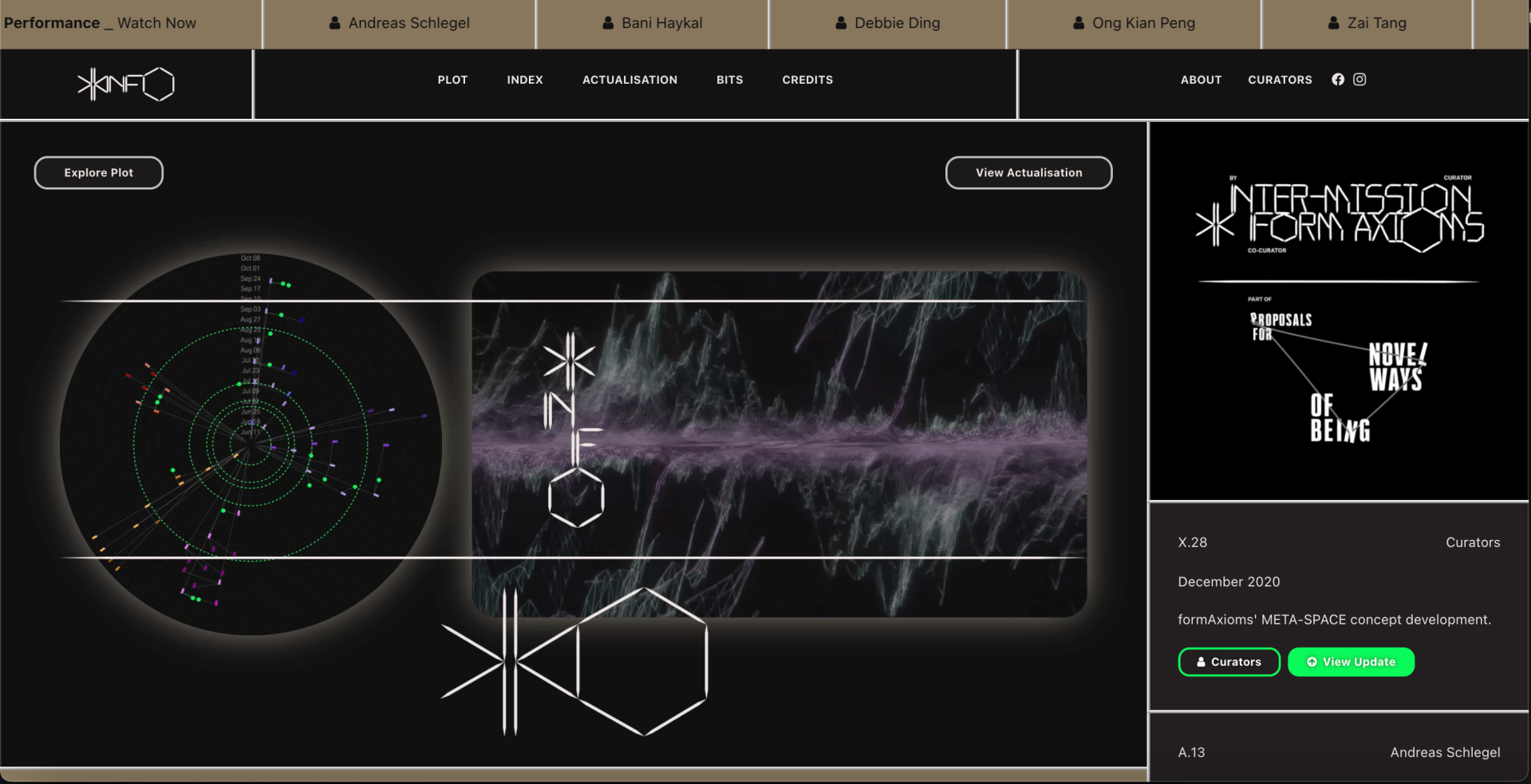
- See “Negentropic Fields” (www.negentropicfields.info), a project I co-curated that was presented at the National gallery Singapore at the end of 2020. “INFO”, the platform developed, is an archive in the making, working through a block based system constructed via iterative “upload”, an online, updatable and expandable space for a community of artists to exist. On the platform Art’s objecthood was suspended so as to consider art as the making of a collective geist, a multi-threaded endeavour. The platform was designed to be an active online repository that expands, making concepts readable as mereological objects. It made explicit the core of concepts, presenting effects and actions as they were broken down in discrete bits. The platform facilitated translations. Various media provided to the curators are casted into digital topologies, an operation that required permutations between effects and concepts, translations done in a collaborative fashion, creating affordances, reinforcing deviations, generating unexpected blossoming. The project had loops linking iteratively the digital back to the physical and vice versa. It had an online component for coordination: the platform, an offline component, explorable as a multi-level game at specific location and a physical manifestation at the gallery where a strange-synchronisation between the platform online and the game offline happens. Part of the exploration relied on the user’s attitude, the interaction with the sensor needs to be learned and performed in order to inhabit a space other, a hybrid presence trapped between the physical and the digital. It also tried to rethink the issue of surplus. By navigating the immersive environments the audience is given the possibility to discover digital fragments, to steal them and download them accessing a personalised archive on the platform.
- McKenzie Wark: “What we need is neither abstraction nor occupying, but the occupying of abstraction” (source missing).
- Stiegler, “The Neganthropocene”, p.49-50.
- See my paper “Latent Cities with Eyes Wide and Shut”, written for the 2019 Shenzhen Biennale of Architecture (available at https:// http://www.archdaily.com/935764/latent-cities-with-eyes-wide-and-shut).
- What Liam Young calls operations of “data-dramatisation”.
- Jaques Rancière: “fiction is a way of changing existing modes of sensory presentations and forms of enunciation; of varying frames, scales and rhythms; and of building new relationships between reality and appearance, the individual and the collective” “Dissensus: On Politics and Aesthetics”, trans. S. Corcoran (London-New York: Continuum, 2010) p.141.
- In François Laruelle’s (non-)metaphysical (gnostic neo-platonist)
terminology, any “decision” is an intervention that fabricates the “real”. Passing through the veil of language, we speak and we “clone” it. Inventing ideas and models, we instantiate collectively and collaboratively new natures. We rely on Laruelle’s posture that we cannot expand on here. See “Struggle and Utopia as the End Times of Philosophy”, trans. D.S.Burk and A.P. Smith (Minneapolis: Univocal, 2012). See also from the same author “Philosophie Non- standard: Générique, Quantique, Philo-fiction” (Paris: Kimé, 2010). - The impossibility of total computation for the axioms of set theory, the impossibility of making the ineffable any good for social construction. All we are given is to take on the risk ethically and define explicitly the models we adhere to and its inherent limits. At the beginning of thought Eubulides of Miletus asked: “What is a heap of sand?”. We must accept the impossibility of “naming” the totality of “a Thing”, as the Sorites Paradox demonstrated in its actual definition. We also must remember that the situation is no different with formal language and the impossibility of “computing” the totality of “a Thing”, as material limits (energy resources are limited and so is the size and power of CPU and GPU), formal limits (Halting problem, P vs NP, The N body problem, Gödel’s “incompleteness”, Quantum instability, Navier-Stokes equations, etc.), and data-set biases determine what ultimately can be said and done with any modelled projection.
- Aurélien Barrau, “Discrete Continuity”, in “Ryoji Ikeda | Continuum” (Paris: Éditions Xavier Barral, 2018), p.68.
Bibliography
- Badiou Alain, “Being and Event”, trans. O. Feltham (London: Continuum, 2005);
- Barrau Aurélien, “Discrete Continuity”, in “Ryoji Ikeda | Continuum” (Paris: Éditions Xavier Barral, 2018);
- Bataille Georges, “The Bataille Reader”, ed. F. Botting and S. Wilson (Oxford: Blackwell Publishing, 1997);
- de Bruyn Eric C.H., “Constructed Situations, Dynamic Labyrinths, and Learning Mazes: Behavioral Topologies of the Cold War”, in Grey Room (2019) (74): 44–85. DOI: https://doi.org/10.1162/grey_a_00263
- Deleuze Gilles, “Difference and Repetition”, trans. P. Patton (New York: Columbia University Press, 1994);
- Easterling Keller, “Medium Design: Knowing How to Work on the World” (London: Verso, 2021);
- Hollier Denis, “Georges Bataille: Against Architecture”, trans. B.Wing (Cambridge: The MIT Press, 1992)
- Jameson Fredric, “A Singular Modernity: Essay on the Ontology of the Present” (London: Verso, 2002);
- Jameson Fredric, “Cognitive Mapping”, in Nelson, C. / Grossberg, L. ed., Marxism and the Interpretation of Culture (Champaign: University of Illinois Press, 1998);
- Laclau Ernesto, “Emancipation(s)” (London: Verso, 1996);
- Lardreau Guy and Jambet Christian, “L’Ange. Ontologie de la révolution, tome 1: pour une cynégétique du semblant (Paris: Grasset, 1976);
- Laruelle François, “Struggle and Utopia as the End Times of Philosophy”, trans. D.S.Burk and A.P.Smith (Minneapolis: Univocal, 2012);
- Laruelle François, “Philosophie Non-standard: Générique, Quantique, Philo-fiction” (Paris: Kimé, 2010);
- Meillassoux Quentin, “After Finitude – An Essay on the Necessity of Contingency”, trans. R.Brassier (London: Continuum, 2010);
- Metzinger Thomas, “Being No One: The Self-Model Theory of Subjectivity” (Cambridge, The MIT Press, 2004)
- Priest Graham “Beyond the Limits of Thought” (Oxford: Oxford University Press, 2002);
- Rancière Jaques, “Dissensus: On Politics and Aesthetics”, trans. S. Corcoran (London-New York: Continuum, 2010);
- Stiegler Bernard, “The Neganthropocene”, ed., trans., Daniel Ross (London: Open Humanities Press, 2018);
- Tafuri Manfredo, “Architecture and Utopia – Design and Capitalist Development”, trans. B.L. la Penta (Cambridge: The MIT Press, 1976).
FEDERICO RUBERTO produces and curates textual, physical and multi-media projects that intersect digital (platforms) and physical space (buildings), spatial structures (planetary urbanism), political economy, technology (of self) and (artificial) ecology. He investigate the multi-scalar processes that virtualise-actualise models: of the self, of world(s), and language.
Personal ig (opaqueojo)
Twitter: @w_sklog
formAxioms (formaxioms.com form.axioms)
 :: DIFFRACTIONS ::