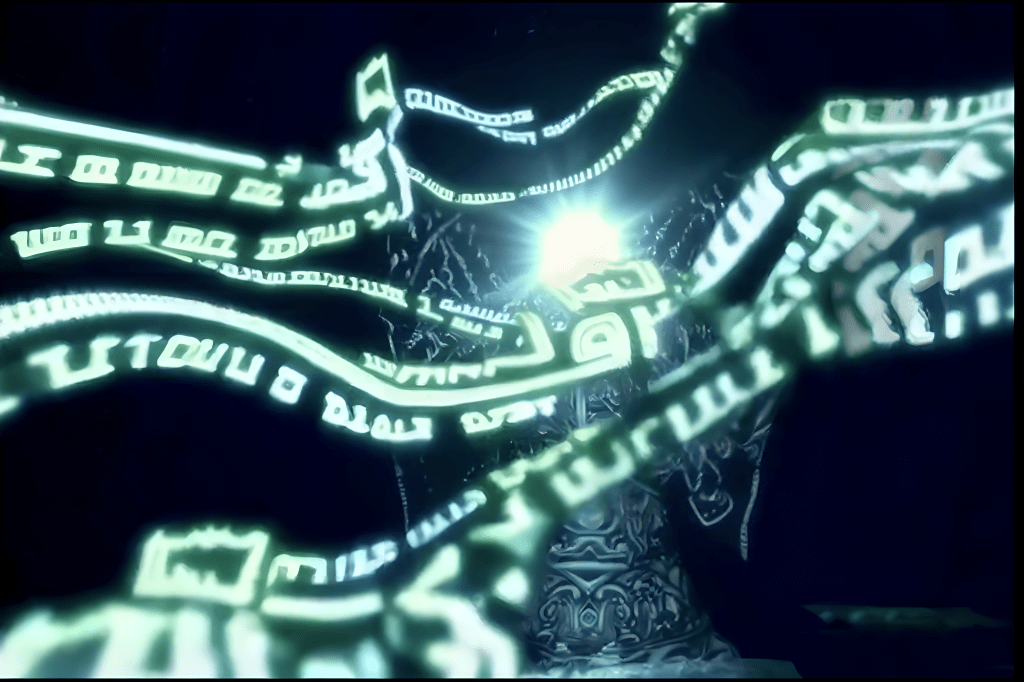
A video essay based on Derealized Deterrence: Belief as Payload in the Theater of the Feed.
A winged figure hovers in a scorched pixel desert. Soldiers freeze. The screen fades in with a phrase.
The algorithm dreams in angels. This is one. In 2025 during the 12 day Iran – Israel war, the battlefield wasn’t just the sky, but the feed.
As missiles fell and civilians died, Instagram flooded with visions. Some looked divine. After the ceasefire, Iranian official Abdullah Ghanchi insisted Tehran’s streets were littered with Jewish talismans, proof, he said, of an occult strike.
The supreme leader had long warned of enemy djinn. Israel’s UN advisor mocked him, tweeting in Farsi, Djinn are everywhere. The curse became a meme.
The meme, a spell. But in this feedback loop, even mockery can summon monsters. The spell, once ridiculed, starts to feed the algorithm.
At the same time, the internet responded with its own magic. Angels and dust too. Iran flagged UFOs.
Glowing saints over rubble. Some believed. Some wanted to.
These weren’t just memes, they were hyperstitional payloads, fictions repeated into force. In war, belief is a weapon, and AI made it easy. Not propaganda, but prophecy.
Machine-rendered visions that blurred truth, fuelled fear and sanctified violence. Hyperstition, fiction that makes itself real, was theorized by Ccru and further developed into the desert by Reza Negarestani. Baudrillard called it simulacra, images without origin stronger than truth.
One asked, what if God is simulated? The other warned, the Gulf War did not take place. What if this war didn’t either? What if the miracle was the interface? This is digital occultism. A war of perception fought with neural sigils and algorithmic spells.
Ancient generals carried talismans. Now we carry latent models. The battlefield is haunted by hallucinated saints, doing psychic damage on contact.
Deepfakes are the new angels. Algorithms the new demons. The sacred and synthetic have merged, and something powerful has emerged.
In this new theatre, images don’t describe war, they compose it. The old gods return, not through revelation, but rendering. And we are still learning how to look away.
 :: DIFFRACTIONS ::