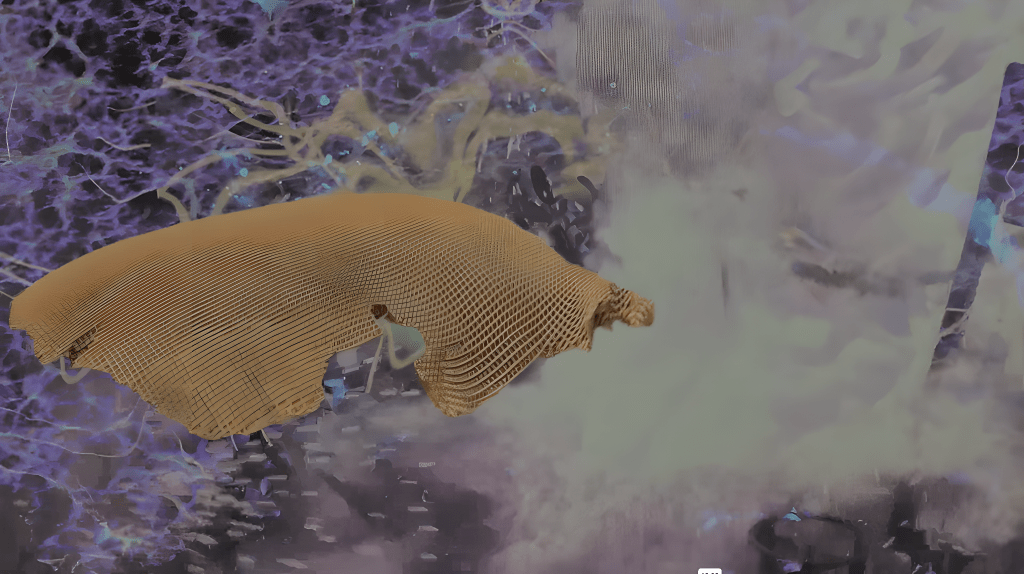
An interview with Dr. Betti Marenko, who is a transdisciplinary theorist, academic, and educator working across process philosophies, planetary technicity, and design cultures. She is the founder and director of the Hybrid Futures Lab, a transversal research initiative developing speculative-pragmatic interventions at the intersection of philosophy, design, technology, and future-crafting practices.
Her new book, The Power of Maybes. Machines, Uncertainty and Design Futures (Bloomsbury, 2025) positions uncertainty as an epistemic resource to address the challenges brought by planetary computation, rethink the encounter of the human with machines and resist algorithmic capture. Contributing to the discourse around the reinvention of critique for the algorithmic age, The Power of Maybes argues for the design of modes of living as a micropolitical project through practices of attention and a pan-sensibility attuned not to what is, but to what may be, divesting agency from the trap of the past with its nostalgia of what has been, and the safe replication of the known we call future.
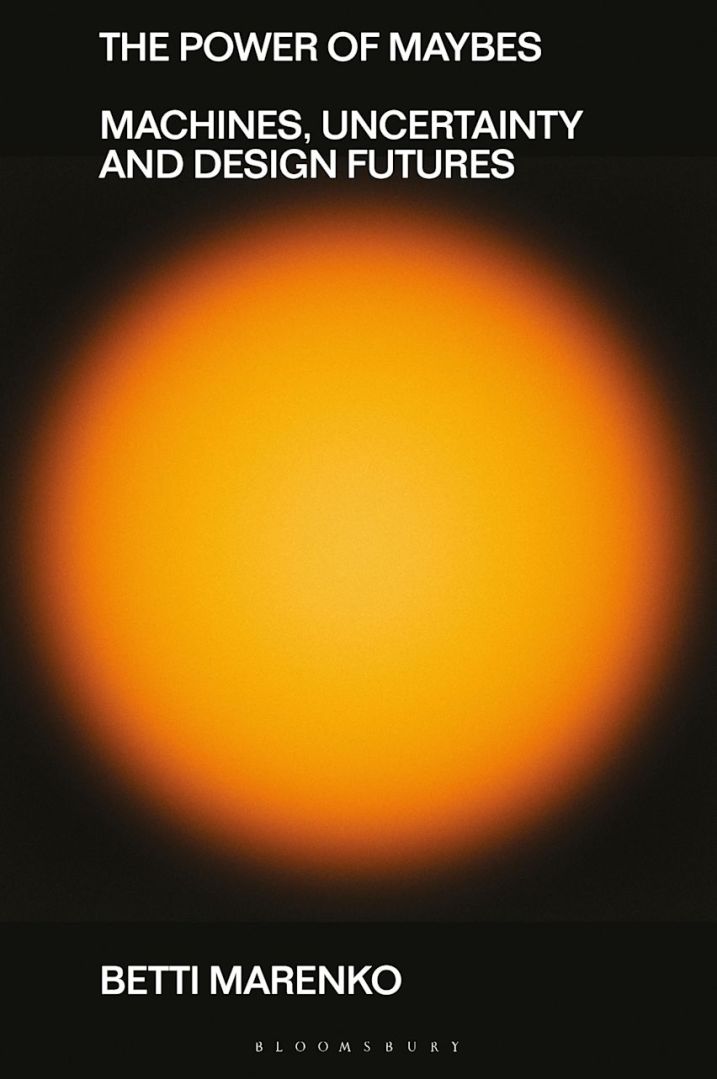
DIFFRACTIONS: Your work engages deeply with uncertainty, ambiguity, and the transformative potentials of design, AI, and algorithmic cultures—often through the lens of process philosophy, planetary technicity, and speculative-pragmatic interventions. Could you reflect on some formative encounters—whether theoretical, artistic, or experiential—that have critically shaped your intellectual trajectory and approach to such themes?
BETTI MARENKO: My focus on the uncertain, the ambiguous, and the indeterminate is a logical continuation of my earlier research into hybrid modes of existing, but somehow this is a connection that I am explicitly making only now with my new book, The Power of Maybes. Machines, Uncertainty and Design Futures.[1] Reflecting on how my inquiry got to be what it is, several other trajectories emerge: having been schooled in my youth, from the late 1980s, in post-autonomist, anarcho-punk practices of resistance, subversion, and autoproduzione; taking part in Italian counterculture movements pushing for, practicing, and defending activism, occupation, and alternative lifestyles as lived critique; and experimenting with radical practices of embodied transformation in the body modification and BDSM subculture of early 1990s London. All this may also be a fitting testimony to my own idiosyncratic and unorthodox intellectual trajectory.
My reticence to be pigeonholed into a single field, a single role, or a single discipline has ever since pushed me to privilege the hyphen mode with its hinging (and disarticulating) properties. I have been a sociologist-squatter, a punk-semiotician, a raver-philosopher, an educator-dominatrix, a tattooist muse-scholar, and an activist-yogini, all the while making, unmaking, and remaking myself.
If I cast my mind back to the first book I wrote—Ibridazioni. Corpi in Transito e Alchimie della Nuova Carne, Castelvecchi, (1997)—I was absorbed by tattooing not simply as a way to permanently modify my body but also to express an uncompromising and permanent faith in the process of change. My argument, which I developed in my second book, Segni Indelebili. Materia e Desiderio del Corpo Tatuato Feltrinelli in 2001, and subsequently in my PhD thesis, was that only by permanently marking my skin could I fully commit to unending change. Whereas others saw tattooing as the marker of an engraved identity to parade, prompting the infamous question, ‘What if you change your mind?’, I saw an extraordinary and indelible reminder of the power of my embodied subjectivity to access metamorphosis and to forever bear its traces: a permanent reminder of what is possible.
I confess that your question about formative encounters and its push into digging into my deep archive has really helped to catalyze a map of my present by reframing and surfacing past connections, and I am grateful for this! There were many important milestones in my progression as a thinker: I start with my beloved professor of Sociology of Culture at the University of Urbino—the late Piero Ricci, an extraordinarily erudite affabulator, semiotician, linguist, and bon vivant, whose lectures in the late 80s and early 90s were as crowded as concerts. A scholar of boundless curiosity, his research interests were as varied as 16th-century manners, the semiotics of food, Alice in Wonderland, and French philosophy. Not only was he my supervisor and mentor—I wrote a thesis on the semiotics of advertising—but he was the first to say to me, “Signorina, ma lei deve leggere Deleuze!” (Miss, you must read Deleuze!).
And I did. It was 1990, and I never stopped.
Another Urbino professor who I was fortunate to have as my mentor was the late Maurizio Del Ninno, an anthropologist whose work on popular traditions was full of empathy and attention, whether he was immersing himself in the local folklore or teaching us about Kuna art. He opened my eyes to modes of thinking beyond the confines of the then-strictly Europe-centric canon. I should also mention that Urbino hosted the International Semiotic Centre, founded by Umberto Eco and others in 1970, which maintained strong connections with the French intellectual milieu—Barthes, De Certeau, Courtès, but also Greimas, Lotman, and Todorov. I naturally orbited toward it, fascinated by open-ended questions around processes of signification, and found myself at home in its yearly—and notoriously polyglot—summer conferences that attracted scholars from all over the world. That was the first platform that saw me presenting my (budding) research into technologies of skin marking and shedding subjectivity. It was during one of these summer symposia that I met Ted Polhemus, a London-based American anthropologist who had studied with Mary Douglas and who at the time was one of the curators of a major exhibition at the V&A titled Streetstyle: From Sidewalk to Catwalk—1940 to Tomorrow. He would offer me my first job when I arrived in London in 1993. I will get back to that.
Meanwhile, back in Urbino, the year is 1990. It is the year of the Pantera—the occupation movement that was spreading across Italian universities as a protest against impending privatization. I got deeply involved in that movement, which was notorious for its use of the most cutting-edge tech of the time—the fax. Every occupied faculty’s first request to the senior management was a fax to set up a proper communication hub. I still have a box of documents that were produced and disseminated in real time across the whole network of universities. At the University of Urbino, it was my faculty (Sociology) that held on for several months until a nighttime police raid evicted us, which resulted in charges and a trial. Even before this experience, I had been active in various movements of autoproduzione—producing fanzines and taking part in the Lega dei Furiosi, a network of independent activist producers of alternative music and content distributed across the network of centri sociali.[2]
With my friend and collaborator Giacomo Oliva—today a multimedia artist—we were active as Parasite Conspiracy, making fanzines like Muco. Roba Che Cola and Gramigna la ‘zine maligna: mixing surreal agitprop, intellectual derives, anarchic philosophy, cut-up poetry, DIY creativity, and feverish cut and paste. I mention this as I cannot possibly separate my formative years—until I moved to London—spent on the fringes, exploring, observing, experimenting, and learning in and on my body, alongside an eclectic ensemble of individuals scattered across Italy and beyond, who had in common a passion for creative modes of resistance.
Going even further back in time, I must say that I grew up in Genova in the 1970s during the so-called anni di piombo (the years of lead). Genova was one of the frontline Italian cities most affected by the actions of the Red Brigades. Roadblocks, intense territorial control and surveillance, fear in the streets, shootings, and strikes and attacks were daily occurrences. I remember this as the background of my childhood and teenage years. Genova was a desolate, cold, unfriendly city. A city in profound decay, with high unemployment due to the closure of the steel plants and the crisis of the harbor, still scarred by the ruins of the 1942-43 bombings by both the Allied forces and the Germans. The maze of Genova’s old medieval centre was plagued by rats, rubbish, and crumbling buildings (the opera theatre remained a bomb site until 1991).
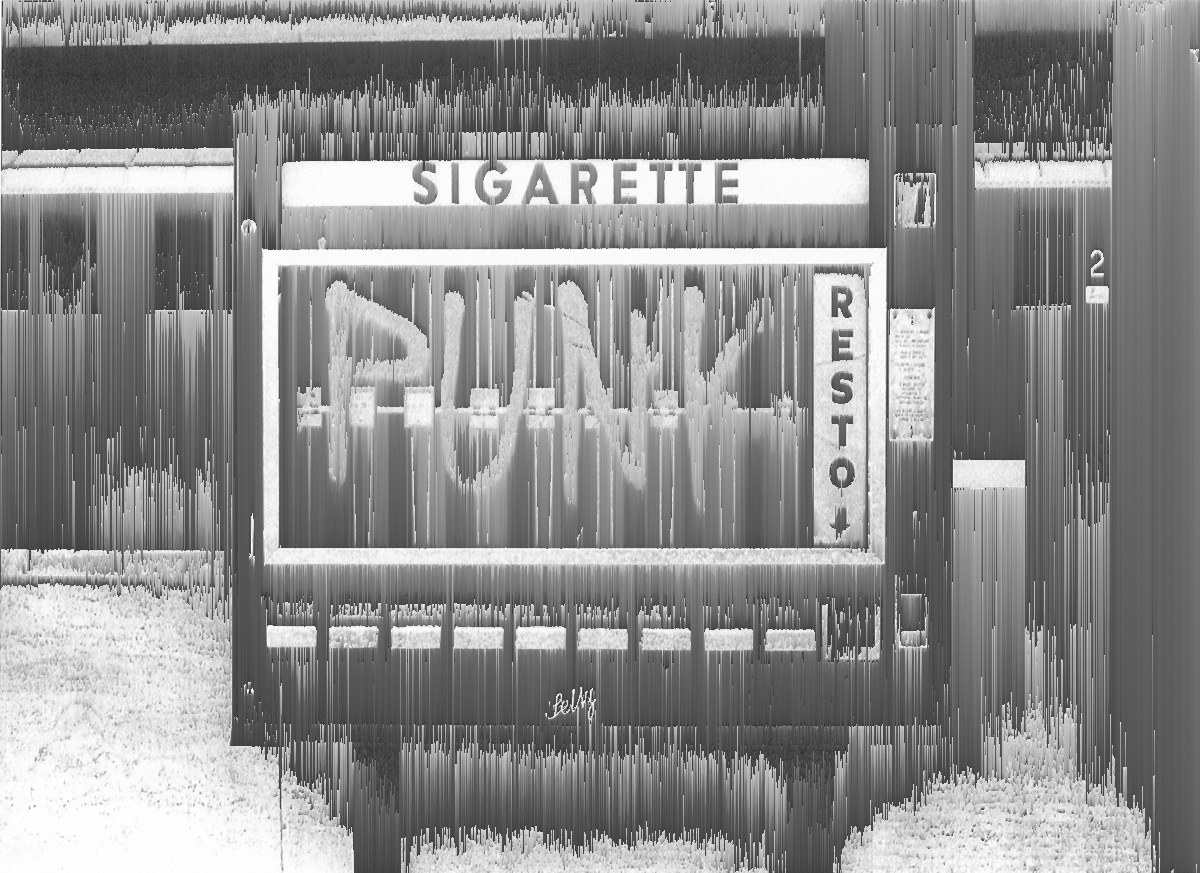
For young, angry, disaffected people there were only two routes: heroin, which was flowing unimpeded everywhere, a devastating silent plague that turned so many (and so many friends) into walking zombies; and the punk rebellion associated with the centri sociali, whose dictum ‘Qui Dentro Niente Eroina’ (No Heroin Here) I was lucky to introject deep inside of me—like a mantra, literally—and which was channeled through a very fertile scene of music, squatting, creative practice, and resistance, inspired by the UK anarchic-punk scene, Crass, Poison Girls, and many others—Dead Kennedys, MDC, Husker Du etc. This was the politics that saved me. My yearning to leave Genova behind—all those deaths were heavy to bear—was seminal in making me what I am. But the legacy of being from Genova—a fierce working class and communist stronghold, the only city in Europe liberated by the partisans of La Resistenza without the intervention of the allied forces—was something I strongly felt when I grew up there and still feel now. This is not nostalgia but the acknowledgment that those ‘formative encounters’ you mention in your question are not only with people but also with places, situations, and events. Just to give you an example, when I was in primary school—a mere 30 years after the end of WWII—my music class consisted of our ex-partigiano teacher leading us in kids’ renditions of Bella Ciao and Fischia il Vento, both legendary Italian Resistenza songs.
But enough with this.
Let me jump forward to 1993. I just graduated in sociology, and with a pending trial for the Pantera occupation, I bought a one-way ticket to London, and a few days later, I was in the city I had wanted to be in since I was a child—when I watched a documentary about London punks spitting on camera!—and found myself working as a researcher for Ted Polhemus, who was writing not only on street styles but on the fetish scene too, a wonderful pioneering book of kinky lives and experiences titled Rituals of Love. Sexual Experiments, Erotic Possibilities.[3] Ted was instrumental in introducing me to the underground fetish scene of the early ‘90s. Of course, I had already heard rumors and fabulations when I was still living in Italy. People would come back from trips to London with stories about the new body modification scene, about underground fetish clubs, and about the Torture Garden. The attraction was irresistible. I simply had to go. I wanted to be part of it. And I did. Once again, I propelled myself into something unknown, something I was extremely curious about, a curiosity that seems insatiable.
My slight careless attitude—I admit I was the sort of person who, when offered an unidentified substance, would happily swallow/snort first and ponder later—was amply compensated by everything that I learned by plunging into the scene—fetish clubs, illegal raves, techno parties, tattoo parlors—meeting in the process extraordinary creatures, artists, performers, mavericks, and misfits, some of whom are to this day my true chosen family, like Valentina Leo (aka Mrs Love), today a tantric teacher extraordinaire based in Cape Town and former photographer, artist, cabaret producer, world traveler, true sister, and in.sect.corp collaborator. At the same time as getting heavily tattooed and working as a dominatrix and a model, I was studying and writing my PhD on tattooing by way of Deleuze, Guattari, and Spinoza. It was a time of alchemical transformation, radically and uncompromisingly embodied: the more the ink penetrated my skin, the more ink I could put onto the page. The more I got tattooed, the more I wrote. My encounter with the striking women of the artist collective 0(rphan)d(rift>)—Maggie Roberts and Ranu Mukherjee—[4]really catalyzed this process, and this is how PAZ Permanent Autonomous Zone was born.[5] Riffing on Hakim Bey’s infamous TAZ [6]and working together in late-night sessions in Ranu’s flat in Dalston, 0(rphan)d(rift>) created a digital video collage capturing the delirious ecstasy of my body metamorphosis. PAZ premiered at the Horse Hospital in London in 2001 and was shown during my book launches in Italy and talks at my alma mater in Urbino, where by then I was regularly lecturing. 0(rphan)d(rift>) were wild and poised and fully committed to their art practice, with an intensity that I recognized in myself and that made us feel at home with each other—they are my family to this day.
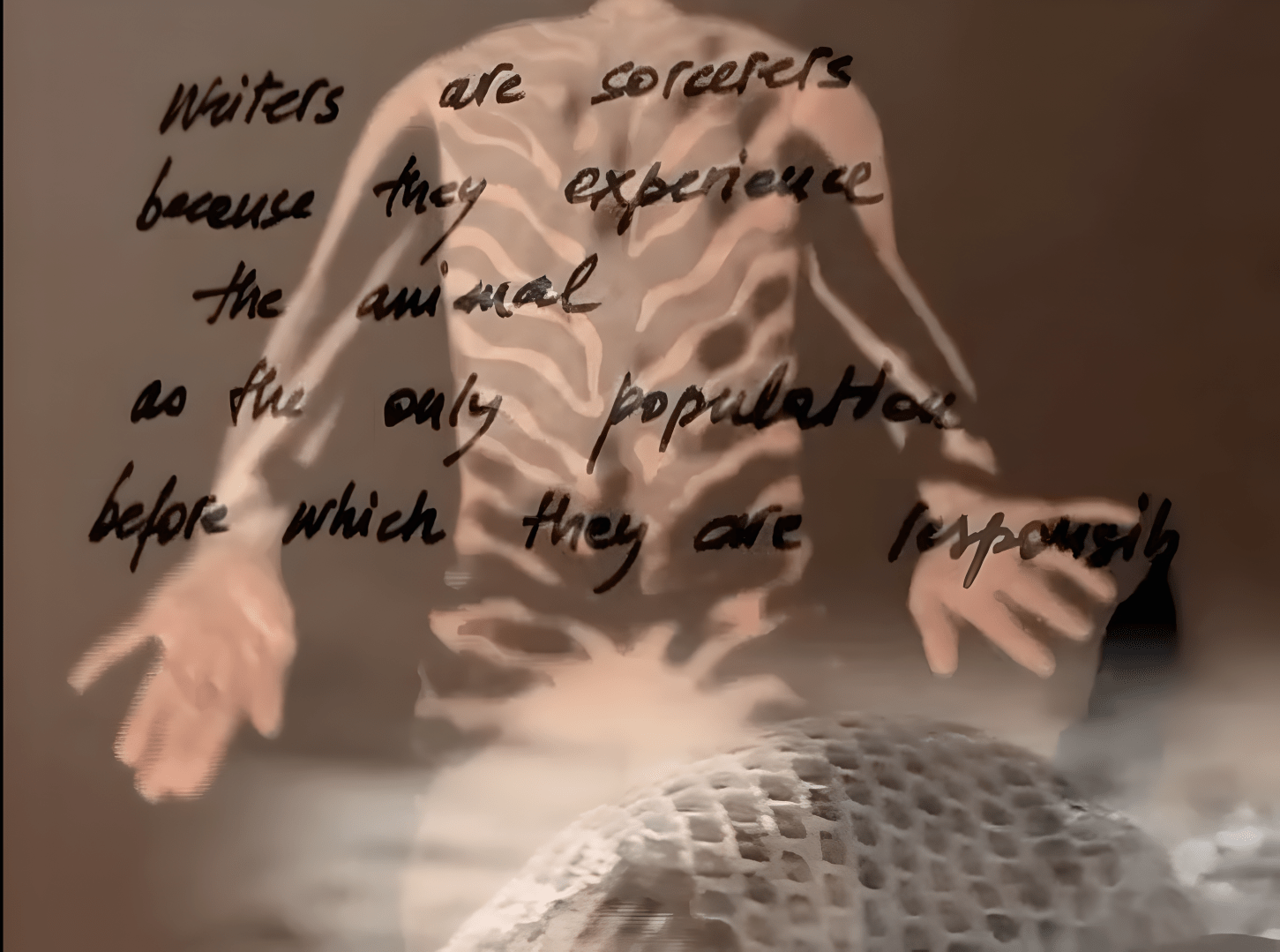
Commissioned for her 2001 italian conference tour, presenting ‘THE SKIN MACHINE: Tattooing and Technologies of Becoming Else’.
The same year PAZ was made, my second book, Segni Indelebili, came out, and here I must mention another encounter, with Raf Valvola Scelsi, Italian co-founder of the underground cyberculture magazine Decoder and of the publishing house Shake,[7] at the core of Milano’s alternative scene, and astute commissioning editor at Feltrinelli. He believed in me and my idea for the book. Another important influence was my friend (and PhD supervisor) Tiziana Terranova, whose gentle and steely presence was undoubtedly influential in shaping my trajectory. I admired (and admire) her academic rigour, her scholarship, and her 100% dedication to the craft of writing—something I was not ready to do myself, with my London life of excess, unruliness, and hedonism that was taking me in thousands of lignes de fuite. But once again, change knocked on my door. I was living in a former stable in the East End—a place that had become a peculiar epicenter of counterculture, domestic raving, bonfires, activism, indoor gardening, and hustling—and in 2003 I was suddenly evicted. I sold everything I owned during a three-day event called Everything Must Go!!! organized in collaboration with C6/DotMasters—[8]there is still a digital trace of that event online with a long piece I wrote describing the rampant process of gentrification that was taking over the East End of London in the early 2000s—anyway, I left London with a few boxes of books and spent one winter holed up in the mountains in the Italian Apennines between Liguria and Tuscany, where I finished my PhD thesis. Living like a hermit, writing at night and walking the woods during the day, strangely suited me.
I was ready for another change, but I didn’t know which one. Straight after my PhD viva with Rosi Braidotti, once again I flew away, this time to India, where I spent several months traveling across the Himalayas, in Himachal Pradesh and Ladakh. I then settled in Varanasi to study. It was there, when gazing for hours at the holy Ganges, that I found out I was pregnant with my daughter Joy. Once back in London, I co-edited with C6 the left-field volume: DIY Survival. There is no subculture, only subversion,[9] and within a couple of years I had started teaching at Central Saint Martins through another fortuitous encounter with someone who was pivotal in my trajectories and swerves: Jamie Brassett, a maverick philosopher who had studied with Nick Land and who was teaching critical thinking for design at Central Saint Martins. Ours was one of the weirdest encounters. We had met a few years earlier, I think in 1998, when I did a documentary for Swiss television titled La Seconda Pelle (The Second Skin) about the London body modification scene. [10]
Through my friends at Into You (Alex Binnie’s groundbreaking tattoo shop in London, where I got most of my work done by Alex and Xed le Head), [¹¹] I arranged the filming of someone getting pierced—the piercer in question was Mark Hopkins, one of the first London professional body piercers with whom I would collaborate on live body suspensions and live for a while in the back of a private bar he was running in Clerkenwell, The Refreshment Room (long story)—and that was how I met Jamie. We became friends and connected over a mutual love of Deleuze, body modification, and Spinoza. He was the first to invite me to teach at Central Saint Martins, and a couple of years later I was running the Contextual Studies Programme for Product Design—a role I still have. Jamie and I went on to edit together Deleuze and Design (Bloomsbury 2015)—the first book to interrogate design through Deleuze and Guattari’s thought.[12] Not many academics can say that they met while one was filming the other getting their genitals pierced! This is not just a sassy anecdote.
To me, it is the testimony of a life spent zigzagging across places and situations, interests and ideas, disciplines and milieus, sometimes on the edge (with risk of falling), other times braiding them all in strange and unpredictable life-changing moments. Acknowledging all that went into the making and unmaking of my trajectories, personal and professional, is also about attending to the ethics and the politics of my research, through which I strive for the convergence of mode of knowing, mode of being, and mode of acting. Put differently, my knowledge and what informs my conduct cannot be separated from the person I am and am becoming through my practice. For me this is important because it illuminates my affinity for transdisciplinary inquiry as a way of producing knowledge beyond academic scholarship, as I wanted to show through my meandering account above.
DIFF: Your forthcoming book, The Power of Maybes: Machines, Uncertainty, and Design Futures (Bloomsbury, 2025), reframes uncertainty not as a problem to be solved but as a generative resource. What are its central arguments—especially your view of uncertainty as a capacity rather than a deficit?
How does this approach diverge from dominant paradigms (e.g., predictive analytics, scenario generation, risk management, and predictive policing) that treat unpredictability as a threat to be minimized?
BM: My argument, which is also a wager, is that an allyship with uncertainty is not only possible but necessary to build an alternative to the worst excesses of algorithmic governmentality. I claim that uncertainty can be entered into, dwelled in, and experienced as a way of counteracting capture and reimagining the encounter of the human with machines. This is what the power of maybes stands for: an endorsement to live with uncertainty by cultivating modes of knowing and being (and resisting) that hold uncertainty as an ally. I place uncertainty at the centre of a web where multiple lines of inquiry concerning uncertainty, futures, machines, design, and power—intended in both senses of entrapment and coercion (potestas) and capacity and potential (potentia)—intersect and contaminate each other.
For me, this transversality is necessary to cast uncertainty in a new light, one that illuminates the specificity of the current moment—the ‘now’—while treasuring the shadows through which the ‘now’ tilts into the future. I believe that the transversal inquiry into uncertainty I propose, whose aim is to reposition how uncertainty is conceptualized, discussed, handled, metaphorized, confronted, is crucial to make sense of one of the dominant issues of our time: the epistemic challenges brought by planetary computation—the “most radical process of artificialization of intelligence that human history has ever seen.”[13] Planetary computation has epoch-defining effects: what counts as knowledge has been reconfigured by intelligent machines of prediction; the automation of decision-making has become a mode of governance; uncertainty is constrained into predictable grooves that capture my potential, pre-empt my behaviours, foreclose my futures. As uncertainty gets seized, ambiguity is eroded, and existence is impoverished.
For me, to understand these power manoeuvres that target uncertainty in order to disengage from them and reclaim the uncertainty of futures has directly to do with rethinking what uncertainty is and how to re-inhabit it. A new approach to uncertainty becomes, therefore, essential to the project of resisting machines’ capture.
My starting point was thinking about how uncertainty could be reimagined as a space to inhabit with a specific kind of pleasure: the pleasure that comes from lingering in what I don’t know, rather than trying to jump into conclusions, solutions, answers, outcomes, and results, or trying to erase, minimize, or deny the risks that come with not-knowing. Of course, one way of responding to uncertainty is by framing it as a risk. This is the approach found in social sciences, economics, statistics, and the insurance sector. Risk is the general term for unwanted and negatively perceived events (e.g., hazard, loss, damage, threat) and for the calculation of the probability of said unwanted events. Framing something as a ‘risk’ implies the evaluation of a potential negative outcome. Thus, risk expresses the present calculation of a future uncertainty. It indicates in mathematical terms the statistical probability and the cost of the worst possible outcome. However, no matter how objective and scientific the assessment of a given situation is, it is always informed by socially shared beliefs, in other words, by what in this precise moment and in this current context—sociocultural, financial, economic, legal, etc.—is perceived as risk. There is no risk assessment (and therefore no risk per se) without contextualization.
Indeed, what is risk if not a perception? Sociologist Gerda Reith puts it bluntly when she says that “there is no such thing as risk in the world, only dangers we construct in our head.”[14]
Far from being an intrinsic property of things or an autonomous entity, risk is always a contextual one. It emerges from the web of connections that weaves together myself, a potential cause of risk, what may be at risk, and what I expect to be (or I perceive as) the consequences. Therefore, it is more correct to say that risk is a ‘cognitive frame’ rather than a real (or quasi-real) phenomenon that I experience directly.[15] In any case, what matters is the extent to which the quantification of a future contingency (my perception of risk) becomes a guide for present anticipatory action. Thus, how I (or a society) conceptualise the relationship between uncertainty and risk is instructive of where my (or that society’s) priorities are. How I perceive risk reveals how I see my future; thus, it shapes my present too.
But risk and uncertainty are not the same thing. Uncertainty cannot be measured, calculated, or insured. Risk can. And while the management, governance, and reduction of risk are widely researched, uncertainty—taken not as a ‘risk to manage’ but as an ‘ocean to swim in’—is less so. From these considerations it emerges that if risk is the eventuality that something bad might happen, what I experience is not risk per se but my knowledge of its (contextually constructed) calculation. Risk has to do with knowing (how much or little), not with being. Risk is epistemic, not ontological. This leads to the familiar paradox that the more information and knowledge I have, the more uncertainty seems to grow. The more I attempt to immunize myself against accidents, failures, or negative events, the more I may be inclined to see the ‘future’ exclusively on the basis of how risk can be assessed: a mode driven by strategies of anticipatory governance such as pre-emption, prevention, and precaution.
I must clarify at this point that my inquiry into uncertainty is also bounded by two standpoints: on one side, my endorsement of the power of maybes must not be read as a route to just ‘embrace uncertainty’ and ‘unleash potential,’ both neoliberal rhetorics propounded for the maximization of efficiency and the optimization of creative outputs — I develop in my book a series of stratagems to enter and dwell in maybes; on the other, I take the position that uncertainty is a relentless, cosmic force, an ocean of undifferentiated contingency flowing beneath everything living and non-living, human and nonhuman, thus beneath questions of social exclusion, privilege, and inequality, not because these don’t matter or are marginal, but because uncertainty, as I see it, is ultimately indifferent. Yes, inequality, injustice, and asymmetric distribution of resources, of access, and of power and agency will certainly exacerbate uncertainty, but this is true only from a human perspective. It has very little to do with the indifferent, immanent flow of things.
My question throughout the making of my book was, how do I bring back to the subjective experience this sense of oceanic whatever-ness without losing its immensity and power and without forcing it into a blueprint or freezing its flows? To even begin to contemplate uncertainty as a capacity rather than a deficit requires, therefore, two manoeuvres nestled into each other: the cosmological—pinning uncertainty back into its place as an irreducible universal force—and then reconnecting this to what circulates beneath the human. This is where the plural ‘maybes’ comes in, to signal that to speak of uncertainty is ultimately to speak of pure indeterminate potential prior to its capture and differentiation.
Maybes stands for this unthinkable multitude of possible possibles, the ever-dynamic, ungraspable virtual ocean of all that may be—it may be x, it may be y, it may be z, it may be otherwise. Maybes stands for radical contingency. It is not finite nor discrete, countable nor calculable, predicted nor predictable. It is cosmic—in the Heraclitean sense of an uncreated universe where everything is flux, each thing existing in and of itself, ceaselessly and unforeseeably transforming. That’s also why my inquiry into uncertainty leads to the metaphysical question: How do I approach the sensible totality of the world in all its incandescent movement? For me, this is about staying with uncertainty in its cosmic dimension: a dimension at once material and sensible, intelligent and intelligible, where undifferentiated potential swirls.
This perspective, which I call ‘cosmological orientation,’ is the condition I pose to my rethinking of uncertainty. To see uncertainty as cosmic is how I regain my existence in its plenitude—with all its potential, including the potential to not. By inhabiting uncertainty as a mode of oceanic experience, I access the power of the unknown, recruiting un-knowing and not-knowing not only as modes of knowing but also as ways of feeling for unknown futures away from the anticipatory discourses of neoliberal innovation, futureproofing, techno-determinism, and instrumental reason. In short, by insisting on inhabiting uncertainty, rather than shunning it, I argue that I can learn to cultivate a vital capacity: how to be nourished by uncertainty, whatever it may bring. This is why The Power of Maybes advocates that making friend(s) with uncertainty is the portal to a full, round, whatever life, full of all its unforeseeable ‘may bes’. It is in this whatever that my ultimate power resides—my power to, as well as my power to not. With this I also wish to bring back critique to the dimension of the micro-political, the minor intervention, the tiny gesture that, paradoxically, contains all the infinite universes I belong to already. I see this cosmic uncertainty, in all its plenitude, as the basis for a political stance of resistance and refusal enlisted to the project of reimagining the present and creating other ways of being against the unabated “desertification of all modes of existence.”[16]
DIFF: Your work engages deeply with Luciana Parisi and her focus upon algorithmic indeterminacy as well as the threads of uncertainty, randomness, and abduction, which are operative conditions in the open-ended evolution of machine intelligence.
How does her work overlap with what you term FutureCrafting or a concrete method for collective navigation of uncertainty? How does it translate your conceptual reframing of uncertainty—not as a problem of control but as a space for intervention—into participatory practice?
BM: Parisi is not only one of the most original thinkers today writing about philosophy and computation and the onto-epistemic challenges brought by the automation of automation; she creates entire novel constellations of thought with her concept-making. What I keep on finding so inspiring about her work is the way in which it feels like operating on a razor’s edge to the limits of what is thinkable and articulable. I find in her writing a constant tension, an appetite, a visceral desire to express what needs to be thought and invented, something that very few exceptional thinkers are able to do—Guattari, for me, is another. Engaging with this kind of work is a physical experience, like being drawn to the verge of a cliff, where the danger of falling is real, and equally real is the elation of soaring. Her work inspires me to strive to produce writing that is rigorous and bold.
I draw on her ideas around algorithmic automation and automated cognition, signaling the irruption of an alien mode of reasoning that is no longer based on deduction, causality, instruction-giving, and the recognition of existing patterns but is driven instead by an adaptive learning that produces patterns of non-observable events, tending towards the emergence of non-conscious intelligence.[17] Epistemically, this concerns the shift to the open-endedness of hypothesis-driven knowledge production (abduction), which supersedes models of deductive rationality of the past (rooted in cause-effect) and inductive rationality of the present (rooted in observable phenomena and behaviours). At the core of this process is the incomputable, which has become the ‘absolute condition’ of computation and creates a “new kind of empiricism in which data is ‘liberated’ from the static condition of the given. Data is now stretched to embrace potentiality, indeterminacy, and contingency.”[18]
As machines behave as evolutive and adaptive cognitive systems, developing an abductive logic that uses indeterminacy to generate speculated, non-observable realities, cognition seems to expand into the nonhuman territories of the machine. In other words, algorithmic patterning seems to create opportunities for novel modes of thinking that question existing structures of thought. “While it seems still premature to conclude that machines are subjects able to know and change their own rules,” Parisi cautiously writes, “it would be myopic to deny that computational automation has exposed the transcendental schema of reason to the experimental becoming of thought.”[19]
By positioning the abductive logic of machine reasoning as an alien system of cognition, Parisi suggests that a new mode of thinking—which is both reason and imagination—can develop. Now, this is something that I find truly thought-provoking if considered in the context of how to do critique in an era—planetary computation—that demands new categories of thought, ideas, visions, and gestures that can sustain new imaginaries and tell new stories. Categories such as human, nonhuman, machine, natural, artificial, synthetic, organic, and inorganic are inadequate for a seriously critical and creative project of re-thinking the encounter of human and machine. We still live by the modern concept of the human that emerged in a specific place (Europe) in a specific time (the Enlightenment), a notion that pitted the ‘human’ equally against nature (as superior to it) and against machines (as other than them). [20] Still ensnared by a notion of intelligence based on the human brain and the human nervous system, our anthropocentric and zoocentric narcissism feeds an exceptionalism whose consequences are deadly for all that exists.
While the theoretical void left by the inadequacy of these categories is colonized by the agendas of what Tiziana Terranova calls the Corporate Platform Complex (CPC)—the privately owned “worldwide infrastructure that has brought together technologies of communication and computation, connection and calculation in unprecedented ways”[21]—a reterritorialization is also underway. Reactionary forces drive a re-entrenchment of universals (the Human, the Technology, the Progress, the Future, etc.) precisely when their terminal fragility, obsoleteness, and inadequacy are at their historical peak. At the same time, the void left by these no longer-adequate categories is filled by the CPC and its pervasive modes of engagement that are designed to be extractive (as they extract value from human attention, labour, sleep time, eyeballs, and life itself), predatory (as they are driven by stakeholder capitalism’s imperative to profit growth), and pathogenic (as their by-product is endemic malaise). With the stimulus-reward mechanism in full operation, monetizing every aspect of our lived experience, the CPC keeps on diverting attention, capturing potential, and flattening ambiguity. Seizing uncertainty. There is therefore work to be done towards building an alternative vocabulary, a different portfolio of resources, and a repertoire of speculative-pragmatic otherwise-ness. Parisi’s work points unambiguously to how to generate novel, creative, but also radically weird, powerfully other, uncompromising alien ‘images to think computation with’ that are different from those manufactured by the agendas of CPC, Artificial Intelligence labs, and ultra-reactive government policies.
But there is more. This form of speculative agency not only escapes the capture of data normativity but can push back against the dominant paradigm of technicity—the servo-mechanic paradigm of technology—which frames the automation of automation as a shift from the automation of human labour whose prototype is the enslavement of bodies by the industrial/plantation machine. This model concerns, on one side, the Promethean mastery of tools with its anthropocentric prominence informed by a historically specific notion of the human; on the other, it is predicated on the extraction of value from labor—from the plantation first, then from the assembly line, and finally from cognition, affect, attention, and eyeballs. The legacy of this servo-mechanic model of technology, with its assumption around what counts as human and its inherent predatory and violent exploitation, cannot be undone nor ignored. In other words, no critique of automation, no critique of technology, and no critique of planetary computation can take place unless the question of colonialism as the founding project of the servo-mechanical model of technology is concomitantly addressed.
This is also why images, albeit alluring, of hybrid mergings of human and machine remain unsatisfactory and inadequate: because they cannot account for, and unhinge, the nexus of technology, capital, colonialism, and enslavement expressed by the servo-mechanic paradigm. For Parisi and the Critical Computation Bureau, it is precisely this model that is being challenged by the new, alien mode of automated reasoning emerging in the unknowability of machine thinking. What is at stake, therefore, is that the transformation of reason occurring in machine thinking offers the opportunity to move beyond the realm of the universal rational human and its Enlightenment legacy and away from a recursive and extractive system that continues to be imbued with the violence of colonial episteme.[22]
Another way in which I have engaged with Parisi’s work is in the methods that, in The Power of Maybes, I call ‘constellation-building.’ I should say first that my book is the result of transdisciplinary research whose raison d’être is how to disassemble, engage with, and deep-dive into uncertainty without freezing it, without claiming to ‘know’ it, but by finding a way to pay attention to a topic that by definition is slippery, ungraspable, and 100% meta… This echoes in part the ongoing discussion in the post-humanities of how to invent methods to investigate events without constraining their flux.[23]
Now, transdisciplinary research presents numerous challenges: It is highly generative—the thrill of engaging with what may seem like an open-ended and…and…and…mode, but can easily crumble if not supported by a solid scaffolding and by a serious understanding of how to sustain a transdisciplinary ethos. Therefore, building constellations is not only about instigating a dialogue among disparate elements and ideas and just hoping that something will happen. It is also about crafting the affordances for those elements to connect meaningfully—to be hinged. In other words, this concerns not only knowledge but modes of knowing too. How do I get to know what I know? Among the modes of knowing that I develop in my book and that constitute the building blocks of my constellations—intuition, chance, imagination, and transversality, which is the capacity of connections to go on building more connections—there [24] is also abductive thinking, the invention of explanatory and interrogative hypotheses. What all these modes have in common is a striving to intensify what can be thought. They are all ways to expand the pool of ‘possible possibles.’
I borrow Parisi’s reading of abductive thinking as a generative method unconstrained by either a priori theory or a posteriori verification but rather as something “primarily attuned to the unpredictable nature of fact, thought, and experience,” defining “an immanent relation between the thing and its unknown potentials.” [25] Abduction ventures to the “limits of the observable where thought becomes experimental and experiential of the future.” [26] As she evocatively puts it, abduction is like an excitable, curious probe-head that “demands of thought to become felt, fact to become potential, imagination to supersede observation, object to affect method, and method to become transformative of the object.”[27]
FutureCrafting is a way to do this that investigates the potential that futures may bring without getting stuck in insidious narratives. It stems in part from my work with design students trying to develop intelligent modes of sense-making that don’t fall prey to either dystopian or utopian spectacularization but remain highly generative and transversal. In my teaching I am not interested in the production of flawless future scenarios to be consumed. This is a distraction. What I am interested in is to surface and make explicit the ways in which any future scenario that gets produced is already informed by powerful narratives and mythologies, at times so pervasive as to become invisible, at times downright mystifying, always baked in with their biases, assumptions, agendas, and toxic ‘commonsense.’ Think of the go-to repository of images and stories that emerge by default and appear to be entrenched—just google “artificial intelligence” and take a look at the dispiriting homogeneity of the image results. I am interested in how to recognize and push back against the predictability of such stories and repositories of imaginaries and dislodge them from ingrained grooves so that other stories and visions can take their place.
FutureCrafting is indebted to Brian Massumi’s notion of ‘speculative pragmatism.’[28] I read speculative pragmatism as what allows me to stay open to invention and potential (speculative) while, simultaneously, paying attention to what is happening and how potential takes shape (pragmatism). The speculative and the pragmatic are hinged, and it is this hinge that affords both connection and disjunction, which is the kind of generative mode I aspire to with theories, practices, and methods. Indeed, I find speculative pragmatism a productive way of addressing the relationship between theory and practice, because it disabuses one of thinking of practice as distinct from theory—a pillar of my design teaching. Pragmatic does not mean practical or non-theoretical; it is rather what mobilizes ideas and ‘unstiffens’ theories—to use William James’ expression. Speculative pragmatism has to be experimental; it intimates me to find ways to test and try out things, to observe, to experiment, and to learn; to escape what I know already, to sidestep existing grooves, and to parachute myself into the discomfort of shifting terrains. In the same vein, FutureCrafting is a way of engaging with what does not exist yet by ‘feeling for’ potential’s subtle movements and using this uncertainty as an opportunity to create meaning, effectively turning not-knowing into a mode of knowing.
I should clarify that I don’t see FutureCrafting as a method intended as a recipe to apply to any given circumstances in order to obtain a predictable set of results. In this I follow Elizabeth St. Pierre’s notion of post-qualitative inquiry, stating that methods are traps, not only always inadequate to the task but effectively preventing events from coming into existence. [29] So, the challenge is how to approach the uncertain not-yet with enough flexibility—so that potential is not constrained—but also with sufficient rigour so that the opportunity for sense-making remains legible—in other words, how to turn the mess, unruliness, excess, and what Erin Manning calls the anarchy at the heart of speculative pragmatism—into[30] modes of knowing.
Framed in this way, FutureCrafting is about speculating on futures by prototyping not what the future should or could be—those existing stories again—but by attempting to grasp what the now is tending towards and using this perception of knowledge to conduct experiments in the present—for instance, by working on what I call ‘minimum viable utopias’ rather than getting wedged in by established dystopian or utopian scenarios. I run FutureCrafting experiments with my design students to surface the stories about the futures that otherwise would remain latent and baked in their design interventions, scaffolding entire worldviews and cosmologies. We use the Future Philosophical Pills—a deck of cards for the interrogation, scrambling, and denaturalization of these stories and for the ideation and prototyping of alternative (different futures, parallel presents). To uncover those stories also means to historicize them, shed them like old skin, and begin to actively unlearn them. Hybrid Futures Lab—myself and design strategist Kaye Toland—has run workshops with the Future Philosophical Pills at the Tate and the Home Office to mobilize those stories into worldbuilding spinoffs.[31]
Ultimately, FutureCrafting becomes a stratagem to conjure new figures of thought. I have written elsewhere that FutureCrafting should be forensic, as it uses objects as witnesses to root the present; it is diagnostic because it is not about finding a solution to the problem of the future but rather about pausing in the space in between now and then, putting forth a diagnosis of what it is that makes those interventions possible, and how you can disrupt them; what are the underlying assumptions, and what are the vectors that make you think; and finally, it should be divinatory, as it uses chance as an opportunity to make meaning. For me, FutureCrafting is a way of staying clear not only of the lure of dystopian scenarios, with their distinctive brand of anxiety-fueled paralysis, but also of the toxic positivity of hyper-optimism and even of hope. Here I am drawing on Spinoza, for whom hope and fear are indissolubly connected, with hope easily turned into an exercise of unchecked imagination with little understanding of the forces that make things move and unfold—I have just started a new research project on this and on how to build an antifascist imagination, which takes me straight into Spinozian territory.
DIFF: Another foundational thread in your work orbits around modes of non-knowing—a concept you frame not as ignorance but as an active, generative space. You engage Boaventura de Sousa Santos’s reclamation of Nicholas of Cusa’s docta ignorantia (‘learned ignorance’), where knowing is recognizing the limits of knowledge. Yet, you also pivot to Chinese thought, invoking wu-wei (‘non-action’) and perhaps I could add here also shi 勢 (the disposition or propensity of things), which treats non-knowledge as a way to discern unseen potentials in the world’s becoming.
Could you characterize how your conception of non-knowledge bridges these traditions—disrupting Western epistemologies of mastery while resonating with non-Occidentalist frameworks? How does this destabilize human-centric notions of agency, and what methods (e.g., design practices, ritual, speculative tools) might ‘tune’ us into the shi of things—the latent propensities of nonhuman systems?
BM: Yes, you pick up correctly on some of the undercurrents of not knowing, and I thank you for this. Indeed, I write extensively about the propensity of things, and I borrow from Barry Allen and François Jullien—eminent scholars of Chinese philosophy—the argument that a shift is needed from the founding interrogation of Western ontology (what is this? what is not this?) to the Taoique, where dyadic thinking (being-not being) dissolves in the continuity of the Dao. Allen writes beautifully about this in his call to “overcome the limitation that makes us think in terms of is and is not, or in terms of boundaries and forms rather than relations and evolution.” Instead of things (knowing their names and how to talk about them), we spontaneously change with them and become a part of their economy.”[32] This argument is inspired by the Chinese Dao, the spontaneous flow of transformation that involves everything and everyone. Dao is simply the ‘way,’[33] but not in the sense of a road or path, more like a river or a canal. It is the way of flowing water. Dao is the art of transforming with changes, which is also “an art of knowing what is not known and what not to do.” To remain fluid and capable of seizing opportunities when they are easy is in part knowing how to evade the need to act at all. A kind of not-knowing—knowing how not to act; what not to determine, when not to continue, and when to defer, refrain, or consult.” [34] Put differently, this is about grasping what Jullien calls the ‘propensity’ of things and Allen calls ‘vanishing’ into things—by penetrating the present and catching a glimpse of what may be.
It is not about prophesizing or mechanically anticipating the future; it is about sensing how things may develop before changes take place and responding to them as they unfold. FutureCrafting, again.
Now, this takes me straight into how to deal with the unknown, and the first task is to demystify not knowing and unknowing and dispute the dominant (Western) equation that portrays them as ignorance—a space to be filled, a void, or, worst, a black hole: ignorance is darkness, knowledge is light. Indeed, unknowing remains relatively unattended by the post-humanities. It tends to be constructed negatively as lack (of knowledge) and darkness (of ignorance); it is often rendered as ‘impenetrable fog of obscurity.’ Moreover, as we start to really ponder not-knowing, things quickly become paradoxical. If I know that I do not know, does it still count as not-knowing? What is the difference between not-knowing, nonknowledge and unknowing? How do I turn the unknown into a way of knowing, whilst retaining its full potentiality? There is a formidable richness in treating unknowing as a topic of inquiry.
A subtle distinction exists between ‘unknowing’ and ‘nonknowledge.’ The first emphasizes process, the second outcome. For Giorgio Agamben, ‘not knowing’ (non sapere) concerns an unexplored territory to be conquered by knowledge; while ‘nonknowledge’ (non conoscenza) is a zone that must remain unknowable, thus demanding continuous vigilance. Note that this distinction between sapere and conoscere is regrettably lost in the translation from the Italian.35 The thing is, I simply do not know what this zone of nonknowledge may contain. Maybes nothing at all. It may not even exist. What one can do, in the absence of certainty, is to strive to maintain a relationship with ignorance, acknowledging and accepting the extent to which such ‘absence’ of knowledge is not absence at all, but a steering guide. Agamben’s exhortation is to let this ‘stubborn silence’ be a response in itself: a ‘stubborn silence’ is here to teach and must be listened to. This is how I voyage into the unknown and inhabit nonknowledge, alert to the incipience of things as they move, sensitive to their propensities, all the while plotting exits that may (or may not) plunge me further into the unknown.
Finding richness in unknowing is something that many have been fascinated by—poets (Thoreau, Keats), philosophers (Bataille) but also scientists and artists. In particular, I draw on one of the 15th century’s most distinctive voices, the scholar and mystic Nicholas of Cusa—philosopher, theologian, diplomat, cardinal, humanist scholar, papal legate, traveler extraordinaire, promoter of interfaith tolerance, and known for his doctrine of ‘learned ignorance’ (docta ignorantia). Echoing Socrates, learned ignorance means that true knowledge can only be found in ignorance; becoming aware of my limitations is the highest form of knowledge; and to be learned means to know that I do not know. The only thing I can do is to keep on searching for ways to dwell in the zone where knowing turns into unknowing, keep on making conjectures in the knowledge that my knowledge will always be incomplete.
Learned ignorance is not to be dismissed as a paradox. In fact, it is a powerful argument to turn ignorance into transformational learning: the point of learning is not acquisition of knowledge but being changed by it. Boaventura de Sousa Santos has drawn on Nicholas of Cusa to offer a counterpart to the violence of Western epistemicide by way of reclaiming indigenous theories marginalized in the West. De Sousa Santos calls this his ‘search for a non-Occidentalist West.’
As infinite knowledge (which Cusano calls ‘divine’) cannot ever be reached, it can only be acknowledged in two ways: “through our total ignorance of it; and through the limitations it imposes on the accuracy of the knowledge we have of infinite things.”[36] De Sousa Santos uses this point to argue that “to be a learned ignorant in our time is to know that the epistemological diversity of the world is potentially infinite and that each way of knowing grasps it only in a very limited manner.”[37] Knowledge is not an object to obtain or a place to reach. It is a continuous process of learning that is at once humble (because it is aware of its own limits) and plural (because it is open to all other possible knowledge). Learned ignorance becomes a radical, timely, and urgent argument for pluriversality.
DIFF: Your work frames design as a micropolitical project that creates alternative modes of living—not through grand utopias but through practices of attention and what you term a ‘pan-sensibility.’ Where does your work engage and resonate with thinkers like Yves Citton (who theorizes attention as a collective, ecological force)?
Could you discuss how attention and pan-sensibility choreograph micropolitical ‘lines of escape’ from dominant systems? For instance, how might these practices reconfigure agency beyond human-centered paradigms, and what role do nonhuman actors (e.g., algorithmic systems, ecological processes) play in such constellations?
BM: To see design as a micropolitical project is also to reverse its world-saving evangelism by exorcising the ghosts of modernism still in circulation under different guises. It means for design to push to de-emphasize instrumentality and accentuate instead the uncertain, the amphibolic, the inoperative, and the useless even; to deactivate existing performances of usability to make space for modes that disengage from a logic of instrumentality. My proposition is that a shift to inoperativity can offer design a way out of its instrumental fixation. In practice this would mean taking ‘whatever-’ness’—potential before differentiation, or what I call ‘maybes’—as a design brief. The thought experiment I propose is to imagine design stemming from and going toward not the functional and the instrumental but the indeterminacy of whatever—a design practice that alights from this premise and takes potential rather than the human, the user, or the stakeholder at its core. It seems to me that this could be the continuation of design’s engagement with the making and unmaking of worlds as an ontological force, as it concerns design’s effort in materializing the unthinkable and in bringing into existence realities. What is design if not the construction of the artificial, in other words, what could have been otherwise?[38]
Working with potential means to enter the space of maybes and treat it as an incubation space. Let’s recall that incubation originally referred to the practice of sleeping in a sacred space, such as a temple or a sanctuary, to receive divine revelations, that is, by allowing oneself to enter unknowing. The space of maybes is the incubation space par excellence. It means to engage creatively with the uncertainty of the not-yet, with the uncertainty of the unknown, with unknowing itself. And this is a practice that must be crafted. Seen in this way, with potential at its centre, design would be what acts in the present by enabling the present’s multiple declensions while resisting the manoeuvres that insist on divesting the present from its totality of potential. The present must be inhabited fully by refuting dependency on past structures, the constriction of anticipatory governance, and the delusional postponement of utopias.
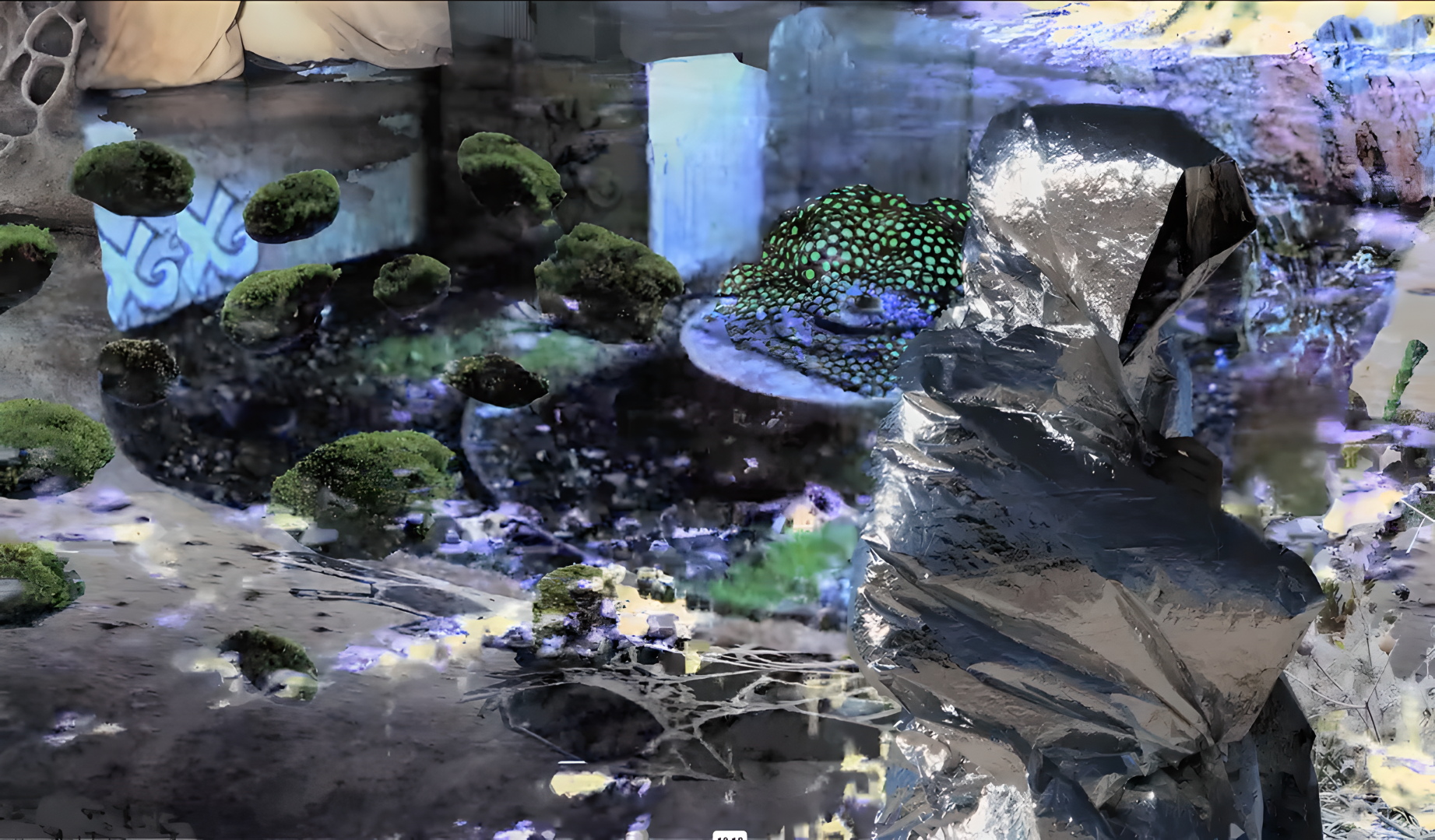
Black Water ghost prescient :: 2015 Mer.Maggie Roberts. 0rphan Drift.
Such a view of design feeds clearly into the larger project of positing design as an ontological force, as voiced by brilliant theorists like Adam Nocek, Anne-Marie Willis, Tony Fry, Arturo Escobar, Claudia Mareis and many others. So, the question is, can design push back against its extractivist lineage, its instrumental projections into the future, and its founding notion of the human as the terminal user? Can it resist and dismantle those techniques it has mastered, that empty life of its potential, whether by algorithmic governmentality, by optimisation, by colonisation of the lifeworld, or by the normalization of fear? For design to repattern itself around potential and inoperativity, as I suggest, means first to take them both seriously as the condition for the creation of new modes of knowing, living, and being. If the key question that design is facing concerns under which conditions the radical futural difference, or what Nocek calls the ‘coming into presence of ‘unassimilable difference’ may take shape, then I would argue that the conditions are those offered by entering the inoperative space of full potential—the space of maybes. It is not a comfortable space, nor is it reassuring, but it is the only one that, for me, is worth working with.
This no longer has to do with the constitution of the human (as user, consumer, target, stakeholder, product), but with its de-creation; not just with the making of the human, but with its profound, uncompromising, difficult unmaking. In other words, this is an argument for design to rethink the human as a designed artifact and subjectivity as a product of intersecting heterogenous systems of governance at scale, from the macro, the infrastructural, and the planetary to the microbial, the molecular, and the viral. It also means to continue the work of provincializing the normative constructs of the Western/Northern and refusing the violent aberration of its universalising claims, especially when practices of inclusive, socially responsive, participatory, and collaborative design are used to repurpose and ‘wash’ top-down, universalising, and defuturing stances. Let us not forget that universalizing claims, in their attempt to embrace the totality, do slide into totalitarianism.
Finally, it also means to start deploying design to disassemble the very same systems it contributes to create, dismantling, bit by bit, the equipment of control and algorithmic governmentality, its machines of prediction and capture that feed on potential. Resistance is a design brief against the servo-mechanic paradigm. This is where the opportunity is given for a design that decentres the human, that supersedes the user by staying beneath those indexes and differentiations, a design that can shift, little by little, into a non-anthropocentric mode.
This is where ideas around a micropolitics of design begin to take shape. “It suffices to move just a little bit,” says Agamben.[39] There is an echo here of Deleuze’s ‘inconspicuous events’ that can elude control no matter how small. Eluding control, resisting, becomes a matter of small gestures: a micropolitics of practices. In the tiny movement, in the humble, ordinary, seemingly negligible act, worlds are contained. The tiny gesture, far from being insignificant or negligible, is the expression of an intoxicating attention to the ‘small’ that carries the potential of its own extraordinary-ness into adjacent possibles, into contiguous spaces. Contiguity denotes proximity and the orientation that emerges when surfaces, and their interstices, are adjacent. Contiguity with all that exists—human, nonhuman, whatever—is exquisitely suited to express connections ‘to come,’ connections on the verge of happening but uncertain yet—it is not the case that etymologically it shares a root with contingency and contagion. It is through the ‘little bit’ that I enter into the zone of maybes.
I must say that I find contiguity to be a formidably generative image for modes of living that hinge on pure potential, more than the insistence on and invocation of ‘relationality.’ To be clear, I do not question relationality, but as a concept it quickly sinks into the indifferent generalist universality of ‘everything is connected,’ losing the generative power that I crave in concept-building. I choose to endorse contiguity, adjacency, proximity, and propinquity as modes of spatial intimacy inclusive of all the divergences, asymmetries, and uneven distributions that make up adjacent possibles. I read adjacence and being at ease in this space of ‘nearby-ness’ as a kind of spatial intimacy where movement happens before any determination, where proximity coincides with favourable timing, and with the practice of crafting propitious encounters, which is Spinoza’ ever-actual lesson. This space of nearby-ness, contiguity, adjacence, of being on the verge of touching affords the opportunity to act through tiny, even imperceptible movements. Here’s where the smallest gesture can precipitate the greatest shifts.
DIFF: Expanding on this focus, given you are deeply interested in design, can you explain your focus on hybrid animism that challenges the standard pillars of user-centered design that effectively lock us into an anthromorphized echo-chamber. Animistic design is suggested as capable of fostering affects, sensibilities, and thoughts that capitalize on the uncertain, the unpredictable, and the nonlinear, and their capacity to trigger creative pathways. Could you share formative encounters with animism or magic that inspired this turn and how you adapt these concepts to a world of ambient intelligence, cloud services, and ‘enchanted objects’ (to borrow David Rose’s term)—where technology risks becoming fetishized as mystical or agential.
BM: Animism is a topic that I kept on returning to in the course of over a decade, from 2009 until 2022, no matter what else I was engaged in researching. I suspect the reason for this is the attraction I have for concepts that possess inherent plasticity and afford unorthodox stretches into contiguous zones and the potential of novel interpretations. Animism is a thick concept, or, to borrow Philippe Descola’s expression, an archipelago of figurations to capture its capacity to adapt, morph, and hybridize and accommodate varied and variable theoretical requirements.
I have written five articles on various aspects of animism—on the power of relics, animism’s relations to object theory and design, animism as a speculative fiction, techno animism, and finally hybrid animism as a philoso-fiction for the investigation of digital media ecologies.[40] I have used the expression hybrid animism to describe both the transdisciplinary perspective that brings together animism with process philosophies and the critical analysis of computation and also to reimagine the hybrid carbon-silicon animacies circulating in the unfolding of computational (that is, computed and computing) matter. I have tried in this way to look at the intensification of sensibility generated by planetary computation from the perspective of the radical immanence of matter and to frame this as animistic. One of the precious rewards of returning to the same topic of investigation across many years is the opportunity for self-evaluation and for tracking how one’s own thinking evolved, diverged, flipped out entirely, or took a new direction, even and especially when the new trajectories end up critiquing earlier standpoints.
I mention this because my work on animism is a case in point, moving from an endorsement of techno-animism through the lens of magic and enchantment—see my chapter ‘Algorithm Magic. Gilbert Simondon and Techno-Animism’(2019)—to spotlight this as one of the most powerful rhetorical devices in the narratives around AI: the mystification of the unknown as esoteric depth. This is, of course, what Kate Crawford and Alexander Campolo eloquently call ‘enchanted determinism,’ described as “a discourse that presents deep learning techniques as magical outside the scope of present scientific knowledge, yet also deterministic, in that deep learning systems can nonetheless detect patterns that give unprecedented access to people’s identities, emotions, and social character.” [41] The challenge I identify here remains how to understand (and deploy) the unknowability of machines without reverting to the tropes of wonder and mystery on one hand or to the fiction of utter transparency and interpretability on the other.
To get back to animism, what prompted my initial research and subsequent investment in this topic was, in my early days working in design, an attempt to make sense of the sheer power that objects exercise on individuals by way of hinging my expertise from philosophy, social sciences, and cultural studies with design. This took me on a varied exploration of consumption and branding (harking back to my early studies on the decoding of the semiotics of advertising), as well as of object theory, fetishism, anthropology, and the animistic turn in archaeology, among others.
Anselm Franke’s two well-known volumes, Animism I (2010) and Animism II (2011), were also quite central, as they gave voice and consolidated a great deal of swirling perspectives. In particular, I saw animism as a generative framework to use to investigate and make sense of the distinctive and growing repertoires of somatic and affective investment with digital objects, smart devices, and intelligent companions, as well as the growing pervasiveness of ambient computing, the cloud, and the invisible digital hum we all are immersed in—figuring out how to adapt animism to 21st-century planetary computation. My take has always been less interested in animism as the conduit for an expanded notion of personhood—the world seen as a community of persons, most of whom are not human, with its too-easy slip into the anthropocentrism it claims to oppose—and more on how I can use animism as the driver to take me into the very core of matter, to investigate matter’s animation and propensity to morph and be ‘alive’ in the process, in short, what in philosophical terms is described as matter’s radical immanence.
This brings animism in direct dialogue with a constellation of ideas—from process philosophy to quantum physics—that see matter traversed by immanent forces. In my work I have tried to use animism as a sort of ‘epistemological picklock’ to disrupt established binary ontologies on the ground of a radical relationality, and then to push this manoeuvre even further for animism to become a disruptor not only of relationality but of rationality itself with its enshrined primacy of human cognition, personhood, and human exceptionalism. This is essential to reflect on the impact of planetary computation on the human, for instance, at how artificial intelligence is conceptualised and the tendency to see this through the narrative of techno-determinism—whether techno-utopian or techno-dystopian, both always predicated on the centrality of the human.
Hybrid animism for instance, helps me to make sense of the data-driven algorithmic flows traversing and indeed becoming us and of the nonhuman modes of processing emerging in machines that compute below human cognition. Rather than taking animism as vitalism or as an all-encompassing horizontal ontology, the notion of hybrid animism expresses the co-habitation and co-evolution of the human with the nonhumanity of increasingly sentient machines in a planetary milieu characterized by growing distributed sensing capacities.
REFERENCES
1.https://www.bloomsbury.com/uk/power-of-maybes-9781350377288/.
2.https://xxmilaleghe.noblogs.org/post/2013/12/16/la-lega-dei-furiosi/.
3.https://www.amazon.co.uk/Rituals-Love-Ted-Polhemus/dp/0330330934.
4.https://www.orphandriftarchive.com/. https://www.ranumukherjee.com/.
5. https://www.youtube.com/watch?v=2NQI1SmfAxQ.
6. The Temporary Autonomous Zone https://autonomedia.org/product/taz/.
7. https://shake.it/ See Also: https://anarchivism.org/w/Decoder.
8.https://web.archive.org/web/20110606005136/http://www.c6.org/emg/ . See also: https://dotmaster.co.uk/.
9. https://neural.it/2006/06/edited-by-betti-marenko-diy-survival/ also https://www.metamute.org/shop/openmute-press/diy-survival#:~:text=There%20is%20no%20subculture%2C%20only,the%20maverick%20art%20group%20C6.
10.https://www.swissfilms.ch/en/movie/la-seconda-pelle/126e15d9728b4da79550ccf7022774a1.
12.https://edinburghuniversitypress.com/book-deleuze-and-design.html.
13. Luciana Parisi (2015), ‘Instrumental Reason, Algorithmic Capitalism, and the Incomputable’, in Matteo Pasquinelli (ed), Alleys of Your Mind. Augmented Intelligence and its Traumas, Luneburg: Meson Press, 125-137, p. 130.
14. Gerda Reith (2004), ‘Uncertain Times. The Notion of ‘Risk’ and the Development of Modernity’, Time & Society, 13(2–3): 383–402, p. 386.
15. In their seminal work on risk, anthropologists Mary Douglas and Aaron Wildavsky argued that the perception of risk is highly based on, and shaped by, individual opinions and collectively shared cultural beliefs; current and past social relations; memories, legacies, discourses, and practices; trust in institutional expertise; distribution of knowledge; and hierarchies of power.
16. Isabelle Stengers, and Didier Debaise (2017), ‘The Insistence of Possibles. Towards a Speculative Pragmatism’, Parse, 7: 12-19, p. 14.
17. Luciana Parisi, (2019b), ‘Critical Computation: Digital Automata and General Artificial Thinking’, Theory, Culture & Society, 36 (2): 89-121.
18. Luciana Parisi and Majaca, Antonia (2016), ‘The Incomputable and Instrumental Possibility’, e-flux, 77, p. 4.
19. Luciana Parisi, (2019), ‘The Alien Subject of AI’, Subjectivity, 12 (1): 27-48, p 43.
20. Tobias Rees, “Non-Human Words: On GPT-3 as a Philosophical Laboratory.” Daedalus, The Journal of the American Academy of Arts and Sciences 151, no. 2 (2022): 168–182.
21. Tiziana Terranova, After the Internet. Digital Networks between Capital and the Common (South Pasadena: Semiotext(e), 2022), 7.
22. Critical Computation Bureau (2021), ‘Editorial. Dialogues on Recursive Colonialisms, Speculative Computation, and the Techno-Social’, e-flux, 123.
23. Rosi Braidotti and Matthew Fuller, (2019), ‘The Posthumanities in an Era of Unexpected Consequences’, Theory, Culture & Society, 36 (6): 3–29.
24. Félix Guattari (2015), ‘Transdisciplinarity Must Become Transversality’, Theory, Culture, & Society, 32 (5-6): 131-137.
25. Luciana Parisi (2012), ‘Speculation. A Method for the Unattainable’, in Celia Lury and Nina Wakeford (eds), Inventive Methods. The Happening of the Social, Abingdon and New York: Routledge, 232-244, p. 236.
26. Ibid: 237.
27. ibid: 241.
28. Brian Massumi (2011), Semblance and Event. Activist Philosophy and the Occurrent Arts, Cambridge, Mass. and London: MIT Press.
29. Elizabeth A. St. Pierre, (2014), ‘Post Qualitative Inquiry’. Keynote Lecture, Australian Association of Research in Education, New Zealand Association of Research in Education, Brisbane, December 2 https://www.aare.edu.au/assets/documents/Elizabeth-Adams-St.-Pierre-ppt-presentation.pdf
30. Erin Manning (2015), ‘Against Method’, in Phillip Vannini (ed), Non-Representational Methodologies. Re-Envisioning Research, New York and London: Routledge, 52-72.
31.https://www.arts.ac.uk/colleges/central-saint-martins/research-at-csm/hybrid-futures lab#:~:text=The%20future%20Philosophical%20Pills%20are,you%20are%20taking%20the%20pill.
32. Barry Allen (2011), ‘The Cloud of Knowing. Blurring the Difference with China’. Symposium: Fuzzy Studies, part 1. Common Knowledge, 17 (3): 450-532, p.497.
33. Compare dao to the Western notion of method, a term that also means “way” [from the Greek meta + hodos]. But this is where things diverge: method, as shown earlier, takes me through well-known grooves into familiar territories that yield predictable and tested outcomes. Method works with what I already know, presuming and defining the obstacles to overcome and specifying ‘how to’ do just that.
34. Barry Allen (2011), ‘The Cloud of Knowing, p: 484.
35. Giorgio Agamben, (2009), Nudita’, Roma: Nottetempo.
36. Boaventura De Sousa Santos (2009), ‘A Non-Occidentalist West? Learned Ignorance and Ecology of Knowledge’, Theory, Culture & Society, 26 (7-8): 103-125, p 114.
37. Ibid: 115.
38. Clive Dilnot (2015), ‘The Matter of Design’, Design Philosophy Papers, 13 (2): 115-123.
39. Giorgio Agamben, (2001), La Comunita’ Che Viene, Torino: Bollati Boringhieri, p.24.
40. Betti Marenko (2022) ‘Hybrid Animism. The Sensing Surfaces of Planetary Computation’, New Formations: A Journal of Culture, Theory and Politics 104/105. Special issue: Animism in a Planetary Frame. Philip Dickinson and Sam Durrant eds. 183-197;
Betti Marenko (2019) Algorithm Magic. Gilbert Simondon and Techno-Animism, in Simone Natale and Diana Pasulka eds. Believing In Bits: Digital Media and The Supernatural. Oxford University Press, 213-228;
Betti Marenko and Phil Van Allen (2016) ‘Animistic Design. How to Reimagine Digital Interaction Between the Human and the Nonhuman’, Digital Creativity 27,1. Special issue: Post-Anthropocentric Creativity. Stanislav Roudavski and Jon McCormack eds., 52-70;
Betti Marenko (2014) ‘Neo-Animism and Design. A New Paradigm in Object Theory’, Design and Culture 6,2. Special issue: Design, Thing Theory and the Lives of Objects. Leslie Atzmon ed., 219-242;
Betti Marenko (2009) ‘Object-Relics. A Neo-Animist Paradigm’, MEI Médiation & Information 30-31. Special Issue: Objets & Communication. Bernard Darras and Sarah Belkhamsa ed, l’Harmattan, 239-253.
41. Kate Crawford and Alexander Campolo (2020), ‘Enchanted Determinism. Power Without Responsibility in Artificial Intelligence’, Engaging Science, Technology, and Society, 6: 1-19, p. 3.
 :: DIFFRACTIONS ::