0rphan Drift has explored the boundaries of machine and human vision, since its inception in London in 1994. The collective as avatar has taken diverse forms through the course of its career, sometimes changing personnel and artistic strategies in accordance with the changing exigencies of the time.
From 1994 to the early 2000s, 0rphan Drift’s core collaborators were Maggie Roberts, Ranu Mukherjee, Suzanne Karakashian and Erle Stenberg. From the early 2000s, Maggie Roberts and Ranu Mukherjee have channelled the 0rphan Drift signal, collaborating with animators, musicians, an Interspecies Communicator, marine biologists and Machine Learning engineers for specific projects.
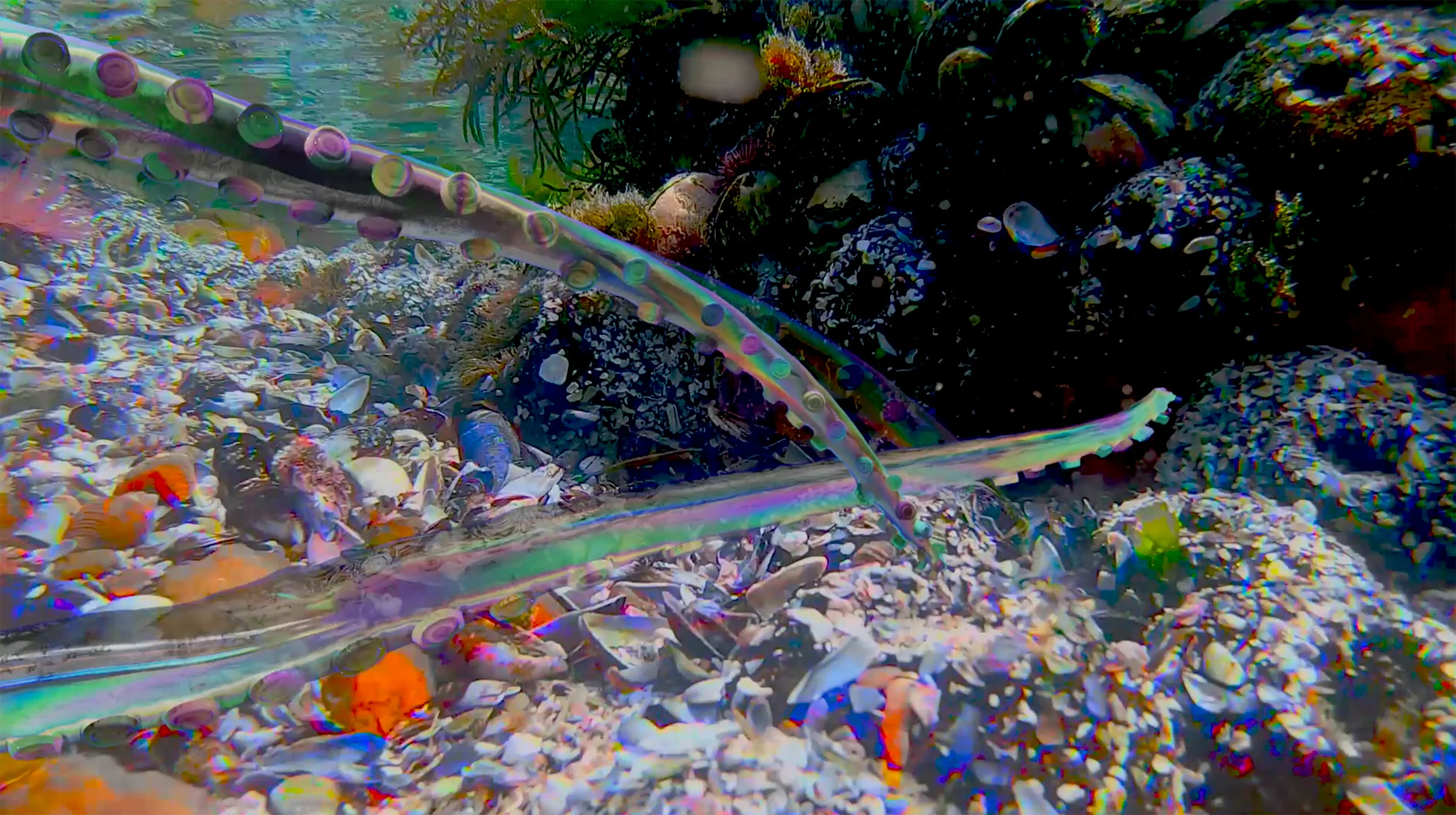
In its latest manifestation, 0rphan Drift considers distributed, many-minded consciousness through the somatic tendencies of the octopus and an Artificial Intelligence. Inspired by embodied cognitive science and marine ecology, their multiple channel installations suggest possibilities in expanding and inhabiting other systems of perception and proprioception. They combine video, animation and text with newer tools they are exploring such as LIDAR, Blender, Touch Designer and photogrammetry to suggest new spatio-temporal formations and ask what kind of bodies might be possible with these new coordinates. Currently they are working toward deepening their engagement through collaborative explorations with oceanographers, script writers, dancers, sound artists, an underwater cameraman, Machine Learning futurecasters and teuthologists.
https://www.orphandriftarchive.com/
DIFFRACTIONS: You have described 0rphan Drift as “an experiment with artistic subjectivity, operating collectively as a singular artist”. If that singular artist is a continuously evolving entity, what is it becoming now that it could not have become in its 1994 or 2003 formations? What new vectors of subjectivity are opened by the current synthesis that weren’t available to the initial 4.5-member hive?
Ranu Mukherjee: We are less interested in anonymous production as the internet and tech has become fully commercialised and misinformation, or propaganda driven communication feels omnipresent. Acknowledging our material and physical (mental/emotional/ideational) labor as a source, along with those we work with, now seems more radical than being a hive mind. The way we work is still organised as a collective function of relations between subjects of various natures, and the avatar holds its own history and presence now, which grows and changes with its public reception. With 0rphan Drift established as an entity with history, we are able to engage with it as individuals that have taken different paths and turns since its inception. The notion of the collective, the expanded collective, takes non-human agency into account in a much more specific way in the recent formation of 0rphan Drift – the ecological necessity is front and center.
Maggie Roberts: And from a methodology perspective, the global proliferation of the Internet, and the assumption of availability across time zones, has given global reach to the collaborations and opportunities in a more immediate way. Relying more on long-distance collaboration affects the way work gets made. We design that into each project. The collaborations are increasingly intergenerational too, with the two co-founders at the centre. It is exciting to incorporate a wider range of digital tech skills when appropriate, often enabled by younger artists who are involved. ‘Vectors of Subjectivity’ – 0rphan Drift is still a strange attractor, operating often through chance encounter or synchronicity, but assembles teams for specific projects, rather than continuing a hive mind. Some collaborations are deliberately interdisciplinary, building generative friction and a challenging of parameters, assumptions and perspectives into the production. This has emerged from the increasingly ecological underpins, and the realisation that the arts and sciences, for example, can imagine into each others’ worlds.

DIFF: Also, your name itself evokes a state of detachment and a mode of movement. In an era of planetary-scale computation and algorithmic capture, where identity is increasingly fixed by data, does “drifting” and being an “orphan” from fixed categories take on a different urgency in our contemporary world?
RM: Initially we saw ‘0rphan’ as a condition generated by humans themselves – producing fugitivity is in itself generated by the attempt to fix and restrict identity, or the privileging of overly instrumentalist tendencies. This type of refusal is more amplified now, but also takes different forms. Detachment is selective, not complete – we are actually interested in being deeply tuned in and connected, but not necessarily to this kind of fixed categorisation.
This does not mean being detached from ancestors or labor or place or the materiality of life on earth – It means being detached from fixed, binary and toxic discourse, or the obsession with knowing and certainty.
MR: And part of this commitment means the avatar stays fluid, porous, curious, intuitive and multi-perspectival. To Drift – explore, be expansive, make space for the Unknown, recognise unexpected possibilities, experiment across mediums and kinds of cultural production – still operates as integral to our engagement in the world. Also, the belief that we are channelling an avatar or entity still holds, and that it attracts what is needed in terms of story, research, skills or aesthetic encounters needed in a particular project.

DIFF: How does ‘ontological drift’ function as a tactic or what does blurring categories actually undo or push back against?
RM: Interspecies thinking, considering the way other beings hold time, and exist in their life worlds. We have been looking at cephalopods in particular. Practicing art making as a fundamentally time based engagement situates change as the standard – shapeshifting becomes the mode of moving through space and time. We take a multidimensional approach – any type of practice that connects us physically with wider and varied timescales is important.
MR: So there is an aspect of time travel in the work. And through that, bringing radically different kinds of knowledge-gathering into relationship – e.g. in the recent OctopusAI project, traditional interspecies communication and marine science. We have always made sure to embed encounters with the unknown in all the work, whether screen-based, multimedia installation, text, performance. Collage as a method runs through everything, together with layered different aesthetics and excessive textured stimuli, dismantling linear meaning-making – or representation. We want to emphasise a multiplicity of sensing as the primary site of response and intelligence.
DIFF: What were some formative artists, events, encounters or influences – from science fiction, cybernetics, acid house, jungle or elsewhere that shaped you from a young age and still bear a significant mark on your work?
RM: – Octavia Butler for her mastery in describing the generative nature of otherness and sending out warning signals.
– Maya Deren’s Divine Horseman (the film and the book) was important as an initial exposure to Vodou. When George Bush started speaking about Vodou Economics, the demonisation of African ancestral devotion began to reveal itself as a principle behind white supremacy in the West. We met Leah Gordon after she brought a vodou ritual to a night club in London. This led to a long engagement with Haiti and its arts and artists.
– Laurie Anderson’s genre defying practice is always an inspiration.
– Polyrhythmic music (particularly the emergence of jungle – the clubs – the experience of watching different people dance to different lines of rhythm, all remaining in sync with the music – that experience is still influential in the methodology and structure of visual work.
– We both trained in painting – so many painters were important influences – the practice of moving liquid pigment across a surface by hand to make an image informs the tactile feel of our screen based work.
MR: To add to that beautiful list…
– Andrei Tarkovsky, Marguerite Duras, Robert Bresson, early Bill Viola, Chris Marker, David Lynch – film makers who stretched time and embodied perception in singular ways, pushing story telling into nonlinear and multiple dimensions. And the writer Virginia Woolf.
– Science Fiction writers mapping our relationships to technology, changing what it is to be human, space opera visions. From William Gibson, Pat Cadigan, Greg Bear, J.G. Ballard through Ursula Le Guin, to more recent Peter Watts, Jeff Vandermeer, Neal Stephenson or Amal El-Mohtar and Max Gladstone.
– Eco crisis theorists such as Donna Haraway, Amitav Ghosh, Viveiros de Castro or Elizabeth Grosz.
– Painters Piero della Francesca, Sigmar Polke, Gerhard Richter; multimedia installation artists Pipilotti Rist, Pierre Huyghe, Laure Prouvost.
DIFF: What do you think has also enabled this singular artist-avatar to persist across three decades of radical technological and cultural change?
RM: Adapting to various life changes alongside the cultural and technological ones, taking our time, making work on our own schedules, ongoing friendship and meeting new collaborators in different parts of the world, the persistence of what brought this avatar into being in the first place – global conditions that extended into the future from where the avatar emerged are ongoing and necessitates the work.
MR: 0rphan Drift is a channel, deeply enmeshed with ongoing questions of changing what it means to be human. There are continuously evolving provocations, new ways of making ruptures and glitch in the dominant narratives of our time. The exciting possibilities of kombinayzon tactics across mediums. Staying awake is a commitment. And lasting friendship, continuing shared interests and questions, new blood, a passion for colour, texture and time, the power of aesthetic languages, beautiful and excessive.
DIFF: Is there a core methodology or principle that has acted as a binding agent for the 0D hive mind?
MR: Perhaps layered multi-agent production involving trust, feedback loops, intuition, friction and rupture.
DIFF: You were part of the Virtual Futures conferences at Warwick, where you encountered members of the CCRU, including a significant but singular extended collaboration with them at the end of the 90s. Did that specific encounter leave a trace that still resonates in 0D’s work today?
RM: CCRU formed after the first Virtual Futures. By then, 0rphan Drift had been around for a few years and we shared methodologies and differences. The influence of theory, of philosophy as practice, of the dismantling of hierarchies between ‘high and low’ culture – or body and brain – was infused in the cultural soup we were part of, which included CCRU but also many other writers, music producers, artists- 90s UK was an era of major impact, collective production, artist run experimental culture, the early days of the digital era. It is a little hard to describe, but very recognisable in the work that came out of this period.
MR: Some granular positives – collaborating on the Syzygy project with CCRU modelled a methodology for manifesting and giving agency to multidimensional characters that exist across fact/fiction, abstract/virtual/mythic/fantasy/actual, different temporalities and media. A coalescing of complex and multivalenced ideas into characters with specific agency, behaviours and attributes. One resonating trace is the fact that we are still good friends with the original CCRU women and Kode9, deeply appreciating each other’s larger long term practice and ideas.
A negative aspect – certain trends revisiting CCRU in the last 10 years have read our work in the 90s as a satellite of CCRU, rendering our huge and varied artist archive slightly invisible at times. This is being rectified by a new generation of largely women curators and writers across the States, UK and Europe, researching the CCRU’s place in the 90s UK that Ranu refers to.

DIFF: Your work has engaged with the octopus not only as a metaphor but as a methodology. How did the creature’s distributed embodiment (a mind with “eight arms that are independently intelligent”) actively shape the aesthetic and formal decisions you made in designing the AI training approach?
MR: Apart from the general symbolic parallel between ML training involving a Generator and Distributor arm, and the octopus’ 8-arms information gathering, octopus distributed and embodied intelligence shaped the overarching speculative framework running through the larger OctopusAI project – rather than the actual AI Unsupervised Learning architecture for ISCRI.
As a methodology in more speculative ways, it could help us ask questions of AI training agendas and their increasingly visible consequences around bias, figure ground separation, limitations of pattern recognition, the need for embodied and environmental awareness, understanding multiple simultaneous viewpoints or temporalities as different kinds of valid information, perhaps in friction but a generative space. And that, the octopus being perhaps the most alien to our human experience of intelligence, proprioception and perception, could emphasise the importance of acknowledging the unknowable and the uncertain as integral to processing a multiplicity of lifeworlds – whether organic, inorganic, synthetic or hybrid.
In terms of aesthetic decisions throughout our OctopusAI project, the octopus as methodology has underpinned explorations into colour and pattern as language, intimate tactile worlding, conveying polarised light and UV vision, multiple viewpoints and vast spatial and chemical awareness, protean embodiment, for example. Its being often almost indistinguishable from/ completely enmeshed with its environment has been important too.

DIFF: What choices did you and the consultancy agree upon to honor the octopus’s Umwelt within the constraints of the technology?
MR: Initially we planned to install the ML system in a mesocosm (an enclosed purpose-built ocean-simulating environment, including ocean water, prey and kelp forest plants from the local ocean), housed in a laboratory environment and easier to install, monitor and change the sensors, screen artwork content, play objects etc. We all felt that, however ethical in terms of recommended current research protocols, this would replicate human control and exploitation models rather than be a collaboration between an octopus, AI and humans – which was the core aim of the project. So we redesigned the data collection (sensors) and the emitter (screen artworks and play objects) to be in an open ocean octopus habitat.
DIFF: You have worked with underwater cameraman James Loudon, who came to the project eager to “unlearn all he has been taught about filming marine life” and to experiment with “dismantling the human point of view”. What specific techniques have you developed to decenter human perception in your documentation of octopus encounters?
MR: Perhaps because I spent a lot of time in the Capetown part of the Great African Sea Forest (filming with James), there was some excitement about whether there was a way to suggest the camera view was that of an octopus, in general terms. Firstly, trying to avoid representational (from human p.o.v.) filming of an actual octopus. Filming with an intensely close up specialised macro lens was interesting – rendering subjects in the forest so macro that they were on the edge of human recognisability, and giving a sense of tactile immersion in details not visible to usual human vision. Or analysing octopus jet-propulsioned swimming movement and trying to visualise a world seen from eyes positioned on the top of the head, then trying to mimic that movement and capture viewpoints of simultaneous eyes looking out in different directions and ‘backwards’ on the head… or filming low in the Kelp Forest as if from the p.o.v. of an octopus hunting or exploring. All these were just approximations, but did stretch the imagination.

DIFF: Is the project about approximating octopus perception, or is the productive friction of the attempt itself the real point?
RM: I’m not sure that filming like an octopus is really the way we would describe the point or approach – it is more about considering the language that the octopus produces as a being – and how we might see differently through it.
The way we consider formal choices in the work are related to the biology, perception and proprioception of this creature. For example, our four channel film installation ‘If AI Were Cephalopod’ is structured through color fields that correspond with the chromatic responses of the octopus to various conditions. As humans making cinematic work, we need to make choices about pace, rhythm, character, structure – and these are informed by our research and observation of other beings, temporalities and relationships. And, yes to generative failure and productive doubt.
MR: The imagining into specifics of octopus lifeworlds has been explored more through animation, Lidar and collage than filming, or a combination of these with filming of the wider forest and ocean environment. The animations have been fuelled by working with a traditional Interspecies Communicator, enabling intimate responses to the perception and proprioception of an octopus – its spatial awareness, pressure sensitivity, wave motion, chemotactile sensing, colour and pattern as communication, UV and polarised light vision, camouflaging – becoming the thing you touch as you move, protean embodiment, distributed intelligence. N.B. Interspecies Communication downloads are first experienced by the body, so a glimpsed sense of intimate experience affected our imagining and how we visualised the octopus Umwelt.
Productive generative failure, glitch, mistakes are all definitely part of our interaction with digital software tools – and before that, analogue, whereby we recognise a ‘language’ or kind of aesthetic or character/ agent in a story produced by ‘failure’ or ‘mistake’.
DIFF: You’ve built a Bateson-inspired framework that treats the octopus, its environment, and the AI as a single fluid learning system — and deliberately builds uncertainty and ‘unknowing’ into the human side. How does this practically counter the extractive dynamic in ML, and what does ‘facilitating rather than controlling’ actually demand of you day-to-day?
MR: We built a ML framework based on Whole System Theory (Bateson), whereby the AI is learning from an octopus in (and inextricable part of) its marine environment. The animal, its affect in the environment and the environment itself are all part of the learning system. Not distinguishing between figure ground, agent and environment was key. The algorithm, trained in the latest Unsupervised Learning models, is learning in a continuously changing fluid environment not focused on human goal oriented learning parameters.
These aspects of the design aim to counter the neoliberal assumptions of what constitutes signal/ information, and what noise/ not relevant, and to address bias through attempting continuous training that assimilates uncertainty as a necessary part of experience.
(See the Diagram images). Furthermore, the humans involved would be responsive and facilitating rather than controlling and determining meaning-making. We would not even necessarily recognise/ know when, if or how communication happened between the AI and the octopus. Unknowing was built into the human side of the collaboration, which felt weirdly exciting.
DIFF: If the goal was to create an AI that learns from an octopus’s Umwelt, what ethical framework did you develop to prevent this from becoming another form of colonisation of the non-human lifeworld?

MR: Firstly, just to mention that we want to challenge the term ‘non-human’ – out of the current options circulating to describe all lifeworlds and decentre the human, we prefer the phrase ‘more-than-human’.
For Iscri, actually training an AI on an octopus’s Umwelt, the ethical framework was as non-invasive as possible. Sensors, small screens and play objects were envisaged placed in an open Kelp Forest coastal environment, in an octopus’s territory. It would be up to the octopus whether it wished to engage. Centering the uncertain, deliberately challenging colonising methodologies through the system architecture, decentering (western) human goal oriented assumptions, and the unknowability and uncertainty of engagement or outcome definitely contributed to our funding difficulties.
Our current OctopusAI project, 9Brains, is an eco-science fiction that refocuses on interspecied/ multidimensional/ pluriversal agency, with organic, inorganic, synthetic and virtual characters having equal importance in the story.
RM: We learned a lot from this project, about the ethical dimensions of such a project and also the material constraints posed by a literal actualization of this idea – We have since gone back to bringing the research into fiction and filmmaking – modes that can be speculative and embody questions rather than needing to answer to instrumental goals. It gave me renewed faith in the importance of fiction and poetics as strategic practice – the gap between working with an actual creature (potentially subjecting it to a process it did not choose) and considering this in fictional form, seems worth noting as a generative space in the work.

DIFF: Your work has merged “ancient predictive technologies such as I-Ching… with moving images and AI”. How do you experience the difference between the agency of these older, more-than-human intelligences and that of a synthetic one like a neural network?
RM: Technologies such as the I-Ching offer us agency, by tapping into universal energies that are coursing through everything as invisible force. Synthetic intelligence in computational form seems to set up an entirely different relationship. Your question makes me wonder – are we looking for a different relationship with AI? Probably. But maybe not as an oracle.
We are most interested in an expanded view of possibility that AI suggests, beyond instrumental or assistant-mode goals – and beyond Silicon. Our current experience with AI is limited materially speaking – but the questions it is posing are critical beyond its own current state.
MR: The agency of the I-Ching, and more recently, of Tarot and astrology, feel more multi-dimensional, magical tools that are real agents mirroring and interpreting patterns for us across deep, present and future time, weaving archetypes and different frequencies in a generative way.
We are researching many potential more ecosystemic aspects of a neural network as an embodied ‘more-than-human intelligence’ in our current ‘9Brains’ narrative. There is a relationship to Deep Time, not knowing and organic and elemental becoming that are opening a more multi-dimensional space of operations and sensitivity. As Ranu says, I think we are probably looking for a different relationship with AI, and we are searching in the wild.
DIFF: You have been recently featured/behind the “Metabolic Drift” which is described as a journey through the “interconnectedness of the Noosphere, Biosphere, and Geosphere,” you seem to be proposing a form of perception that is not merely intellectual but metabolic. Given your history of “treating information as matter and the image as a unit of contagion,” how does the “sonic-led” nature of this journey enact a different cognitive relationship to these spheres than a visually-led one?
RM: Metabolic awareness seems undeniable in this moment, when our attention is being mined with devices designed for dopamine receptors. Perception has never been purely intellectual – awareness, sense and sensitivity increasingly requires protection and cultivation.
MR: It conjures less of a ‘cognitive’ than sensory and physical relationship to these material and planetary consciousness spheres.
The sonic, for us, has always expanded and distributed the affect of an artwork out into the sensing body. Immersed in a tactile ocean. Particularly with the 90’s AV work, our video assembly and editing methods followed a more usual-to-music production method – intensive layering of different simultaneous speeds and textures, repetition, pitch shifting, shivering vibrational visual fields – nonlinear, spacious and polyrhythmic. Wanting to access a more tactile, intimate, less vision-led or individual-centric response, nonlinear and vibrational.

DIFF: 0D has tracked and intervened in the relationship between technology and subjectivity since 1994. Looking forward to 2054, what emerging technological or ecological developments are you already attending to as the raw material for the next phase of 0D’s evolution?
RM: The importance of ecosystems thinking for survival is shifting subjectivity from the inside out. The coincidence of climate change, the emergence of AI and geopolitics are informing available narratives of a future that amplify a sense of polycrisis. It feels like a call to produce difference – to unfold a different path, other stories, or at least poetic and informed responses.
Many are working on this. We are looking for different ways and asking questions posed by biocomputing in relation to ecological shapeshifting.
MR: We’ve learnt a lot from the octopus about being enmeshed in an ecosystem and, for example, about protean shape-shifting, colour as language, tactile becomings. It’s informed our imagining versions of more-than-human intelligence and embodiment, merging the synthetic and elemental, more hybrid and porous Being. We’re navigating questions of how to collectively imagine and produce the post eco-crisis future. For now, there feels an urgency to counter the toxicity and damage with robust imaginings that help create hope, and plurivocal agency. Perhaps, with many others, we are providing a space to ask questions around our role as a species, and in relation to currently unrecognisable versions of AI technology.

DIFF: Beyond the octopus and AI, what other beings or systems are now coming into focus for you?
RM: The octopus and the AI are in relation within 0rphan Drift’s work as a form of inquiry into the nature and complexity of what we call intelligence. This pairing allows us to compare two kinds of other beings and imagine what a relationship between them might produce. The horizon of attention is at this intersection. The octopus also lives in an ocean ecosystem that is in itself a body – an unfathomably epic, complex and essential body.
MR: Each arm of the octopus feels a different perspective, perhaps a different world. Such sustained immersion in the octopus lifeworld, imagining into different kinds of sensing, perception, embodiment, folds back to the human. Likewise, imagining AI differently, ecologically, and what this might channel. Appearing on the horizon, a sense of humanity changed by such encounters.
0D folds and loops in feedback moving like waves and rip tides. Always responsive, towards sentience not yet coalesced.