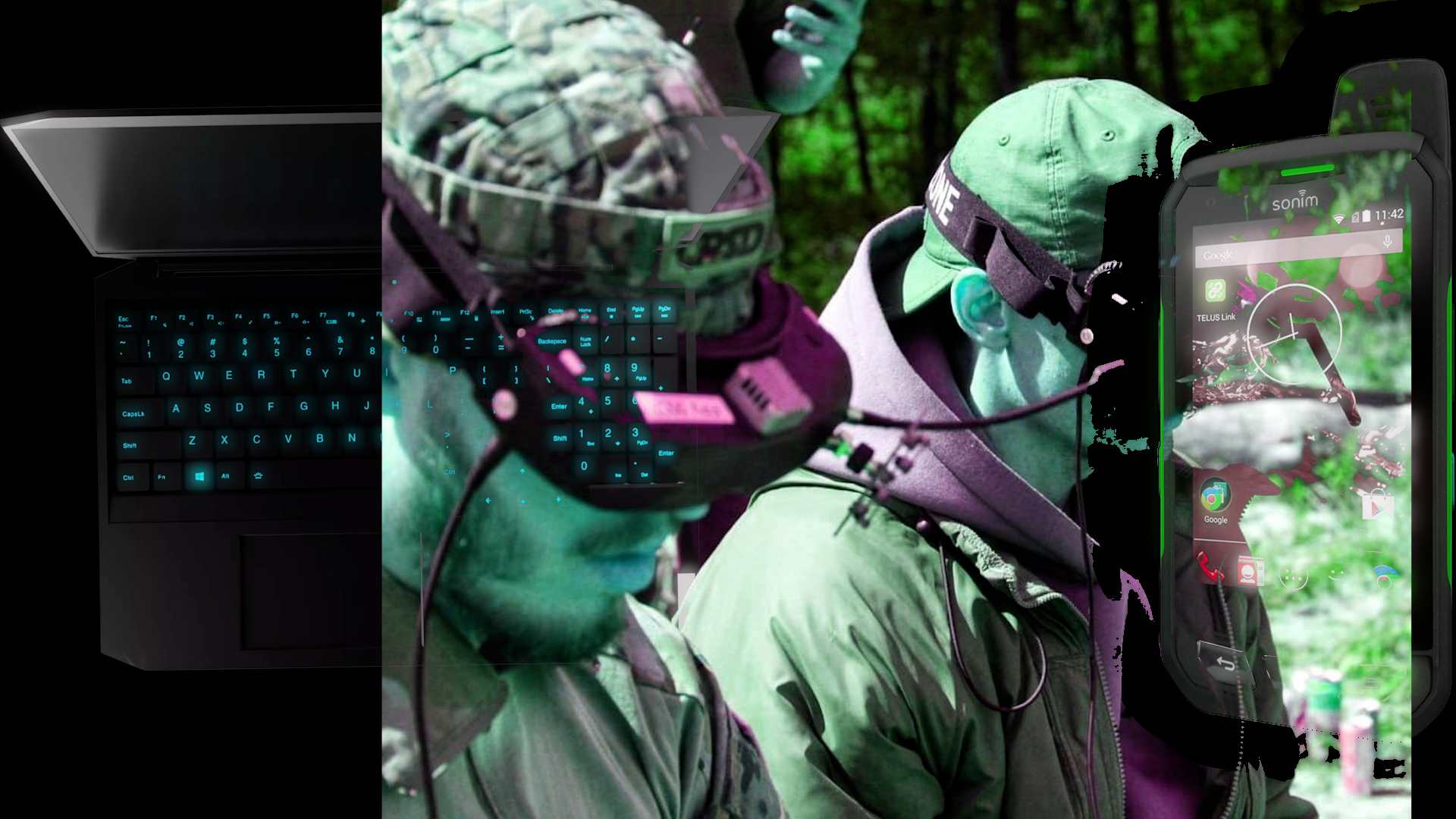
This is an interview with Matthew Ford. Dr. Matthew Ford is an Associate Professor in War Studies at the Swedish Defence University (Försvarshögskolan) in Stockholm. He is a leading academic whose research focuses on the intersection of technology, data, and the conduct of war in the 21st century. His recent work, War in the Smartphone Age: Conflict, Connectivity and the Crises at Our Fingertips (2025), examines how data-saturated battlefields and mass smartphone use are reshaping modern conflict.
DIFFRACTIONS: You and Andrew Hoskins defined “radical war” as a condition where the digital-saturated battlefield that is “legitimised, planned, fought, experienced remembered and forgotten in a continuous and connected way, through digitally saturated fields of perception.” How did that concept evolve arguably into the more granular, infrastructure-focused argument of your new book? Would you have any reflections about your book Radical War: Data, Attention and Control in the Twenty-First Century (2019), in light of developments in 2026?
Matthew Ford: Radical War was conceived in 2019, before the AI revolution had reached its current extraordinary intensity. Its purpose was to bring media studies and war studies into genuine conversation – a pairing that remains surprisingly neglected. War studies pays lip service to media but rarely engages substantively, while media studies has historically shown little appetite for war. Yet the internet does not get switched off in war zones. Ordinary people continue living their lives online, and war comes to them through those same channels. The question becomes: what happens when these worlds collide?
The book was an attempt to think through that collision. We drew on empirical cases from both media and war studies literature, and we speculated about the significance of the smartphone. But it was the war in Ukraine that truly validated our framing. Shashank Joshi, the Defence Editor at The Economist, told me privately that the book was “on the money” in many respects — a comment that landed with more force than I had anticipated. When the full-scale invasion began, I knew we would quickly discover whether Radical War offered a useful lens for understanding contemporary conflict. Publishing a book on the cusp of a major war is a high-risk proposition; your ideas are almost immediately stress-tested by unfolding events.
I spent that first month of the invasion monitoring what was happening online, partly because Andrew Hoskins and I were scheduled to brief the US Marine Corps at the end of March. I remember thinking that we risked being severely outmaneuvered unless we fully understood what was unfolding. So we paid close attention.
Radical War laid out a theoretical framework for understanding two interrelated dynamics: on one side, the relationship between mainstream legacy media and social media, and how that reshapes the broader media ecosystem; on the other, how connectivity functions on battlefields — not just military connectivity, but civilian connectivity — and how that transforms the conduct of conflict. That framework, centred on data, attention, and control, has continued to inform my thinking.
The book I have just completed, War in the Smartphone Age, represents my effort to cash out what I had observed in the three years since we published Radical War. I wanted to make these dynamics intelligible to readers who are neither open-source intelligence specialists but may be horrified by what they see on their phones — to help people understand what they are looking at and to deconstruct it. During that first month of the full-scale invasion, I watched people reduced to tears. We were thousands of miles away in Britain, yet the violence was right in their faces. That visceral proximity demanded explanation.
Radical War is also certainly a product of its moment, and in some respects it has already been overtaken by the AI revolution. Yet in other respects, it continues to orient my thinking. AI is built upon the very same infrastructures that make smartphone use possible. At the same time, AI is accelerating the proliferation of digital slop and misinformation, overwriting memory and, in effect, overwriting history. All that remains — in a radical framing — is a vague sense that events somehow happened. We find ourselves increasingly locked into a sharp, fragmented, splintered present. These infrastructures are conditioning us into that logic, whether we like it or not. AI is cementing us in those fractured spaces because it is literally rewriting our shared history.
How do we trace our way back to a stable media environment? In twentieth-century terms — editorialised, structured, vertical print and broadcast media — we had a clear sense of what the establishment, the newspaper barons, and the government wanted us to understand. That framework no longer holds. It now collides with participatory media, leaving people profoundly uncertain about what is true. AI accelerates that uncertainty, breeding misunderstanding and disorientation. It is a deeply dispiriting state of affairs. People tell me that going online now feels like stepping into a dumpster fire — a cacophony of shouting and rage-bait. That is how platforms are monetised.
Also, the fundamentals are straightforward. Mainstream media is subject to libel law — you can sue the publisher. Social media platforms, by contrast, are legally constituted as platforms rather than publishers. Section 230 of the Communications Decency Act shields them from liability for user-generated content. The individual who posts is the one legally responsible. What gets published depends on platform policy, but the platforms themselves are rarely, if ever, successfully sued. Individuals might be, but in practice the sheer volume and velocity of content makes accountability nearly impossible.
People post at speed and with little regard for accuracy. The smartphone collapses the distinction between producing, publishing, and consuming media into a single device. Online temporality operates at a rhythm fundamentally at odds with traditional print and broadcast media, which were subject to editorial oversight and legal constraint. This shapes not only how we represent war — but, crucially, this is the smartphone-age inflection point — it has moved beyond information operations and now directly affects the conduct of war itself. This is the conduct of war now. With War in the Smartphone Age, I tried to pull that thread through more explicitly, tracing how the mediation of war has become inseparable from its execution.

DIFF: I’m curious about how we come back to that refrain from Sun Tzu that war is about controlling and shaping perception and what is consistently quoted from him that “all warfare is based on deception.” I suppose we can still say if there is a distinctly ‘Western’ idea of war that it is still often rooted or carries residue from the Clausewitzian model, centering on or historically privileging the physical battlefield. Yet there are much deeper historical precedents through the lens of early modern political thought, we find Machiavelli (1532), and Hobbes (1651) in Leviathan, both alluding to the manipulation of perception, the management of opinion, and the shaping of subjects’ minds as integral to the exercise of power.
So these reflections are hardly new. However, I am also interested in the twentieth and twenty-first centuries, with the institutionalisation of psychological operations, the CIA’s Cold War experiments in mind control and brainwashing, and now as we are witnessing the diffusion of mass and social-media manipulation coupled with AI/big data, psychotargeting, neuroscience that we see a pronounced and amplified turn toward the “cognitive” dimension. Given those much older roots, would you still say there has been a genuinely novel emergence of thinking about the “cognitive” dimension in contemporary warfare, or are we essentially confronting age-old deception rebranded with digital tools and institutional frameworks?
MF: You used the word “cognitive.” NATO and others are now framing this as cognitive warfare, and I find the term deeply unhelpful — as if the mind has only now become the battlefield, as if it never was before, as if this is some shocking revelation demanding doctrinal frameworks for soldiers. I do not believe that for a moment. Perspectives are clearly important. At the same time, you can win the online conversation and lose the war. There is a real danger that the information space becomes divorced from the analog — the place where things go bang, where kinetic acts occur. In my view, what we are seeing is an enmeshment. Someone like Antoine Bousquet might call it post-digital. This is simply ordinary reality now. We have entered a space where we can no longer imagine a world without the internet. Digital experiences are deeply embedded in consciousness. Tweaking the online space reshapes consciousness in particular ways.
But when it comes to war, something is still going bang somewhere. The challenge for researchers is the risk of becoming trapped in the study of discourse. Discourse matters, but materiality must be brought back into the frame. That is precisely what I was trying to do with War in the Smartphone Age: bring the analysis back down to the material. Cell phone masts, fibre optic cables, low Earth orbit satellite technology — these are not ethereal. The cloud is a physical thing. It has electromagnetic presence, and it can be physically tinkered with. You can blow up a data centre. You can attack a fibre optic cable. That affects information flow and perception. Or you could flood the online space with masses of AI-generated slop and poison the well — changing perspectives so radically that people would have to take off their digital goggles and return to something analog. You could imagine a world where the only way actors shape the information space is by poisoning it entirely. Software engineers would have to go back to the last clean copy of the internet and reload from there. I think that will happen. I think it already has begun.
DIFF: Tying to materiality from another angle, I was reading about large language models operating on token-based consumption models, where costs scale directly with usage. Given that the US military had integrated Anthropic’s Claude across classified networks and was using it for intelligence analysis, target identification, and operational planning in real combat zones like Iran and Venezuela. Accordingly, the scale of token consumption must have been enormous. Reports that have been released as well are suggesting even defense contractors were imposing monthly token limits on employees to control costs. Also, it brings up the question, at what point does the cost of AI-driven warfare become prohibitive, and how does that material constraint shape military decision-making?
MF: It is infrastructure. It runs on electricity. It has costs. We are building out massive compute power that will require enormous amounts of energy — likely from fossil fuels. Climate change, food insecurity, migration. At the same time, AI is stripping out middle-class jobs. Elon Musk declares civil wars inevitable in Europe or Britain — partly, I suspect, because his AI platform is creating the very conditions in which everyone politically folds. No jobs. Migrants. That is a toxic combination. There is pushback against the AI revolution. Governments and tech businesses need to make their case, but they are not doing so effectively. Their message is predictable: AI reduces the need for people, automates processes, makes businesses more efficient, and returns shareholder value. But the downstream consequence is political instability.

DIFF: At first, it might be strikingly obvious, but why for your current book did you specifically select the smartphone? I think you have highlighted its multifunctional role as physical object, a sensor platform, and a networked endpoint. But why the smartphone for understanding warfare, as opposed to satellite-connected radios or other objects?
MF: Everyone in the global north lives their life through these devices — banking, shopping, chatting, watching films, everything. And this same device delivers horrific imagery to wherever you are in the world. You do not have to be on the front lines to witness it; you do not have to be in Sudan to see genocide unfolding. For someone like me, who watches this space closely, these images are simply on the top layer of your social feeds.
I remember being genuinely shocked once when my feed presented me with an advert for groceries, a cat meme, and a beheading video, all in succession. How did this happen? The phone gives you the ability to produce, publish, and consume — you are not merely a passive recipient but an active participant. There is a feedback loop. Sometimes that is as subtle as metadata shaping your impressions; other times you are reposting, commenting, recontextualising, or taking an image from one platform and posting it to another, thereby changing its meaning and reframing the entire narrative.
At its heart, the book begins with an attempt to help people navigate the mess and uncertainty — the churn, the splintered realities we all now inhabit. There is very little shared understanding left, so it becomes essential to understand why you are seeing this feed rather than that one, to recognise that everyone’s feed is unique. From that awareness, you can start to ask: what tools might help you step outside your own media bubble?
For War in the Smartphone Age, I assembled an open-source intelligence group. We conducted research for the Foreign, Commonwealth & Development Office and the Defence Science and Technology Laboratory to test whether these analysts could work to the same standards as the US intelligence community. It is possible. If you train and educate people in sources and methods, you can create analysts. Intelligence analysts are not born — they are made. If you do that at scale, monitoring social media 24/7, you can crowdsource intelligence product with remarkable speed. The challenge, however, is understanding who is involved, who is in your network, who is doing original research, where they are located, and what their sources and methods actually are. Online, you are locked in a hall of mirrors. Anyone who reveals their sources and methods risks having those sources shut down. When the Ukraine invasion began, webcams showed Russians advancing. Bright sparks on social media posted the footage, and the Russians promptly took those webcams offline.
Training people to understand this landscape is achievable. There are inherent limitations to open-source work, but you can begin to apprehend the structure of knowledge — what you can learn, and what you cannot. You still need people operating in the field. Old-school research still has a place. You cannot automate your way out of the need to speak with someone who has actually been in the fight.
Ukraine has been remarkable in this regard. There are individuals who have conducted no actual research — they have simply surfed the web, cultivated a few contacts, and then pass off their observations as authoritative judgment. They are becoming war-porn influencers, posing as academic experts. You have to be critical about what they are doing and how they are gathering their information.
DIFF: Could you elaborate on Telegram and Signal as operational interfaces for sensor networks, targeting data collection, and command-and-control?
MF: Telegram is a particularly telling example, as is Discord — the platform where a great deal of open-source intelligence work now takes place. Some Discord channels host several thousand participants engaged in open-source analysis. They have developed their own cultures, rules, and working practices designed to ensure analytical quality. When you have a Discord community dedicated to all-source intelligence — satellite imagery, SIGINT, electronic intelligence — with three or four thousand people focused on open-source material, they can operate at a scale and speed that the established intelligence community simply cannot always match. These platforms effectively connect the battlefield to a global network of freelance analysts who may not be Ukrainian and may not be in Ukraine, yet they provide actionable intelligence that allows Ukrainian forces to identify Russian positions and strike them. All of this is built on a social media platform originally designed for gamers.
In a Ukrainian brigade headquarters, you would encounter a bewildering array of platforms and technologies — analog radios, digital radios, Starlink — all lashed together. Discord, Google Docs, Telegram, Signal, WhatsApp. You piece it all together to receive a drone feed and redirect artillery fire. Unless the drone pilot has a direct feed to the artillery unit, that information is relayed through headquarters. This is gradually changing with the introduction of situational awareness software platforms, but it is worth reflecting on how, when necessity dictates, civilian technology is rapidly repurposed for military ends. Software engineers, in this sense, are the munitions workers of the twenty-first century. It is no wonder, then, that Iran targets data centres across the Middle East.

DIFF: I think you speak about it in the book and I think this has already spanned the military and civilian divide, where we’re increasingly shifting toward crowdsourced targeting models. I know from what I read that around 2022, a pro-Russian journalist shared photos on Telegram showing the local headquarters of a Russian Wagner paramilitary group in Ukraine. One photograph clearly displayed the building’s address plaque. Three days later, Ukrainian artillery reduced the building to rubble.
Also, in Ukraine you have the “e-Enemy” chatbot, launched by the Ministry of Digital Transformation in March 2022 just two weeks into the full-scale invasion. Essentially, any Ukrainian citizen who has verified their identity through the government app can submit text, photos, videos and precise location data about Russian troop movements and command posts. The chatbot operates like a mobile game where users tag enemy locations and receive emoji rewards. I’m curious if you have thoughts on how much longer before fully automated targeting complemented by large language models or AI agents scans those same conversations, extracting coordinates, and feeding them directly into targeting pipelines without any human intermediary?
MF: I would add here that Polymarket also has a lot to answer for. It has fundamentally reshaped war reporting, journalists are now being attacked for telling the truth because it does not align with someone’s financial stake. [The Times of Israel military correspondent Emanuel Fabian received death threats after reporting that an Iranian missile had hit Israeli territory on 10 March 2026.] The threats were explicit: he had cost bettors money, and they wanted retribution.
I have a paper forthcoming with Gregory Asmolov on what we are calling the “open kill web.” Individual participation is no longer limited to representing war through your phone — you can directly engage by taking a photograph and feeding it into an application that routes it to a fusion cell. You become a walking sensor. The prospect is profound: you do not need the state at all. You can reconfigure the entire supply chain — from supplying munitions to identifying targets to executing strikes — without any state involvement, entirely digitally, entirely remotely. The technology already exists.
From a Western European perspective, the concept of total defence entails mobilising the citizenry to resist invasion, potentially through their smartphones. But if you are dealing with a non-state actor or a terrorist group that does not even have a state apparatus, you encounter a different order of challenge. Governments will naturally work to prevent this kind of participation, yet humans are remarkably adept at circumventing controls. Consider the democracy protests in Hong Kong in 2019: operating under total surveillance by Chinese security services, protesters used edge computing, AirDrop, and other techniques to evade detection, rendering facial recognition ineffective while still organising through their electronic devices. These challenges will persist on both sides of the equation — controlling participatory warfare on one hand, and finding ways to escape those controls on the other.
DIFF: Let’s bridge into the concept of the “stack.” How did you engage with Benjamin Bratton’s original conceptualisation? Where did you draw on it, and crucially, where do you see your own approach diverging from his or complementing it? And finally, looking at the framework as a whole, where do you see its limits when applied to contemporary warfare?
MF: I found the stack useful as a metaphor for thinking about whatever this accidental mega-structure is that has emerged over the last forty years. Its accidental nature creates the very conditions that make participatory warfare possible. Increasingly, it is structuring how — in this post-digital sense — we think about and conduct war. The enabler on the fighting end is the information infrastructure that militaries must manage and control. They leverage civilian infrastructure because it is more efficient, robust, and scalable than anything they could build themselves. It is only at the pointy end that considerations of robustness and security truly come into focus — the electromagnetic spectrum, signal emissions, frequency hopping.
Because they rely on civilian technologies for the heavy lifting, these infrastructures become the topography of war itself. Wars are fought over, across, and through them. Controlling a geographical node is one thing; controlling a digital node may be equally important. That can be achieved through cyber means or by physical attack.
The Hamas attacks on southern Israel in October 2023 illustrate this with devastating clarity. The Israelis had deliberately kept Gaza on a 2G network because end-to-end encrypted software does not function efficiently on 2G. Everyone communicates by voice or text, which is readily transcribed, forming a massive database for social network analysis of Gazan society. If you had a smartphone, you had to walk to the border hoping for a roaming signal from Egypt, or rely on Wi-Fi — but the hardwired connectivity out of Gaza passed through Israel and was tapped.
Remarkably, Hamas organised its assault while operating under permanent surveillance. Israel had discounted the possibility of a major attack, assuming Hamas was not sophisticated enough to pull it off. They were wrong. Hamas had developed a highly sophisticated campaign. Breaking through the wall was the easy part; the harder challenge was buying themselves enough time. To slow the Israeli Defence Forces’ response, Hamas struck military communications bunkers that coordinated intelligence gathering. Knocking those out created confusion and uncertainty, gaining two or three precious hours for Hamas to fan out across southern Israel. They switched to Israeli SIM cards and left civilian communications infrastructure intact — not only so they could keep communicating, but crucially, so that Israelis would broadcast their own murder and atrocity over social media. The paralysis came not from Hamas’s own propaganda, but from Israelis themselves overloading the platforms with the horror unfolding around them.
Hamas understood that they would achieve greater political impact by leaving civilian information infrastructure intact and letting Israelis document their own victimisation. That sophistication — weaponising information infrastructure for political effect — is directly reshaping how wars are fought.
In Iran, with the recent US-Israeli strikes, we see targeting infrastructure operating at a speed and scale that was unimaginable just a decade ago — 500 targets a day, two or three times the rate of strikes during the Kosovo campaign. AI-enabled targeting means that instead of a thousand people working on strike packages, a team of twelve can do the job. The challenge is no longer identifying targets; it is having enough platforms to deliver the munitions. Meanwhile, the social media context moves at such speed and scale that it becomes almost impossible to fix the narrative.
We are witnessing a political context that is profoundly unstable in ways that would have been unthinkable in the twentieth century. Military objectives — “we need to keep hitting targets” — and political objectives are shifting almost at the speed of social media. From a strategic perspective, the question becomes: at what point can these two dimensions be relinked so that we can declare a meaningful achievement? Yet different media contexts in different parts of the world have different rhythms. How do you integrate them? This is having corrosive effects on military strategy-making. The ends-ways-means framework still has relevance, but how do we make it meaningful when the information environment itself is actively destabilising political objectives?

DIFF: Also, what about the interpenetration of platforms like Amazon Web Services, Microsoft Azure, Google or these titans hosting critical state infrastructure? Ukraine was interesting to read recently, where AWS was hosting over fifteen petabytes of data from over sixty government organisations such as state registries and universities. Another example is Israel’s army which used Azure then switched to AWS after backlash and scrutiny. Where do you see this going? It seems from what I read that these platforms are enhancing the advantages for certain clients, states, paramilitaries, and will increasingly pit these major platforms against each other.
MF: Big tech’s ambition is to achieve network effects, to secure a foothold inside armed forces and government, and to entrench itself in a monopolistic position that cannot easily be displaced. Palantir, Amazon — once you move government into the cloud, where do you go? Ukraine’s government moved its data into the cloud and gained a measure of security: even if Ukraine were to fall, the Ukrainian government could continue to exist online. But all the services that spin off from that move become dependent on cloud infrastructure. Once you are in the cloud, you are in the cloud. If you want to leverage AI, you need that compute power. You have to think very carefully about how much of this remains sovereign to government.
It has always been the case that governments contract for software and hardware. But until relatively recently, organisations had their own hardware, their own IT teams, and could control what resided on their hard drives and how their networks operated. That has become harder with the scale of cybersecurity challenges. As organisations migrate into this space, I am worried about what that does to the relationship between citizen, state, and big tech. Software as a service, cloud as a service — government becomes a perpetual renter, constantly paying to access the latest updates. It starts free, but once you are locked in, the price rises.
It is reminiscent of the Black Mirror episode “Common People”, in which a woman’s consciousness is hosted on a server via a subscription service called Rivermind. The surgery is free, but the monthly fee to keep her brain active is $300 — and the cost only escalates. Instead of government taxing industry, big tech taxes everyone to maintain its position. Government serves big tech, not the other way around. That runs directly counter to democratic accountability. For armed forces, this is especially problematic: if you outsource command-and-control infrastructure, and the company is under pressure to restrict your access to the battlefield, or you have not paid your subscription, or you cannot download the latest targeting pack, you are in a suboptimal position, pressured to pay more. I would rather take the risk of sovereign technologies than become reliant on a non-sovereign platform.
Also, Ukraine is building its own tailored stack. They released war-fighting data as open source, making it freely available for companies to optimise their technologies — that is a smart move. Create an ecosystem of companies so you do not end up reliant on any single business. How do you solve the Elon Musk problem? More competition in low Earth orbit satellite technology. Musk tries to curry favour with Trump and keep regulators from allowing other businesses to gain a first-mover advantage. But the Ukrainians fought for that data with their blood, and they made it available precisely to stimulate market competition.
DIFF: What emerging technologies are currently capturing your attention? I am thinking specifically of 3D printing near the battlefield, where open-source repositories now enable individuals to manufacture their own MANPADS. Do you see this as a significant development, or is it more of a niche capability?
MF: Of course, we might echo William Gibson’s maxim: “The future is already here—it’s just not evenly distributed.” I am drawn to the spaces that most people overlook. The prevailing fascination is with the shiny and the new — AI, revolutionary breakthroughs, the next big thing. But for ninety-five percent of the world, there is a lag. The genuinely interesting developments are happening where the shiny stuff is not. That is where things get lashed together — open-source solutions, old technologies, pragmatic improvisation — figuring out how to make things work within specific processes and social contexts, in the particular circumstances of particular wars. That, to me, is worthy of serious study.
We should not confine our attention to Ukraine or Iran. There are conflicts across the globe where technology plays a defining role, where war and technology have become synonymous. AI, smartphones, low Earth orbit satellites, WhatsApp in place of radios, even broadcast radio — all are now enfolded into the lived experience of war. It is one thing to observe events in Iran broadcast across social media; it is another to recognise that when Iranians turned off the internet, Americans controlled satellite access, and then the Chinese made their own satellite imagery freely available. The lesson is clear: the Americans think they control the information environment, the Chinese show them that they do not.
The unexpected, the pragmatic, the jerry-rigged — the shock of the old. That is why I wrote about rifles. They are mundane, unglamorous, yet they have killed far more people than nuclear weapons ever will. Smartphones are the same. Everyone has one; no one really thinks about them. But they are the engine driving the AI revolution. If we were to put down our digital devices, there would be no data for anything to run. You have to go back to thinking about the older things — how they overlap, how they mesh, and how they persist alongside the new.
REFERENCES
Asharq Al-Awsat. (2024, January 23). Hamas: Communication network via special hubs, written messages. Asharq Al-Awsat.
Bratton, B. H. (2015). The stack: On software and sovereignty. MIT Press.
Clausewitz, C. von. (1976). On war (M. Howard & P. Paret, Eds. & Trans.). Princeton University Press. (Original work published 1832)
Ford, M., & Hoskins, A. (2022). Radical war: Data, attention and control in the twenty-first century. Hurst & Company.
Ford, M. (2025). War in the smartphone age: Conflict, connectivity and the crises at our fingertips. C. Hurst & Co. Publishers.
Ford, M. (2017). Weapon of choice: Small arms and the culture of military innovation. Hurst & Company.
Hobbes, T. (1996). Leviathan (R. Tuck, Ed.). Cambridge University Press. (Original work published 1651)
Machiavelli, N. (2008). The prince (P. Bondanella, Trans.). Oxford University Press. (Original work published 1532)
Manufacturing 3D Mag. (2026, March 26). Open-source 3D printed missile prototype costs just $96. Manufacturing 3D Mag. https://manufactur3dmag.com/3d-printed-missile-prototype-open-source-96/
Sun Tzu. (2005). The art of war (R. D. Sawyer, Trans.). Basic Books. (Original work composed c. 5th century BCE)
The New York Times. (2026, April 29). Opinion: A journalist covered a missile strike. Then the death threats started. The New York Times.