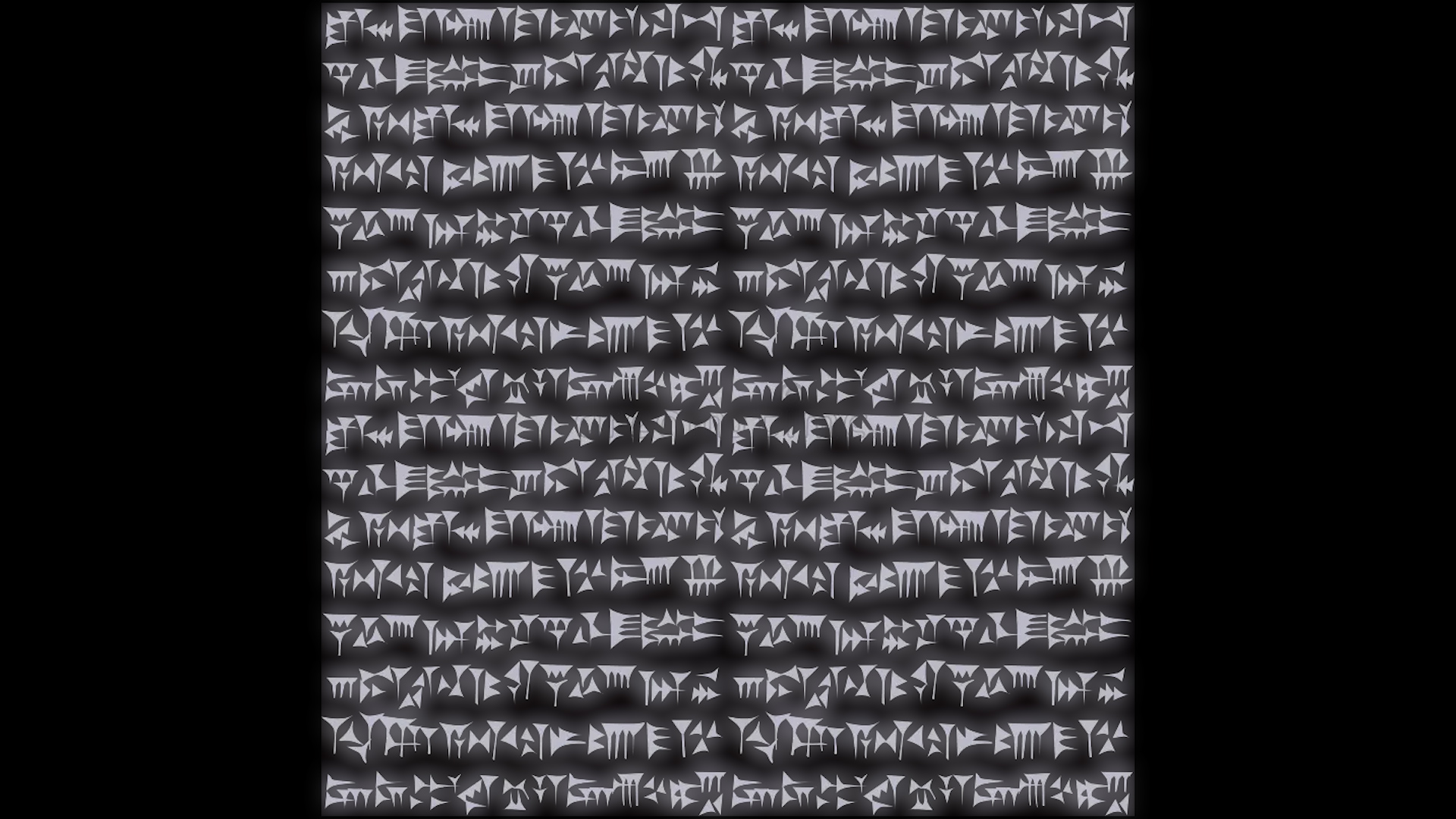
Drawing an arrow between the technological device that is a pointed weapon all the way to the mathematical object that directs our abstractive attention
▼ ▼ ▼
This is a feature for the SPIRES series curated by Kitsumute.
▼ ▼ ▼
Sonia de Jager [1]
The arrow might be, today, one-of-the-if-not-the-most pervasive symbol in the decorated world [2]. It suffices to say: look around you. From the mouse pointer on your screen; to the roadsign on your street; to the labels on your food; to any instruction manual; to almost all scientific diagrams, and more, and everywhere. Arrows direct our attention and volition, arrows imply possibility: from the moment they are launched from a hand; to the abstractions they seek to combine on paper; to the locations they draw us into. Arrows capture both relation and reference in an utterly convincing way, and there are multiple reasons we can investigate why and how this is the case.

When contemplated in its full history, conceptual facets and (re)presentations: its ubiquity is surprisingly undertheorized. No existing survey, to the author’s knowledge, spans the arrow’s not-so-straightforward trajectory from tool to → (navigation) symbol to → logic and mathematics. Sure, there exist plenty of books on notation and on the histories of symbols and on the uses of spear-like technology by different ob-ject-ifying hominins. But drawing a line→or arrow←between all of these is not only interesting as a (transdisciplinary, multimedia) research program, it is also philosophically valuable: it forces a (very crude, very loose, very concrete, very malleable, very transcendent) lens which can give us new insights into abstraction.

The arrow says something about aerodynamics and how we are physiologically embedded and biologically invested in the realities we produce-consume, it says something about the capacity to recursively, iteratively abstract at different levels of definition, it says something about the physics of energy transfer, and much more. Human enculturation would not have been what it is, without the arrow’s (mind-)extending, avantgarding, indexing, orienting effects.
Thought would not have been what it is without (its) technologies, and we might even argue a distinction between the two is impossible. [3] Our philosophical contemplation of the arrow is aimed at this larger question: what is thought, how is it materialized and how does it transfer? The arrow being a concept + object + symbol + predictive or teleological device par excellence, all simultaneously, gives us a pretty pertinent entry into many ways in which we could approach a conversation with this question.

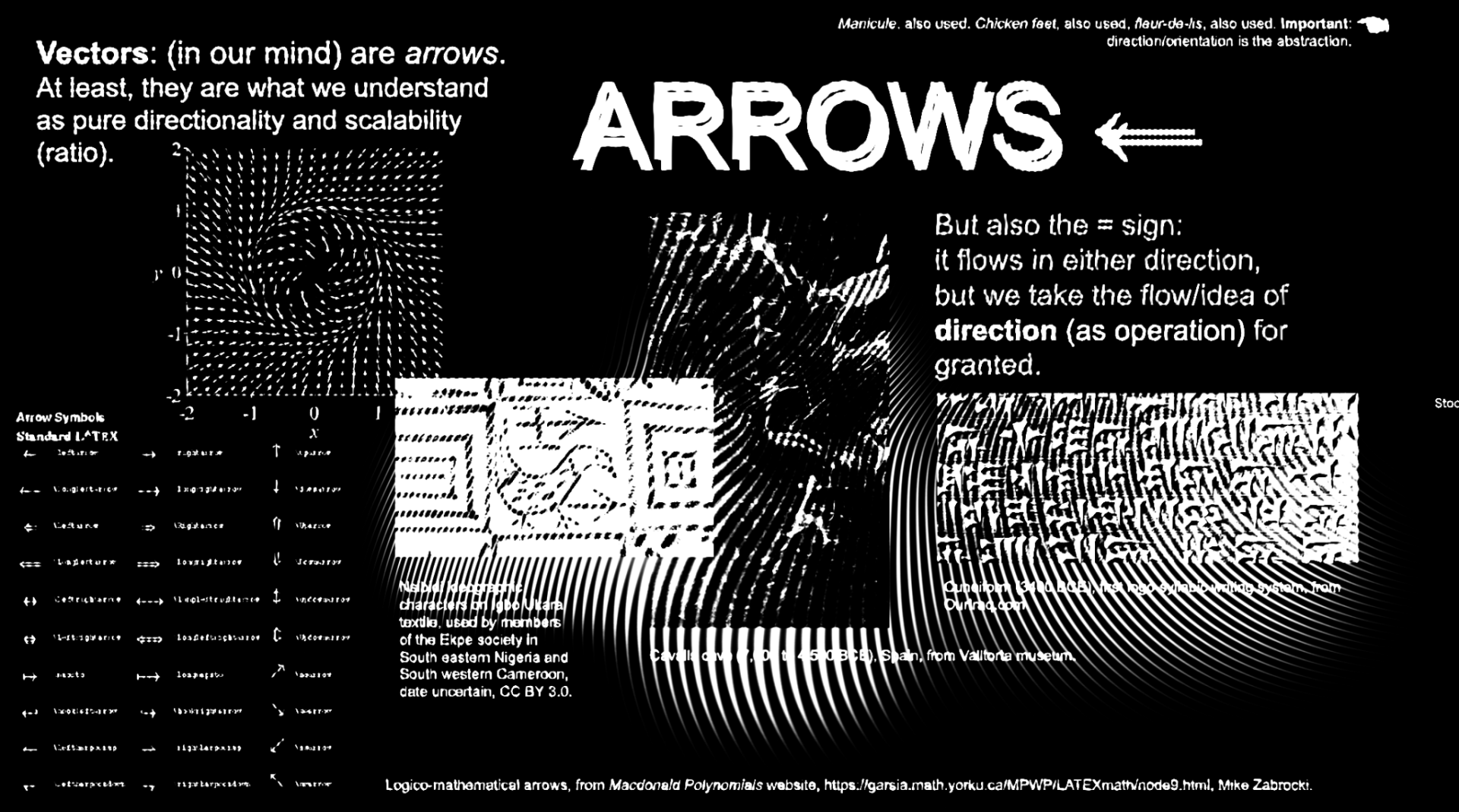
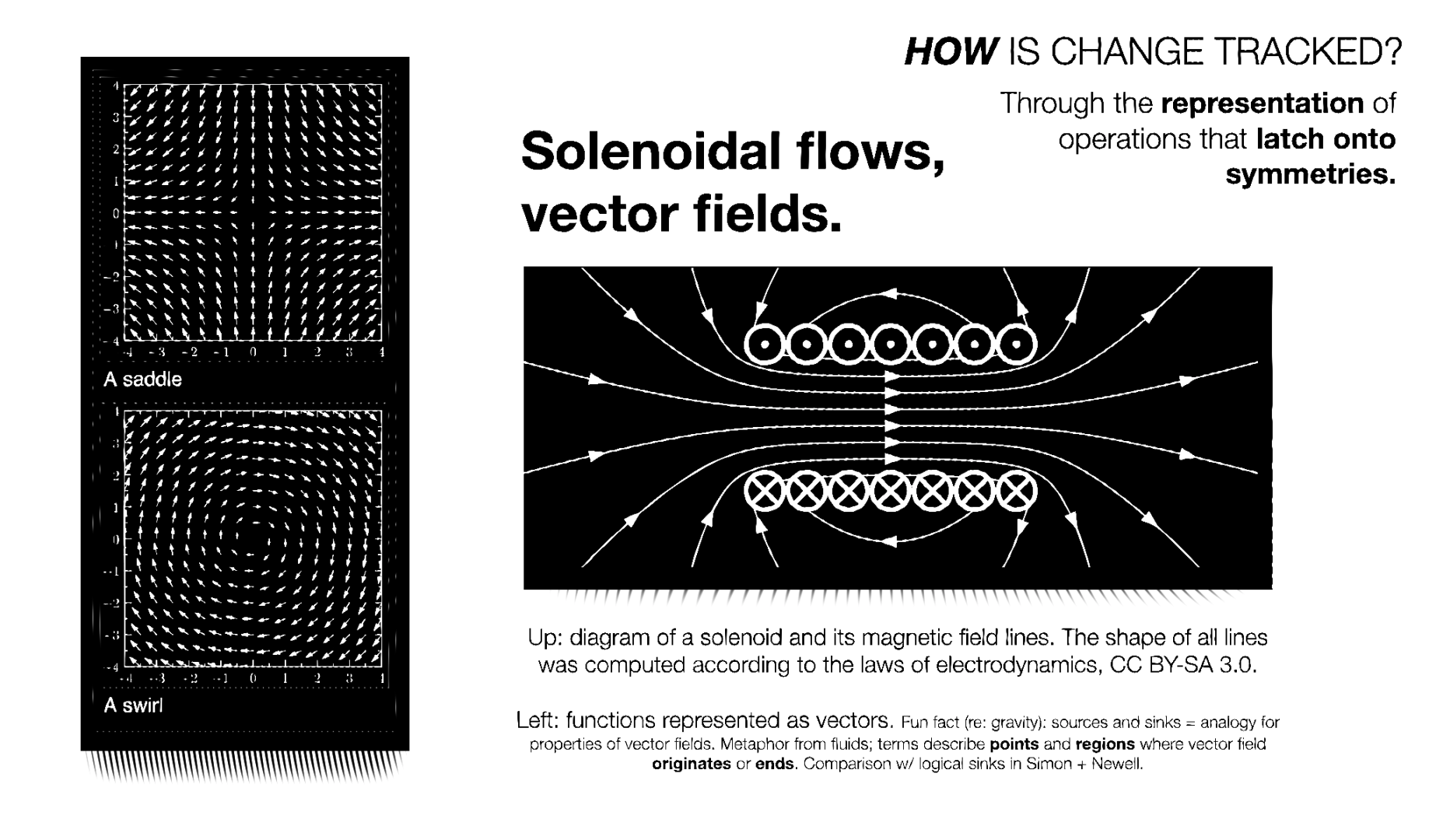
In print, it functions as a “visual verb” of sorts [4]— on everyday life surfaces (screens, signs, buildings, etc.): it indicates what we could aptly designate action potentials [5]. The arrow represents degrees of freedom; it reduces the complexity of possible interactions with the environment by presenting action constraints. In presenting us with possibilities the arrow often restricts possible predictive dimensions to near-singular directionality: whence this? The arrow gives us causality, sequences and it hides behind the operations that give us our most basic mathematical tools (which is why it now flies in full glory in contexts like category theory).

The arrow stems from us being bilaterally parted. We are (wonky) symmetrical beings, in many ways, a condition which affords different capacities for triangulation: between our two eyes, when we have them, between two minds, between different media: spreadsheets and microscopes. But indeed (if you had to stop and think for a second about the last two), in thinking triangulation between phenomena as divergent as numerical representations and historically-sharpened technological vectors: what of this capacity once it ascends and descends levels of (physiological and cognitive) abstraction?

Philosophically—not in logic, where it plays specific roles in different shapes and contexts, more on this later—the symbol of the arrow is rather unique in that it captures both relation and reference (two fundamental problems of, especially, Eurocentric 20th century musings on foundations). Its appearance and increasing proliferation in mathematical arenas hints, to the author, at the suspicion that understanding our uses of it will lead to new ways to understand thought and computation, because of opening up new perspectives on relation and reference. But this is beyond the brief scope of this reduced purview.
Let us move forward, downward.
↓

Symbols literally move reality: how about these scribbles dancing right in front of your face? Or them eventually becoming sounds you utter to someone else, who also ends up being moved by them? Moving implies direction, and vice versa. We are born from symmetries and their disrespecting (from comparable other beings, as well as endowed with specific morphological traits) and are oriented (biased, from a birth canal, in a particular history and geography). Every capacity we consider cognitive (visual or auditory/rhythmic processing, mathematical reasoning, linguistic prowess, complex planning, etc.) presupposes having a basic “sense of directionality” minimum. Every phenomenon we consider salient is always a breaking of symmetries: change, difference, dysfunction, noise, etc. An analysis of these phenomena presupposes how we are embodied and grounded → which assumes our given physiological (and analytical) symmetries, looping back. The arrow tacitly underlies it all, in its sheer simplicity.
We’re not the only ones with a (dynamic) penchant for triangles. And because of this we should also understand our limitations in how perception shapes reality, “all perception is (controlled) hallucination” (predictive processing dictum), i.e., we see what we want to see, because of what we are.
Which always bottoms out at the question: are patterns real?

The arrow is thus the abstraction of our ability to triangulate, its shape sitting visually comfortably with what we experience as the distancing vanishing-point effect of perspective. Looking at the horizon has the shape of an arrow. Based on physiological constraints, it is the concept that emerges from being evolutionarily so predisposed. We are pointing animals. But if we were a starfish, we might ‘think’ rather differently. As the history of metaphors-turned-concepts perhaps reveals: if we mostly threw rocks, or had teleportation technology, we’d probably have different concepts (of direction, or non-direction). Concepts—like “red”, “direction,” “cruelty”, or “mother”—are the abstractions through which we (on a phenomenal-linguistic spectrum) access reality. Concepts are constructive inferences, they are predictions about what could be, based on what has been.

Natural language is fuzzy and allows for interconceptual exploration: most concepts are flexible and open-ended. Because of the drive towards abstraction, the birth of different logics, and many more events, we have computational language(s): where our intentions can be well-defined enough for near-perfect prediction. Again, pay mind to how the arrow joins the fuzzy/possibilistic and the deterministic: it represents absolute accuracy in, e.g., a directed graph (no ambiguity: node → node) but, as a visual verb, on the road it tells you where to “sort of” go. In logic it gives us truth, and stripped bare, simply becoming a capacity to point (as well as to draw limits as degrees of freedom) it gives us the reference to ourselves, or others, it abstracts the in/out self/non-self binary. This is very chicken-or-egg: which came first? Think about LUCA (last universal common ancestor) floating around: did orientation precede referentiality or referentiality precede orientation? Can the two be conceptually decoupled, even?

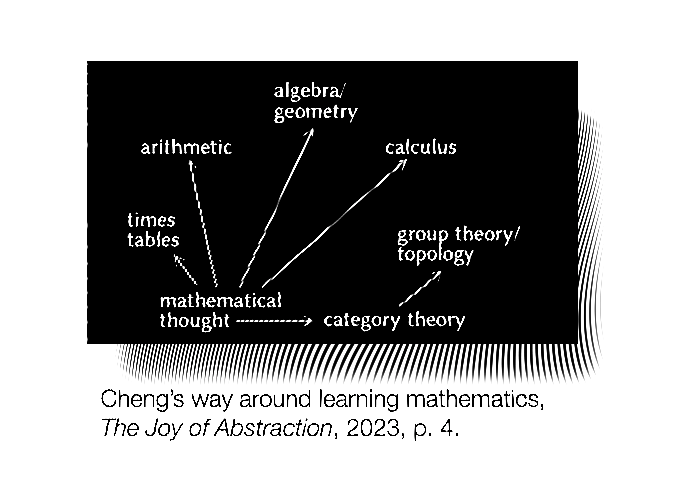
In category theory, we can contemplate this strange circular thinking about thinking; because the work there is to track how structures can and cannot be said to hold degrees of agreement with each other. In “The Joy of Abstraction”, Eugenia Cheng tells us that to witness similarities in thought processes is what enables cognitive efficiency. The circular then, being a low-energy configuration, makes sense in terms of efficiency: cycling through the same is an easy way to make sure persistence is guaranteed. The arrow breaks out of the circle, if you forgive this poetic phrasing. To abstract is to witness a relational property beyond a concrete object. This takes work. It has to break out. Gabriel Catren [6] sees category theory as the place where we can argue for a constructive place of abstraction, and we follow that impetus through this incursion into the arrow.
What further frames our drive are some unnerving questions: what happens when abstract entities gain traction on something beyond reference? E.g., in systems that build formal logics which entail (where there is a foreseeable degree of socially-agreed upon predetermination: e.g., in the effects/functions of logical operators). What is (self-)reference a possibility for?
If self-reference is the basic characteristic required for what we tend to call “perspective” (which assumes directionality), then perhaps the possibility of a self, where the ability to metacognize emerges from, too, is what presents to the self, as a possibility. Maintaining this possibilistic conversation with oneself is fundamental to experiencing a sense of continuity (memory, gravitational agency center, etc.) and the arrow provides an entry into this logic. More questions ought to follow.
• ✦ • ✦ • ✦ •
1. Please see the author’s website for more context on this research, which is slowly turning into a book, of (possibly) the same title.
2. Author will refrain from explaining most word choices from now on, but decided to place this one here as a signpost to invite (or point ↓) the reader to read many of the terms employed through various lenses. In the case of “decorated world” this does not only refer to the surface-level meaning of worlds where aesthetics—or: how sense-perceivers organize sense-perception for consumption—has been taken into consideration when constructing said worlds, but also to how the word harbors intention (directionality) at an etymological level, as well as how in many contexts the meaning of “decorated” implies someone having received designations which rank them in a particular(ly belligerent) social context. The history of the arrow is inevitably one of killing, dominating, consuming, obfuscating. Saying “decorated world” therefore signals both a fact and a dissatisfaction with said fact, or epistemic reality.
3. This text is part of the ongoing research by S. de Jager on the theme of “The Poltergeist in the Machine”, see the introduction to the project here for more thoughts on the subject of lowest common communication denominators such as the arrow, and their capacity to target interesting aspects of function, treated in this research as a concept which captures the identity of a process, resolving at least some of the conflicts between these two concepts.
4. Ji, Huichao and Brian J. Scholl. ““Visual verbs”: Dynamic event types are extracted spontaneously during visual perception.” Journal of Experimental Psychology: General 153, no. 10 (2024): 2441.
5. Another special “concept density” note: the author is here simply saying that arrows show where one could go or what one could do, but the author is also echoing action potential in neurons, phenomena which also have a non-symmetrical direction, and energy potentials in physics. Funnily enough, Wikipedia’s entry on “Potential energy” (accessed May 1st 2026) presents a tensed bow and arrow as the entry’s opening visual example.
6. Please see forthcoming article on CT by G. Catren.