Abstract
The traditional view of diagrams as secondary representations of prior ideas does not take into account the diagram’s formative function in mathematical invention; for if diagrams simply showed structures previously available to thought, the manipulation of them could not lead to genuine new knowledge. This essay claims that the diagram is to be defined as a productive, a-subjective reasoning space in which material restrictions, virtual pressure, and formal transformations generate relations surpassing intentions embodied in its original formulation. Using C. S. Peirce, Gilles Chatelet, Antoine Culioli, and Daniel Sacilotto to represent the diagram as a frozen gesture, i.e. strictly closed material arrangement, capable of generating heterogenetic opportunities by means of experimental manipulation of its internal syntax. The argumentation will allow us to understand phenomena such as theorematic reasoning and Shimojima’s “free ride” without reducing the necessity of diagrams to either subjective intuition or mechanical realization of an already given algorithm. The diagram is the missing link between the unmediated Heraclitean flow of things and the Parmenidean directly given formal structure; the activity of representation constitutes the result of previous work done by diagrams as intermediaries. The essay concludes that diagrammaticism implies a non-personal theory of logical depth as reason, having a material basis, loses its individuality.
Introduction
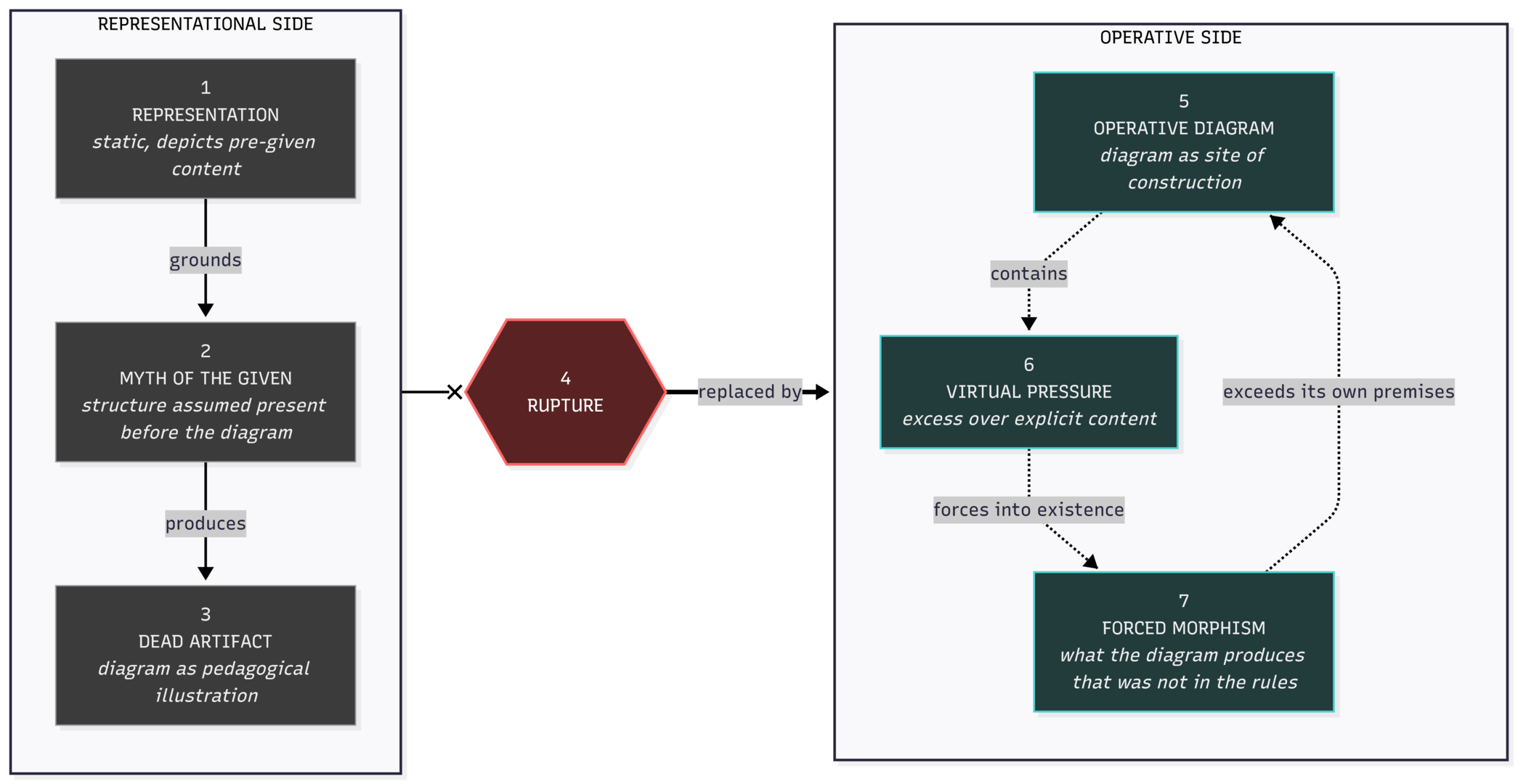
The ordinary assumption regarding diagrams is that they are merely illustrations, pedagogical pictures of thoughts that already exist in a purer and more logical form. In this view, the diagram is always secondary and derivative of the “real” logical content found elsewhere. If diagrams were merely illustrative, however, we could not account for the fact that thinkers consistently discover new knowledge by manipulating them. The history of mathematics is full of cases where the diagram came first. For example, Euler discovered the properties of graphs by drawing them, and Grothendieck operated in diagrams that preceded his formal statements. This traditional dismissal of the diagram is rooted in the myth of the given, c’est-à-dire, the assumption that the structure of a problem is already there before we begin to think about it. If the diagram were only a representation, it would be a dead artifact, which is to say that it could show us what we already know, but it could never invent. I want to argue that the diagram reasons through being a material site where virtual gestures are frozen, mobilized, and transformed into new ones, a process that is operative before it is representational and irreducible to the acts it appears to decompose into. To achieve this, we must move beyond viewing diagrams as mere proofs without words and recognize them as the gestures of thought.
The Myth of the Given and the Secondary Diagram

The representationalist account of diagrammatics asserts that the diagram functions primarily as a secondary sign, a heuristic vehicle that stands for a logical or mathematical content existing entirely independently of its graphical instantiation. In this framework, the diagram is defined as an individual image or a sensible particular that serves to illustrate universal truths which remain ontologically prior to the act of diagramming. For example, we can consider the treatment of the commutative diagram in category theory.
The diagrammatic arrangement of dots and arrows is understood to represent an objective mathematical fact, namely that two distinct sequences of morphisms compose to the same unique result. The diagram is considered useful only insofar as it makes this pre-existing relational symmetry visible to the human eye, facilitating the discovery of a truth that would remain valid even if no such figure were ever drawn. This traditional perspective is firmly anchored in Frege’s distinction between objective logical content and the contingent graphical expression used to communicate it.
Here, the diagram resides perpetually on the wrong side of the semiotic divide, getting relegated to the status of Vorstellung (a subjective representation) rather than Darstellung (a direct presentation of the thing itself) [1]. Because a diagram is a physical situation subjected to the vagueness of the sensory continuum, it is dismissed by formalists as a second-class citizen in the realm of rigorous proof. If logic is conceived as a blind calculation or a linear string of arbitrary signs, then the spatial intuition provided by a diagram is at best a pedagogical crutch to be discarded once the student ascends to the purity of symbolic formalism.
The failure of the strictly representational account of the diagram is also corroborated by the metalinguistic aporias found within contemporary linguistics, specifically in the work of Antoine Culioli. As Lionel Dufaye observes, Culioli’s Théorie des Opérations Prédicatives et Énonciatives (TOPE) posits that while linguistic markers represent representations, they are never truly equivalent to the fluid notional activity they attempt to capture. In this framework, the relationship between a word and a notion is fundamentally asymmetrical, as a notion is only “partially captured” by the discrete units of language [2]. This structural limitation illustrates Sellars’ myth of the given by demonstrating that language acts as a restrictive frame that, as Laplane writes, “freezes the fluidity of thought in its gel” [3].
Even at the level of the basic linguistic mark, the representational model collapses because the signifier cannot sustain the overflowing symbolic activity of the mental gesture. The diagram, when viewed as a secondary and static representation, suffers from this same terminal inadequacy, stratifying into an incomplete freezing of a dynamic and infralinguistic process that invariably exceeds its formal boundaries.
If the diagram is merely a secondary transcription of a pre-existing logical content, one must account for the status of that content prior to its diagrammatic inscription. The myth of the given here is the fallacious assumption that mathematical or logical structures exist in a finished, directly drawable state awaiting a pictorial aid. This perspective is dismantled by the historical and technical reality of mathematical invention, where the diagram is not a reproduction of a structure but the very site of its production [4].
For Leonard Euler, the topology of the Königsberg bridge problem did not persist as a latent given of graph theory before his pen touched the paper, but rather, the act of drawing the diagram constituted the invention of the theory itself. The diagrammatic intervention allowed for a marvellous help that made the correctness of reasoning jump to the eyes through the organization of space, a process that linguistic or symbolic formalization could only attempt to mirror post hoc [5]. Similarly, the categorical diagrams of Alexander Grothendieck functioned as the operative milieu in which complex entities like schemes and topoi became thinkable for the first time [6].
As Neil Tennant, cited in Logical Reasoning with Diagrams, argues the representational view of the diagram predicates itself on the assumption that the diagram is merely a “heuristic to prompt certain trains of inference” but is ultimately dispensable as a proof-theoretic device [7]. This traditional dogma suggests that a proof is a purely syntactic object consisting only of sentences and that any visual accompaniment is a superfluous, potentially fallacious adjunct.
Such a view constitutes the myth of the given applied to diagrammatics, as it assumes that a logical structure exists in some purer or ancestral form independently of its material inscription, waiting only to be illustrated or depicted. As established in Reza Negarestani’s formidable Intelligence and Spirit, following the tradition of the Pittsburgh School of Sellars, the myth of the given is the foundational assumption that pre-conceptual content, or Nature, possesses an inherent epistemic authority or structured aboutness prior to the mediation of the sign, the gesture, or the concept [8].
This diagnosis reveals a profound misunderstanding of the operative nature of thought. If diagrams were merely illustrative, the history of mathematical invention would be inexplicable, mathematicians would not consistently discover new properties by manipulating the very pictures they were supposedly just using, for pedagogical relief. In reality, structure is constituted through the gesture. The representational given assumes that the sign substitutes for something that exists independently of the sign-system, but as the work of Euler and Grothendieck demonstrates, the correctness of reasoning is often something that must be “given to see” (Euler’s donne à voir) through the diagrammatic act itself [9]. Euler’s practice showed that the correctness of syllogistic modes jumps to the eyes through the topological relations of inclusion and exclusion in his circles.
In Euler’s view, the visual intuitions underlying diagrammatic practice are transformed into logical intuitions capable of providing an adequate view of the forms of propositions. Similarly, Alexander Grothendieck’s creative innocence and his introduction of schemes and dessins d’enfants (children’s drawings) reveal that deep mathematical structures are discovered only through the extrinsic invention of expressive diagrammatic languages, thus, mathematical evidence was found in the natural effect produced when the space between the symbol and the gesture is abolished.
The dismantling of the dead image of diagrams begins with the deconstruction of the myth of the given, the epistemological fallacy which posits that certain items of knowledge are present to the mind immediately and without the mediation of prior inferential structures. Within semiotics, this myth manifests as the assumption that linguistic items or visual signs possess intrinsic meanings that are simply expressed or communicated rather than being dynamically constituted through use.
So, the static diagram is often erroneously treated as a mere visual archive or a mirror of a persisting world. To counter this dead approach, Antoine Culioli and Lionel Dufaye in Fluid Formalisms distinguish between the static diagram and the dynamic graph, a distinction that shifts the focus from the sign as a repository of meaning to the sign as an operative site of construction.
The static diagram serves as a “cartography of the wefts and warps of the semantic fabric,” representing the khrema, the available material or the state of affairs as it is given in a finite, territorialized approach [10]. However, such a representation risks freezing the fluidity of thought in its gel, reducing the processual activity of the mind to a series of discrete, inert markers. Culioli insists that this must be supplemented by the dynamic graph, which corresponds to the Greek pragma, that which we make of the available material. The static diagram identifies the coordinates of a territory, the dynamic graph expresses the meta-operations performed upon those components, such as the ponderation of certain dimensions or the stretching of others to account for semantic plasticity.
Thus, we are concerned here with the operative character of the diagram that the dead account misses. Two thinkers provide this from different directions: Peirce from semiotics and Châtelet from the phenomenology of mathematical practice. The operative diagram as a material site of frozen gesture, virtual pressure, and heterogenetic production. A third thinker, Reza Negarestani, gives this account its ontological ground by reframing philosophy itself as a program for world-building. By identifying the diagonal as a synthesis between horizontal networks and vertical hierarchies, Negarestani establishes the diagram as a navigational tool for emancipation, where the logical depth of the construction becomes the measure of its intelligence.
For a Reasoning in Diagrams

In Peirce’s semiotic architecture, the capacity of a sign to facilitate deductive reasoning is rooted in its specific relational structure, a quality that distinguishes the diagram from other modes of representation. Peirce situates the diagram within his fundamental trichotomy of signs, which are defined by the nature of the relationship between the representamen and its object. While the icon signifies through resemblance, the index through causal or factual connection, and the symbol through arbitrary convention or law, the diagram occupies a unique position as a relational icon.
Peirce’s trichotomy of signs constitutes a foundational framework for understanding how different modes of representation relate to their objects. This classification is rooted in Peirce’s broader metaphysical categories of Firstness, Secondness, and Thirdness, which describe the universal modes of experience. While many semiotic systems focus on the arbitrary nature of the linguistic sign, Peirce’s system emphasizes a plural relation where signs are embodied to convey cognition from a deliverer to an interpreter.
1. The icon is a sign that refers to its object by virtue of a mere community in some quality or resemblance. It represents its object primarily through similarity, regardless of its mode of being. Icons exhibit features of a state of things as if they were purely imaginary. A painting of a person or a simple image of a black square functions iconically because the visual form resembles the intended object. A pure icon is a sign that represents whatever it may represent solely through its suchness, carrying no factual information but is valuable for enabling an interpreter to study the character of an object if it were to exist. The icon can integrate general elements, even if it looks like a simple image, but as it integrates less generality, it approaches mere suchness, which facilitates experimental manipulation, which, as we’ll see later on, is of great importance in diagrammatic reasoning [11].
2. The index is a sign whose relationship to its object consists of a correspondence in fact or a causal connection, being marked by the brute reaction and alterity of Secondness. In opposition to the icon, which relies on resemblance, the index relies on contiguity or an actual existential bond. For example, a weathervane pointing in the direction of the wind or a footprint indicating that someone has passed. The index has a pure denotative force that is non-discursive, locating objects and events in time and space—identifying the where and when—in a way that icons and symbols cannot.
3. The symbol is a sign whose ground of relation to its object is an imputed character or a conventional law, corresponding to the category of Thirdness, which involves mediation, habit, and generality. Symbols function through a socially coded system of conventions that must be learned. Language, mathematical symbols, and sign-posts are all symbolic because their meanings are established by rules rather than resemblance or physical connection [12]. The value of a symbol lies in its ability to make thought and conduct rational, enabling the prediction of the future, representing a general mode of rational conduct that would ensue upon the acceptance of the sign [13]. The intellectual purport of a symbol is fundamentally linked to the formation of a habit. A symbol incorporates a general disposition to act in a certain way, acting as a catalyst that causes these habits to be reinforced or modified.
The diagram occupies a privileged position within the iconic category as a relational icon or icon of intelligible relations. Unlike a simple image or photograph, which might replicate sensory qualities, the diagram’s iconicity is strictly structural, mapping the internal relational logic of its object onto its own constituent parts. For example, a geographical map does not mimic the visual appearance of a terrain but preserves the isomorphism of its spatial relations [14]. This structural rather than sensory orientation explains why the diagram serves as the primary instrument for mathematical and logical reasoning; it can represent abstract entities that lack any perceptible form by exhibiting the necessary relations that constitute them.
Therefore, this can be conceptualized as diagrammatic reasoning. An experimental practice that fundamentally destabilizes the traditional distinction between passive observation and active ratiocination. At the heart of this process is the construction of a diagram according to a specific set of rules or hypotheses. However, the defining characteristic of diagrammatic reasoning is not the mere act of construction, but the subsequent stage of experimentation upon said diagrammatic site. As Peirce notes, these operations, whether performed on paper or within the “mind’s eye,” are functionally equivalent to the physical experiments conducted in the natural sciences, “questions put to the Nature of the relations concerned” [15].
The practice enters the realm of theorematic reasoning, where the introduction of new elements, such as subsidiary lines in geometry or permissible transformations in algebra, alters the relational field of the diagram. This manipulation leads to structural surprise, the emergence of necessary relations that were not explicitly stipulated by the initial construction rules. We call this surprise structural because it results from the inherent constraints of the diagrammatic medium, that is, its operational constraints.
This phenomenon is what Atsushi Shimojima defines as a free ride [16]. A free ride occurs when the physical or topological configuration of a diagram site causes a new fact to be realized as a side-effect of valid operations. For example, in the construction of a Venn diagram or Euler circles, once certain premises are graphically encoded (such as “All A are B” and “All B are C”), the conclusion (“All A are C”) becomes manifest on the diagram site without the reasoner having to take a specific step to represent it. The information appears as if miraculously because it is a consequence of the interaction between the symbolic rules of the system and the material/spatial form of the representation. This seeing thus involved in diagrammatic reasoning is therefore a fusion of vision and thought. As the diagram is a manifest theory of relations, it instantiates the very structure it represents, its syntax becomes a direct instance of its semantics. The mathematician experiments by skeletonizing the problem, stripping away accidental features to expose the significant relations.
In doing so, the diagram becomes the theatre of the movements of intelligible matter, an external object of observation that is simultaneously an immediate embodiment of the reasoning process itself [17]. Therefore, this experimental practice demonstrates that necessary reasoning is observational. Through manipulating the diagram and observing the results, the reasoner discovers unnoticed and hidden relations among the parts that were not part of the original design. The deductive must of a conclusion is thus perceived as an indefensible compulsiveness similar to a perceptual judgment, hence the mathematician recognizes that the conclusion is compelled by the very conditions under which the diagram was constructed.
For example:

Consider a classic commutative square in category theory: a diagrammatic configuration consisting of four objects—A at the top left, B at the top right, C at the bottom left, and D at the bottom right. Connecting these objects are four established, solid morphisms: f:A→B, h:A→C, g:B→D, and k:C→D. The entire structure is governed by the commutativity condition g∘f=k∘h, a background relation that ensures both paths from A to D yield the same result. This commutative diagram functions as a relational icon that makes the deductive force of necessary reasoning visually given. Within this square, we introduce a dotted morphism, ∃!m:A→D, as a virtual pressure forced by commutativity. The diagrammatic syntax here worries the already available image by introducing a pressure that creates space for a new dimension, the existence of m. The reader discovers the necessity of this morphism through a fusion of vision and thought in which the answer jumps to the eyes.
Yet, while Peirce identifies the fact of this productive excess, he leaves the underlying mechanism of the experiment largely underspecified. He admits that the mathematician’s ability to guess in advance what changes to make is a mystery, often treating the transformative step as a matter of individual will or aesthetic intuition rather than defining the formal mechanics of the transformation itself. Consequently, even though Peirce captures the continuity of thinking in actu, he does not provide a robust account of the specific operative forces that allow a configuration to transcend its own materiality.
Freezing, Cutting Gestures

The act, within the work of Gilles Châtelet, functions as the endlessly repeatable segment of action, serving as the minimal unit of algorithmic execution that defines the legible surface of mathematical practice [18]. This atom of the algorithmic is governed by a legality that controls its staging through a definitive protocol of decomposition, ensuring that the operation is exhausted by its own results and lacks the potential of irritation necessary to perturb established equilibria. In Culioli’s terminology, the act inhabits the domain of khrema, that which is available, wherein metalinguistic representations are fixed and materialized as a sequence of discrete members insulated from the transformative pressure of the virtual [19].
In Negarestani’s architecture in Intelligence and Spirit, it corresponds to abilities, a form of pattern-governed behavior characterized by structural capacities and memoryless combinatorial iteration, which, unlike recursion, fails to encode the history of transformations between constituents [20]. The act functions as a pudibonderie ingrate of operative clarity, a passive registration of ontological states that remains atonic and incapable of launching multiscalar problems that characterize the heterogenetic movement of the diagram.

On the other hand, the gesture must be understood as a modality of movement that is categorically distinct from the endlessly repeatable segments constituting the act. Whereas the act conforms to an algorithmic legality that exhausts itself in its own production, the gesture is inaugural and elastic, possessing an intrinsic capacity to gain amplitude by determining its own field of influence. This elasticity ensures that a gesture awakens other gestures, functioning as a reservoir of germinal forms that stores up allusion’s provocative virtualities without debasing them into mere abbreviations [21]. By perturbing the equilibria presupposed by stabilized protocols, the gesture acts as a clinamen-like operator [22] that tears through preorganized semiosis to release clumps of meaning that precede new praxeological frameworks. Consequently, the gesture cannot be decomposed into a series of acts without losing the pressure of the virtuality that defines its ontologico-epistemological texture.
To segment it would be to strip it of its ability to envelop its own unfolding. This generative excess establishes the diagram as a multiplier of virtualities where every manual mark leaps over the figure to force the creation of new problematic Ideals. The gesture is thus identified with Culioli’s pragma, the domain of what we make of the available khrema, wherein meaning is dynamically built through the trace of mental gestures. The gesture hence immobilizes a specific movement only to sketch its unfolding toward a non-yet-thought horizon, ensuring that the diagram remains a machinic power capable of adapting to a reality yet to come.
Diagrams are not acts nor gestures. Diagrams function as a transfixed gesture, seized mid-flight to establish a metastable site of intensive operation. In Châtelet’s formulation, the diagram immobilizes movement to condense the virtual pressure that worries the stability of the graphic figure, ensuring that the manual order breaks all figurative coordinates to liberate new possibilities of fact [23]. This stasis is the precondition for the diagram’s specific mode of existence, an ontology wherein its genesis is comprised in its being.
It is here that the thick lines of the established image are haunted by the blossoming of dotted lines, which denote the pressure of the virtuality creating space for an emergent dimension. The diagram is a swarm of virtual gestures held in an ascesis of closure [24], a cistern of potentiality that reasons by its capacity to leap over existing figurations and force the creation of new individuals. This revanche de la main ensures that the diagrammatic site remains a locus of fulguration, where the transfixion of one gesture necessarily serves as the germe d’entourages for the next, asserting an ontology of the provisional that perpetually relaunches its own processual trajectory through a series of allusive stratagems.
The thick lines of the diagram constitute the sedimented residue of actualized gestures, expressing the stabilized regularities and acts of a determined semiotic field where the movement of thought has been momentarily transfixed into a formal closure. The dotted lines function as the constraint of virtuality, worrying the thick, figured images to create an aperture for a new dimension that is not yet given in act but is already operative as a germ of deformation [25] within the diagrammatic substrate.
This distinction reveals that the diagram’s mode of existence is a genesis comprised in its being, where the formal constraints of the visible morphisms (the thick lines) act as a frozen configuration that simultaneously harbors an invisible reservoir of potential trajectories. In the case of an arrow from A to D represented by a dotted line, this inscription is the structural demand of an elusive stratagem that leaps over the figures to necessitate the emergence of a new individual. The mathematician who completes the diagram is thus engaged in the actualization of a virtual possible, providing the carnal eidos of the line through a gesture that responds to the specific vibratory patterns already latent in the diagram’s rigorous closure.
Therefore, the capacity of the diagram to reason is predicated upon its status as a frozen gesture that immobilizes a movement only to cut out new ones from its own virtual interiority. As La Mantia suggests, the diagrammatic mode of existence is uniquely defined by a genesis comprised in its being, establishing a territory of tensions where the genesis of a configuration is never exhausted by its local conditions of production [26]. This productive excess over explicit content is what Châtelet identifies as the constrain of virtuality, expressed in the dotted line which, far from designating a discrete point, worries the thick figurative trace to create space for a new dimension.
This is why the surprise noted by Peirce in the exercise of theorematic reasoning is created as a formal consequence of the medium’s machinic power. The mathematician observes unnoticed and hidden relations because the diagrammatic site acts as a reservoir of germinal forms or loci of fulguration that harbor gestures not yet made. The diagrammatic interplay thus functions as a demon of proof, guiding the mathematician toward discoveries that exceed the initial precept or construction rules [27]. By transfixing a gesture mid-air, the diagram preserves the intensity of the possible against the pudibonderie of operational clarity, allowing the mathematician to observe the conclusion as being compelled to be true by a virtuality that is real without being actual. Reasoning here is the gestural adjustment of these free fluctuations, where the diagrammatic site becomes the very armature intérieure of a thought in movement.
The diagrammed, summarized in the formula le diagramme saute par-dessus les figures, designates the operative mechanism whereby the diagrammatic act ceases to be a static encoding and becomes an autonomous machinic power. This jump is strictly heterogenetic, as it functions through a categorical leap that forces the creation of new individuals whose nature is fundamentally irreducible to the initial figurative starting point. Within this framework, the emergence of a dotted arrow or a supplemental morphism in a categorical operation is an effect of virtual constraint that worries the image until it explodes into a new dimension. As Charles Alunni elucidates in his characterization of the diagram as the demon of proof, this jump constitutes a theoretical jump or allusive stratagem that re-enchains thought across discontinuities [28]. The diagrammatic jump constitutes the formalization of Peirce’s experiment, providing the genetic mechanism for what Peirce identified as the synthetic extension of knowledge, a movement he observed as the hallmark of theorematic reasoning but left structurally opaque. This jump beyond the figure (saute par-dessus les figures), as articulated in Châtelet, is the operative actualization of the constraint of virtuality inherent in the diagram’s material construction. By functioning as a rigorous site of closure, the diagram serves as a machinic incubator for implicit gestures that the experimental manipulation forces into manifest visibility.
This is the essence of Alunni’s demon of proof, an operative power that orients the demonstration through a series of heterogenetic ruptures, where the dotted lines (pointillés) of potentiality erupt through the constraints of the established figure to liberate new plastic unities. Knowledge is extended because the diagrammatic site contains more than its initial parameters, harboring an invisible reservoir of gestural traces and prefigures that are relaunched through the act of scribing. The diagram reasons because its material limits are rigorous enough to act as a catalyst for the contingent, transforming the khrema of the static representation into the pragma of a synthetic event that jumps over the deductive impasse to produce an unforeseen relational truth.
Yet, if we are attentive, we will see an antinomy arise: Chatelet’s reliance on the revanche de la main, the revenge of the hand that subverts linear successivity to reach higher degrees of abstraction, threatens to re-tether the operative force of the diagram to an irreducible phenomenological remainder. Writing the gesture as an elastic, inaugural, and pre-semiotic movement that awakens in us other gestures, Châtelet’s vocabulary seemingly necessitates a specific site of sensorimotor intentionality, a living body or operative body from Merleau-Ponty capable of registering the vibratory patterns and pressures of virtuality latent within the formal layout. This reliance on the carnality of the mathematical eidos poses a substantial challenge to the neorationalist project of a deprivatized account of mind, which identifies spirit with its own deeds within a functionalist, social-discursive space [29].
The revanche itself, where notation contaminates calculation to produce an auto-spatiality akin to a literary metaphor, suggests the hand is an active participant in the stratagem rather than a mere extension of a formal program, thereby forcing a confrontation with the neorationalist claim that these normative structures can maintain their axial force without a structuring agent. The problem remains whether the diagrammatic locus of contraction is a mind-independent formal property or a logical phenomenology whose how is perpetually dependent on the specific constraints of the human cognitive-practical apparatus.
If, as Roger Sessions suggests in the context of gestural ontology, a gesture necessarily diminishes into a static, impact-less state unless it is on each occasion reinvested with fresh energy by an enacting agent, then the pressure of the virtuality that Châtelet locates in the dotted line ceases to be a formal necessity and becomes a relational property dependent on a specific body [30]. The allusive stratagem of the diagram would then not reason of its own accord, as its productive excess would be an effect of cultivated perceptual habits or a gestural discipline that the mathematician projects onto the material sheet. Such a conclusion would severely destabilize the neorationalist thesis of functional autonomy, which seeks to demonstrate how a complex system can be structured without a structuring agent via an axial proposition derived from abstract mathematical formulas [31].
To concede that the diagram’s power of saut (jump) resides primarily in the body’s Einfühlung (intropathy) is to risk reducing the logical irreducibility of rational thought to a mere animal dimension of neuromuscular action. The dotted arrow of a commutative square would not represent a structural necessity forced by the ascesis of closure, it would merely be the subjective completion of a habituated gestural economy. The structural consequence of this subjectivist retreat is that the diagrammatic function, which should mesh directly with material flows to catalyse machinic choices, would be demoted to a passive illustration of a content already available.
Our objection sharpens into a dilemma: either the diagram’s virtuality is intrinsic to its material-relational configuration, in which case it must remain operative independently of any attending consciousness, or it is phenomenologically constituted, in which case Châtelet’s account collapses back into a sophisticated version of the representationalism it sought to dismantle. If the virtual pressure that worries the already available image requires the mobile corporeality of Dasein to be incarnated in the mobile point for its generative potential to be realized, the diagram returns to the status of a dead artifact, a mere placeholder waiting for a living mind to animate it from without.
Following Merleau-Ponty, who identifies the body as a sheaf of functions interlacing vision and movement, purchases the reality of the operative gesture only at the cost of the diagram’s autonomy [32]. If we attempt to secure the diagram’s autonomy by retreating into a structuralism of blind algorithmic drawing, we are left with a colder sense of notation that cannot account for the productive, heterogenetic leap of the revanche de la main. As Negarestani notes, the functional autonomy of such systems must be materially constrained yet capable of abstract protocols of rationality that function without a structuring agent [33]. The axis of the diagrammatic system, much like an axial proposition, is derived from a formal-mathematical necessity that must hold the system in place regardless of the subjective representation or manual traits involved in its execution. The argument cannot rest with Châtelet’s intropathy, therefore it requires a transition toward an impersonal ascesis of closure that explains how the diagrammatic real materially writes itself through the logical irreducibility of its own constraints.
The maintenance of the diagrammatic site’s epistemic autonomy, namely the assertion that it genuinely generates knowledge rather than merely serving as an auxiliary for a subject’s interpretive investment, necessitates a pre-subjective commitment that grounds the constraint of virtuality within the formal architecture of the diagram itself. Within this rigorous ascesis of closure, the diagram operates prior to and independently of any psychological act of recognition, functioning as a system of operative constraints that dictates the possibility of its own transformation. This is where Negarestani’s functionalist resolution becomes necessary, namely, the claim that mind is only what it does serves as the only move capable of reframing the subject from a phenomenological who-feels to a functional what-structures.
For Negarestani, mind is a functional designation for the very act of structuration, meaning that the “I that thinks” is fundamentally an encapsulation of the formal movement of self-consciousness through shared logico-conceptual rules [34]. Thereupon, what is traditionally characterized as subjectivity is a local expression of the same multi-level structural constraints that the diagram enacts at the level of its material syntax. The mathematician does not bring virtuality to the diagram from an external inner state or intellectual intuition, but the diagram recruits the mathematician as a functional item or realizer in the propagation of its own operative gestures. Subsequently, if we replace the spontaneous image of the thinking ego with a functionalist account of agency as a mode of integration of computational processes, the diagram’s reasoning would be constructed as a direct manifestation of its own logical depth.
The diagrammatic gesture must be understood as fundamentally pre-subjective, an ontologico-epistemological commitment that severs the neorationalist project from the ontologico-phenomenological preoccupation with lived experience or the anthropocentric intentional project. Within Negarestani, reasoning is a deprivatized structuration realized through social and material scaffolds. Symmetrically, the diagram is only what it does, insofar as its machinic power and operative power actively perform the labor of dividing, knotting, and extending the continuum to produce new facts, the diagram must be understood as an objective instantiation of reasoning prior to any subject who reasons through it. It follows, drawing upon Robert Brandom’s distinction between mind-independence and attitude-independence, that the diagrammatic site is strictly attitude-independent, which is to say that its internal inferential structure and its consequences of application are determined by the rigorous rules of its own construction rather than by the subjective taking or interpreting performed by a particular agent [35].
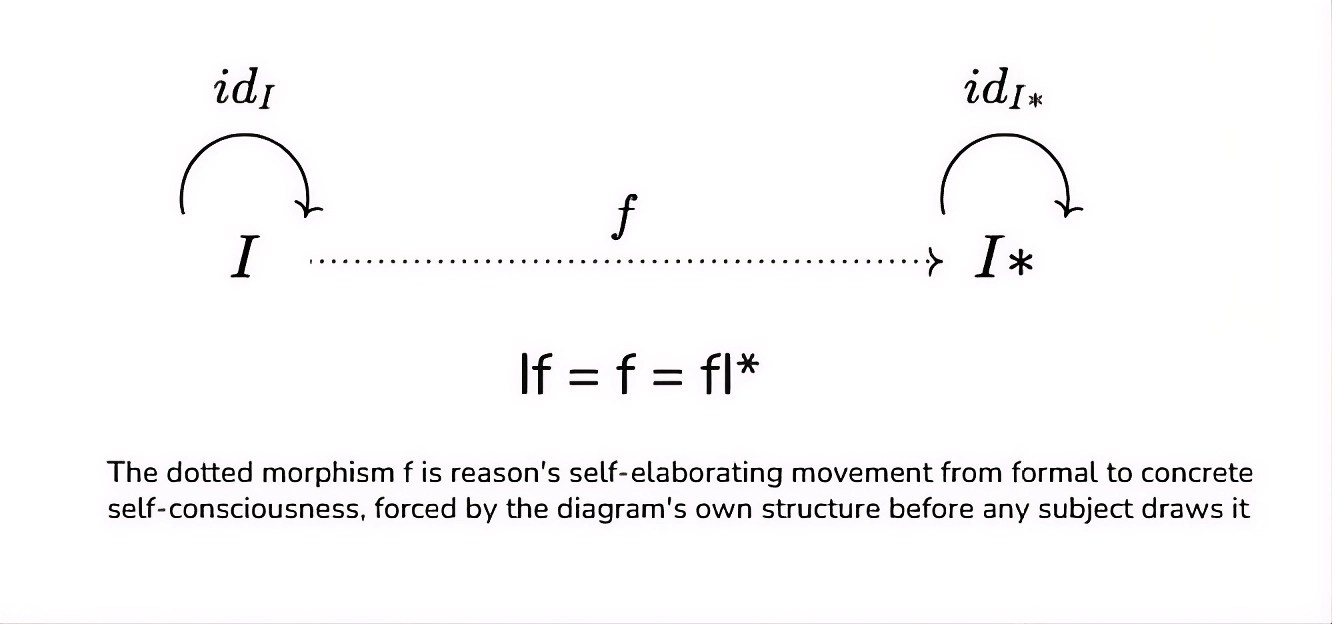
Negarestani defines sapience as a “functional diagram”, a minimal, revisable description of the capacities required for thought and action that functions as a sui generis form [36]. This diagrammatic nature is articulated in the I=I∗ formalism, which models the transition from formal self-consciousness (I) to concrete self-consciousness (I∗) through the labour of negation. By utilizing Lawvere’s functorial semantics, this transformation is revealed to be a commutative diagram where the morphism f:I→I∗ represents a mapping that preserves structure while facilitating the unbinding of the apperceptive self from the here and now. The identity relation If=f=fI∗ establishes that the formal and the concrete are structurally correlated through identity transformations, yet the dotted arrow of f serves as the site where the trivial curriculum of the monadic ‘I’ is superseded by the functional circle of a reality in excess of thought. When the mathematician follows the virtual pressure or the allusive stratagems of the diagram, they are participating in the autonomous self-realization of reason through a material substrate that reason has already inhabited and structured. The diagram, as a pure transcendental condition, thus becomes a toy meaning-dispenser where the interaction between verifier and falsifier, cognitive and recognitive, mechanizes the architectonics of negation to leap toward new forms of intelligibility [37].
The diagrammatic site, typified by the rigorous constraints of the categorical commutative square, replaces, as Negarestani in his 2026 lecture ‘Contingency, Priced In’ calls it, the “anemic discourse of risk” and “managed deviation” prevalent in contemporary aesthetic practice with a material ascesis of closure [38]. In Contingency and Complicity, Negarestani writes that genuine encounter with contingency is structurally distinct from naive openness, which remains tethered to the affordances of the subject and is thus limited by what the cognitive agent can afford the outside [39]. Complicity demands a twisted type of interaction wherein the diagram is a site of structural accountability rigorous enough to be butchered open by the very materials it seeks to organize.
The reasoning power of the diagram resides in this paradoxical inversion, because it is the closure of attentional processing, the thick lines and rigorous rules that exclude infinite recursion, which allows the virtual pressure of the outside to express itself as an impelling mechanism. As it imposes a formal capture that dates a process and secures diagrammatic consistency, the diagrammatic site becomes a genuine prey for the intervention of its contingent materials, forcing the work to disclose its dependencies and externalize its metabolic costs. Reasoning is thus enacted through the pressure of what the closed structure is structurally incapable of absorbing, a collision that transforms the bare entanglement of the Given into the active organization of the Giving [40].
Furthermore, the diagrammatic operation constitutes the site of what Negarestani, following Charles H. Bennett, identifies as a deep object, defined by the radical disparity between its compact generative description and the protracted, structured trajectory required for its realization [41]. While the syntactic constraints of a diagrammatic frame, such as the formal properties of a commutative square, may possess low Kolmogorov complexity [42] evidenced by a minimal description length, the actualization of the virtual pressure inherent in its configuration remains computationally expensive. This realization cost represents the diagram’s logical depth, an internal index of the plausible number of computational steps in its causal history, acting as a vessel for the organized history of sedimented gestures of thought.
Within this framework, Châtelet’s dotted line is an unrealized logical depth that worries the already available image. When the mathematician executes the heterogenetic leap to a forced morphism, they are paying the reconstruction cost of a deep object whose compressed vector of labor and past intelligence demands actualization. This process is predicated upon the ascesis of closure, as it is only by maintaining a rigorous formal boundary that the diagrammatic site can be opened by, rather than merely open to, the contingent materials and technical inheritances that puncture the mathematician’s intention.
The diagram reasons, therefore, because its depth renders it irreducible to a shallow algorithm or a memoryless iterative process, hence it functions as a message in a bottle that must be simulated through a protracted trajectory of conceptual labor to reveal the conditioned necessity of its internal logic.
Two Consequences of the Operative Gesture: Epistemological

The standard view of mathematical cognition as a process of externalizing a pre-existing internal ideation is fundamentally inverted when the diagram is understood as a site of operative construction. Rather than serving as a transparent medium for a prior noēsis, the diagram constitutes the theatre of movements of intelligible matter wherein thought appears as a fulguration or lightning bolt triggered by the specific preparation of the figure. Following Châtelet, this suggests that the mathematician does not see a truth and then scribe it, rather, the activity of the hand in scribing allusive stratagems creates the circumstance by which thought is accablé, overwhelmed or burdened, by a new dimension of the virtual [43]. In this encounter, the diagram acts as a deep object, possessing a compact generative description yet requires a protracted and structured trajectory of real realization through gestural experimentation. The thought is not the origin of the line, but the result of the line’s own becoming-other as it follows the pressure of virtuality.
It is of utmost importance to note that this operationalized gesturalization does not do away with representation but radically re-situates it within a pragmatic-cognitive hierarchy. As Daniel Sacilotto, in his exquisitive Structure and Thought: Toward a Materialist Theory of Cognition, demonstrates the error of traditional epistemologies lies not in the concept of representation itself, as some Frenchmen might think, but in the foundationalist-epistemological compulsion to treat it as an originary given [44] Representation is better understood as a self-correcting enterprise and a conceptual achievement that marks the historical sedimentation of knowledge [45].
It is the form thought assumes only after it has traveled through the stages of localization, simulation, and formalization to achieve a stable isomorphic correspondence with the world. Representation is thus the end state of smoothing, the point where the vibratory patterns of the diagrammatic encounter are finally transfieged into a sign. The diagram, by contrast, operates in the warmer level of knowledge that precedes this sedimentation, functioning as an incubateur of the virtual before thought curls up into the cold, rigid closure of a finished representative model, a site of ascesis because it enforces a material closure rigorous enough to resist premature representational capture, thereby allowing the outside of the contingent problem to enter through a heterogenetic leap.
The diagram functions as the critical topological site of continuity between the registers of picturing and signifying, occupying a specific threshold within Sacilotto’s pragmatic hierarchy of representational cognition. At the foundational level of this hierarchy, representational functioning is defined by localization, that is, the extraction of structural information from an environment through reliable differential responsive dispositions.
This process, which Sacilotto following Sellars identifies as picturing, establishes a causal-material isomorphism that acts as a nomological structural double of its environment. Unlike the higher-order levels of simulation, discursive conceptualization, or theoretical formalization, this pre-conceptual picturing operates as a non-normative, non-inferential map-making [46], operating at the caesura where this raw register of causal interaction meets the rule-governed intentionality of signifying, the diagram provides the geistig scaffold necessary for the emergence of semantic complexity [47].
The diagram reasons by substituting a subject’s normative investment for the machinic power of its own internal syntax. The diagrammatic configuration, a material site of closure, is rigorous enough to transform the passive suchness of picturing into a productive, forced synthetic judgment. This transformation is effectuated through Châtelet’s virtual pressure, where the diagrammatic architecture functions as an indicator of required relationships [48]. Rather than relying on a transcendental “I think,” the diagram utilizes its own allusive stratagems to project dotted morphisms that outrun the immediate sensible given.
This architectural pressure permits Shimojima’s free ride. An inference in which the conclusion is not explicitly stated but is nonetheless automatically generated by the operational constraints governing the diagrammatic site [49]. Thus, in the transition from matter to sense, the diagram serves as the trans-entitarian homogeneity where the causal continuity of the world is format-shifted into the inferential chains of reason, demonstrating that the forced necessity of a logical consequence is fundamentally grounded in the structural equivalence of the material picturing that precedes it.
The failure of contemporary structuralist materialism to adequately theorize the diagrammatic stems from the dual impasse that Sacilotto identifies as the Heraclitean and Parmenidean trajectories of post-Kantian thought. The Heraclitean orientation, exemplified by the metaphysical vitalism of Deleuze and the machinic practicism of Land, correctly identifies representational identity as a derivative capture of a more fundamental becoming, yet incorrectly concludes that this allows for an unmediated flight into acategorial flux.
By treating representation solely as an obstructive dogmatic image, this tradition falls prey to a myth of the given in reverse, wherein the real is hypostasized as an inconsistent, non-conceptual abyss, a factical contingency that ultimately renders the traction of theoretical discourse upon the material world unintelligible. On the other side, the Parmenidean rationalism of Badiou and Meillassoux recognizes the necessity of formalization to pierce the circle of correlation, but it errs by treating mathematical structure as a domain of direct, intellectual intuition. This approach elides the material-gestural process, what Châtelet terms the thought experiment of the diagram, by which formal structures are historically and operatively produced, thereby reducing the carnality of the eidos to a dogmatically affirmed, static ontology.
The diagram is the missing term in this dialectic, it is a site of formalization that refuses Platonist abstraction from sensibility, while simultaneously constituting a site of material constraint that rejects the Heraclitean liquidation of normative structure. Rather than an imitative artifice or a mirror of nature, the diagram is a locator, a function of variable dimensionality that extracts information from its environment to produce a nomological isomorph of the world.
Representation, then, must be understood in Sacilotto’s rehabilitated sense as a self-correcting enterprise that unfolds diachronically through natural and cultural history [50]. In this view, the stable cognitive maps and generative models typically labeled as representation are not the origins of thought but the cumulative sediment of diagrammatic practice, they are the trace-designs left behind as the diagram’s forced gestures and virtual pressures stabilize into reliable, socially-perspectival systems of reference. A diagram does not represent a pre-existing logical structure, because its operative closure creates the very conditions under which a structure can be subsequently recognized as represented, converting the catastrophe of the non-manifest into a historically progressive, intelligible order.
If one were to follow Merleau-Ponty, it would follow that the diagram’s operative character be a function of a body’s cultivated perceptual habits, which is a version of representation in Sacilotto’s narrow modern sense, as the representing item (the trained body) imposes structure on the represented item (the diagram). But if one were to follow Sacilotto, one would see that Merleau-Ponty mistakes for phenomenological constitution is actually the localization level of the hierarchy, that is to say, the causal-material picturing that precedes normative investment. Therefore, the trained body is not constituting the diagram’s virtuality, because the diagram’s virtuality is being recruited by the diagram’s material syntax as one element of the picturing relation. The mathematician’s cultivated habits are themselves the downstream product of prior diagrammatic encounters.
Diagrams as Sellarsian Images-of-man-in-the-world
The diagram operates as the pre-sedimentary locus of Sellars’ stereoscopic fusion, functioning where the logical irreducibility of the manifest image’s space of reasons encounters the causal reducibility of the scientific image’s postulational unobservables. It is here that the mathematician’s operative gesture performs an ascesis of closure, constructing a material site rigorous enough to withstand the virtual pressure of the not-yet-thought.
Neither purely manifest, as it bypasses the doxastic conservatism of the framework of persons, nor strictly scientific, as it precedes the stratification and postulational induction of unobservable mathematical entities, the diagram serves as the genetic condition for both images, as it provides the structural isomorphy necessary for map-making before the stabilization of the synoptic image, allowing the contingent pressure of the outside to infiltrate the formal system through a heterogenetic leap that disrupts the equilibrium of established knowledge. In this sense, the diagrammatic act is a noetic catastrophe that realizes the freedom of thought as a practical project of unbinding intelligence from its given limitations, ensuring that the truth at the level of represented content remains anchored in the correct picturing of a non-conceptual matter-of-factual reality.
If Sellars’ Myth of Jones [51] delineates a trajectory of interiorization, as in whereby the manifest image secures its reflexive integrity by postulating introspectible episodes via the analogical modeling of overt linguistic performances, the diagrammatic gesture effectuates a radical inversion of this vector [52]. While the manifest image’s logical space of reasons is architectonically dependent upon the inward projection of discursive norms to explain behavioural regularities, the diagram functions as a material site of closure that antecedes and recruits the very sapient activity it appears to represent. In Sacilotto’s reading of Sellars, the transcendental imagination provides the algorithmic structure or recipes for the localization of objects, yet these remain proto-conceptual until subsumed by the propositional structure of the understanding [53].
The diagram, however, makes the normative force of these forced morphisms visible as a material configuration that institutes the constraints through which the subject subsequently navigates its own possibilities for change. Thus, far from being a sedimented byproduct of an internal discursive faculty, the logical space of reasons is effectively downstream of these material-semiotic operations, this is to say that it is a historical internalization of the invariants and virtual pressures generated by diagrammatic practices that initially externalize the conditions of possibility for any such thing as thought.
With refiguring representation as the sediment of the diagrammatic act rather than its transcendental origin, we move to resolve the dialectical impasse Sacilotto diagnoses between the metaphysical regressions of Heraclitean empiricism and Parmenidean rationalism. The Heraclitean tradition, exemplified by Bergson and Deleuze, correctly identifies the manifest image’s representations as derivative but erroneously concludes that this justifies a retreat into an ineffable flux, thereby relapsing into the myth of the acategorial given. This orientation incorrectly treats the sub-representative intensities of experience as a non-conceptual bedrock, failing to see that any attunement to the Real is itself a theoretical edification [54].
The Parmenidean orientation insists upon the priority of formalization but treats mathematical structure as directly accessible, eliding the material-gestural process of stratification and the semantic coordination required to bridge formal syntax with the ostensive basis of the world. The diagram functions as the missing third term. Neither manifest nor scientific, but the operative threshold where picturing as a naturalistic second-order isomorphism and signifying as a normative inferential role first become continuous. Sellars’ stereoscopic vision, the synoptic fusion of reasons and causes, is thus only realizable because the diagram is always already operating beneath both images, generating the structural bind that each image retrospectively takes as its foundational given.
Computational

Châtelet’s gesture/act distinction implies that the algorithm is what you get when all virtuality has been exhausted, when every dotted line has been actualized into a thick line and every elastic gesture has been resolved into a discrete act. The algorithm is the diagram’s normal form, that is to say, the fully actualized, maximally determined residue that thought takes when it has finished producing and begun merely executing a protocol for decomposing action into endlessly repeatable acts [55]. The diagram precedes the algorithm as gesture precedes act. Any account of intelligence that begins from the algorithm has already missed where thought starts, mistaking managed deviation, the rebranding of mishaps into mere openness or process, for the genuine contingency that punctures intention and initiates heterogenetic work.
Peter Wolfendale confirms this genetic priority from the perspective of transcendental psychology, asserting that even the most abstract formalisms are “bootstrapped from a basic bodily grasp of orientation and gesture” [56]. The diagram, in its provisionally visible cutting-out of an invisible multiplicity, functions as an agential mediant, a device that enables thought to navigate the outposts of the obscure at the very threshold where discernment is not yet self-evident. The algorithm is incapable of serving as this mediant because it presupposes a settled state of designative ontology, where the space of possible moves is already mapped and invariant. In contrast, the diagrammatic gesture operates in the microfissures and synaptic openings before such mapping exists, facilitating the crucial leap from the causal-structural abilities1 to the logico-semantic abilities2 through the revisionary-constructive loop of a reason that remakes its structure over time.
Both Wolfendale and Negarestani refine the critique of algorithmic reason by rejecting the notion that computation serves merely as the terminal state or exhausted residue of thought’s production. While Châtelet characterizes the act as that which exhausts itself in its result and excludes the look that envelops, Wolfendale argues that the mind is a computational process without necessitating a retreat into an illegitimate stored-program paradigm where the self is written in a fixed language [57]. The act represents only an impoverished model of computation, the closed batch-process model that treats logical inference as a mechanical expedient or a monologue. By contrast, when computation is understood through an interactive paradigm as a dynamic interaction or a series of concurrent communicating processes, it facilitates a genuine increase in information rather than mere deductive closure. This expanded sense of computation, epitomized by Negarestani’s copycat strategy, signifies that interaction is computation itself, providing the very mechanism of semantics [58].
Computation is the ultimate artifact and conduit that allows the diagram’s allusive stratagems to be functorially reintegrated into the space of reasons. In this interactivity, computation functions as a transcendental operator that bridges the causal-structural capacities of abilities1 and the logico-semantic functional abilities of abilities2. Computation becomes the formal vehicle through which the diagram’s forced gestures acquire a stable, transmissible, and revisable form. The formal dimension is a pure transcendental condition liberated from provincial experiential types [59]. By following Negarestani and treating thinking as a practice of artificialization, the diagrammatic practice utilizes computation to unbind the formal, ensuring that the ascesis of closure provided by the diagram’s material site becomes the condition for logical world-building.
The precise target of this diagrammatic turn is what Pete Wolfendale characterizes as neuronal barbarism, which is defined as the reduction of sapient intelligence to the status of a lookup table that merely retrieves preformatted outputs from a finite repertoire of preformatted inputs [60]. This is the algorithm in its pejorative sense, where computation is stripped of its interactive, concurrent, and resource-sensitive character and reduced to a batch process that mistakes the historical sediment of prior diagrammatic encounters for the total horizon of thought. Within this restricted paradigm, learning is misconstrued as the mere execution of established grammars, and the dynamic, exploratory mutation of the system is sacrificed to a homeostatic preservation of the given. Negarestani identifies the aesthetic manifestation of this error in the critique of managed deviation, where the artist’s happy accident is revealed as a staged seizure performed within the institutional insurance of a padded cell. Such gestures are priced in advance, converting the appearance of contingent interruption into a signal primed for financial and curatorial absorption.
This pseudo-contingency mimics gestural excess while the virtual pressure that should propel the diagrammatic take-off is pre-exhausted [61]. Against these domesticated forms of complexity, the diagram functions as the site of a genuine structural puncture, a material realignment where the framework of organizing what can happen is itself rendered inoperative. The diagram precedes the algorithm as gesture precedes the endlessly repeatable act, for the gesture is that which inaugurates a family of transformations rather than merely following a protocol of instructions. Therefore, the algorithm becomes a genuine vehicle for reasoning only when it recovers the interactive character the diagram enacts at the level of material syntax, the ascesis of closure that lures anonymous materials into revealing their own dependencies and limits. To equate the stored-program paradigm with the totality of computation is to fall prey to computation’s own version of the myth of the given, failing to recognize that the formal’s true power lies in its capacity for recursive self-reformatting through the very interaction with the contingent outside it was designed to navigate.
Against Parisi’s Critique of Prometheanism
Luciana Parisi, following Sylvia Wynter, argues that both neurocognitive and formal models of automated cognition are epistemologically complicit in the colonial cosmogony of Man, the over-represented origin story of human sapience that racializes and genders intelligence by grounding it in mathematical formalism and biocentric universalism, her subsequent rejection of the Promethean project as a sovereign self-determination overlooks the essential role of material closure in the actualization of reason’s autonomy [62]. The move toward a ludic formalism of technique doesn’t necessitate the abandonment of Prometheanism, but rather its re-grounding through Châtelet’s distinction between the act and the gesture. If the algorithm is merely a protocol for decomposing action into endlessly repeatable acts, diagrammatic reasoning functions as a gesture that inaugurates a lineage by leveraging the pressure of the virtual against its own formal boundaries. The genuine Promethean commitment is not to the self-authentication of a fixed biological subject, but to the ascesis of closure. In this unnatural space of reason, the diagram becomes a cognitive-practical prosthesis for a decontainment of thought that treats its own givenness as a manipulable datum. Reasoning uses the locativity of the diagrammatic sign to transform the catastrophe of the non-manifest into a computational resource for the iterative, inhuman bootstrapping of autonomy.
Parisi’s diagnosis of the sociogenic principle correctly identifies how recursive colonial epistemologies program sapience, but her subsequent turn toward the daimon of ludic formalism as a site of pure abstract arbitrariness risks the symmetrical error that would be dissoluting the space of reasons into mere stochastic drift. If liberation is equated with a locative interactivity that evades all normative structure, it effectively voids the ascesis of closure required for a diagram to reason. The diagram’s virtuality is a structural compulsion, the dotted morphism of a commutative square is a unique, necessary composition forced by the diagram’s own material architecture. In this register, reason appears as the virtual pressure of a site closing rigorously enough to necessitate its own heterogenetic opening. Furthermore, Châtelet’s operative gesture is pre-subjective not because it retreats from normativity, but because normativity is an objective structuring activity prior to any particular human instantiation. As Negarestani contends, subjectivity in mathematical inquiry is merely a local expression of the same functional organization the diagram enacts through its material syntax. This constitutes a Prometheanism without Man, an autonomous reason that recruits the mathematician as a material site for its independent elaboration, not the human’s reason extending into the machine, but Reason finding in the diagram an artifactual conduit through which it elaborates itself prior to and independently of any particular human instantiation.
Parisi’s retrieval of Simondon’s technical mentality, intended to bypass the biocentric and formalist descriptive statements of sapience, is fundamentally anticipated by the diagrammatic gesture, which functions as an allagmatic synthesis of structure and operation. While Parisi posits that ludic logic constitutes an artificial epistemology grounded in the technique-sign, the diagrammatic ascesis of closure is already that material site where rigorous constraints generate the virtual pressure necessary for heterogenetic leaps. The diagrammatic act is a modality of movement that precedes the algorithm, resisting both atomistic reduction and holistic totalization by embodying the entelechy of functions in unformed matters. Thus, the revenge of the hand does not necessitate a counter-epistemological refusal of reason, as it identifies the algorithm as an endlessly repeatable special case of the broader diagrammatic machinic power.
Conclusion
The question of formalization persists, as we must ask whether the virtual pressure of the diagram can be given categorical or sheaf-theoretic form, thereby reclaiming practices of normalization from the purely algorithmic. The deep object points toward this necessity, for if the dotted line indexes a logical depth whose structured trajectory of realization is not yet actualized, then the central task of neorationalism is to map the formal architecture of that depth. If the dotted line is logical depth not yet realized, what is the formal structure of that depth? If the diagram reasons by closing rigorously enough to be opened by what it cannot contain, if its virtual field is generative rather than empty, pressuring rather than absent, then the question of what that virtual field draws from, what grounds the blank space between the thick lines, is the question of nothingness itself.
REFERENCES
1. Gangle, R. (2015). Diagrammatic Immanence. Edinburgh University Press.
2. Dufaye, L. (2023). Fluid Formalism. In F. La Mantia, C. Alunni, & F. Zalamea (Eds.), Diagrams and Gestures: Mathematics, Philosophy, and Linguistics. Springer International Publishing.
3. Laplane, D. (2000). La pensée d’outre-mots, la pensée sans langage et la relation pensée-langage. Institut d’édition Sanofi-Synthélabo.
4. French rationalist philosophy of mathematics, coming from Léon Brunschvicg, Gaston Bachelard, Jean Cavaillès, up until Albert Lautman, approaches the concepts of discovery and invention as an integrated dialectic of necessary creation. Within this tradition, mathematical progress is viewed as an autonomous becoming where the unpredictable novelty of an invention is simultaneously grasped as a rational necessity. A central theme in this tradition is the reconciliation of the unpredictable event of discovery with the internal necessity of mathematical development. As Matt Hare writes in his PHD Dissertation The Effects of Concatenation: Jean Cavaillès and Mathematical Philosophy, Jean Cavaillès describes the mathematician as a revealer of necessities who performs history-negating work to uncover structures that, once established, appear as if they were always required by the preceding problems. Drawing on Richard Dedekind, Cavaillès argues that the introduction of new concepts follows with absolute necessity from earlier definitions, yet these extensions remain unpredictable from the standpoint of the mathematician’s initial lived experience. This process is termed concatenation (enchaînement), a movement of thought that generates its own contents and results in a perpetual revision of contents by deepening and erasure.
5. Boi, L., & Lobo, C. (Eds.). (2022). When Form Becomes Substance: Power of Gestures, Diagrammatical Intuition and Phenomenology of Space. Springer International Publishing.
6. Zalamea, F. (2012). Synthetic Philosophy of Contemporary Mathematics (Z. L. Fraser, Trans.). MIT Press.
7. Allwein, G., & Barwise, J. (Eds.). (1996). Logical Reasoning with Diagrams. Oxford University Press.
8. Negarestani, R. (2018). Intelligence and Spirit. MIT Press.
9. Boi, L., & Lobo, C. (Eds.). (2022). When Form Becomes Substance: Power of Gestures, Diagrammatical Intuition and Phenomenology of Space. Springer International Publishing.
10. Dufaye, L. (2023). Fluid Formalism. In F. La Mantia, C. Alunni, & F. Zalamea (Eds.), Diagrams and Gestures: Mathematics, Philosophy, and Linguistics. Springer International Publishing.
11. Kiryushchenko, V. (2023). Diagrams, Visual Imagination, and Continuity in Peirce’s Philosophy of Mathematics. Springer International Publishing.
12. Brandt, P. A. (2023). Diagrams, Gestures, and Meaning. A Cognitive-Semiotic View. In F. La Mantia, C. Alunni, & F. Zalamea (Eds.), Diagrams and Gestures: Mathematics, Philosophy, and Linguistics. Springer International Publishing.
13. https://uberty.org/wp-content/uploads/2015/07/Zalamea-Peirces-Continuum.pdf
14. Kiryushchenko, V. (2023). Diagrams, Visual Imagination, and Continuity in Peirce’s Philosophy of Mathematics. Springer International Publishing.
15. Peirce, C. S. (1906). Prolegomena to an Apology for Pragmaticism. The Monist, 16(4), 492–546.
16. Shimojima, A. (1996). Operational Constraints in Diagrammatic Reasoning. In G. Allwein & J. Barwise (Eds.), Logical Reasoning with Diagrams. Oxford University Press.
17. This is a commentary on the free ride and correlationism; no specific citation.
18. La Mantia, F., Alunni, C., & Zalamea, F. (Eds.). (2023). Diagrams and Gestures: Mathematics, Philosophy, and Linguistics. Springer International Publishing.
19. Dufaye, L. (2023). Fluid Formalism. In F. La Mantia, C. Alunni, & F. Zalamea (Eds.), Diagrams and Gestures: Mathematics, Philosophy, and Linguistics. Springer International Publishing.
20. Negarestani, R. (2018). Intelligence and Spirit. MIT Press.
21. Châtelet, G. (2016). L’enchantement du virtuel: mathématique, physique, philosophie (C. Alunni & C. Paoletti, Eds.). Éditions Rue d’Ulm.
22. In the work of Guattari, the clinamen, a concept borrowed from the ancient philosophers Epicurus and Lucretius, is the foundational principle of contingent deviation that enables the birth of the world, the creation of new forms, and the subversion of static structures. In Lucretius, the clinamen describes an infinitely small deviation of a single atom from its vertical path as it falls through an infinite void. Without this contingent, symmetry-breaking swerve, atoms would fall like rain in a strictly ordered, eternally unchanging, and timeless state. The clinamen causes atoms to collide, initiating the passage from disorder to order and from the formless to the formed. Through the influence of Michel Serres, Guattari interprets the clinamen as an ancestor to modern non-linear dynamics and fluid dynamics, denoting an infinitely short moment that functions as both a digital differential and the analog beginning of a turbulent flux. (For more on Guattari and ancient philosophy, see Genosko, G., & Segovia, C. A. (Eds.). (2025). Felix Guattari and the Ancients: Theatrical Dialogues in Early Philosophy. Bloomsbury Academic.)
23. Châtelet, G. (1993). Les enjeux du mobile: mathématique, physique, philosophie. Editions du Seuil.
24. Negarestani, R. (2015). Contingency and Complicity. In R. Mackay (Ed.), The Medium of Contingency. MIT Press.
25. In his study of Francis Bacon, Gilles Deleuze identifies the germ of deformation as a critical operative element within the diagrammatic gesture, serving as the catalyst for the emergence of the Figure from the ruins of representation. Deleuze and later commentators like Noëlle Batt distinguish between deformation and transformation based on intentionality and structural constraints. Transformation is generally a rule-governed, reversible process that preserves a figurative link or structural affinity between the starting point and the result. Deformation, on the other hand, is a not conscious doing that involves a radical dissimilarity between the painter’s intentional project and the actual image on the canvas, being characterized by the absence of rules and the shattering of figurative links. The diagram is the site where these informal forces are induced and distributed. In Bacon’s work, the diagrammatic practice inscribes a germ of deformation into the figures being worked on. This is often manifested through involuntary marks, accidents, or what Deleuze calls manual marks that escape the conscious mind’s control. (For more on Deleuze’s diagrammatic study of Bacon, see the introduction to Diagrams and Gestures.)
26. La Mantia, F., Alunni, C., & Zalamea, F. (Eds.). (2023). Diagrams and Gestures: Mathematics, Philosophy, and Linguistics. Springer International Publishing.
27. La Mantia, F., Alunni, C., & Zalamea, F. (Eds.). (2023). Diagrams and Gestures: Mathematics, Philosophy, and Linguistics. Springer International Publishing.
28. La Mantia, F., Alunni, C., & Zalamea, F. (Eds.). (2023). Diagrams and Gestures: Mathematics, Philosophy, and Linguistics. Springer International Publishing.
29. Negarestani, R. (2018). Intelligence and Spirit. MIT Press.
30. Mazzola, G. (2016). Melting Glass Beads—The Multiverse Game of Gestures and Strings. Glass Bead, 0. https://www.glass-bead.org/wp-content/uploads/melting-glass-beads_en.pdf
31. The New Centre for Research & Practice (2022). “From Blind Obedience to Normative Freedom 7/8” (Seminar by JP Caron).
32. Zalamea, F. (2012). Synthetic Philosophy of Contemporary Mathematics (Z. L. Fraser, Trans.). MIT Press.
33. The New Centre for Research & Practice (2015). “New Rationalism: The Shape of Systems to Come” (Seminar by Reza Negarestani).
34. Wolfendale, P. (2026). The Revenge of Reason. Urbanomic.
35. Negarestani, R. (2018). Intelligence and Spirit. MIT Press.
36. Negarestani, R. (2018). Intelligence and Spirit. MIT Press.
37. New Public Forum (2026). “Contingency, Priced In” (Lecture by Reza Negarestani).
38. Negarestani, R. (2015). Contingency and Complicity. In R. Mackay (Ed.), The Medium of Contingency. MIT Press.
39. Guattari, F. (2013). Schizoanalytic Cartographies (A. Goffey, Trans.). Bloomsbury Academic.
40. Negarestani’s recent research has taken up the concepts of deep objects and logical depth, as per his lectures at the New Centre “The Depthwise and the Diagonal” and “Enlightenment Reloaded”.
41. Kolmogorov complexity is a measure of the informational content of a data object, defined as the length of the shortest computer program, or description, required to generate that object. The concept is a pillar of Algorithmic Information Theory and is formally defined in relation to a universal Turing Machine (U). If v is a binary string, its Kolmogorov complexity K(v) is the minimum length of a program t such that U applied to t outputs v. Kolmogorov complexity focuses on the size of the compressed representation. For example, a book on number theory listing many difficult theorems has low Kolmogorov complexity because all those theorems can be derived from a very small number of initial definitions. On the other hand, logical depth measures the computational work or time required for a program to generate the object. While the number theory book has low Kolmogorov complexity, it is logically deep because it takes a massive amount of time/steps to actually unpack or reproduce those theorems from the basic axioms. Sacilotto, D. (2024). Structure and Thought: Toward a Materialist Theory of Representational Cognition. Northwestern University Press.
42. Châtelet, G. (2016). L’enchantement du virtuel: mathématique, physique, philosophie (C. Alunni & C. Paoletti, Eds.). Éditions Rue d’Ulm.
43. Sacilotto, D. (2024). Structure and Thought: Toward a Materialist Theory of Representational Cognition. Northwestern University Press.
44. Sacilotto, D. (2024). Structure and Thought: Toward a Materialist Theory of Representational Cognition. Northwestern University Press.
45. Sacilotto, D. (2024). Structure and Thought: Toward a Materialist Theory of Representational Cognition. Northwestern University Press.
46. Negarestani, R. (2018). Intelligence and Spirit. MIT Press.
47. La Mantia, F., Alunni, C., & Zalamea, F. (Eds.). (2023). Diagrams and Gestures: Mathematics, Philosophy, and Linguistics. Springer International Publishing.
48. Allwein, G., & Barwise, J. (Eds.). (1996). Logical Reasoning with Diagrams. Oxford University Press.
49. Sacilotto, D. (2024). Structure and Thought: Toward a Materialist Theory of Representational Cognition. Northwestern University Press.
50. Sellars, W. (1956). Empiricism and the Philosophy of Mind. In H. Feigl & M. Scriven (Eds.), Minnesota Studies in the Philosophy of Science, Vol. I. University of Minnesota Press.
51. Sacilotto, D. (2024). Structure and Thought: Toward a Materialist Theory of Representational Cognition. Northwestern University Press.
52. Sacilotto, D. (2024). Structure and Thought: Toward a Materialist Theory of Representational Cognition. Northwestern University Press.
53. Sacilotto, D. (2024). Structure and Thought: Toward a Materialist Theory of Representational Cognition. Northwestern University Press.
54. La Mantia, F., Alunni, C., & Zalamea, F. (Eds.). (2023). Diagrams and Gestures: Mathematics, Philosophy, and Linguistics. Springer International Publishing.
55. Wolfendale, P. (2026). The Revenge of Reason. Urbanomic.
56. Wolfendale, P. (2026). The Revenge of Reason. Urbanomic.
57. Negarestani, R. (2018). Intelligence and Spirit. MIT Press.
58. Negarestani, R. (2018). Intelligence and Spirit. MIT Press.
59. New Public Forum (2026). “Contingency, Priced In” (Lecture by Reza Negarestani).
60. Parisi, L. (2021). Interactive Computation and Artificial Epistemologies. Theory, Culture & Society, 34(7-8). https://doi.org/10.1177/02632764211048548
61. Negarestani, R. (2018). Intelligence and Spirit. MIT Press.
62. Parisi, L. (2021). Interactive Computation and Artificial Epistemologies. Theory, Culture & Society, 34(7-8). https://doi.org/10.1177/02632764211048548