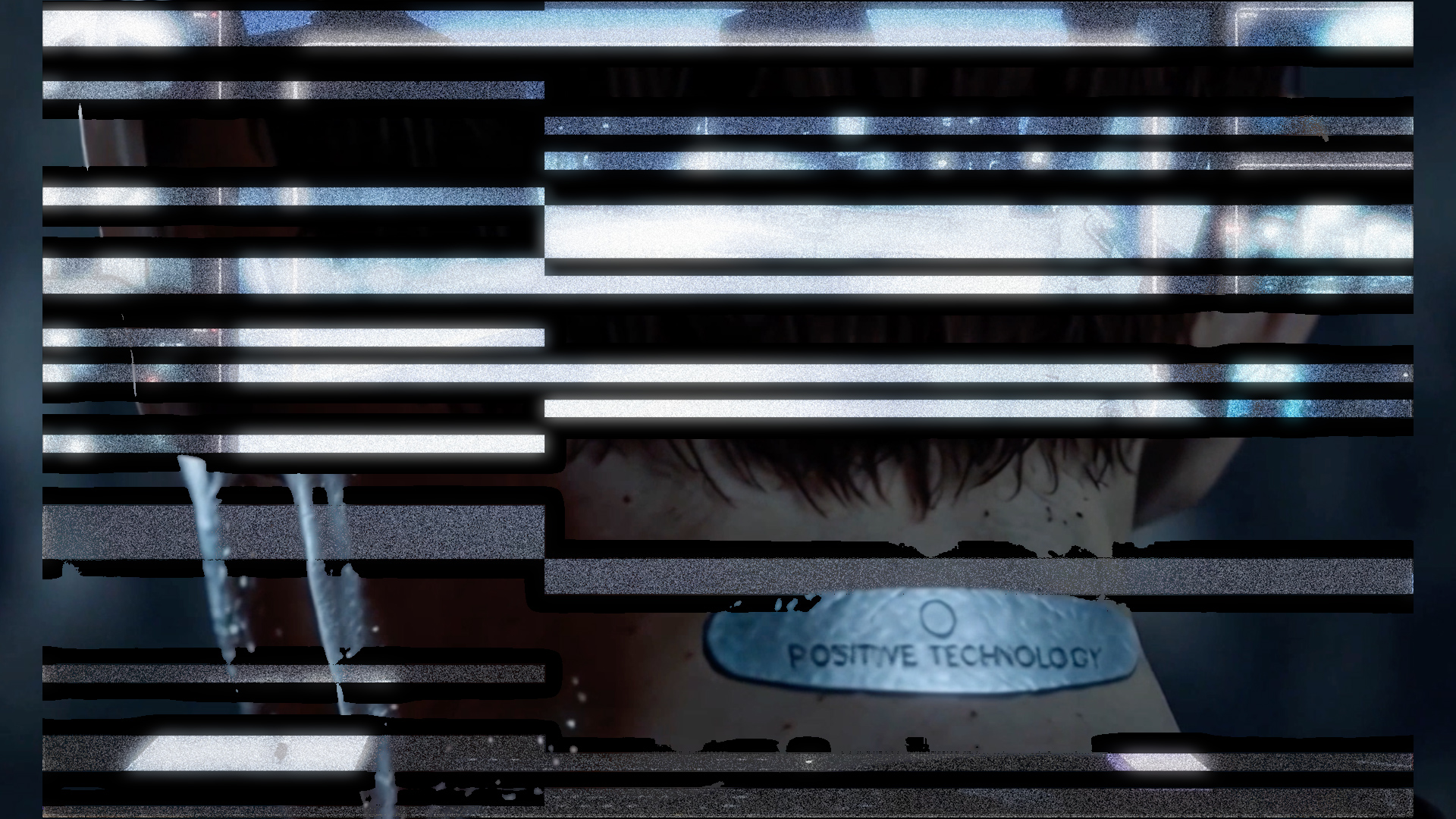
This is a contribution to the LETHE MACHINA SERIES curated by Sasha Shilina and Silas Nemo from DIFFRACTIONS.
This is an interview with Mark Cinkevich. Mark Cinkevich is a Belarus-born interdisciplinary researcher and artist. His practice sits at the intersection of fact and fiction, drawing on critical, speculative, and experimental approaches to examine the post-Soviet infrastructural and social landscape. Through his work, he explores pressing concepts such as nuclear colonialism, infrastructural colonialism, extractivism, and monstrosity, investigating how infrastructures and visual technologies organize power, surveillance, and control.
Cinkevich’s projects have been presented at major international venues including transmediale in Berlin, the BFI London Film Festival, Ars Electronica in Linz, the National Gallery of Art in Vilnius, and the Aksioma Institute for Contemporary Art in Ljubljana. He frequently collaborates with fellow researcher and artist Anna Engelhardt; together they created the film Terror Element, which has been screened and exhibited across Europe and the United States. In 2025, he undertook a residency at MeetFactory in Prague as part of the DATAS: The Data and the Sovereign program, continuing his investigation into the “nonbattle image” and the role of visual and algorithmic technologies in maintaining state control with his work, Navigating Militarized Urban Futures.
DIFFRACTIONS: Can you reflect on your work and introduce yourself a bit, specifically, how did you arrive at your current focus on the intersection of infrastructure, surveillance, and algorithmic governance? And what do you see as the through-line connecting your various projects, from Terror Element to Navigating Militarized Urban Futures to your current mapping of Belarusian digital infrastructure?
Mark Cinkevich: All of these projects are essentially the same project for me, a continuation of the same work I have been doing. My background is in cultural studies, critical theory, and philosophy. I started paying attention to these issues when I ended up in my home country and, as a good philosopher, began engaging with the problems at hand.
What I saw in Belarus before the 2020 elections was a clear and illustrative case of how state sovereignty is being dismantled. Around 2019, I started my first project dealing with infrastructures of occupation, focusing on the nuclear power plant in Belarus. The plant was meant to open in 2018 but was postponed. Belarus had never had nuclear energy before, and Lukashenko decided to build it believing it would boost the country’s energy production and economy.
When the nuclear power plant was constructed, Lithuania recognized it as a threat to national sovereignty and state security due to nuclear danger. The Russians refused to allow the European Commission access to the construction site. In response, Lithuania initiated a project in 2017 to dismantle all shared energy infrastructures between Belarus, Russia, and European Union countries.
Before this, there was what functioned as a ring, literally an electrical ring connecting Belarus, Russia, Lithuania, Latvia, and Estonia. They were all synchronized in one electric grid and would balance each other. But because the nuclear power plant constructed by Russia posed a danger to national security, they needed to prevent any electricity flowing from it.
Already in 2019, before the elections in Belarus, it was clear to me as a researcher that if Lukashenko won, it would mean complete integration into the Russian energy system and the complete disassembling of all infrastructures uniting Belarus with any other country. Belarus is surrounded by European Union countries and Ukraine. Ukraine had set out to integrate into the European Union energy system, with their first integration attempt scheduled for February 24, 2022, the day of the invasion.
Through the nuclear power plant project, I saw how the entire energy infrastructure of the state gets integrated into another state. There is a very interesting mechanic that enabled this integration: the mechanic of overproduction. In colonial infrastructures, you typically deal with extraction, but here Russia provided money, nuclear infrastructure, uranium processing infrastructure, transportation infrastructure, post-processing uranium infrastructure, and loans. Belarus covered only ten percent of the nuclear power plant’s cost, yet the plant created forty percent overproduction of energy for the entire country. Electricity cannot be stored and must be consumed simultaneously, so Belarus now depends on Russia as a consumer of this overproduced energy.
This was clear in 2019. Then 2020 followed with rupture, crackdown, and sanctions, leading to complete alienation and a loss of sovereignty for Belarus. Belarus suddenly did not control its own energy infrastructure – it depended on the uranium and on Russia as a consumer. Simultaneously, the state began conserving all its resources.
I observed and wrote about this as an infrastructural process of occupation, dismantling sovereignty, and state integration. The nuclear power plant became one of the core elements that went into the making of the film Onset, which is also about electricity. One thing we noticed was that electricity would be channeled into specific places, and consumption was scaled up by constructing military infrastructures on Belarusian territory already in 2020. This laid the groundwork for Belarus becoming a parking lot for Russian military vehicles and prepared the foundation for the future processes we trace in subsequent work.
Onset is directly informed by the result of this nuclear power plant project and further complemented by more information that we researched together with Anna Engelhardt. Terror Element is again a work about colonial wars and occupation. In this work, we examine how a black-box mechanic is always implemented by states to outsource responsibility somewhere. This case is specifically important because it looks at forensic science, showing that even the dragon slayer – forensic science itself – loses its power and becomes merely aesthetic. No tool is immune: theoretical, forensic, scientific, and medical approaches can all be made into black boxes that produce obscure conclusions that can be weaponized.

Mark Cinkevich, “Belarusian Toxic Nightmare,” 2020. Image by Anna Engelhardt.
I was thinking about this in parallel to the 2020 protests in Belarus, when police killed a man on the street. They claimed he was drunk, with a high blood alcohol percentage, but the medical conclusion from the hospital showed no alcohol in his blood. However, it did not matter whether the alcohol was there or not, the message was circulated and used as justification regardless. This is one of the key mechanics enabling occupation, the ability to provide any claim with, as if, “scientifically accurate” evidence.
In my most recent work, Navigating Militarized Urban Futures, I continue looking at how occupation unfolds, focusing more on the digital domain. The level of control Russia has obtained over Belarus reveals new tropes of colonial dependency being constructed with new infrastructure. Digital infrastructure is one such infrastructure, and it creates a specific and fascinating case study.
Because there is complete Russian control over Belarus’s entire logistics and energy infrastructure, the territory of Belarus can be used for attacks on Ukraine. The Belarusian state cannot resist because it lacks control over its own infrastructure, this is crucial to understand when tackling the source of colonial aggression.
With Navigating Militarized Urban Futures, because there is now such extensive control over infrastructures, the next scale of operations becomes possible. For example, Russia does not want its military vehicles to be seen when moving across Belarusian territory, so it needs uninterrupted control of all visual data collected from the entire country. The system gets implemented and constructed first, and only then does it get legalized.
By tracing various material flows of goods and resources, in my work I map how infrastructures and technologies of occupation precisely enable one state to control another. Occupation is not just standing in a field with a gun, it is controlling the terms of circulation. Data is one of the most central elements to be circulated. There is the implementation of migration databases and criminal search databases. Anything associated with state sovereignty gets reassembled on the digital level. My work traces how this happens – how sovereignty gets dismantled and how new infrastructure gets installed – mapping the entire process.
DIFF: I would like to talk about the concept of “infrastructural horror” that runs through your collaborative work with Anna Engelhardt, particularly the collaborative text “Infrastructural Horror.” You articulate how monsters are pervading infrastructure: oil platforms, wires, and mines, I also sense this toxic residue in that work. With Navigating Militarized Urban Futures, there is another layer – the flip side of infrastructural horror involving surveillance, cables, and data centers operating in perhaps less apparent ways than traditional surveillance. Could you elaborate on the intersection between these works and the concept of infrastructural horror?
MC: This connects with my work on the theory of monsters. For an anthropologist doing cultural studies, monstrosity is a fascinating concept that appears frequently in discourse. Monsters always embody what is most scary at any given time and function as feedback machines.
The contemporary monster is increasingly losing all visual markers. In the past, a monster would be half fish, half human – in the Middle Ages, the question was whether an animal had a soul, so a half-animal, half-human creature was terrifying because you did not know if it could go to heaven. Later, monstrosity encompassed anything that did not fit the image of the white, middle-aged Catholic man. Then it transferred out of the visual domain into the behavioral domain – super normal-looking killers and maniacs.
In monster theory around 2010, with the Norwegian shooter Anders Behring Breivik, who passed all psychiatric tests, we saw someone who went so deeply into a specific ideology that it made him enact absolute monstrosity. Yet he was very difficult to categorically exclude from normality because he appeared so normal, like Ted Bundy, whom people genuinely loved based on his appearance.
This loss of the visual is very present in what Navigating Militarized Urban Futures discusses. It does not matter how something looks or what its visual quality or content is – what matters is how it is processed. The processing pipeline overdetermines the content so much that content itself becomes irrelevant. If an undercover policeman is recording people on the street, it does not matter what he recorded – what matters is how the digital system processes the data, what tools are applied, and how the data is handled. Someone can be prosecuted based on that recording regardless of what they did on it. An image of a new monster can be produced and constructed to fit the needed narrative.
This system can jump ahead and construct the specific images it needs while simultaneously trying to eliminate all visual identifiers. That is one reason there are no specific protagonists in our work, we work with suspense. The system itself produces fear, because fear is the result of its functioning when you are placed in a particular situation.
Mark Cinkevich, “Navigating Militarized Urban Futures,” 2026.
DIFF: Since you have laid out how Belarus is deeply entrenched with Russian surveillance systems and has become a testing ground for Russian indigenous digital systems, could you elaborate further on the historical patterns? Particularly regarding the concept of a “cyber perimeter”, from what i’ve read an evolving form of colonial border operating through data rather than territory. I recall there was a Wired article about Russia’s Safe City program, launched in Moscow and exported to Belarus, which was reportedly scrapped in 2022 when Russia invaded Ukraine. Could you help connect these dots?
MC: It is two things simultaneously. Belarus being a testing ground for colonial powers is a recurring historical pattern. But what exactly they test exposes how the system operates.
Safe City is the main program for public security in Belarus. Whatever software Safe City ran on in Russia is the same being implemented in Belarus. Russia has a long-term interest in constructing what they call the “sovereign internet” – the ultimate goal being to disconnect from the world internet at any moment and continue functioning independently within their own network. This requires a scale of rearrangement that is hard to comprehend, but they are doing precisely what you are describing.
Cloudflare, which provides IP addresses and is such a significant part of the internet that some say it is partly the internet itself, is now being blocked by Russia. They are breaking everything apart to achieve sovereignty. The sovereign internet, as Russia imagines it, includes not only Russia but also states under Russian influence, particularly those in the Collective Security Treaty Organization, including Belarus.
The scale of control Russia has in Belarus, enabled by energy infrastructure, is much higher than in any other post-Soviet state – even within the Collective Security Treaty Organization. Belarus has historically been a place where Russia tests things. For example, they introduced an anti-constitutional tax on being unemployed in Belarus in 2015–16 – a tax on “social parasites” – and later implemented it in Russia. They tested this in Belarus first.
Digital systems are precisely one of these test cases. Companies like Positive Technologies provide video analytics software and data processing software for deep packet inspection – the same software is used across these countries. Russia initially promised that each country in the Collective Security Treaty Organization would develop its own segment and implement software independently, but they lied. Everything is being assembled around a core established in Moscow. Countries like Kazakhstan and Belarus utilize the same Russian-provided software for the cybersecurity of ministries, banks, and nuclear stations, and they report criminals to Moscow. However, Belarus does not see what Kazakhstan reported, and Kazakhstan does not see what Belarus reported, that is the arrangement they are creating.
The limit of the security apparatus now runs alongside the border, but it is no longer the Russian border or even the Belarusian border. It is defined by where the security apparatus can function on the same infrastructure – it can extend into the occupied territories of Georgia. That is just how far the security apparatus reaches into territory. Russia is making these Collective Security Treaty countries implement more regulations, testing more in Belarus and deepening dependency.
This creates a separation that topples even nation-states and provides a new territoriality that is more powerful than many traditional boundaries. If you look at protected national parks: UNESCO heritage sites or endangered European bison habitats, the border cuts through these valuable forests regardless of ecological protection. What defines this new territoriality is the edge of the Russian security apparatus meeting NATO’s security apparatus.
DIFF: Could you elaborate on the diagram you have created illustrating the Belarusian–Russian fusion surveillance stack, populated with analog cameras, CCTV, automatic number plate recognition cameras, IMSI catchers, deep packet inspection systems, and so forth? How do these systems work in tandem, and is there a single centralized database capturing all individuals? It sounds like everything travels back to Moscow.

Mark Cinkevich, “Navigating Militarized Urban Futures,” 2026. Gameplay screenshot.
MC: It is convenient to think about this through theory on how the contemporary subject functions – the concept of a “data double” or “digital subject.” This is a body assembled from information, and the system is meant to act upon it. The variables are what hardware you use to intake information and what that information is used for.
When seeing all these arrangements, it is easy to be scared because it is so totalizing and unpredictable. Foucault said that if you get rid of this construct, “man would be erased, like a face drawn in sand at the edge of the sea” (Foucault, 1989). That is not about whether it can all be stopped, it is about how it works now.
In the diagram, I begin by naming the hardware tags, because these determine the type of intake the government has from its citizens. A human produces sensor-like flows – chemical flows, data flows – that emanate from the body and get separated into discrete flows. Visual data from cameras or chemical analysis from airport fingerprint scanners are types of flows taken from the body. This begins at the hardware level, through which the state obtains an image of a citizen.
This data double has been argued to have almost no relation to the person it is meant to represent, but that is not its goal. The goal is to be acted upon for governance, commerce, and control. The entrance point is variable (what hardware we use), and the exit point is also variable.
An interesting observation at the grand tectonic scale is that in the West, commerce plays a bigger role in processing digital doubles, because some digital infrastructure is created with a profit-making incentive. In the East – in Belarus and Russia – that is absolutely not part of the rationale. They are never interested in profiting from the data. It will be used and sold for marketing purposes, but that is not the primary goal. They are willing to waste money on the system, which is created solely for power management, with much less profit-making incentive. This small difference adds variability at every stage, stacking up to quite a different arrangement overall.
DIFF: You have stressed that when dealing with countries like Belarus and Russia, you can present all the evidence and they will outright deny it. This ties into epistemological questions about state denial and the refusal to acknowledge what is visible – shaping the politics of evidence. How does the state’s self-disclosure or legalizing of arrangements function when there is total disregard for counterclaims?
MC: One thing that comes to mind is how this shapes engagement with material from the region. Sometimes the way they lie exposes what they want to hide. When they conduct nuclear testing near Arkhangelsk in northern Russia, nuclear fallout sensors cascade-switch off across Russia, coinciding with how the particles are meant to travel. They will “accidentally” switch off for two hours here, two hours there – you can precisely trace the cloud’s location by the fact that the sensors are not working and determine that nuclear testing happened and roughly at what time.
There is an impossibility of juridical intervention at any level – juridical discourse is rendered almost powerless. It exists to assert symbolic normality. Legal domains become instruments, used for referendums like the Crimean occupation or the nuclear power plant referendum, creating an image of legitimacy. But Terror Element shows how this legitimacy is constructed.
When the full-scale invasion of Ukraine started, it was apparent that for Russia, any data-capture infrastructure in Belarus had become critical military infrastructure. You can start working with that, mapping and thinking. Ukraine was developing tactics to counter this strategy. In 2023, the cybersecurity decree stated that Positive Technologies would be the main provider of digital infrastructure for the state, but no further details were given. This alone tells you everything you need to know.
The company will deny working with the state or providing intelligence for the military and occupation. But their office is in the same building as the Belarusian KGB in the city center. Their statements are so obviously untrue that, for someone who knows the context, further confirmation is not needed.
This is where I diverge from colleagues in the West. In the West, the ultimate goal of such an investigation is to hold someone accountable or make it juridically actionable. That is a completely different process. This is why my work is art practice – I do not have documentation proving Positive Technologies works with the Belarusian state, but I know their office is in the same building as the KGB, administered by a private company called the Operations and Analysis Center, directly subordinated to the President of the Republic of Belarus, separate from the Ministry of Internal Affairs and the KGB. There is a missing link they will not admit, but art practice gives me the advantage of not going to court. I can skip wasting time and resources proving something obvious and proceed with analyzing the mapped data.
DIFF: A concept you employ that I am particularly interested in is the “non-battle image,” as articulated by Jussi Parikka, derived from Brian Massumi and Paul Virilio, and central to your project. As Parikka spells out, we “might not (always) be at war, but we are (always) mobilized and operationalized. This could also be referred to as the perceptual and operational fine-tuning of the ‘nonbattle’… In the nonbattle, the relation between action and waiting has been inverted. Waiting no longer stretches between actions. Action breaks into waiting… when you have nothing on which to act tangibly, there is still one thing you can do: act on that condition. Act to change the conditions in which you wait” (Parikka, 2023: 16). In your work, and even more broadly, how does this concept of the non-battle help us understand surveillance as a form of continuous mobilization rather than episodic intervention? I saw recently for example a headline from the US, there is now talk of a “precrime” approach to combat “far-left terrorists” – a perfect crystallization of Massumi’s concept of preemption. Having come from an environment where this is already established, what do you think mentally prepares people for a world where any reason can be fabricated to justify that you pose a threat?
MC: I really like this question. When I read it, it always reminds me that theory is not just concepts – it describes real-life mechanics. The non-battle image is connected to warfare. The idea is that action breaks into waiting when you have nothing tangible to act upon, no enemy to kill. You can still act on the conditions.
During the protests in Belarus, when people came out to disagree with the eighty percent election results, they were met with actual military force. That was very strange at first, but then it made sense – it was not civil unrest but a military operation for retaining power. Because there was no enemy to act upon, they acted on the population, which became the battlefield.
This ties into the non-battle image. When there is no enemy to destroy, you need to create one, because the state must kill someone to function. They manufacture an enemy identifiable to the state. This is why I see the juridical as losing power – in Belarus, and now increasingly elsewhere, it does not matter what you do; the law will always back up law enforcement. Between a policeman and a civilian on the street, there is no law regulating their behavior – the law will always justify the policeman’s actions.
Then, to kill, the state needs to produce a killable figure – a “terrorist.” Where the non-battle image becomes operationalized is that they have ways of collecting the flows emanating from bodies, and they use these to profile those most suitable for this role and the state’s rhetoric. In Belarus in 2025, before the elections, there were preemptive detentions exactly as you described, done on the basis of predictive databases created by Russian software – analysis unknown even to the Belarusian state.
For example, you go to a protest, and there is a stingray (IMSI catcher) simulating a mobile network tower. Your phone automatically connects, and they know everyone within two kilometers is at the protest. They ping your phone, associate it with your passport, send an SMS saying “we know you were at the protest.” The system correlates this data with your Google Chrome browsing history, your visits to opposition websites, things flagged by deep packet inspection, any graffiti you tagged in the city center. The system profiles you as “unsafe.”

In 2025, Belarus had two lists: people previously detained for political reasons and profiled as dangerous, and people profiled as dangerous but not previously detained. This ties back to Terror Element – the practice is not new. Historically, before elections, police would arrest people suspected to be dangerous. In the past, they did it based on other knowledge – now AI takes part, or it has been completely digitalized.
When the image gets operationalized, they get your data table and can create a monster out of you. In Belarus, they post videos of people apologizing in front of the police, using all the technical terms, creating a symbolic spectacle of normality and enforcement. Because it is so operationalized and black-boxed, it allows creating an individual that can be destroyed – like Raman Bandarenka, whom they killed, then claimed he was an agent and had alcohol in his blood, making him killable. They created a monster out of him posthumously, reassembling him into whatever spectacle they wanted.
DIFF: Another thread I have been pondering, and it certainly requires being attentive to local contexts, configurations, and assemblages of surveillance systems, devices, and techniques complemented by AI. I have been researching silicone masks, adversarial fashion and patches, and one-pixel attacks – techniques that, even temporarily, can thwart these systems or throw a wrench into them, making bodies illegible to a degree. Can you speculate on counter-techniques that may provide provisional points of concealment or elusion? And given that surveillance operates at such granular levels, where we are decomposed or atomized, segmented, and granularized – how do we reflect on practices of illegibility at this level?
MC: To be honest, this is exciting, but I struggle to think in that direction. The closest I have come to this is the idea of counter-techniques as one of the key tasks for artists, researchers, and philosophers. The gaps in systems reveal so much, and paying attention to what gap exists and what enables the gap is essential work.
On the flip side, I am interested in states doing the same thing. We want to anonymize ourselves, but states also want to anonymize themselves – and states have more infrastructural capacity for state services to stay anonymous. Suddenly we find ourselves in the position of tracers wanting to de-anonymize them, while states are invested in making retrospective de-anonymization impossible, granting carte blanche for violence.
In Belarus, we had OMON – analogous to ICE, in the sense of plainclothes gangs running the cities, beating and killing people. They want to stay anonymous. We want to de-anonymize them because we want justice – to punish specifically those who did wrong. If everybody is guilty, nobody is guilty. We need to pinpoint who did what to retain a theoretical hope for justice to be restored.
States have techniques like post-producing police officers’ faces out of images, photographing only hands and bodies without faces. In courts, there are protected witnesses with fake names, masks, and voice modulators so neighbors will not recognize them in small towns. We need to learn from how they anonymize – to see the holes in their anonymization and learn how to de-anonymize them.
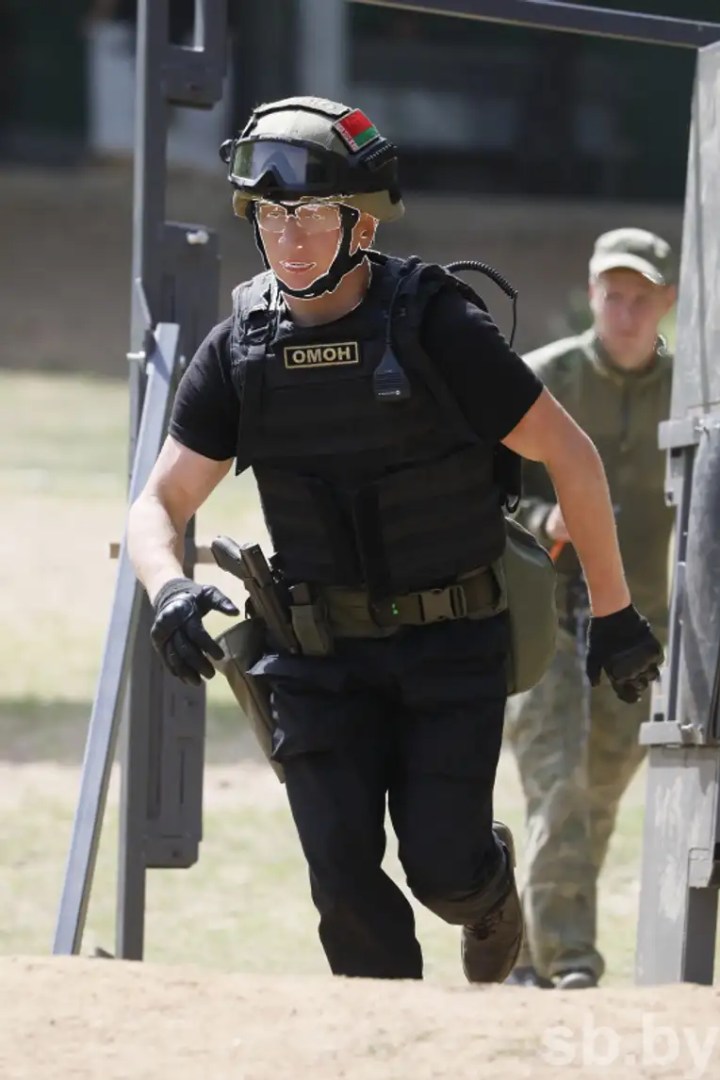
A riot police officer with post-produced facial features. Photo: Vitaly Pivovarchik / Sovetskaya Belarus – Belarus Today, 2020. SOURCE.
DIFF: Looking at photos from the USSR forty years ago, police officers’ faces were visible – no balaclavas. It seems from what I heard that when Putin came in, he normalized FSB agents wearing balaclavas, and this extended to all state security. This is interesting because of the associated Eastern European musical acts wearing masks, the balaclava has become an image of what the state does in unleashing terror.
MC: The state has the right to deny being represented, this is core power: unrepresentability. When all offices fuse, like during the Crimean invasion, the people storming Crimea had no identification. Balaclavas were definitely an element – they were called “little green men,” and Russia denied they were Russian soldiers. Without balaclavas, they would obtain an identity – someone would recognize, for example, a comrade from the Suvorov Military Academy. Then, the consequences of partaking in inflicting violence leak into one’s individual life. To completely avoid this and keep things fused is the key to consistent state violence without responsibility.
In Russia and Belarus, one key thing is that the state tries to completely protect itself and spread responsibility. Protesters try to do the same – paying in the same coin, where the balaclava gets adopted to refuse being captured by the state. This goes back to the mask discussions.
What I am thinking about with counter-infrastructure is the internet itself, these very cables. Not all infrastructures are themselves enabling counter-infrastructure. For example, the weaponization of the rail tracks as sabotage infrastructure is very episodic and has severe repercussions for an individual in Belarus. But it is the very same cable connecting Belarus and Russia that is used for transmitting VPN data. The existence of infrastructure enables counter-infrastructure. This is probably why Russia wants a sovereign internet.
The sovereign internet is not only a parallel infrastructure in that sense but also a parallel reality. In 2014, during the Crimean occupation, developers at Yandex Maps (the Russian Google Maps equivalent) had a leak in their code. The developers did not know where to put Crimea – Russia or Ukraine. The coder solved the problem by not taking responsibility: if you visited Yandex Maps from Ukraine, Crimea was part of Ukraine; if you visited from Russia, it was part of Russia. Two parallel realities enabled by the digital system, both existing depending on where you come from territorially.
And about masks in relation to protests. The reason people might not wear masks is that if you are caught wearing one, you are in more trouble. In Belarus, people stopped wearing masks because it does not matter – you would still be traced back home, and a mask would cause more suspicion. In Georgia, masks worked for a time, but after the last elections, with more Russian influence, protests were cracked down on in the same way as in Belarus, with activists followed back home and arrested days later.
The state sometimes puts no expiration date on some events. If you were at a protest and registered by a camera, the Belarusian state specifically pushes the agenda that eventually they will come after you. It is now 2026, but there are still arrests almost every day from the 2020 protests – they keep identifying people from street cameras. They will continue until they get everyone.
This is why it is so scary, you are never guaranteed safety even if you do not participate in anything. You go to the supermarket, get caught by a video camera, the data gets processed in a specific way, an officer decides you are behaving “improperly,” and the law will back them up.
DIFF: Could you talk about collaborating with Anna Engelhardt, and how open-source intelligence methodologies inform your practice? How did you get introduced to OSINT, and do you see yourself more as an artist or a researcher?
MC: I learned the term “open source” through Anna and was introduced to OSINT methodology through her. Since then, it has become a part of my research process. At the moment of data collection, you collect primary sources and literature – and primary sources do not always come in text form.
Working with Anna reoriented my practice toward producing something other than text. The process is very similar to research, and OSINT data is just raw data for my research. It is now impossible to work on mapping the security apparatus or occupation without some grasp of these skills.
I am a researcher who developed an artistic practice. Artistic practice sometimes allows for work that would not be possible or would be less exciting as an academic work. Artistic practice allows for a number of mediums beyond text. Otherwise, I use all means to map, study, and analyze the technologies and infrastructures of occupation and power distribution.
REFERENCES
Engelhardt, A., & Cinkevich, M. (2023). “For he will kill you with his horrible sight”: Compiling the Belarus political book of beasts. Fieldsights, Society for Cultural Anthropology. https://www.culanth.org/fieldsights/for-he-will-kill-you-with-his-horrible-sight-compiling-the-belarus-political-book-of-beasts
Engelhardt, A., & Cinkevich, M. (Directors). (2023). Onset [Film]. Film London.
Engelhardt, A., & Cinkevich, M. (2024). Infrastructural horror. e-flux Architecture. https://www.e-flux.com/architecture/new-silk-roads/621479/infrastructural-horror
Engelhardt, A., & Cinkevich, M. (2025). Terror Element [Film / installation].
Foucault, M. (1989). The order of things: An archaeology of the human sciences. Routledge.
Massumi, B. (2015). Ontopower: War, powers, and the state of perception. Duke University Press.
Parikka, J. (2023). Operational images: From the visual to the invisual. University of Minnesota Press.