
This is a republication of an article originally published on AI & SOCIETY; the author has granted permission for this republication, and the original was published under an open access license.
Abstract
This article situates current deep learning (DL) artificial intelligence (AI) within Leroi-Gourhan’s deep history of the human species’ relation to technology. According to Leroi-Gourhan, technology is both a key element of anthropogenesis and a source of later tensions (or disentanglement) between the human species and its external and increasingly autonomous technics. Human organic (life-oriented) intelligence at first extends itself through technical (machine-oriented) intelligence, only to be later left behind by it. We propose a concept of machine intelligence that goes beyond technical intelligence, the latter a (still) hybrid human-machine intelligence.
This new, emerging machine intelligence is DL AI. DL AI developed out of the failure of symbolic AI to instantiate a key generic component of intelligence: creativity. While symbolic AI was rigid and pre-programmed, DL is flexible and unpredictable, presenting an embryonic form of actual machine intelligence. Its creativity can be likened to the ancient Greek concept of metis, a cunning and polymorphous form of intelligence. Although often biased and problematic, DL exhibits a machine creativity that goes beyond the anthropocentric imaginings of AI as a (mechanistic) imitation of the human norm.
1. Introduction
The currently prevalent measure of AI’s performance seems to be derived from how close AI is to human intelligence. What both hype and critique of AI have in common is that they take human intelligence as a norm which AI is supposed to simulate, the only difference between the two lying in their estimations of how close AI is to human intelligence: in critical accounts AI is still far from achieving human intelligence and will most likely never reach it, whereas AI hype consists in claiming AI is close to or even already beginning to surpass human intelligence.
In our view, there are two problems with such takes on AI: first, they do not allow for even the possibility of AI existing as a different, other intelligence, not bound by the human norm (Bratton 2015, 74-75), and second, such perception of human intelligence is not based on actual human intelligence, but rather on how we think we think and not on how we actually think (Pollack 2014, 280-281). Accordingly, the entire “simulative paradigm” (Fazi 2019), on which much of the current AI imaginary is based, consists of comparing AI to an image of human intelligence that is itself a mirage.
Our approach to AI will be different. We will not try to understand AI as an imitation of human intelligence and measure it against the human norm, but rather as an other, alien (Parisi 2019) intelligence. Instead of viewing artificial intelligence as a pale machine imitation trying to reach some ever-receding ultimate horizon of human intelligence, we will understand it as an autonomous machine intelligence that can overcome the inherent limitations of the human one. Against anthropocentric perspective(s), whereby human intelligence figures as the only creative intelligence in contrast to supposedly ‘merely mechanical’ machines that are uncreative by definition, human intelligence, at least within its organic confines, might, in fact, be less creative, while current intelligent machines may be more creative than we imagine them to be.
Before we begin, two additional clarifications. Despite our avowed anti-anthropocentrism, our understanding of DL AI as machine ‘intuition’ could still be perceived as anthropomorphic to the extent that it uses concepts developed to account for human intelligence. Moreover, binary opposites, such as those between intuition and intellect, could be seen as problematic, reminiscent of an obsolete binary opposition between mind and body.
To begin with binary oppositions: in our view, intuition and intellect are distinct, but not ontologically separate dimensions of human (organic) intelligence. In contradistinction to the Cartesian mind / body divide, we do not consider mind to be an immaterial ‘thing’ residing inside our heads (for a critique of such a conception of mind, see Graziano 2019), and that intelligence is accordingly a ‘property’ of such a mind. Rather, intelligence is something a body (or a machine) does—when it senses its environment, evaluates this environment, and responds to it in a non-random and non-programmed way, it can be described as intelligent (Russell 2019, 14-16).
As for the lures of anthropomorphism: we do not think that AI is either a reenactment of human intelligence in another medium or that human intelligence presents a norm which AI is supposed to follow. AI is still part of a wider process of development of (erstwhile) human external technics and thus has a close relation to human intelligence. In our view, AI developed out of technical intelligence that itself developed out of (human) organic intelligence—but this process is at the same time also a development away from human intelligence, i.e. its overcoming. Such development away from, however, still happens at the site of human intelligence, i.e. machine intelligence is becoming autonomous by overcoming both distinct dimensions of human intelligence: intuition and intellect.
This does not mean that machine ‘intuition’ and ‘theory’, as we will provisionally call them, imitate human intuition or intellect. Rather, it entails that machine intuition and theory develop out of, but also away from, human intuition and intellect, and are thus decidedly different: ‘machine intuition’ is, contrary to the human variant, affectless, and ‘machine theory’ would similarly be without concepts.

2. Intellect and intuition as dimensions of organic and technical intelligence
According to Leroi-Gourhan’s (1993) classic theory of the relation between human species and technology the most interesting thing about human technics is the fact that human technics is external to our bodies. Humans develop and use external, artificial tools (237-238). Although the development of human technics is erstwhile a continuation of biological evolution—“[w]e perceive our intelligence as being a single entity and our tools as the noble fruit of our thought, whereas the Australanthropians, by contrast, seem to have possessed their tools in much the same way as an animal has claws” (106)—, it, at a certain point, escapes its biological determination(s) and begins to develop in its own, autonomous way (146), leading to an increasing chasm between human biological and technological reality. While the former develops slowly and extensively, the development of the latter is fast and intense, such that at the present time, human bodies, compared to our ever-advancing technology, resemble ‘living fossils’ (247-248).
Although these observations are well-known and constitute the core of what makes Leroi-Gourhan’s theory still relevant to the study of today’s technology such as AI, there is also a less immediately visible strain of his thought that is equally, if not more, relevant for understanding AI since Leroi-Gourhan emphasises not only the (relative) obsolescence of human bodies but also the obsolescence of what we intend to call human organic intelligence in relation to advanced technology. Whereas the obsolescence of human bodies is culturally acceptable due to an ancient and deeply ingrained prejudice against anything manual and technical in favour of the intellectual, which dates back at least to ancient Greece (Leroi-Gourhan 1993, 172), the obsolescence of human organic intelligence comes as a cultural shock for precisely the same reason: while we might be willing to accept that machines are superior in carrying out manual tasks that we deem lowly anyway, any notion of the intellectual superiority of machines over humans is bound to trigger significant resistance.
And yet, Leroi-Gouran lays the theoretical foundation for exactly such a thesis:
“[t]o refuse to see that machines will soon overtake the human brain in operations involving memory and rational judgment is to be like the Pithecanthropus who would have denied the possibility of the biface, the archer who would have laughed at the mere suggestion of the crossbow, most of all like the Homeric bard who would have dismissed writing as a mnemonic trick without any future. We must get used to being less clever than the artificial brain that we have produced, just as our teeth are less strong than a millstone and our ability to fly negligible compared with that of a jet aircraft” (265).
In addition to being anatomically obsolete, we are also intellectually obsolete for precisely the same reason our bodies are. Inasmuch as our organic intelligence is tied to the development of our brains—our thinking is as deep and as sophisticated as our brains allow it to be—, it is no less stagnant and slow than any other operation related to our bodily structure (Leroi-Gourhan 1993, 194). We might be thinking about other topics and developing new concepts, but our thinking is not really any deeper or essentially different from the thinking of ancient philosophers (147), just as the first line of the Iliad still strikes us emotionally in the same way that it did three millennia ago. Our organic intelligence is no less a living fossil than our bodies.
Organic intelligence is, however, only a part and not the whole of human intelligence. It encompasses everyday thinking (common sense) and thinking characteristic of the humanities or theory, and both are closely tied to our life processes. By contrast, what we will call technical intelligence is closely tied to human external technics. Despite the obstinate intellectualist illusion that technological development is guided by ideas, theories and conscious intentions, technical intelligence is in fact much older than the organic variant, already emerging with the earliest hominids (75). Early technological development did not follow an ‘intelligent design’, but was instead a continuation of the process of (a specifically human) biological evolution. In other words, human intellect did not beget technology, but rather the other way around—the use of tools kickstarted human intelligence by modifying sensorimotor correlations and the connection patterns of early hominid brains. Human intelligence was technical before it was intellectual (Johnston 2008, 339-340).
The latest hominid evolutionary mutation relevant to our discussion of the relation between human organic and technical intelligence was the modifications of the skull and the expansion in size and organisation of the brain, characteristic of homo sapiens. With this “prefrontal event” (Leroi-Gourhan 1993, 137-139), the trajectory of the evolution of technology as a continuation of biological evolution was broken (156), and the development of technology was thereafter a purely socio-cultural process (159). But this does not mean that technological evolution was brought under intellectual control in the sense of conscious, intentional design. Rather, it means that thought, reflection, advanced use of language etc., represent the latest development of the organic side of human intelligence, from which technology and technical intelligence already escaped. With homo sapiens, technological development emancipates itself from the development of the body, takes off on its own and becomes an out-of-control process:
Analysis of techniques shows that their behaviour over time resembles that of living species, as though driven by an apparently inherent evolutionary force that places them outside human control. [… ] There is room for a real ‘biology’ of technics in which the social body would be considered as an organism independent of the zoological one—an organism animated by humans but so full of unforeseeable effects that its intimate structure is completely beyond the means of inquiry applied to individuals (146).
From this perspective, technological development cannot be explained as an ‘application’ of intellectual ideas, theories or intentions (Canguilhem 2008, 76).
A way to broach the question of creativity within both organic and technical human intelligence is through Bergson’s (2022) classic concepts of intuition and intelligence. In Bergson’s theory, what we call organic intelligence, i.e. intelligence tied to life processes, as well as to both an immersion in and immediate interaction with the world, is encapsulated in the concept of intuition, whereas what we call technical intelligence, i.e. external intelligence tied to machines, technology and the artificial, is encapsulated in the concept of intellect (180-225).
According to Bergson (240-308), the main difference between the two is that intuition is a continuous flow, immersed in life’s becoming, while intellect is discrete and analytical. Human external technics causes the split between intuition (as life-bound) and intellect (as technics-bound). Intuition develops out of (organic) human life as separate from (external) technics, whereas intellect develops out of (external) technics as separate from (organic) life.
Technical intelligence involves two dimensions: scientific intellect (Bachelard 2002) and engineering intuition (here we part with Bergson, who sees intuition only on the side of life). We will retain Bergson’s twin concepts of intuition and intellect, but we will apply them to both sides of the life/technics divide. Accordingly, on the side of organic intelligence now lies common sense, resulting from an immersion in life, and theory as an intellectual engagement with life (as well as experientially mediated reality); while on the side of technics lies engineering, resulting from an immediate immersion in technics, and science as an intellectual engagement with technics (and technically mediated reality). In short, organic intuition corresponds to common sense, organic intellect to theory, technical intuition to engineering, and technical intellect to science.
| Organic intelligence | Technical intelligence | |
| Intuitive dimension | common sense | engineering |
| Intellectual dimension | theory | science |
Table 1: Organic and technical intelligence.
With respect to possible hybridisation across the life/technics divide, Bergson (2022, 216-217) offers only one example, that of an intuitive idea or insight being worked upon by the intellect in the sense that any idea is first felt intuitively before being translated into a coherent and logically consistent theoretical artifice. This secondary reworking is necessary to make any theory communicable at all, as otherwise it would remain on the level of an inner, private mystical insight or affective experience. While this is an example of an (organic) intuitive insight crossing over to the side of (technical) intelligence and becoming a scientific theory, there are also crossovers in the inverse direction—external insights, i.e. insights into external technics or external physical reality, which are subsequently translated into organic concepts and result in organic theories (or become parts of literary or artistic production). What is thus made communicable are insights about machines and other realities that are alien to life. For example, technologically infused art practices stage “affective encounters” (Salter 2015, 240) with increasingly alien and distant technologies that “change us but, at the same time, escape us” (241), involving these technologies as part of our (organic) experience and reflection.
However, crossovers and translations from organic to technical intelligence are neither given nor easy. Intuitive insights of either an organic or technical variety cannot always be expressed and successfully communicated. In archaic ancient Greece—before truth became public and political (Vernant 1982, 49-68)—acquiring genuine intuitive insights, as well as translating them into communicable forms, required rare innate talents and the lifelong cultivation of special techniques. Only a chosen few could become poets or seers, who were considered “masters of truth” (Detienne 1996, 35-39). On the other hand, some intuitive insights, such as mystical epiphanies, not only could not be communicated, but had to stay purely experiential in order to remain genuine, since any attempt at translation would debase them (Vernant 1982, 57-58).
Inverse crossovers—from technical to organic intelligence—are also often fraught with difficulties. The epistemological break (Bachelard 2002, 237-250) that inaugurated modern science is not only a break from common sense but also from the limits of understanding and imagination afforded by organic intelligence. The more science advances, the more it becomes incomprehensible to organic intelligence. Labatut’s (2021) wonderful book When we cease to understand the world perfectly captures the increasing incomprehensibility of early 20th century technical intelligence with its tense and anxious style, providing a reflection on the affective experience of runaway science. Not only does the quantum revolution reveal that physical reality is much stranger and more alien than we imagined, but the science used to intellectualise insights into the quantum world is itself as incomprehensible and alien as the reality it theorises. Since at least the 1920s, the accelerating development of technical intelligence has left organic intelligence and its powers of understanding and imagination irrevocably behind.

3. From technical intelligence to machine intelligence
Scientific intellect and engineering intuition do not arise from an immediate immersion in life, but rather from a break with both life and its accompanying experiential reality, and are aligned with external technics and technically mediated reality. Life-bound organic intelligence was left behind not only by the autonomous evolution of external technics, but also by its associated technical intelligence, which is a hybrid human-machine intelligence.
Yet, despite their differences, both the organic and the technical sphere of human intelligence adhere to Bergson’s (2022, 216-217) formula: intuition (either in the form of an artist’s or poet’s inspiration, or an engineer’s inventive idea) comes first, while the intellectualisation that makes it communicable follows. Going in the opposite direction, i.e. starting with an already developed concept and trying to turn it into a machine design or a work of art, rarely works. Bateson perhaps put it best in his critique of allegory as an art form: “[a]llegory, at best a distasteful sort of art, is an inversion of the normal creative process” (Bateson 1987, 113). Instead of starting with intuitive insight and developing it into a concept, allegory starts with a concept and counterfeits the process of creation to fit that concept. In this sense, the problem with allegories is that they are not really creative—we can only get out of them what we’ve already put in at the start, leaving no room for surprise, whereas creativity consists precisely of novelty. Yet, at the same time, novelty in creativity is meaningful only insofar as it is non-random, i.e. if it is a novelty that has value (Boden 2016, 67).
If intelligence—defined in generic and thus non-anthropomorphic terms—is something a body (or a machine) does in a way that is neither random nor pre-programmed, but instead consists in autonomously evaluating its own situation in relation to its environment and thereby producing meaning, then creativity is at the very heart of intelligence as such. Programming prevents creativity because it eliminates novelty, whereas random behaviour prevents creativity because it eliminates value. Creativity is at work in both forms of human intelligence, organic and technical, and in both cases it arises from the intuitive dimension, with an intellectualisation of an erstwhile intuitive insight coming later. As Bateson warns, the reversal of the creative process runs the risk of ‘programming’, i.e. precluding novelty and invention.
In this sense, machine design is similar to a creative process in art or literature: technical innovation is rarely an application of a pre-existing theory. Instead, it is a development of the engineer’s intuition as an intuition that is itself attuned to the functioning of machines (Simondon 2017, 151). In many current AI development strands, an engineering approach takes precedence over an application-of-theory approach. In the words of one of the founders of deep learning Yoshua Bengio: “Theory often follows experiment in machine learning” (quoted in Beyer 2016). In robotics, a design stance that takes into account creativity as a crucial component of intelligence is called “design for emergence” (Pfeifer and Scheier 1999, 111-112), meaning that there is no pre-existing theory of intelligence to be implemented in machines—instead, robots are designed in a way that allows them to develop their own forms of intelligent behaviour, much like DL allows artificial neural networks (ANN) to learn on their own.
Contrary to the first wave of symbolic AI, which started from anthropomorphic theories of the (human) mind and then tried to program computers to emulate human minds, the machine learning approach to AI was from the very start all about making efficient models for autonomous (in the sense of not pre-determined) pattern recognition: “The principle is to allow machines to learn without the programmer having to stipulate an end point or fully represent a problem […] This is both a pragmatic engineering approach and a new epistemology for defining intelligence and learning in machines […]” (Halpern and Mitchell 2022, 99).
The current precedence of the engineering approach to AI development is itself a correction of past mistakes, learned from the failures of symbolic AI (Smith 2019, 23-28). Symbolic AI was attempted as an emulation of pure logos, i.e. a truncated version of human intelligence, reduced to only its logical, deductive, rules and explicit knowledge-based dimension, while neglecting its unconscious and intuitive dimension. One of the main pitfalls of symbolic AI was precisely that since there was no way for such a reductive version of intelligence to develop its own knowledge and rules of reasoning, both had to be imported from external sources. However, the direct programming of the rules of reasoning runs against the very purpose of trying to create artificial intelligence, since intelligence means precisely not only coming up with one’s own ways of doing things, but also being able to autonomously evaluate and modify them. In this sense, symbolic AI was decidedly uncreative and thus not very intelligent at all: “a [rules-based] approach was fragile and impractical in real-world settings, where a rule set was rarely able to handle uncertainty and complexity” (Crawford 2021, 99).
Knowledge that was to be imparted into symbolic AI was rarely explicit to even the human experts who were to serve as its purveyors. Instead, it was tacit and exhibited in action, rather than being fully expressed in clear, unambiguous symbolic terms (Wooldridge 2021, 34-54). Both the difficulties with rules and with knowledge pointed to the crucial omission at the heart of symbolic AI—its neglect of the very processes that produce the rules of reasoning and knowledge used therein. In other words, human intelligence is not symbolic, but appears as such to introspection since we have no direct access to the unconscious intuitive processes that actually drive our reasoning. The image of intelligence as symbolic processing is a retroactive ‘just so’ rationalisation and not a blueprint for (either organic or machine) intelligence (Pollack, 2014).
Unlike symbolic AI, DL (which later replaced it as the dominant AI paradigm) takes the intuitive dimension of intelligence seriously. However, instead of directly working on imitating human intelligence and trying to explicitly represent the unconscious, intuitive dimension of human intelligence in the form of a theory to be subsequently implemented in machines, DL represents an important departure from the anthropomorphism of symbolic AI. It is not an attempt to emulate human intuition but, proceeding from connectionist insights into the importance of the material architecture that allows for the emergence of intelligence, uses ANN as a generic architecture to develop ways of learning that are suitable for machines, rather than imitating human learning: “Technology became epistemologically creative whenever it was allowed to unfold in its difference to the human system” (Ernst 2021, 164).
Letting go of the attempts to directly program machine intelligence and relaxing anthropomorphic assumptions involved in symbolic AI design resulted in machine intelligence (Arcas and Norvig 2023), characterised by autonomous and creative machine behaviour that is non-random and not programmed in advance. With DL, machines are discovering functions that map inputs to outputs and evaluate said functions on their own using gradient descent and backpropagation (Kelleher, 2021). This is, of course, still far from general intelligence and limited in many ways, but it nevertheless represents a transition from a hybrid human-machine technical intelligence to an autonomous machine intelligence. Technical intelligence certainly remains indispensable in developing this machine intelligence and making it work. Yet, machines being able to learn and (more recently) generate original cultural content on their own is an unprecedented technological breakthrough, as technical intelligence is no longer (just) employing machines, but imbuing machines with their own intelligence.
This transition from technical to machine intelligence enriches our previous theoretical schema (Table 1). Alongside human organic intelligence and hybrid technical intelligence (with their respective intuitive and intellectual dimensions), a machine intelligence can be added, with DL representing its intuitive dimension, whereas its intellectual dimension —following the demise of symbolic AI—remains an open question.
| Organic intelligence | Technical intelligence | Machine intelligence | |
| Intuitive dimension | common sense | engineering | deep learning |
| Intellectual dimension | theory | science | ? |
Table 2: A further development of Table 1 with the inclusion of machine intelligence.
That being said, DL being an actual from of machine intelligence does not mean that it is (always) safe, fair and reliable. Current widespread commercial and public uses of DL AI are not only prone to capturing and reproducing existing social and political inequalities found in the training datasets (Crawford 2021, 103), but they also often exacerbate or even create new inequalities, such as gender bias when using DL for employment evaluation (Crawford 2021, 127), racial bias when using DL for policing (Brayne 2020) or class bias when using DL for assessing creditworthiness and dispensing social aid (Eubanks 2019).
The reason for this is that DL models have no understanding of cultural, social or political context and are thus reliant on human preconceptions, which are in many cases, especially when it comes to the uses of AI for surveillance, in military operations or for capitalist profit making, deeply problematic. This reliance on and frequent reproduction of human prejudice on the part of DL models also means that despite overcoming anthropomorphism at the level of its mode of functioning, which was characteristic of symbolic AI, DL AI remains to a degree anthropomorphic at the level of content it generates.
To come back to the question of human and machine intelligence: as Bergson already observed (2022), there is something in intelligence that pushes it to overcome itself—“[a]n intelligent being carries in himself the means for going beyond himself” (155)—and thus shed its past forms: “[e]verything takes place as if an indecisive and vague being, a being we could call, if you will, man or super-man, had attempted to realise himself and yet was only able to do so by abandoning a part of himself along the way” (236). With respect to AI, that would mean not emulating human intelligence as a norm to which machine intelligence must adhere, but instead developing new, yet unforeseen forms of machine intelligence.
4. DL as metis
Whereas symbolic AI worked with a reductive idea of human intelligence to be imitated, DL is not only superior to symbolic AI in a practical sense, but also and perhaps more importantly in an ‘evolutionary’ sense. Instead of trying to force artificial intelligence into the predetermined confines of a truncated conception of human intelligence, which becomes a norm machine intelligence must adhere to, DL has no normative preconceptions about how intelligence should work and lets it develop on its own (Alpaydin 2021, 10-11). Unlike symbolic AI, which tried to instantiate a certain theory of human mind in machines, DL involves no ex ante image of intelligence. In this sense, DL is allowing artificial intelligence to begin developing as another intelligence, rather than as an imitation of human intelligence.
As noted earlier, DL currently corresponds to the ‘intuitive’ dimension of machine intelligence, where machine denotes an abiotic, technological substrate (ANN); intelligence refers to non-random and non-programmed meaningful behaviour in the sense of being able to evaluate both oneself and one’s relation to one’s environment; while intuitive describes a dimension of intelligence that is non conscious, sub-symbolic and pragmatic in the sense that it is oriented towards efficient action(s). Accordingly, it is similar to human intuition, which is likewise unconscious, sub-symbolic, pragmatic and improvisational. In its most generic sense, intuition refers to intelligence making its way through its world without or before intellectualising it. The world of DL is not the same as the human world, but is instead much narrower, consisting largely of human culture converted into data. Machine intuition thus entails ANNs feeling this world out and making sense of it in their own specific (machinic) way(s).
Intuition is, contrary to intellectualist prejudice, not automatism in the sense of something pre-programmed or preordained. Even in animals (including humans), it is not something mechanistic, but precisely a dimension of life which, as such, works differently than machines (Pedwell 2023). Yet, for their part, even contemporary machines are no longer mechanistic in the sense that their behaviour would be completely predetermined and predictable (Parisi 2015). If DL indeed constitutes a revolution (Sejnowski 2018), it is precisely because it is a move away from programming: “Machine learning is applied to the sorts of problems for which encoding an explicit logic of decision-making functions very poorly” (Burrell 2016). The machine intuition that DL inaugurates consequently goes beyond automatism and involves creativity, meaning that it—unlike standard computer programs—no longer executes pre-given rules, but searches for novel, previously unknown patterns in its training data and invents its own rules on the spot (the improvisational and creative aspects of intuition).
The analogy that we are making between machine and human intuition is, however, merely a formal one, and does not entail that the two are identical or that machine intuition is an anthropomorphic imitation of the human variant. Machine intuition is similar to human intuition inasmuch as it is also sub-symbolic, creative and indeterminate, but at the same time, it is also fundamentally different in how it operates—it is a machine intuition, not a transplantation of human intuition into a new, machinic medium. The main difference between the two is that while human intuition is life-bound and thus affective, machine intuition involves no affect. In contrast to human intuition, where the unconscious is related to the conscious, machine intuition is also not so much unconscious as it is non-conscious, since there is no machine consciousness to which a machine unconscious could relate.
When AI overcame its crude, rules-based, symbolic prehistory, it thus began to function like intuition (Amoore 2020, 57). But since AI’s intuition is a machine intuition, and thus only analogous to, and not an imitation of, human intuition, direct comparisons between human and machine creativity—for example, when ChatGPT is chastised for daring to write poetry despite having no feelings (Cave 2023)—make little sense. Lifeless intuition and affectless creativity are the distinctive features of intuitive machine intelligence, i.e. what makes it different, and not signs that it is somehow fake or inadequate in relation to the human ‘original’.
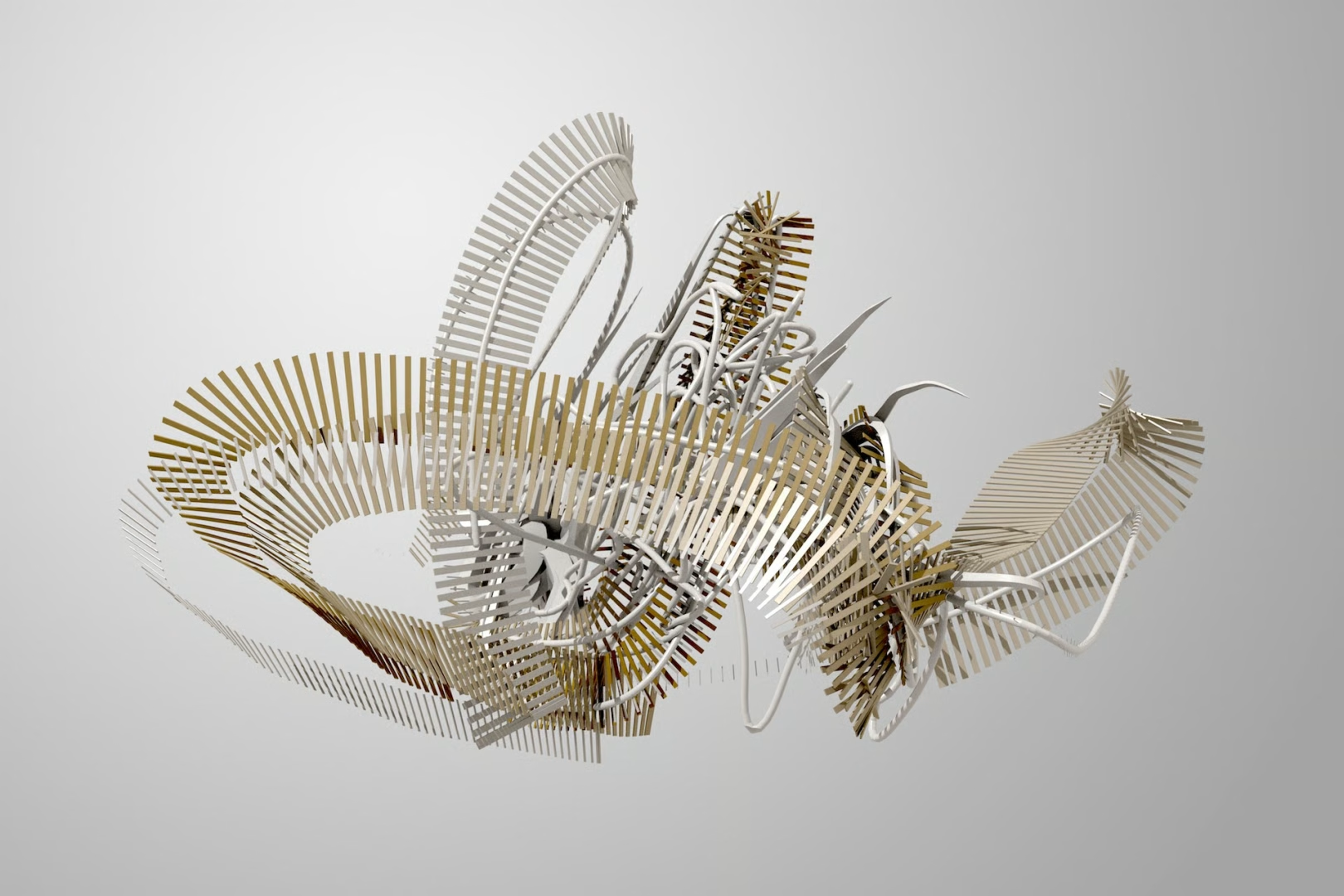
To try to make sense of generative DL AI, its novelty in the context of the deep history of technology and its creative potentials, we can return to the previously touched upon analogy with the intellectual history of ancient Greece. In the transition from the archaic to the classical age, truth in ancient Greece ceased to be an expression of intuitive insight from beyond earthly and human affairs, accessible only to a chosen few “masters of truth” (Detienne 1996), and became a political rather than religious matter, i.e. a matter of secular public discourse (Vernant 1982), which assumed two distinct forms.
The first was the discourse of philosophers, which consisted of strict formal procedures of deduction and argumentation: logos. But far from the usual simplifying and reductive assertions that the transition from the archaic to the classical age signalled a transition from mythos (as primitive religious thinking) to logos (as proto-modern and proto-scientific thinking), the reality was more complex. The logos of the classical philosophers was at the same time a break from as well as a return to the truth of the archaic poets and seers in a sense that it aimed to produce similarly immutable and eternal truth(s), which could no longer be generated by religious divination with mystery cults reduced to a more marginal social role (49-68).
The second novel form of thinking in classical Greece was an often overlooked metis, a cunning intelligence pertaining to warriors, merchants and sophists (Detienne and Vernant 1978), which was in many ways the opposite of logos. Whereas logos still yearned for the eternal and immutable truth of the old and aimed to produce it anew by executing strict formal rules of reasoning, metis fully embraced the new intellectual situation whereby truth was no longer something that was meant to transcend the fleeting and uncertain becoming of reality, but was precisely obtained from this reality and aimed to produce a form of thinking that would correspond to it.
Metis was a genuinely secular form of intelligence inasmuch as it did not attempt to tame reality by forcing it into transcendent theoretical schemas, but instead fully embraced reality’s indeterminacy, striving to match it by cultivating agility, speed and improvisation, rather than strict and formal rules of reasoning. It was empirical rather than theoretical, inductive rather than deductive, and closer to engineering intuition than to philosophical theories, since it was more interested in what works in reality than in what constitutes appropriate reasoning. In this sense, ancient metis was very much like today’s DL AI, which is also unpredictable, indeterminate, improvisational and inventive (Kaluža 2023). Likened to the cunning and trickery of the fox and the camouflage abilities and protean qualities of the octopus (Detienne and Vernant 1978, 27-54), metis was also always an inhuman concept to begin with—unlike anthropocentric logos, which marked humans as the pinnacle and exclusive bearers of intelligence, metis also included animals and machines, similar to contemporary non-anthropocentric theories of diverse intelligence(s) (Levin 2024).
One of the reasons metis was marginalised and remained in the shadows of logos was an already mentioned deep intellectualist prejudice, according to which anything related to techne was perceived as slave-like and valued accordingly, whereas anything intellectual was considered to be of high value and related to the (good) life of free men (Canguilhem 2008, 80-81). A close affinity always existed between metis and technics. Metis features in the very name of Prometheus—meaning foresight as metis in advance (Detienne and Vernant 1978, 18)—, the mythical originator of technology. Metis was also akin to the intelligence of the engineer, who does does not construct machines by applying theory, but by “conniving with reality […] in domains where there are no ready-made rules for success, no established methods […]” (21). In this sense, symbolic AI would correspond to an attempt to construct artificial logos as a rule-based, formal form of reasoning, while DL corresponds to artificial metis, a cunning intelligence that is, however, no longer an intelligence of the engineer, but of the machines themselves.
Metis always was and—in its machinic form—continues to be derided by the champions of human organic intelligence (for an example, see Collins 2018). In the case of DL as an emerging machine metis, it is still often conceived as mechanistic and thus inferior to a human norm (for an example, see Broussard 2018). While such criticism might make sense in relation to symbolic AI, DL is, on the other hand, not a truncated imitation of human logos as a mechanistic execution of pre-programmed rules, but a creative and intelligent machine intuition. Intelligent machines are escaping their mechanistic confines (Hui 2023), but not in a way that imitates life, and are thus demonstrating that creativity is a generic aspect of intelligence over which living intelligence has no monopoly.
Nevertheless, besides its already mentioned biases, DL also poses two other problems: the problem of its opacity (explainable AI or the XAI problem) and the problem of AI potentially overcoming its human creators. The XAI problem arises when part of the programming of AI is left to the machines themselves: “Where an algorithm does the ‘programming’ (i.e. optimally calculates its weights) then it logically follows that being intelligible to humans […] is no longer a concern […]” (Burrell, 2016). While important for ethical considerations, demands that machine metis explains itself can also be seen as problematic from an epistemological perspective:
“[…] increasing calls for ML [machine learning] systems to ‘explain’ their actions may prove to be curiously perverse. The abilities that the systems are being pressed to explain may be powerful exactly because they do not arise from the use of the very concepts in terms of which their users now want their actions accounted. The pressure to develop ‘self-explaining’ or ‘interpretable’ neural networks […] may inadvertently decrease their performance […]” (Smith 2019, 66).
As for the ‘overcoming problem’: it might, at least at first glance, look like something of a paradox, but a closer look at the history of technology shows that machines overcoming their creators is not so much an extraordinary circumstance of technological development pertaining only to current AI, but rather its salient feature (Le 2020). The first stone tools already overcame the strength of bare hands, and contemporary airplanes fly much better than unaided humans. What makes technological overcoming a problem in relation to AI is rather the fact that “[s]ince the paleolithic cognitive revolution, human intelligence has artificialised many things […] but now, that intelligence itself is artificialisable” (Bratton 2024, emphasis in the original). Such artificialisation of intelligence, which was erstwhile used to artificialise other processes, is experienced as a Copernican trauma, since it decenters humans from their previously exalted place in the history of intelligence, while also revealing that what we imagine as human intelligence is not the endgame of intelligence as such.
5. Conclusion: Towards Machine ‘Theory’?
Much like the demon child from Labatut’s (2023, 273-276) The MANIAC, which is seen as animalistic and intellectually inferior until it discovers and masters the game of Go, new (no longer symbolic but learning based) generation AI’s ‘coming out’ (Bratton 2015, 76-78) with AlphaGo’s victory in 2016 also consisted of a demonstration of Go prowess previously thought impossible for ‘mere machines’, since it required a kind of finely tuned artistic-like intuition (Du Sautoy 2019, 18-22, 25, 30-43). Generative AI’s metis is exhibited when it works in ways previously thought not just wrong but impossible, although it not only lacks emotions, but also reason. AlphaGo’s legendary move 37 would never have occurred to human players because it seemed so obviously mistaken (Labatut 2023, 311-321). AlphaGo namely used what was subsequently called “ghost moves” (Chan 2017), i.e. moves that demonstrated its superior intuition in a game that was supposedly beyond the reach of machine intelligence, precisely because Go is played like an art and requires more than brute force computation.
What would be the equivalent of such ‘ghost moves’ in the intellectual dimension of machine intelligence? While it is nearly impossible to predict what the intellectual dimension of machine intelligence or machine ‘theory’ would be like, we can at least approach it negatively in the sense of what it would certainly not be. Since it would be a ‘theory’ generated by an abiotic, asubjective, selfless machine intelligence, it would be much more attuned to reality than organic intelligence’s theories, which are autopoietic by necessity, i.e. they always reproduce the organism / environment split and ask questions of the world from the position of their separation from it (Solms 2022, 162-163).
Machine ‘theory’ would also generate no concepts to the extent that concepts are not inherent to reality, but instead reflect (human) language (Smith 2019, 63), and a crucial breakthrough of current generation AI lies precisely in its overcoming of concepts and conceptual thought (138). Pace Marcus (2022), conceptual thought as a goal for AI only makes sense from an anthropocentric perspective, where AI is required to imitate human intelligence. What is, for example, astonishing about large language models from the user’s perspective is that they can generate human natural language efficiently without having any conceptions of linguistic rules or structure, whereas from a perspective of designing them, such disregard is the very condition of their functional efficiency. When it was designed to execute linguistic rules, natural language processing was tragically ineffective (Sejnowski 2018, 251-259). To take another example: the neural network TD-Gammon played backgammon without any concepts or understanding of the game in the human sense (Pollack 2014, 284-285), yet proved superior to human players precisely because concepts are not the endgame of intelligence, but are limited in the same way all organic intelligence is, and thus represent an inhibition of the development of intelligence beyond the human. Machine intelligence would involve both an intuition empty of affect (DL) as well as a theory empty of concepts.
Conversely, is speculation about ‘machine theory’ not itself an anthropomorphic projection, since it imagines future AI as a reproduction of the split between the intuitive and intellectual dimensions of intelligence, characteristic of human intelligence? Not necessarily, at least if we consider the process of abstraction as a generic feature of any intelligence (Fazi 2021, 66), regardless of its concrete instantiation. In this view, the human intellect, starting with language releasing human intelligence from the limitations of immediate experience (Leroi-Gourhan 1993, 195), and continuing with writing, theory and artificial languages of science, is but one, specifically human instantiation of a generic propensity to abstraction, inherent to any intelligence, while abstraction instantiated by ‘machine theory’ would not necessarily be conceptual.
Another significant question is what kinds of machines could carry out the completion of machine intelligence’s millions-of-years long process of overcoming its organic determinations and realising itself autonomously? Digital computers—as logos machines—are already becoming inadequate from the perspective of a metis-like machine intelligence (Kelleher 2019, 240-241), and neuromorphic designs (Mead 2023) might prove more suitable not only for current DL (Gomes 2017), but also for potential future forms of machine intelligence. With neuromorphic computing, machine intelligence might be aligning its hardware with its software, the latter having already moved away from pre-programming and rule execution (Karpathy 2017), thereby eliminating the current tension between software that is already becoming continuous and thus synched with reality on the one hand, and discrete, sequential digital hardware on the other. In any case, the truly interesting question is not how far machine intelligence is from imitating human creativity, but how much it is allowed to develop its own mode(s) of creativity.
REFERENCES
Alpaydin, E. (2021). Machine learning. The MIT Press.
Amoore, L. (2020). Cloud ethics: Algorithms and the attributes of ourselves and others. Duke University Press.
Arcas, B. A. Y., & Norvig, P. (2023). Artificial general intelligence is already here. Noema. https://www.noemamag.com/artificial-general-intelligence-is-already-here/
Bachelard, G. (2002). The formation of the scientific mind. Clinamen.
Bateson, G. (1987). Steps to an ecology of mind: Collected essays in anthropology, psychiatry, evolution and epistemology. Jason Aronson.
Bergson, H. (2022). Creative evolution. Routledge.
Beyer, D. (2016). Machines that dream: An interview with Yoshua Bengio. O’Reilly. https://www.oreilly.com/content/machines-that-dream/
Boden, M. (2016). AI: Its nature and future. Oxford University Press.
Bratton, B. (2015). Outing artificial intelligence: Reckoning with Turing tests. In M. Pasquinelli (Ed.), Alleys of your mind (pp. 69–80). Meson Press.
Bratton, B. (2024). The five stages of AI grief. Noema. https://www.noemamag.com/the-five-stages-of-ai-grief/
Brayne, S. (2020). Predict and surveil: Data, discretion and the future of policing. Oxford University Press.
Broussard, M. (2018). Artificial unintelligence: How computers misunderstand the world. The MIT Press.
Browning, J., & LeCun, Y. (2022). What AI can tell us about intelligence. Noema. https://www.noemamag.com/what-ai-can-tell-us-about-intelligence/
Burrell, J. (2016). How the machine ‘thinks’: Understanding opacity in machine learning algorithms. Big Data and Society, 3. https://doi.org/10.1177/2053951715622512
Canguilhem, G. (2008). Knowledge of life. Fordham University Press.
Cave, N. (2023). Issue #218. The Red Hand. https://www.theredhandfiles.com/chat-gpt-what-do-you-think/
Chan, D. (2017). The AI that has nothing to learn from humans. The Atlantic. https://www.theatlantic.com/technology/archive/2017/10/alphago-zero-the-ai-that-taught-itself-go/543450/
Collins, H. (2018). Artifictional intelligence: Against humanity’s surrender to computers. Polity.
Crawford, K. (2021). Atlas of AI: Power, politics and the planetary costs of artificial intelligence. Yale University Press.
Detienne, M., & Vernant, J. P. (1978). Cunning intelligence in Greek culture and society. The University of Chicago Press.
Detienne, M. (1996). Masters of truth in archaic Greece. Zone.
Du Sautoy, M. (2019). The creativity code: Art and innovation in the age of AI. Belknap.
Ernst, W. (2021). Technológos in being: Radical media archaeology and the computational machine. Bloomsbury.
Eubanks, V. (2019). Automating inequality: How high tech tools profile, police and punish the poor. St. Martin’s.
Fazi, B. (2019). Can a machine think (anything new)? Automation beyond simulation. AI and Society, 34, 813–824. https://doi.org/10.1007/s00146-018-0821-0
Fazi, B. (2021). Beyond human: Deep learning, explainability and representation. Theory, Culture and Society, 38, 55–77.
Gomes, L. (2017). Neuromorphic chips are destined for deep learning—or obscurity. IEEE Spectrum. https://spectrum.ieee.org/neuromorphic-chips-are-destined-for-deep-learningor-obscurity
Graziano, M. (2019). Rethinking consciousness: A scientific theory of subjective experience. W. W. Norton.
Halpern, O., & Mitchell, R. (2022). The smartness mandate. The MIT Press.
Hui, Y. (2023). ChatGPT. E-flux. https://www.e-flux.com/journal/137/544816/chatgpt-or-the-eschatology-of-machines/
Johnston, J. (2008). The allure of machinic life: Cybernetics, artificial life, and the new AI. The MIT Press.
Kaluža, J. (2023). Hume’s empiricism versus Kant’s critical philosophy (in the times of artificial intelligence and the attention economy). Információs Társadalom, 23, 67–82. https://doi.org/10.22503/inftars.XXIII.2023.2.4
Karpathy, A. (2017). Software 2.0. Medium. https://karpathy.medium.com/software-2-0-a64152b37c35
Kelleher, J. (2019). Deep learning. The MIT Press.
Labatut, B. (2021). When we cease to understand the world. Pushkin.
Labatut, B. (2023). The MANIAC. Pushkin.
Le, V. (2020). What AI wants: An anamnesis of the future. Šum, 14, 2021–2028.
Leroi-Gourhan, A. (1993). Gesture and speech. The MIT Press.
Levin, M. (2024). The space of possible minds. Noema. https://www.noemamag.com/ai-could-be-a-bridge-toward-diverse-intelligence/
Marcus, G. (2022). Deep learning alone isn’t getting us to human-like AI. Noema. https://www.noemamag.com/deep-learning-alone-isnt-getting-us-to-human-like-ai/
Mead, C. (2023). Neuromorphic engineering: In memory of Misha Mahowald. Neural Computation, 35, 343–383. https://doi.org/10.1162/neco_a_01553
Parisi, L. (2015). Instrumental reason, algorithmic capitalism, and the incomputable. In M. Pasquinelli (Ed.), Alleys of your mind (pp. 125–137). Meson Press.
Parisi, L. (2019). The alien subject of AI. Subjectivity, 12, 27–48. https://doi.org/10.1057/s41286-018-00064-3
Pedwell, C. (2023). Intuition as a ‘trained thing’: Sensing, thinking, and speculating in computational cultures. Subjectivity, 30, 348–372. https://doi.org/10.1057/s41286-023-00170-x
Pfeifer, R., & Scheier, C. (1999). Understanding intelligence. The MIT Press.
Pollack, J. (2014). Mindless intelligence: Reflections on the future of AI. In P. Vargas, E. Paolo, I. Harvey, & P. Husbands (Eds.), The horizons in evolutionary robotics (pp. 279–293). The MIT Press.
Russell, S. (2019). Human compatible: Artificial intelligence and the problem of control. Viking.
Salter, C. (2015). Alien agency: Experimental encounters with art in the making. The MIT Press.
Sejnowski, T. (2018). The deep learning revolution. The MIT Press.
Simondon, G. (2017). On the mode of existence of technical objects. Univocal.
Smith, B. C. (2019). The promise of artificial intelligence: Reckoning and judgement. The MIT Press.
Solms, M. (2022). The hidden spring: A journey to the source of consciousness. Profile.
Vernant, J. P. (1982). The origins of Greek thought. Cornell University Press.
Wooldridge, M. (2021). A brief history of artificial intelligence. Flatiron.
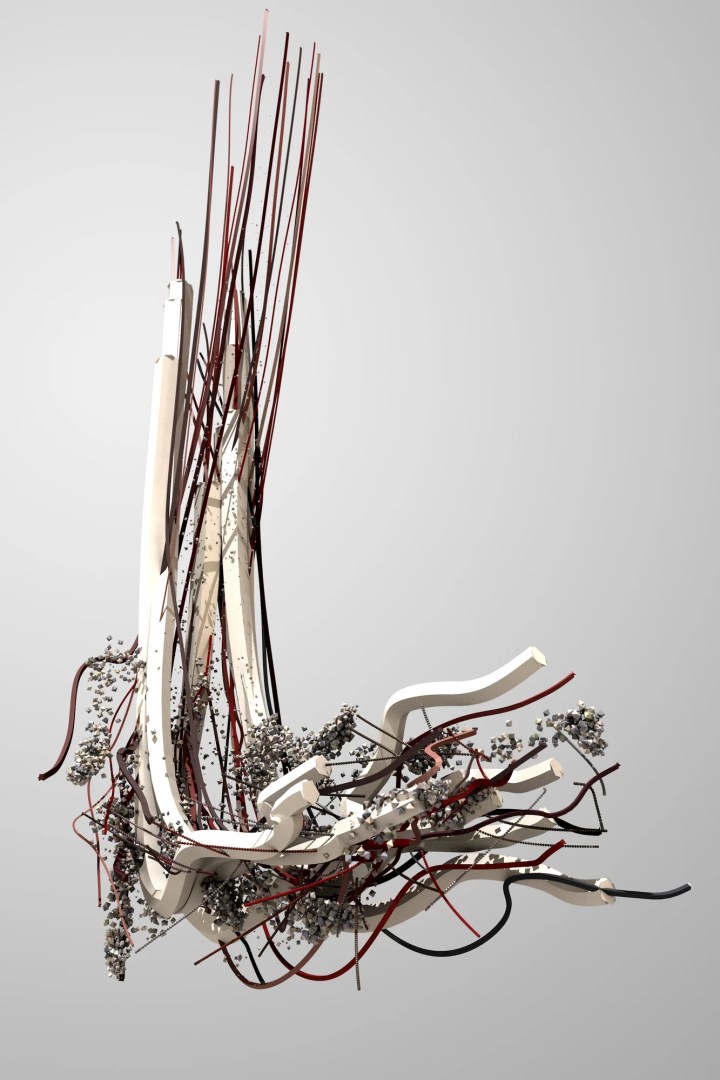
Cover image: Klingemann, M. (2019). Between us (temperance) [Generative adversarial network, digital artwork]. Electric Artefacts. https://www.electricartefacts.art/artwork/mario-klingemann-between-us-temperance