ABSTRACT
In a world where it is increasingly impossible to determine the authenticity – or reality – of any specific image, occasional aberrations in machine learning arise. These aberrations require diagnostic examination to further comprehend our collective relationship with both the image and the machine itself. In an attempt to sociohistorically position the unreal image of artificial intelligence networks, this essay works both as a critique of the dual psychosis of the hyperreal image and as an exploration of machine learning’s occasional aesthetic aberrations as connected to Gilles Deleuze and Félix Guattari’s ‘abstract machine’. Working through and developing further Anna Munster’s concept of “DeepAesthetics” (Munster, 2025), this essay intends to shift the locus of the image or image creation from the assemblage (agencement) to the abstract machine. I posit that machine learning images of ‘deepaesthetics’ should be understood as the aesthetic-becoming(s) of the abstract machine, located in the ‘chronocrisis’ of the unreal image.
: 1.1 The Uncanny Valley :
Four years ago, I finished a major project titled “Messing with the Machine in the Uncanny Valley of Photography” (2022). It is admittedly a mouthful of a title, but the final piece – measuring 37 feet in length and composed of nearly 8,000 images – more than lived up to its ambitious name through its sheer scale. The intention of this piece was to rephotograph fifty famous images from seven different 20th-century art photographers using a GWOT-era CF-formatted digital camera. I intentionally blurred and abstracted the images in the camera and fed them directly into a GAN model, which was then prompted to create a 20th-century art photograph based on these restrictive and (‘messed with’) inputs.

This piece was intended to operate on two exploratory fronts.
First, the project intervened in the dynamic that philosopher Vilém Flusser identified as central to the apparatus: the photographer becomes a “functionary” absorbed by the camera’s black box, serving its program rather than mastering it as a tool. For Flusser, this marks a shift from homo faber (man-the-creator), who wields tools, to homo ludens (man-the-player), whose “play” is constrained by the apparatus’s programmed possibilities (Flusser, 2000). My intervention enacted a “reversal of this reversal” by deliberately using a camera (a low MP CF-formatted Canon Rebel), which, as a technology, was situated firmly in the “uncanny valley” of technics. Not old enough to be considered nostalgic like the 35mm and 120mm film cameras that permeate photo programs around the world, nor the high-tech cutting edge of 100+ MP digital sensors, but rather situated somewhere in between.
Second, this work sought to discombobulate the GAN network by strategically limiting the dataset provided as reference for its computational process. By feeding the system a constrained set of intentionally modified, blurred, and “poor-images” (Steyerl, 2009), the resulting thousands of synthetic “intelligence processes” generated an increasingly abstract historical artifact: the machine’s conditioned attempt to produce a 20th-century art photograph.
Now, to the trained – or even increasingly untrained – eye, one can quickly date this image and likely even the processes by which the print is composed. The “artistic” artifacts of latent space and neural processes, as they appeared in the first half of 2026, quickly date this image to early or mid-2022 – which, in terms of AI technology, might as well have been 1993.
While my own work in the far-off year of 2022 was focused on the aesthetic outcomes of limiting – or rather ‘messing with’ the machine, Texas-based artist Zak Loyd achieved equally abstract outcomes in his “:engine” series. Loyd employed what is known as classifier-free guidance (CFG) or a parameter that determines how strictly the output follows its prompt within Stable Diffusion’s latent architecture. Thus, Loyd in many ways takes the opposite approach.
By tweaking the parametric steps, the images produced via the classifier-free guidance are at once contained or defined by the general category of the prompt but also free to wander or drift into their own aesthetic creation. The machinic output here, when both overwhelmed and yet corralled, manifests in images that are noticeably “retro” – or rather, possess an aesthetic quality definitively of an epoch, recognisable as belonging to the past rather than appearing timeless or purely novel or creative.
It was this idea or recognition of the chronological speed at which the aesthetics of these processes can be demarcated and dated at an accelerated pace – that began to intrigue me, as the techno-economic engines and infrastructures driving said processes continue to “improve” at an exponential rate. In conversation with Tom Leeser, director of the Center for Integrated Media at CalArts, he shared this interest when discussing his own work with AI technologies. What struck us both was how unmistakably dated its AI imagery already appeared — not as a type of failure, but as evidence of something stranger: the accelerating velocity at which non-human imaging enters its own uncanny past or nostalgia, a becoming-uncanny or becoming-nostalgic.

Chronos (Χρόνος): relating to time
Krisis (κρίσις): a separating, decision, or judgment
Ultimately, what seems to be at work here is something I am going to call “chronocrisis”, in which the speed of these technological imaging innovations has created a compression of the past that comes to rupture our collective understanding of nostalgia in terms of visual-virtual aesthetics. This process liquidates our temporal footing. More specifically, it names the condition in which technological acceleration produces a qualitative transformation in our temporal relation to images. It is not simply that images become obsolete faster – though this occurs – but that the mode of obsolescence itself changes. In chronocrisis, the temporal markers that allow us to locate an image historically become simultaneously more granular and more detached from conventional historical reference.
The chronocrisis materialises in myriad ways, but most notable for this inquiry are its impacts on what we might call the uncanny valley of technical images. Echoing Mori’s original formulation, it is typically described as a dip in affective response as objects approached but failed to achieve human-likeness. Extended to synthetic images, the valley describes not a fixed location but a relation — the relation between an image and the standards against which it fails to be convincing. And those standards are themselves historical. What counts as “convincing” in 2022 is not what counted in 2020; what counts as “dated” in 2026 is not what counted in 2024.
In turn, it leaves behind increasingly minute yet recognisable temporal jitters, glitches, and ‘errors’ that reveal the fallible, imperfect, and yet human (all too human) artist behind the machine. As it will be unpacked further, the 20-30-year predictive cycle of nostalgia presented by curator James Laver (Laver’s Law), Simon Reynolds’ “Retromania,” or even Mark Fisher’s “slow cancellation” of the future can all be plugged into what was (prior to non-human intelligence / imaging) – both a chronological loop and a non-assenting point in which, situated in the nadir, would be the “uncanny valley” in regard to all forms of aesthetics.
What I intend to posit is that this shared chronocrisis not only modulates our understanding of the classic-contemporary dichotomy but also offers a praxeological weapon: a mode of human and non-human image-making that shatters both the co-option of imaging technologies by technofeudal capitalism and delivers, perhaps, the final death blow to the long-languishing corpse of realism in aesthetic practice.


What can be observed in the chronocrisis are two opposed vectors transforming the traditional understanding of the uncanny valley. On the one hand, a widening of the valley introduces more technologically recognisable elements that date the image to a specific model, patch, or update. Yet at the same time, these valley moments differentiate and compress into one another, their distinctions collapsing under acceleration. Together, these vectors produce what I call ‘micro-obsolescences’: the smallest identifiable units of image-datedness, the temporal jitters of each program and patch. Nonetheless, there is the paradox that defines the chronocrisis: as these programs’ drive toward realism advances, micro-obsolescences become more difficult to detect even as they proliferate more rapidly. They retreat into the microperceptible, visible only to the trained eye — or to the machine itself.
This retreat is not a disappearance but a compression. Within the deepening nadir of the uncanny valley, micro-obsolescences stack upon each other, digging down into what might be called a ‘valley of compression.’ Here, the ‘allopoietic’ functioning of prompt-based imagery is allowed to make mistakes, to create the uncanny, to leave traces – of the prompter, of the interface, of the ever-imperfect encounter between human and machine.
Theorist Anna Munster’s account of the ‘allopoietic’ illuminates what accumulates in this valley. Following Félix Guattari, she defines the allopoietic as “the collective dimension of alterity with which any entity or system is always already in relation, and which enables novel generative capacities” (Munster, 2025: 37). This dimension is irreducibly temporal. Drawing on a genetic analogy, Munster argues that a gene “is not an isolated unit… but immanently retains a past of actual changes and hence the potential for future changes. In this past-future/present-past/present-future topology lies the gene’s dimension of and for expressive alterity” (37). Technologies, though inorganic, share this structure: they too “immanently carry their pasts—the phyla of their realized and unrealized sociotechnical mutations. They too open onto other futures” (37).
The valley of compression is where this temporal topology becomes visible. The micro-obsolescences that accumulate there are precisely the traces of this carrying — marks of past model versions and patches that simultaneously open futures in which those marks will be read, dated, or misread. Chronocrisis is this visibility: the condition under which the image’s retained past becomes legible as future possibility.
In discussing the deepening nadirs in the uncanny valley of machine learning imaging further, a complementary conceptualisation of this process is also presented by Munster in DeepAesthetics: Computational Experience in a Time of Machine Learning (2025). Working from a positioning of machine learning aesthetics as situated beyond empirical perception, Munster presents the condition of ML aesthetics (or ‘deepaesthetics’) as an experience that is “bound to insensible and microperceptible forms of nonlinear and continuously modulating statistical function and calculation” (Munster, 2025: 9).
Munster advances that “AI’s procedural playing out within current sociotechnical constraints” allows for moments of interaction and striation within the deepening nadir of the uncanny valley, moments in which AI imagery often “wander(s) away from being ‘on task’” (Munster, 2025: 39). Here we are presented with a hypothetical ML aesthetic that is both influenced by said sociotechnical constraints inherent to various networkings and yet can often remain non-perceivable, functioning and discombobulating on the downward slope of the uncanny valley.
The perception or empirical sensation of aesthetico-wandering presented by Munster can be recognised in two separate forms. The first is the one in which the machine is let loose to ‘do what it will’ (in a similar method employed by Loyd in his :engine series), and the second is the one in which the machine is intentionally and forcibly placed into a computational quandary due to a lack or restriction of input (also the intent of “Messing with the Machine”). Interestingly enough, we will see that both of these approaches can be encapsulated and materialised by Munster’s positing of “deepaesthetics,” as a means of computational wandering can be reconfigured through the “computational heterogenesis” [1] of machine learning.
For Munster, the deepaesthetic elements of machine learning operate in a twofold manner. Their purpose is not to define or further recognise the “thinking” – or rather, as will be discussed later, the “intelligence-ing” – that we assume to be inherent to machine learning. Instead, they function to recognise the axiomatic restrictions imposed by predetermined trajectory models.
What Munster’s twofold operation discloses is the binary of technohuman experience/functioning itself. It is within this binary that an invitation is extended – to machine, scientist, and artist – to recognise, utilise, and weaponise the “odd sensibilities and indeterminacies” that machine learning produces. The invisible and insensible of the computational experience here do not limit the human prompter, artist, or scientist – nor do the often problematic statistic-technics of principal component analysis (PCA) remain understated in her analysis [2]. Rather, they are a function of the assemblage nature of ML itself, in which a “quasi-qualitative” (rather than strictly trajectory, quantitative, or mathematically predictive) speaks to the black box computational experience that again blurs the lines of the perceivable aesthetic and the sensuous sublime.

[SOURCE]
: 1.2 The Dual Psychosis of the Un-Real Real :
What does man gain from all his labor at which he toils under the sun? … The eye never has enough of seeing, nor the ear its fill of hearing… Is there anything of which we can say, “Look! This is something new”? [Ecclesiastes 1:3,8,10 (NIV)]
Thus, we further pursue another question here: what is the goal of these non-human imaging processes, of what I am calling un–human labor more broadly? [3] I argue the wanderings, manipulations, and refusals of classifier guidance are not merely creative tactics. They are aberrations. And to understand their force, we must understand the regime they symptomatise and escape in equal measure — the predictive machinery whose dysfunction is also its disclosure. This disclosure has become a site of widespread recognition — artists, theorists, and academics (myself among them) recognise the revolutionary potentialities of non-human intelligence and non-human imaging. Yet recognition is not power. For the vast majority of these systems remain under the yoke of a growing state of surveillance and technocratic capitalism, and we cannot afford to ignore the question that follows: who wields them? This question is inflected by the fact that the end goal of these apparatuses resides not in coding the real or assigning meanings, marking bodies, inscribing values; rather it is the power to set the axioms through which the Real can appear at all. Where codes prescribe what must be believed, axioms indicate what is going to be done.
For Aristotle, technology (technē) was understood as the capacity to bring forth into actuality what previously existed only as potentiality or to “create what nature found impossible to accomplish” (Guattari 1995: 33) whether in the mind of the maker or in the material world. For Marx, by contrast, the question of what is deemed “impossible” opens onto an entirely different terrain: the relationship between labor, historical material conditions, and capital’s ownership of the means of production:
“The machine proper is therefore a mechanism that, after being set in motion, performs with its tools the same operations that were formerly done by the workman with similar tools. Whether the motive power is derived from man, or from some other machine, makes no difference in this respect. From the moment that the tool proper is taken from man, and fitted into a mechanism, a machine takes the place of a mere implement. The difference strikes one at once, even in those cases where man himself continues to be the prime mover” (Marx, 1867).
The wheel aided the farmer, the complex gear the factory worker, and gunpowder the soldier. For Marx, each of these advancements reinforced the capitalist class not merely by easing labor, but by abstracting the worker from direct control over production. Technology under capitalism becomes a weapon in class struggle, not a neutral tool. If we understand technology this way – as embedded in the means of production and material conditions of globalised imperial technocapital – then we must ask: what is perfected labor in terms of un-human imaging generation? Aristotle considered automated tools impossible, a fantasy that could never replace living labor.
Marx, writing after the Industrial Revolution, saw machinery as reshaping labor itself. The question I want to pose, extending both, is this: “What is the impossible task of un-human imaging, and what form does abstracted labor take when the worker is no longer human?” I argue the answer is the perfected simulacra: the total victory of realism, in which anything can be real – beyond any question of if (or when) it ever was or ever will be.
Whereas painters might have at first scoffed and eventually bemoaned the technological advances and realism of the camera, with machine learning there exists no – or little – boundary that can necessarily restrict the “realism” of the image. No more is there any apparent connection or material dependency to capital! While the latter point is often false, seeing as the frenzied capitalist circuit continually creates, regurgitates, and funds itself to the hum of billions, the interaction with the un-human imaging machine throws the technē-human relationship into a fully abstracted, terrifying, and new milieu – one as far removed from Marx’s posited connections between labor, material, and capital as we can imagine as even possible.
This ‘impossible’ labor abstraction contra-Marx effectively short-circuits the Heideggerian posited function of the enframing filter or screen, which is placed over our own eyes in order to see the world as nothing more than stockpiles of reserve material (Bestand). There is no need for a machine to see nor filter in order for it to understand its users as purely that, Bestand (Heidegger, 1977)[4].
Even more consequentially, we can look to Jean Baudrillard’s Simulacra and Simulation (1981) and his provocations articulated in its opening chapter, “The Precession of Simulacra” whereby the map no longer represents a pre-existing territory; it precedes and engenders it. According to Baudrillard, the hyperreal is not the death of the real, but more sinisterly, its more radical eclipse: the substitution of the real by a generative model that functions without recourse to any external referent, an operational double that renders the very question of origin obsolete. This is, accordingly, the condition we now inhabit, melting away the epistemological bases that would still secure a distinction between the copy and the real. Therefore, I choose to believe our Silicon Valley overlords when they say — through actions rather than words — that the goal of un-human imaging is to complete this inexorable territorialization. Billions of dollars are circulating toward the moment when the perfection of the simulacrum will dissolve or erode any capacity — any “response-ability” — to differentiate because the real has been entirely absorbed into its own model.
The triumph of the simulacra, or the perfect copy whose realness or referent we can no longer discern, carries immense sociopolitical implications, already recognisable today. While Baudrillard and Debord might have separately recognised this realisation of a simulacra-sans-referent, what is being developed and perfected here is something potentially more psychotic in terms of the relationship between the human and the image. In many ways, this could prove to be the crowning achievement of the hyperreal.
But this framing, while necessary, misses what is genuinely novel about the current moment. The image has always deceived; Plato knew this. If the mimesis problematic attributed to aesthetics by Plato might have been epitomised by the photographic image – and thus Flusser’s ‘black box’ of the photographic image, in which the perfection of the simulacra manifests in the form of various technical images/objects – the following critique is not of the mimesis of the image, but rather of the temporality of the image itself.
Then, the threat of the un-real real image is not that a photodocumentary image fails to be ‘real’ because it did not – and does not – represent what was real at some past moment. Rather, the threat is that its historicity can no longer represent the lived moment of the real under the regime of ML hyperrealism. We can consider examples that have historically anchored this concern and its implications. Notably, the moving cannonballs of Crimea that ‘were staged’ — arranged by Roger Fenton to give the Valley of the Shadow of Death a more satisfying composition. Or, the hammer and sickle, grafted onto the Reichstag roof, which ‘announced’ a Bolshevik triumph — but the flag had been sewn for the camera, the soldiers posed after the fighting ceased. Both were manipulations. Yet, what prior critiques grasped was not the image’s claim to truth but its embeddedness in sociotechnical conditions: who stood behind the camera, what was cropped out, which bodies were valorised or erased.
These were conditions that grounded a socio-historical context — conditions that, however fraught, still rooted the image to a time and a place. The threat of the un-real real image is not that it falsifies that context but that it renders context itself inoperative. While the liberal notion of ‘post-truth politics’ and ‘fake news’ marked the sociopolitical death of the neoliberal regime of trust in the image and in reality, perhaps what has replaced it — the bipartite psychosis of the ‘real image’ — will prove to be both more effective and more debilitating.
This shift is no longer a matter of abstract theory; it has also been displayed interestingly in the public spectacle surrounding figures like Benjamin Netanyahu. The recent scrutiny of his ‘proof of life’ footage perfectly stages this new dilemma. We are presented with a split: those who see AI-generated artifice, those who defend it as genuine, and those who suspect a deliberate, meta-fake. The collective conversation collapses under the weight of these irreconcilable possibilities. The question then is no longer ‘who stood behind the camera?’ but, more critically, in light of the Netanyahu footage and the confusion it has sown, ‘was there ever a camera at all?’ [5]
Therefore, the goal of realism, perfected, is twofold. First: to induce belief in those who still trust images, producing a public for whom the fake simply is real. Second: to induce psychosis in those who remain skeptical, producing a public for whom nothing can be real. Between these two poles, the territory Baudrillard described finally achieves its triumph — not because we mistake the map for the territory, but because we can no longer locate the territory at all.
But as we asserted this is not simply what we hear as proclaimed as a “post-truth era.” Post-truth assumed that truth existed but was ignored. This is the foreclosure of truth’s accessibility in principle — a condition in which the question “did this happen?” gives way to “when might this happen?” The AI image does not simply fabricate the past; it generates a completion of the post-historical and hyperstitious ‘un-real real’ or inaugurates the closure of any means of knowing without a shadow of a doubt that the in-person lived, rather than seen, is in fact real.
Returning to our focus and link to bipartite psychosis, it can be understood through the function of memory and language as they are processed by capitalist axiomatics. In other words, these axiomatics do not code or overcode like previous social machines; rather, they decode flows and supplant the socius’s traditional coding function altogether. As Deleuze and Guattari state in Anti-Oedipus (1972):
“The axiomatic does not need to write in bare flesh, to mark bodies and organs, nor does it need to fashion a memory for man… Memory has become a bad thing. Above all, there is no longer any need of belief, and the capitalist is merely striking a pose when he bemoans the fact that nowadays no one believes in anything any more.” (Deleuze & Guattari, 1972 : 250).
Furthermore, they speak to the hyperstitiousness of this axiomatic functioning of language – which replaces belief with an empty calculus, decoding memory and desire into flows that can be reterritorialized by power at will. This is precisely what Deleuze and Guattari identify when they write of a language that “no longer signifies something that must be believed, it indicates rather what is going to be done…” (Deleuze & Guattari 1972: 250).
The threat presented by the upcoming triumph of the “un-real real” image may put much of the prior centuries’ criticisms of the photodocumentary image into perspective as just as futile, bourgeois, and historically centric as they truly were. While valid yet vapid critiques of the twentieth-century image have been made from Marxist, feminist, and Luddite positions, perhaps there has been no greater sin than to allow for the at-first gradual, and now exponential, triumph of the unreal and hyperstitious “real” image.
In many ways, we don’t have to wait for this perfect realism to be visibly manifested, and in fact, it is visible in other mediums today in front of our very eyes (screens), but potentially with even greater material consequences. For example, let’s look at the most obvious unreal-real possible, the world of finance and speculative capital, to make the direness of the same ‘progressions’ of the un-real real image clear.
The end of the (international) gold standard by the global capitalist hegemon in 1971 under Nixon cemented the world in which we both live in today, and the overtly fascist turn we have witnessed over the past decade. This axiomatic becoming-virtual or becoming-abstract of capital, now removed from the material shackles of the gold standard of the barbarian despotic machine (and its filiation with the imperial formations) would seem to make perfect sense, as under capitalism which both does and doesn’t have an exteriority, the interiority only grows vaster, or wider, finding new axioms at the dysfunctioning-function of “capitalism’s immanent axiomatic”. Under the reign of speculative capitalism, there now exists entire markets which “unfold right at home” divorced from the concept of labor via the application rather than the implication of “a code”.
A half a century later we can see this application today in how machine learning has impacted the regime of speculative (invisible, virtual, heterotopic, etc.) capital in the very gamification of the market itself. Speculative companies and new cryptocurrencies pop up daily. Markets – still tied to this inherent dysfunctioning-function of financialised capitalism – no longer solely rely on physical material to pillage and a people to colonise, and have thus turned to the magic numbers in the sky to determine our worth. Although here in speculative capital the bipartite psychosis of the unreal-real image is reversed.
Consider, for example, the two primary subject positions that emerge in relation to the un-real real image. In the first regime, the ‘rube’ or ‘patsy’ is the one who believes the image to be true, regardless of its obvious artificiality. In the second, the skeptic is the one who, in response, can no longer trust anything beyond that which is directly lived and witnessed. Within the schema of gamified speculative capital markets, it is often the former — the boomer-patsy of the first regime, whose entire life under capital “unfolds right at home” — who is able to realise speculative “money.” Conversely, it is the paranoid skeptic, who rightfully recognizes the latter regime of the un-real real, who is left in utter awe at the sheer immateriality of virtual capital.

: 1.3 Abstract-Machines :
In both prior examples examined in our previous section, the triumph of the un-real real image and speculative capitalism, there remains a unique relationship to Deleuze and Guattari’s ‘becoming-concrete’ and ‘becoming-abstract’ processes, respectively, and simultaneously. For the ‘real’ ML image, there is a completion of the map of the image and of the real, in which the bipartite psychosis of the image is manifested or generated.
And at the same time, a multi-capacitive ‘becoming-concrete’ in our collective understanding of our relationship to the technical image is based purely on our lack of ability to prove any image as false or any image as real. This process of ‘becoming-concrete’ is thus one of ‘becoming-psychotic’ in terms of our relationship to the image.
Then, these two processes; ‘becoming-concrete’ and ‘becoming-abstract’ speak to the axiomatic dysfunctioning-function of capitalism, one in which Deleuze and Guattari make clear consists of a constant and consistent drive for new axioms, constituting a machine that paradoxically both does and does not contain internal and external limits.
In contrast to the capitalist axiomatic processes of ‘becoming-abstract’ and ‘becoming-concrete’ as posited by D&G, there is a different foundation which remains central to their collaborative project – the ‘abstract machine’ – which might provide us with a better method or means of understanding both the engendered and un-real real image. By considering the complex diagrammatic function of the abstract machine, one which can be effectively recognised through Munster’s ML deepaesthetics agencement (assemblage) [6] operating steps removed from the peak and valley of the chronocrisis, and through said processes might undertake the processes of overturning the ‘hyperstitiousness’ of the un-real real image.
Munster’s presentation of agencement is specific to the various “heterogeneous social, technical, economic, aesthetic, political, biological, inorganic (and more) elements conjoin and multiply in ways that are productive of new relations and events” (Munster, 2025: 29). Before comparing her framework to Deleuze and Guattari’s abstract machine, it is necessary to further understand how she specifies the “process” of becoming heterogeneous, allopoietic, or seeing as no assemblage can detach completely from the strata or territory – alloplastic. Crucially, Munster’s understanding of the agencement through ML’s technical ensemble cannot and should not be limited to “gestures of mapping,” which she views as restrictive and static. Here we find a departure from the defining features of D&G’s assemblage, one worth pointing out.
In defining the assemblage, D&G immediately make clear that the first concrete rule of assemblages (or agencements) is to “discover what territoriality they envelope”, and furthermore specify that “territory makes the assemblage” (Deleuze & Guattari, 1980). This rather consequential prerequisite or predetermined function for any assemblage runs adrift from Munster’s own positing of ML agencement which – in reference to the multiplicity rather than the assemblage itself – is “precisely this increase in the dimensions of a multiplicity that necessarily changes in nature as it expands its connections” (Deleuze & Guattari, 1980:7; Munster 2025: 29). It seems as though, via the understanding or perception of the multiplicity (à la Munster), an agencement must be understood not through the various elements, dimensions, and processes that position this assemblage within a territory (à la DeLanda’s “entities and how”), but rather as an influx-becoming that functions within the latent space of ML.
What then are we supposed to make of Munster’s conceptualisation of ML agencement? In this investigation, it is necessary to probe the processes that form these assemblages – rather than the DeLandian connections (and their admittedly territorial foundations) of the meta-relationships in question. These processes, which should be further developed, nevertheless speak to a kind of deterritorializing or Simondonian “openness” through which deepaesthetics can achieve – or rather, recognise – its two poles: the predictive and the indeterminate.
Recalling D&G’s initial division of the assemblage between the “machinic” and the “enunciative,” and their subsequent “tetravalent” functioning, this schema runs counter to Munster’s understanding of agencement – not in terms of how the assemblage operates, but rather in the author’s desire to differentiate her own positing of agencement from DeLanda’s “assemblage theory.” Given the considerable interaction and intersection between her framework and the various elements of his theory, this desire is – and should be – completely understandable.
The reason for a necessary emphasis on Munster’s usage and development of agencement in this context as mentioned is due to her own positing (and inherence connection) to the abstract machine conceived by Deleuze and Guattari, and – especially in reference to Munster’s deepaesthetics – Guattari’s individual work on machinic heterogenesis. In order to further recognise the differentiation, let us attempt to further understand the relationship between the agencement and the abstract machine. While the abstract machine can be glimpsed in Anti-Oedipus (1972), it is truly deployed as a concept in the sequel A Thousand Plateaus (1980), operating both as the “abstracting” and “concreting” functions discussed earlier in relation to the axiomatic body of capital, while also encompassing – or becoming observable in – multiple other forms.
Importantly, chaos is not beginning but the unstratified — a groundlessness that is the body of the milieu(s) without organs. It is here that terrestrial assemblages emerge, territorial formations that require a ground, yet, in that very requirement, open filiation between intensive heterogeneities. Consider the nomadic war machine: it assembles without settling, territorializes without territory, and in this paradox invites the State’s capture. For the State does not produce the war machine; it captures it, turns its intensity toward mutilation, and makes war its object. This is the double movement: the machine’s line of flight and the State’s capture of that line.
This relationship between the two (the War Machine and the State) speaks to the intensive and thus volatile relationship, insofar as the logic of the war machine with no war as its object and the state makes “mutilation and war” come as primary between the two poles of capture. Whereas the strata (actualized) and the assemblage (intensive) must be “considered under their other aspects,” the abstract machine “knows nothing of forms and substances” and are rather “abstract, singular, and creative… real yet nonconcrete” (Deleuze & Guattari, 1980). In Deleuze & Geophilosophy Mark Bonta and John Proveti (2004) point out that the abstract machine:
“lays out what an assemblage can be made out of and what it can do, not just in its current state, but in future states as it enters into becomings and transformative relations with any of the other assemblages it can reach by inhabiting a ‘plane’ allowing for mutual interaction” (Bonta & Protevi, 2004: 48).
Unlike the “quasi-causal operator” (à la DeLanda) or the various social, economic, and machinic elements that Munster assigns to the agencement, the abstract machine operates as the “cutting edges of [the] deterritorialization”. Through these edges, the territory of the assemblage is connected to others via the diagrammatic mapping and phylum functionings of the abstract machine. If we are to visualise the abstract machine in its relationship to the assemblage, we might see it as the pilot or conductor of the assemblage and its rhizomatic intensities – deterritorializing, pushing outward, connecting nonformal functions with unformed matter.

[SOURCE]
For Guattari, the abstracting machine can be compared in function and relation to the assemblage to the action of extracting – and this speaks to a bipartite function. The abstract machine breaks down all heterogeneous matter, form, and association between the two.
This is its (the abstract machine’s) inherent machinic functioning, insofar as they are “transversal to them [assemblages].” This transversality of abstract machines thus forms machinic assemblages via “ontological auto-affirmation.” As mentioned in ATP, the abstract machine acts as a piloting motor, both deterritorializing and allowing for territorial assemblages to form.
With this understanding of the abstracting machine, Guattari’s assemblage is not a bonding or synthesis of elements. Rather, it can and must be understood – or abstracted – through the establishment of “the general translability of diverse referential and partial enunciative components” (Guattari, 1995: 35). One example Guattari points to is the Concorde passenger jet. For him, it is not simply an assemblage of machinic components but rather one positioned within multiple diagrammatic Universe[s]: a Universe of theoretical feasibility, a technological Universe leading from the theoretically feasible to the materially possible, and political universes that might determine whether such materiality receives funding.
By understanding the various abstracting machines and assemblages, we can, following Guattari, open ourselves to understanding machines not merely as material tools, nor simply as autopoietic systems confined to repetitive tasks, but rather as something potentially allopoietic – assemblages capable of creative functioning, of “wandering.”
Whereas thus far I have presented a reconfiguration of how the assemblage in Munster’s deepaesthetics might operate more similarly to the abstracting machine(s), this movement from one to the other opens up a vast number of potentialities in regards to the various other machinic assemblages which Munster (correctly) identifies as composing ML deepaesthetics. The argument being that in the process or a priori “look out” to the social, economic, cultural, etc. the assemblages and aesthetics of ML must either undertake in its wanderings a process of becoming-abstract or becoming-diagrammatic in order to break through the axiomatic pulsations of capital.
The diagrammatic nature of the abstract machine is crucial to its function as the deterritorializing edge of any and all assemblages, which consist of matter and tensors, operating beyond indexes or signs. This a-signifying (or supra-signifying) characteristic of the abstract machine is that which allows for non-discursive forces to be potentialised, beyond the territorial and intensive forces of the assemblage. This force of deterritorialization is purely and solely dynamic, and its constant in-flux motion can lead to no predictive nor planned intensive composition, as is the case with the strata or assemblage. The transversal and diagrammatic nature of matter is intended to go beyond that which is already mapped, striated, or stratified, or – to use Munster’s verbiage – attempt to allow assemblages to ‘wander’ via lines of flight.
In discussing the relationship(s) between the abstract machine and art in Deleuze’s philosophy, Janae Sholtz centers another element or characteristic of the abstract machine which can also be directly applied to Munster’s ML deepaesthetics, that being via its diagrammatic nature the abstract machine is inherently virtual. The virtual nature of the abstract machine here is what allows the assemblages to seek lines of flight, being real and not always perceptible, dynamic, and yet indeterminate. Removed from the coded and stratified homogeneity of the actual, and prescribing or engendering lines of flight to the territorial collaboratory functionings of the assemblage, the virtual diagrammatic nature of the abstract machines operate transversely on the plane(s) of consistency allow for a change in what intensive assemblages can do non-normatively.
For Sholtz (via Deleuze) these functionings of the abstract machine have various implications that uproot and radicalise our understanding of the aesthetic or artistic experience. Whereas in Kant, the artistic or aesthetic experience is defined by a free play of the faculties engaged in the experience of the aesthetic and cannot be prefigured or predetermined, for Deleuze this experience is still too dependent on the empirical categories of the interested and disinterested, much as the assemblage is rooted to the territory and the strata a milieu.
If we understand art (or in Munster’s case deepaesthetics) as abstract machines rather than categorical assemblages, we can recognise them as “blocs of sensation” that short-circuit the reception/perception or presentation/representation mechanism presented by Kant. This, the abstract machine of sensation, is what draws Deleuze to the paintings of Francis Bacon, inasmuch as the subject is depicted as attempting to escape its own body, in a process of becoming-animal [7], deterritorializing, and furthermore presenting or positing a potentiality of abstract(ing) machine.
While many would argue that the abstract machine cannot be manifested – that it cannot find a territory (canvas, screen, matter, etc.) in the form of an aesthetic or sensuous image – the argument here is not that machine learning and the deepaesthetics it produces are the abstracting machine. Rather, they function as the deterritorializing edge of a process of “becoming-abstract” – or, as will be discussed later, “becoming-thinking.”
In terms of these ‘bloc[s] of sensation’ which characterise the abstract machine function of aesthetics in Deleuze’s project insomuch as they form lines of flight and deterritorialize, there is a necessary application of this process to the wandering deepaesthetics of ML as presented by Munster. Whereas the trajectorial, predictive, singular, and mathematical functionings of ML deepaesthetics manifest in both the bipartite psychosis of the un-real real image (or the mathematical predictions that reterritorialize, code, and stratify, Munster’s deepaesthetics), in becoming-abstract machines rather than functioning as assemblages, achieving in creating the same often microperspective, diagrammatic, the “double deterritorialization” of “Matter” (heterogeneous interwoven virtual elements) and “Function” (aberration and allopoietic outcomes).
: 1.4 Abstracting Machines in the Chronocrisis :
“As a general rule, an assemblage is all the closer to the abstract machine the more lines without contour passing between things it has, and the more it enjoys a power of metamorphosis (transformation and transsubstantiation) corresponding to the matter-function” (Deleuze & Guattari, 2013:165).
“Depth, then, reemerges as what resides within both model and data yet cannot be seen or calculated exactly. These deep spaces emerge as data’s dimensions are reduced, but they also signal a computational register that cannot be fully circumscribed by performing quantizing calculations” (Munster, 2025: 15).
Returning to D&G’s analysis of the State’s bipolar capture of the war-machine assemblage, we find a direct comparison to what Munster identifies as the “homogenizing predictive” structures of ML’s pure and mathematical trajectory. The State operates through the figure of the one-armed bureaucratic jurist-priest-king, whose capture of the war-machine attempts to make war its object. This process manufactures predisposed, zombified, and mutilated bodies – the civilian-soldier – while its bureaucratic interiority positions the intensive nature of the war-machine assemblage between the two poles of the State: the one-armed and the one-eyed. Both of these forces, the State for D&G and the homogeneity/homogeneizing for Munster are bound to inherent faltering, stutters, or wandering from said capture, as the inherent intensive qualities and quantities of each guarantee.
For Munster, this allopoietic and often micropolitical challenge or aberration constitutes what she defines as the assemblage — and thus the produced aesthetics — of ML. For D&G, such challenges manifest through deterritorialization via the cutting edge of the abstract machine, which operates on the edge of each compiled yet non-anastomotic strata.
As D&G have deterritorializing abstract machines, Munster has aberrations, or lines of flight, which function and manifest from categorical mistakes to computational (machinic) heterogenesis; then perhaps it is here, somewhere in between and functioning within both, that we can begin to better understand the anti-realism image of the chronocrisis. One might ask, why would there be a necessary retreat or return down into the nadir of the uncanny valley at this point? We have been discussing becomings, lines of flight, allopoietics, and its inherent autopoiesis – why then now do we need to return to my positing of something so retroactive?
This is where we turn to Munster, who notes of an oddity in this occasional wandering of ML and deepaesthetics which as we will see – or at least it will be argued – that are an inherent feature of any predictive ML.
Munster specifies here (in what I consider to be the ‘chronocrisis’) that:
“machine-learned predicted output is, generally speaking, correlative with its past – it “matches” the information through which it has become… But here we encounter the rather odd space-time of ML’s autopoiesis. We could say that while the generalized program of ML is future oriented, segmenting present data so that it align with definitive predictions, the becoming or heterogenesis of ML loops backward to the future, recursively iterating its outputs via what its inputs will have become” (Munster, 2025: 59).
Even here, in its most mathematical and trajectorial, the homogeneous ML’s becoming (output) is determined by the difference of what it is, and what it had become. The differential here is a future ‘thinking’ which can only reach time=0 intensity=X, by going through what it had already become. Thus, even within the multiple quantitative processes which define contemporary ML networks, this ‘oddness’ of time-space does, for our discussion, situate these processes within the downward slope of the chronocrisis as abstract(ing) machines, unrestricted by strata, territory (D&G), trajectory, or homogeneity (Munster), as allopoietic (and abstract) becomings.
Munster makes this point clear when focusing on GANs (generative adversarial networks), in which ‘x’ could be said to be misunderstood as ‘y’. The adversarial (or trajectorial) nature of these networks will often output images which are in fact ‘uncanny’ or seemingly aberrations from the intended prompt. The autopoietic functioning or features of sites like ‘thispersondoesnotexist’, focused on the adversarial zero-sum singularity of the generator and discriminator, would foreclose any becoming-heterogeneous potentiality which, Munster argues, is potentially observable in CANs (creative adversarial networks).
This move or understanding of failed heterogenesis via attempted adversarial singularity for Munster’s deepaesthetic assemblage connects quite clearly to the anti-realist image intensities of the chronocrisis, and this must be recognised as a victory for any praxeological understanding or utilisation of ML and deepaesthetics. These forms of images and microperceptions seek to interact and intersect with other assemblages of social, technical, biological, aesthetic, cultural, and artistic machines, following the piloting abstract machine’s deterritorializing edge through the space-time of machine learning’s chronocrisis.
What remains to be determined now that a clearer understanding of deepaesthetics and its relationship to the chronocrisis is in place is what – or how – humans must undertake in order to face those who wish to control these systems. In the face of the dual psychosis of the un-real real image, furthering an understanding of this function – of the abstract(ing) deepaesthetics within the chronocrisis – is of the utmost importance to any of those who seek sociopolitical praxis from aesthetic practices. Ultimately, this may be the task of the latent militant aesthete: drifting among aberrations, intervening in imaginaries, and learning to read the micro-obsolescences that our chronocrisis continues to leave in its wake. For these are not merely traces of loss but also openings or marks of futures that might have been, signs that the apparatus is not as closed as it claims.
NOTES
- Heterogenesis here is in direct reference to Félix Guattari’s conceptualisation (1995: 33), which in many ways Munster uses to undergird the positing of machine learning not as a closed or Turing-based binary system, but rather as one that is ontologically and technosocially embedded within a complicated “openness” or wandering that places said learning intelligence within and indebted to social, political, and aesthetic perceptual understandings.
- As I will argue later, Munster’s accurate analysis and critique of PCA and the inherent problematics of statistical imaging—which continue the historic project of eugenics popularized by data structure “sciences” in the late 19th to 20th century—will be applied to my critique of the realist intentions of machine learning imaging.
- This question is central to any sort of praxeological understanding of ML imaging. Whereas Munster goes to great lengths to understand and describe the assemblages and potentialities of ML deepaesthetics, much of the analysis remains rather distant from the ongoing weaponisations of these networks by various elements of Western technocapitalism and is instead focused on the historic connections, misconceptions, historicity, and problematics of PCA and ML’s lineage in eugenic statistics (see Chapter 2 of Deepaesthetics).
- Heidegger, Martin. The Question Concerning Technology (1977): 17-22. Interesting to note in comparison to prior discussion of the ‘uncanny’ that Heidegger points out that ‘Ge-stell’ is “eerie” and “strange”—not dissimilar to the images, fashions, and technologies of the uncanny valley.
- There are already “conspiracies” floating around that the billion-dollar circular flow of capital from one AI firm to another that we have seen in the past year to develop increasingly “real” AI technologies might be for the ultimate defense that no images or videos in the Epstein files can be understood to be real. If they can just get these technologies to a certain point, there will be a “plausible deniability” baked into every element of what should be understood as damning evidence.
- Munster makes use of the original French “agencement” when referring to D&G’s “assemblage” in order to differentiate between her understanding of ML assemblages and the conceptualisation of “assemblage theory” as presented by DeLanda. For Munster, agencement is focused on an “approach that goes to the processes activating” rather than DeLanda’s approach to the assemblage, whose emphasis is on “entities and how, at each level or scale, one gives rise to or conditions another” (29-30). I will use both terms in reference to Munster’s project, not in reference to DeLanda’s “assemblage theory”.
- See chapters 3–5 of Deleuze’s Logic of Sensation, in which each of the supporting elements of Francis Bacon’s work is applied to this schema—ranging from the grid to color choice.
REFERENCES
Baudrillard, J. (1993). The transparency of evil: Essays on extreme phenomena (J. Benedict, Trans.). Verso.
Baudrillard, J. (1994). Simulacra and simulation (S. F. Glaser, Trans.). University of Michigan Press.
Baudrillard, J. (2003). Impossible exchange (C. Turner, Trans.). Verso.
Bonta, M., & Protevi, J. (2004). Deleuze and geophilosophy: A guide and glossary. Edinburgh University Press.
Deleuze, G. (1990). The logic of sense (M. Lester & C. Stivale, Trans.). Columbia University Press.
Deleuze, G. (2003). Francis Bacon: The logic of sensation (D. W. Smith, Trans.). University of Minnesota Press.
Deleuze, G., & Guattari, F. (1983). Anti-Oedipus: Capitalism and schizophrenia (R. Hurley, M. Seem, & H. R. Lane, Trans.). University of Minnesota Press.
Deleuze, G., & Guattari, F. (2013). A thousand plateaus: Capitalism and schizophrenia (B. Massumi, Trans.). Bloomsbury Academic. (Original work published 1980)
Flusser, V. (2000). Towards a philosophy of photography. Reaktion Books.
Guattari, F. (1995). Chaosmosis: An ethico-aesthetic paradigm (P. Bains & J. Pefanis, Trans.). Indiana University Press.
Heidegger, M. (1977). The question concerning technology. In The question concerning technology and other essays (W. Lovitt, Trans., pp. 3–35). Garland Publishing.
Marx, K. (1990). Capital: A critique of political economy (B. Fowkes, Trans.; Vol. 1). Penguin Classics. (Original work published 1867)
Munster, A. (2025). Deepaesthetics: Computational experience in a time of machine learning. Duke University Press.
Sholtz, J. (2015). The invention of a people: Heidegger and Deleuze on art and politics. Edinburgh University Press.
Sontag, S. (2003). Regarding the pain of others. Picador.
Spiegel International. (2008, March 14). The world from Berlin: Is Germany inciting a ‘gold rush’ in Kosovo? Spiegel Online. http://www.spiegel.de/international/europe/0%2C1518%2C551972%2C00.html
Steyerl, H. (2009). In defense of the poor image. e-flux journal, (10). https://www.e-flux.com/journal/10/61362/in-defense-of-the-poor-image/
The Holy Bible, New International Version. (2011). Zondervan. (Original work published 1978)
Daniel Manning Pope Jr. is a researcher, theorist, and artist currently studying and teaching in the Critical Theory program at the California Institute of the Arts. Receiving his MFA in photography/new media from the University of North Texas, Pope’s work is centered on parapolitical studies and the intersection between politics and aesthetics. Pope has shown work/had solo shows at 5&J Gallery in Lubbock Texas, Austin College, 500X Gallery in Dallas; and Stola Contemporary in Chicago. @daniel_manning_pope
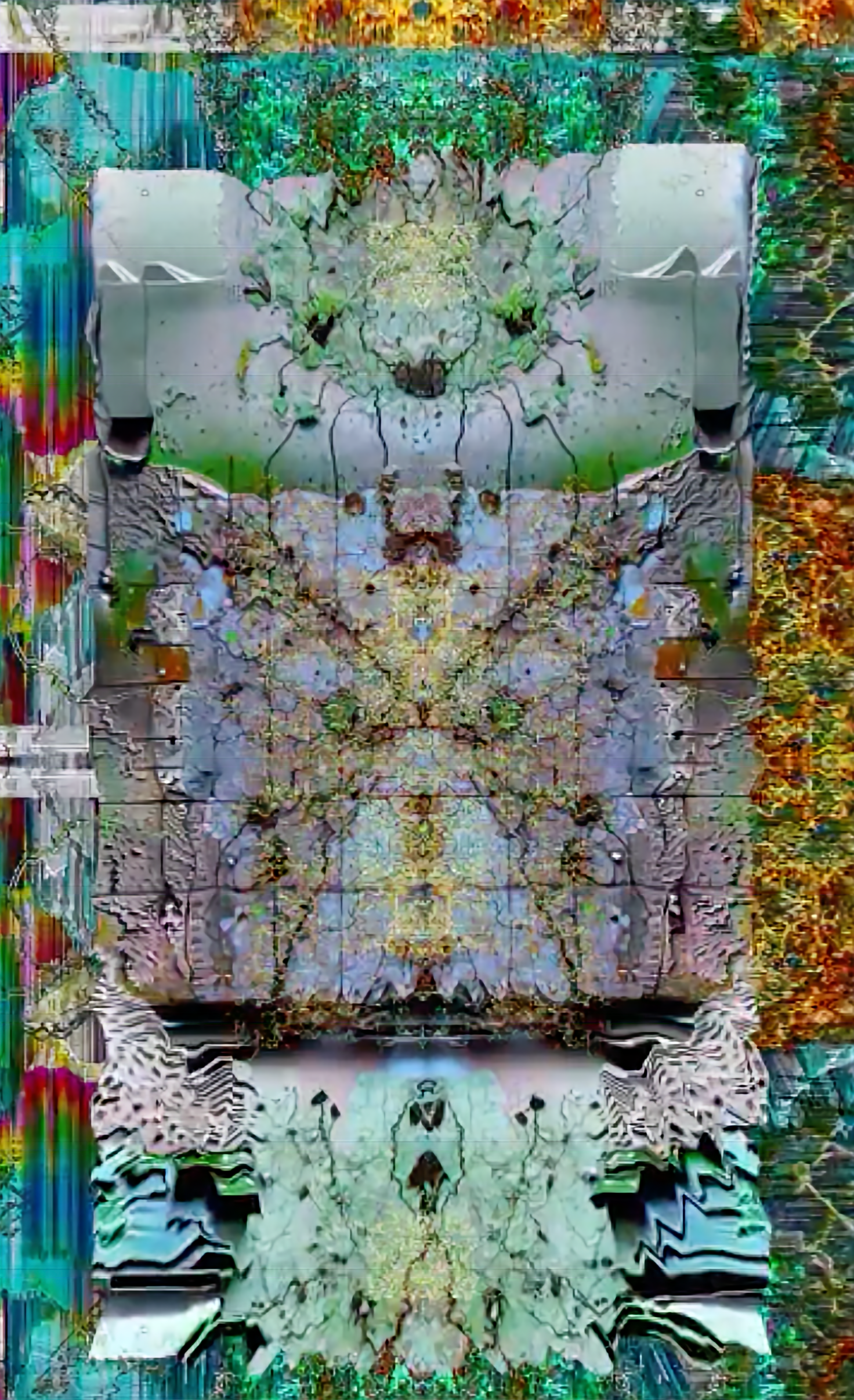
Zak Loyd cover image.