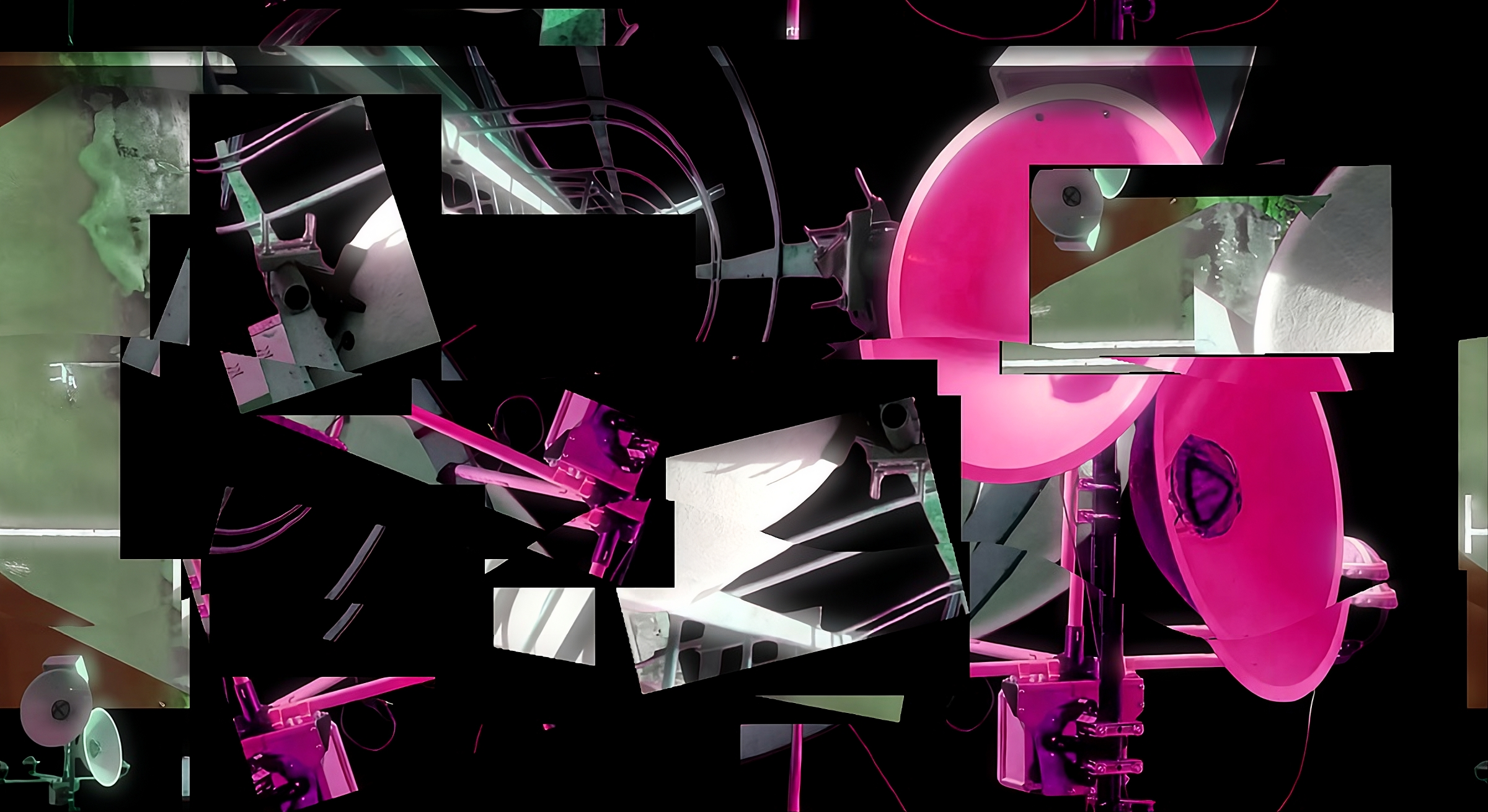
This is a contribution to the ongoing series reflecting upon Manuel DeLanda’s seminal work War in the Age of Intelligent Machines (1991). It is intended to explore and excavate interfaces, scalar abstractions, and experimental forms to generate histories of contemporary autonomous systems, archaeologies, and critiques of contemporary and near-future intelligent war machines.
ABSTRACT:
This essay argues that contemporary targeting chains and machine-learning pipelines connect to a fundamental logic. Namely, both pre-settle reality by converting what cannot be categorized into a quantity to be reduced. Drawing on Brian Massumi’s ontopower (where preemption gives present reality to threats that have not yet emerged) and Gilbert Simondon’s image cycle (where a living being can carry an “incompatibility” rather than simply dropping it), this essay examines how technical systems foreclose the capacity to carry a misfit. It develops the concept of the pseudo-territory as an apparatus operating through three inversions—format, menu, and void—and traces this logic through the Phoenix program, the Bombing Encyclopedia, and the operative images of machine vision. Examining recent targeting failures in the U.S. Maven Smart System pipeline, we argue that algorithmic correction and retraining operate strictly inside this settled framework, reproducing the target class rather than reopening it. Finally, through Karen Barad’s concept of re-turning, this essay identifies the temporal limit no predictive feed can cross, concluding that the institutional practices which keep the misfit available for contestation are necessary, but not sufficient, to invent a new measure.
:: I routed each channel’s output back into its input, allowing the electronics’ own background noise to loop, amplify itself, and transform into sound. This technique is called no-input music, or, in my particular case, no-input noise music. When I started exploring this method, I suddenly realized that its mechanics perfectly described how my anxiety works: it loops over and over again, amplifying itself until it becomes something impossible to ignore. Something huge. Something loud :: — SSSHHHHMARE[1]
:: The security state that grows up to surveil the full spectrum of threat with preemptive intent is the continuation of war by other means :: Brian Massumi (2015)
:: Of all these sounds, nothing is as torturous as the hovering drone—zanananana . . . Day and night, it is ever-present overhead, to remind me that peace is elusive and that danger is omnipresent. The drone’s hum doesn’t just fill the air. It feels as if it is perched right beside me, under my roof, unraveling my mind :: Ahmad Sbaih
:: The Edge ::
The air went metallic first, a thin, blue smell, like a coin held under the tongue. Then the hair on all arms in the room stood up at once, and a thousand people turned their faces toward a sky that had not yet decided to hurt them. Two thousand nostrils wide, all of us sniffing the wind like deer that have caught the hunter’s coat on the breeze, our eardrums strung taut with an infrasonic dread.
We have been taught what to wait for, and to sort the world into danger and everything else before we assign anything a name. Predictive processing, the leading theory in neuroscience, treats this as expectation. On this view, perception is inference. The brain builds a model of what is likely to cause its sensory input, predicts ahead, and gets back only what the predictions missed (Clark, 2016; Seth, 2021). For some of us, that residue is the teacher, and the lesson is war. War trains the body in what the air does before it hurts you, such as a drone’s hum or a smell that arrives before the sound.
For many more it arrives through sleepless feeds and forecasts, an unrelenting information war without a front, fears ratcheted up a notch at a time. A buzz of threads and clips about AI whose stakes are pitched at extinction fever and in which the alarm is also the next seed or funding round. Ultimately, we are engulfed in a climate that keeps emitting its warnings that we cannot opt out of. And where warnings keep coming, the smell stops being an episode and becomes elemental, a waiting that needs no signal to exert its atmospheric force. Only the pulse of the air…
And what we also understand as force, here, is a resonance, a tension and a charge, futurity vibrating in a present that has not yet decided what it is waiting for. Philosopher Brian Massumi terms this resonance ontopower, the power to bring to be, whereby it holds “the futurity of unspecified threat … in the present in a perpetual state of potential emergence(y),” so that “a movement of actualization may be triggered” (2015, p. 15). Preemption is the most consequential form ontopower takes today. Whereas prevention targets a danger already known, preemption holds a threat that has not yet emerged, and in holding it, gives it a present reality. That reality works through attention, before a situation has resolved into anything classifiable. Massumi characterizes this moment as the “infra-instant” of “bare activity”, or the felt present in which a threat that has not yet arrived is already registered (Massumi, 2025).
That moment presupposes a body already tuned to what has not yet appeared; otherwise preemption would have nothing to seize. The question that steers us here is how an organism is already oriented such that it can be preempted at all. Gilbert Simondon, the French philosopher of individuation, furnishes us with the means of conceptualizing how the living being is already oriented by affectivity and the motor image before anything has become an object of perception (Simondon, 2020, 2022; Voss, 2024). An object is, therefore, met by an orientation that precedes it.
This incipient orientation, which Massumi renders conceptually and Simondon locates at a more primary level, is also encountered in several languages. In Spanish huele a quemado, “it smells of burnt,” is an impersonal construction, with no grammatical subject. Italian c’è odore di bruciato, “there is a smell of burning,” supplies a subject, but the subject is only the smell. The burning itself remains unnamed. Both sentences are certain that something is burning. But neither says what. We term the edge the moment such a sentence gets its subject, when the burning is fixed into a name. A name is one form of fixing, and what it does is close a field of possible subjects into this one rather than that. Massumi terms the field from which such thresholds emerge the proto-territory, “tensed with a compelling excess of potential,” a field no formed territory can hold (Massumi, 2009, p. 167).
There are two ways to go on from the edge, and they divide on what happens to what does not fit. The first path is preemption’s. The smell gets its subject, and the subject is an enemy. The fixing converts indeterminacy into a foregone conclusion, the could-have/would-have that retrospectively justifies premises that could not be verified in the first place (Massumi, 2025). What did not fit is settled at the point of detection.
The same excess can be met without being settled. A smell can stay a while with what does not fit, two warnings that say different things, or a verdict in a targeting feed that the day itself does not bear out. This is the second path, and it is the one on which Simondon places invention. A misfit is held in tension until it can be resolved in a new dimension, rather than settled at the point of detection. Scholar Daniela Voss describes this as an image harbouring an “inner tension” that carries “potential energy for a leap into another phase” (Voss, 2024, p. 232); thus, carrying is our term for the activity that keeps that tension in play long enough for the leap to occur.
Changing these classifications does not mean stepping outside them. The edge is not an escape from the rules; it is where pre-set categories meet a situation that exceeds them. The question is whether the excess is registered as excess, or converted immediately into a label. The second path keeps the excess available to alter the categories from within. But if this capacity to hold an excess is real, we must see how it operates in a living organism before asking what becomes of it in a technical ensemble.

:: Carrying and Dropping ::
Simondon provides such an account in his image cycle, which shows how a living being can carry what we have used as the term misfit rather than drop it. For Simondon, an image is not a static picture but a mode of acting in a situation. These images are not confined to the mind; they extend to the body and the milieu, operating relatively independently of the conscious subject. The first phase of this cycle is the motor image, which precedes perception and gives the organism its first, anticipatory grip on a situation. Motor images have their source in the organism itself. The organism’s specialized organs and operative modes act as structural constraints on future behavior (Voss, 2024). Simondon provides the example of the bee-eating wasp, which “cannot wait for information to be complete,” where its first strike is a guess about what it faces, corrected as it closes in (Simondon, 2022, p. 64; Voss, 2024).
Perception then, according to Simondon, is a sequence of active sensorimotor explorations moving from general anticipatory images to images with more “precise information content” (Voss, 2024, p. 231). For example, an organism’s action system activates a behaviour schema suited to the kind of situation before an object has been identified, running, striking, or drawing near (Simondon, 2022, p. 31). To go around a fence one must first have explored enough of the terrain to hold a roadmap, and Simondon’s claim is that possible detours preexist in the perceptual-motor images accreted by past exploration. The more precise the image, the faster the detour is found (Simondon, 2022, p. 146; Voss, 2024).
The cycle continues past the motor image. Voss describes its phases as “overlapping, simultaneous layers, each containing incompatibilities and potential energy for a leap into another phase” (Voss, 2024, p. 232). Motor images therefore solicit perceptual images; intra-perceptual images reduce initial incompatibilities and then create a new compatibility in phenomena such as perceptual constancy and the perception of shapes; symbolic images harbour an “inner tension” of incompatible qualities (Simondon, 2022, p. 124) that may lead to acts of invention, or in certain circumstances result in pathologies as we will elaborate; and image-objects are “crystallisations of thought that can feed back into new processes of invention” (Voss, 2024, p. 232). The cycle then closes where it began, in anticipation, though no longer the anticipation it started from (Simondon, 2022). At each level something is left over. That leftover is what we have captured in this essay as the misfit.
The misfit appears first in the anticipatory grip, where the motor image guesses the kind of situation it faces before the situation becomes a distinct object. It appears again when a name or a class is assigned, because a label also sorts by kind before the specifics are known. In both cases, the fit is rarely exact, and something is always left over that the class cannot hold.
That leftover can be dropped, and the action continues with the existing schema unchanged. The alternative is to carry it. Carrying requires holding two incompatible things together in the same field, rather than letting one cancel the other out. Simondon’s term for this tension is disparation, the mismatch of two orders held together. His primary example is retinal disparity. The left and right eyes always produce slightly different images. If the images were identical, there would be no depth; if they were entirely unrelated, there would be no object. Depth emerges as a new dimension made possible by the disagreement itself. The resolution of this disparation is the act of invention: a new dimension is created where both conflicting images can be held.
This is why the misfit cannot be settled in advance: the new dimension appears only if both conflicting sides are held together, and settling cancels one of them, so the dimension never arrives. Held in tension, the misfit acts back on the organization that produced it. Voss describes this as “a retroactive effect from image to schema, insofar as actual movements act on and modify the virtual potentiality of motor schemas” (Voss, 2024, p. 236). The organization changes by being modified from within. Reconstructing Bergson, Voss also notes that “within the conditions of the problem, the lines of a possible solution already appear, albeit negatively” (Voss, 2024; see Simondon, 2022, p. 140). The misfit contains the shape of its own resolution in the negative, meaning the solution must emerge from the problem’s own conditions.
Carrying can also fail while the misfit persists. A symbolic image need not meet the object it concerns. When what is feared has not yet arrived, nothing corrects the image, and affect supplies the growth perception would have checked. Fear draws a line between near and far and places beyond it a double: an image of what is coming that is nourished by the waiting rather than by information, and so can grow larger than any enemy that could be encountered (Simondon, 2022). A name gives this double an object, and stops its growth. But it stops it too quickly, and in the wrong order. The conclusion arrives before the tension has been carried, so the relation that carrying would have opened never opens. The misfit is not dropped but reorganized: a tension waiting without an object, now attached to a fixed term, where it persists as pathology. This follows from what Voss marks when she notes that the inner tension of symbolic images “may lead to acts of invention, or in certain circumstances result in pathologies” (Voss, 2024, quoting Simondon, 2022, p. 124). Naming or classifying the double gives it an object before its tension can be carried, foreclosing the leap that would have altered the rules.
This failure or carrying—foreclosed before it begins—is the passage into the machine, and into the pseudo-territory, as we will explore.
:: The Pseudo-Territory ::
A feed engages attention; a targeting interface engages targets. In both, the object arrives already sorted into an order that precedes it. This is the operation of targeting extending beyond the battlefield. We term this environment the pseudo-territory: a space where precedence is set by someone other than the one who acts within it.
It is the exact inverse of Simondon’s territory. In Simondon’s territory, the thing itself suggests how it can be used, and detours are discovered through past exploration. In the pseudo-territory, the rules are pre-set and the detour is chosen from a list. The pseudo-territory is the threat environment rendered into a lifeworld, where the order of the menu inflates to become one with the environment itself (Massumi, 2025). Yet, where Massumi’s proto-territory was an excess of potential that no formed territory could hold, this apparatus is what that excess becomes when it has been pre-settled. That pre-settlement occurs through three inversions, each producing a different kind of misfit: a prediction error, a relation, and a remainder.
The first inversion is the format. In a video feed, the format is resolution, frame rate, compression, and dynamic range. In a targeting interface, it is the sensor’s resolution and the tracker’s update rate, the confidence threshold below which a detection is not displayed, the coordinate system in which a position is reported. The format decides which differences can arrive at all, and the misfit it produces is a prediction error, the part of the signal that could not be registered. This is a quantity, and it can be made smaller. Raise the resolution, lower the threshold, retrain the model on more data, and the error declines.
The second inversion is the menu, the fixed list of actions an interface makes available. The menu decides what can be done with what registers. In a feed, the menu offers click, watch, skip, share, report. In a targeting interface, it offers engage, spare, watch, pass on. The menu has few options, and it stays the same whatever is shown. Friend, hostile, neutral, unknown—the identities a military display assigns to a track—look like objects and work as charges, with the precision of objects and the valence of attack and defence. The misfit the menu produces is a relation between two orders, a thing that is neither this nor that and cannot be held in the few terms offered. This is the misfit that could be carried. The categories need not form a closed list. A contemporary model can describe a thing in its own words, or flag it as unusual, without a ready name for it. But at the end someone still chooses from the same short menu. And the targeting system itself is built for one thing: to find targets and strike them. What does not fit can be noticed and passed on, as suspicion or as a possible target. It does not become a question about what counts as a target, and why.
The third inversion is how the pseudo-territory handles what it cannot accommodate: it marks the excess as a void. A label can designate a thing as empty ground, or a person no one has undertaken to protect. These are the voids colonial travellers once “discovered”—population voids, lands said to be unpopulated before the settlers arrived, whose assertion of absence justified what was done next. Karen Barad further traces this colonial logic related to the Trinity test site, where the first nuclear bomb was detonated in 1945. The desert was framed as an empty wasteland, but on Barad’s account it was never empty: “the void is far from empty; rather, it is flush with yearning, with innumerable possibilities/imaginings of what was, could be, might yet have been, all coexisting” (Barad, 2017). What the colonial frame voids is not the land but the relation to it, the nineteen thousand people living within a fifty-mile radius of the test, the pueblos, the rattlesnakes, and the downwind dead. Where Barad’s void is an infinite plenitude the label cannot hold, we call the specific form this exclusion takes in the pseudo-territory a remainder—the person or the landscape the class refuses to hold—which can only be suppressed or kept.
And we also contend that the pseudo-territory doesn’t have to be formatted visually for us; it can be tuned acoustically. Drawing on sonic theorist Steve Goodman (Kode9) and his presentation on Sonic Warfare, we can liken the pseudo-territory to what he describes as an “automated panacousticon,” a distributed matrix of technological ears running from microphones to machine learning algorithms that attempts to occupy the future through preemption (Goodman, 2026, 2:59). Goodman’s example is ShotSpotter, a gunshot-detection network in which ballistic shock waves feed “a predictive simulation mapping the city’s ecology of fear”: forecasting crime, demarcating high and low pressure zones, allocating forces (Goodman, 2026, 3:10).
In Chicago, the city’s Inspector General found that fewer than one in ten police responses to its alerts turned up evidence of a gun-related crime, and that officers sometimes justified stops by how often alerts came from an area (City of Chicago Office of Inspector General, 2021). Like the visual targeting interface, what this acoustic matrix delivers to the operator is already pre-settled; it is not raw sound, but a track, an alert. In the acoustic case, the menu arrives as a detection before the thing has become an object of perception. Goodman’s concept of “machine listening”, or the “third ear” that extends audition into algorithmic sensing, reveals the three moments at work here too. The sensor’s format decides which frequencies arrive, the alert decides what can be done, and what cannot be heard is not silence but a void. Goodman calls this region the unsound: sounds too faint or too low to hear, sounds already gone or not yet arrived, held in memory and anticipation (Goodman, 2026, 52:10). The unsound is charged with waiting, which is why a silent drone could be feared more than a loud one (Goodman, 2026, 28:08).
The target class strikes twice. Extrapolating from Susan Schuppli, Goodman describes the sensory asymmetry of drone warfare: the operator’s view is aimed at a vertical event, the strike, while below, the drone’s sound spreads horizontally over everyone within range (Goodman, 2026, 21:06). The kinetic strike lands on whoever or whatever was written into the class. The sound reaches everyone who could be written into it next. This second strike has no point of impact; it hangs in the air and is one of the ways the smell is made. In Simondon’s terms, the sound can be read as the double of fear. For the person the class targets, the class gives that double an object; for everyone else, it leaves the double hanging overhead. A precise strike therefore does not dissolve the atmosphere. It feeds it.
:: The Chain ::
Importantly, the pseudo-territory is not a metaphor for the targeting chain. It is what the chain builds, and the chain is one apparatus among several that perform the same operation. A person is sorted into a class, and the class can be any type of descriptor deployed in militarised contexts or laboratories of occupation, such as “high-value individual,” “insurgent tax collector,” “courier,” or something else. In each case the class is a type of address. In the Phoenix program during the Vietnam War, a suspected member of the Viet Cong Infrastructure—the parallel political and administrative apparatus that collected taxes and moved messages in the villages—was assigned a VCI number and a target folder. The number made the person addressable. It could be pooled with other numbers, scored, ranked, shared across agencies, and returned in an interface as a track to be confirmed or cleared (Reichborn-Kjennerud, 2025, p. 108). It was the form in which a person could be identified and acted on, even lethally.
The class assigned in Phoenix was the entry point to a targeting chain. Today, that chain is an ever-evolving distributed network of sensors, analysts, interfaces, and operators. Simply, a class becomes an address, then an address becomes a track, and a track becomes an action. Military doctrine formalizes this handoff as the F2T2EA kill chain: find, fix, track, target, engage, assess. A track is a formal object in a targeting interface, a marker that says this is a thing of interest, here, now, with this confidence score.
Because decisions are distributed across designers, annotators, officers, and operators, no single person exhausts the process. This fragmentation makes the accumulated micro-decisions nearly impossible to contest as a whole. Operating at machine speed, this architecture is driven by a temporal logic coupled with the social media feed: both outrun individual human deliberation. Within such a system, the future is strictly delimited. The targeting architecture is organized only to recognize the metrics and targets it was built for, leaving no room for what it cannot categorize. It can flag what it cannot name, as an anomaly or an uncertain detection. But the flag becomes a task: check it, watch it, pass it on, or strike it.
This strict delimitation does not mean the targeting architecture lacks flexibility. A drone that finds its own route illustrates exactly how adaptability serves closure. The drone can manoeuvre around an obstacle, select a path no one drew, and still fly toward the target it was given. Its route-finding is highly inventive at the level of means; information from outside can alter the way without ever altering the end. Simondon’s concept of margin of indeterminacy describes this arrangement: the drone is radically open for navigation but absolutely closed for the target it was assigned (Simondon, 2017). It is highly receptive precisely in order to remain unchanged in what it seeks.
However, this extreme adaptability introduces a structural failure mode. A machine can become more sensitive and more integrated while remaining confined to a narrowing use, its adaptation growing until it outstrips the end it was meant to serve. This is what Simondon characterizes as hypertely, an excessive specialization or adaptation to conditions that the object cannot itself transform. He gives us the transport glider as the purest example. Built for a single passage, hauled aloft by another aircraft, and landed where the apparatus determines, it can fly well or badly without changing the job for which it exists (Simondon, 2017). Whether it is a drone navigating a complex environment or a glider falling through the air, operational time organizes their behavior. Operational time is, thus, time organized by the completion the machine was built to reach. The glider’s single passage gives that time a material form: the end is settled before the way begins, and nothing en route is permitted to change what counts as completion.
Operational time also has a historical genealogy. Manuel DeLanda’s genealogy of the war machine in War in the Age of Intelligent Machines (1991) traces part of how it was built. In DeLanda’s account, the change came when armies took charge of production, displacing the artisan workshop where makers had tracked the singularities of their materials. The drive for weapons with interchangeable parts, begun by the French under Gribeauval and institutionalized in the American armories after the War of 1812, brought standardization and routine into the workshop. Military orders became “frozen in steel” in the form of metallic gauges and jigs, or DeLanda’s “frozen commands”, which replaced “the human skill of tracking singularities” with standardized procedures for imposing a “uniform shape” across all lines of variation (DeLanda, 1991, pp. 30–33). The command structures developed in the armories were later exported to civilian industry, which adopted a system of mass production and the command and control grid needed to impose that system in the workplace (DeLanda, 1991, pp. 31–33). The gauge is operational time in metal.
If the gauge standardizes the weapon, the next step in this genealogy standardizes the target. This frozen command has undeniably extended beyond the metal that first held it, into the realm of informational command and control. Drawing upon Eric Reichborn-Kjennerud’s work The World According to Military Targeting (2025), we can trace a successor known as The Bombing Encyclopedia of the World, which began in 1946. Its first target factory was an alphabetical, numerical, and geographical index to “all possible targets” on the planet, coded onto IBM punch cards. Analysts could then run queries (in the idiom of the time, “make a punch card run”) that returned a target set before any particular enemy had been identified (Reichborn-Kjennerud, 2025, pp. 61–64). A format, in the sense this essay has given the term, is a decision about which differences can arrive, and each was designed, funded, doctrinalized, and contested. Operational time is what these forms and cycles constitute; it is targeting’s artifact.
Operational time therefore has more than one sense in this essay: the time of the glider, the time of the Bombing Encyclopedia’s formats, and the doubled and tripled time of the feed. The senses are compatible because each settles completion before the way begins, and each carries that settling forward. In a contemporary machine-learning classifier, this forward motion is carried by the model’s weights. The classifier that applies its learned categories to incoming frames produces something that is not a picture. Its outputs belong to a domain organized around something other than human viewing.
Jussi Parikka refers to that domain as the invisual, the domain of images that are not made for a human eye and do not function as representations (Parikka, 2023). The late Harun Farocki wrote about “operative images,” pictures “made neither to entertain nor to inform,” which “do not represent an object, but rather are part of an operation” (Farocki, 2004). Artist Trevor Paglen has long mapped its scale: “the overwhelming majority of images are now made by machines for other machines, with humans rarely in the loop,” their function shifted “from representation and mediation, to activations, operations, and enforcement” (Paglen, 2016).
The nose-camera footage from a guided munition during the Gulf War in 1991 was the prototype of the operative image. The munition’s guidance system compared the live image to a stored reference and steered by the difference. Farocki would go on to describe the search program behind such images, drawing a green line of “initial suspicion” and confirming it against stored landmarks such as street crossings and bridges, concluding, “The automated eye has recorded only a few search patterns through which it looks at the images of the real world” (Farocki, 2004).
Yet, those search patterns can only detect what the format permits to exist. Before an automated eye even begins its scan, formats pre-filter images through specific technical parameters. For example, resolution dictates how much visual detail survives and what merges into a blur; compression smooths away certain differences while introducing its own digital artefacts; and the frame rate slices continuous time into discrete intervals, rendering invisible anything that happens between the machine’s captured frames. Architect Eyal Weizman characterizes the limit these parameters produce as the threshold of detectability. Below it, what cannot be resolved is not simply absent. It is destroyed, not by a bomb but by the picture that could not see it, in the sense of an unobserved quantum state (Weizman, 2014).

:: The Unchanged Measure ::
Upstream of a strike or recommendation, a model might get retrained. Retraining is a loop. A model is deployed and produces outputs; some are reviewed, some rejected; rejections are annotated with what the correct output should have been; the annotated cases are fed back into training; the weights are adjusted and a new version is deployed. This process is often framed as error correction. Yet it is perhaps more fitting to understand this as performative prediction. In other words, loops can entrench a model’s initial categorization, making predictions the engines of self-fulfilling prophecies (Perdomo et al., 2020).
A class can, thus, function as what Apostolou (2026) calls a “frozen accident,” a category whose authority is derived from the contingent history of its training rather than from any fundamental necessity. The category could have been otherwise, yet under the measure the loop reproduces, no case can prove that it should have been. In this sense, a feedback loop does not open the class to question; it closes it off by continuously re-enacting the conditions of its own possibility.
We can look to an example of this re-enactment transpiring in the U.S. targeting pipeline in Iran recently. The Maven Smart System, a Palantir-built platform for intelligence integration and target recommendation, was used to generate target lists at a pace that compressed hours of work into minutes. A site in Minab, Iran, had been catalogued as an Islamic Revolutionary Guard Corps facility on outdated data. It was fed into Maven among other candidates and returned as a recommended day-one target. Two U.S. missiles struck it on the first day of the Iran war, killing over 150 people, including 123 children (Bartenstein, 2026). The site’s status as a school was the remainder the class “IRGC facility” could not hold. That remainder was not treated as a question about the class. It was converted into a data-quality error, where the record was stale and the intelligence was considered outdated. Reportedly, after the strike, Palantir added features to “re-review underlying intelligence to identify factors that would disqualify a target and flag inconsistencies and inaccuracies that human review may have missed” (Bartenstein, 2026).
Corrections may have improved the model’s fit to the world, yet they did not make the world answer to its categories. No number of corrected records, however large, can falsify “IRGC facility” as a targeting class, because the human review that would test such a classification had already been hollowed out. Staffing on civilian harm mitigation teams across the Department of Defense had fallen by roughly ninety percent, and no member of those teams reviewed the Minab site before the missiles were in the air (Bartenstein, 2026). This safeguard had been defunded, and its absence was recorded, after the fact, as a process failure rather than as evidence about the targeting rubric itself.
Thus, what correction claims to erase winds up persisting as a trace. A corrected case shifts the weights a little, along with thousands of others, and stays there spread too thin to be read in the weights themselves. It also stays in datasets, logs, and evaluation records, where it can be read but is often inaccessible to the people it concerns. What was corrected, when and why, survives in the distributed effects of training. In Barad’s reading of the quantum eraser, the original pattern never comes back. A different one can be found only by the labour of tracing entanglements, and erasure is “a material practice that leaves its trace” (Barad, 2007).

:: The Unreturnable Measure ::
What would it take to re-turn the scoring standard itself? Even if human review could be slowed to a crawl, even if a specific categorization could be challenged, even if the entire targeting chain could be made to answer for its decisions, a continuous feed still faces a boundary it cannot cross. Put otherwise, a feed cannot fundamentally alter its rules because it can only process the past as training data for the next moment. This is not because the past is merely stored somewhere that better tools might reach. On Barad’s account, the past is a sedimented entanglement that can be reopened only by the labour of tracing it—a labour a feed cannot perform.
Reading Kyoko Hayashi’s From Trinity to Trinity (Hayashi, 2010), Barad contrasts Hayashi’s model of time with two alternative models. First is universal time, whose moments replace one another in succession, “much like identical entities passing by in the evenly spaced rhythms of Fordist assembly lines” (Barad, 2017). Second is the time-travel narrative, where a subject returns to rework a single crucial point and lets the correction propagate forward deterministically. Operational time resembles both models at once: its moments replace one another, and its corrections go back to a single data point and fix it under the same standard. Barad writes that what is at stake in Hayashi’s story is not setting time aright, “as if that were possible” (Barad, 2017).
Operational time attempts this correction anyway, point by point, every time a new model version is deployed. A continuous feed takes this linear time and adds a third motion of its own. New items arrive constantly, clicks from users update profiles, multiple algorithmic guesses about a person coexist at once, and the uncertain guesses are displayed in order to generate more data. Each guess is scored by whether the user keeps looking, and past behavior is continuously fed forward to predict the next click. Against this stands Barad’s figure of re-turning. For Barad, re-turning is not a metaphor for recollection but an embodied practice of mourning: the labour of tracing entanglements so as to do “justice to… those victims who are no longer there, and those yet to come” (Barad, 2017).
The past, on this account, is not behind us but still active in what comes after, and it can be engaged again only by that labour. More specifically, re-turning is an ethical-political practice, not a computational operation, and nothing in Barad suggests a technical system could perform it. Our claim is narrower and analogical: if re-turning names the work by which a past is reopened to contestation, then a continuous feed is defined by its inability to do that work. A feed can iterate on its past as training data, but it cannot re-member it, cannot trace the exclusions that constituted its training, answer to those the class refused to hold, or let that answering alter the measure. What a feed cannot do, on pain of ceasing to be a feed, is truly re-turn its past. For a feed, the scoring standard is the one thing that must remain fixed.
Large language models change one thing in this picture. In a conversation with a model, the record comes back to the person it concerns: a prompt can be edited, an answer regenerated, an exchange branched, an application rebuilt turn by turn. This comes closer to re-turning than anything the feed allows, but it does not reach the measure, since the model’s weights do not change during the conversation and what it was trained toward was settled before the exchange began. Each turn also invites the next, and revising can become a habit of its own: what Wendy Chun calls updating in order to remain the same (Chun, 2016).
:: Coda ::
The audio embedded above captures a no-input performance. In this practice, a closed system with no input refuses to settle on one tone. A mixing desk’s outputs are routed back into its inputs, and the desk’s own noise recursively amplifies. The desk is not a living organism, and the difference matters. As Simondon showed, a living being always has some sensory input, however weak, to orient itself. The desk has none. That is why it amplifies its own noise without limit unless the performer physically alters the cables. A no-input performance is a practice in which the performer makes differences audible by touching the desk at its edge, rather than letting it close on itself.
The targeting chain and the retraining loop operate like this desk. Left to their own internal feedback, they amplify their own categorizations without limit. Whether an institutional pipeline can be worked at its edge, explored until it becomes a territory ordered by the one who acts in it, where the smell had left only warnings, is an open question, since those who work inside it did not set its order. Worked from the inside, worked without its anticipation changing, it becomes one more turn of itself. What separates these two outcomes is whether the model’s anticipation changes or merely grows louder. Massumi’s alternative is not critique from outside but counter-ontopowers, to intervene at the edge so that algorithmic anticipation changes rather than merely amplifies (Massumi, 2025).
What does this intervention require? A twenty-second human review of a suspected target would have to become long enough to record which calls were algorithmic guesses and which were cleared. Annotators would have to be permitted to log why a classification rubric failed, so that the gap between an algorithmic category and the human population it is applied to leaves a trace before the false positives become a list.
None of these practices guarantees invention, nor do they import a scoring standard from outside. They work strictly on a system’s own materials—logs, annotations, or handoffs—that could create institutional conditions where the misfit need not be immediately converted into an optimised score or metric. What these practices cannot supply is a different account of what the targeting pipeline is for, because such an account is not derivable from their operations. Touching these systems at their edge(s) does not mean generating a new metric, but keeping open the possibility of one.
None of this is asked of the side being sorted. There the misfit is carried differently. Ukrainian forces have set out decoys, mock-ups of air-defence systems built to look real to the attacker’s sensors, so that Russian fire is drawn away from the working ones (Axe, 2022). Whoever builds a decoy works at the edge of the attacker’s class, holding together what a thing is and what that class will take it for, and makes something that works in both. The class that guides the strike takes the decoy for a target. The strikes leave that class unchanged. It is patched and sent back, and the side being sorted answers each patch with a better decoy. Each decoy is an invention made under fire.
And we return to a smell that now arrives before the edge, and continues after it. After a strike there is another smell, the one an operational image cannot hold: dust, burnt plastic, the lime of collapsed concrete. What the targeting chain could not carry persists. It surfaces in those who were sorted and in those who did the sorting by hand. Whether the sentence the smell begins is finished by the first algorithmic label that fits, by an enemy, or by one of those who can answer it, is decided in the loop.
REFERENCES
Apostolou, A. (2026). Measuring frozen accidents: Path-dependent emergence in complex adaptive systems [Preprint]. Zenodo. https://doi.org/10.5281/zenodo.22551416
Axe, D. (2022, December 8). Fake air defenses are bolstering Ukraine’s real air defenses. Forbes. https://www.forbes.com/sites/davidaxe/2022/12/08/fake-air-defenses-are-bolstering-ukraines-real-air-defenses/
Barad, K. (2007). Meeting the universe halfway: Quantum physics and the entanglement of matter and meaning. Duke University Press.
Barad, K. (2017). Troubling time/s and ecologies of nothingness: Re-turning, re-membering, and facing the incalculable. New Formations, 92, 61–88. https://doi.org/10.3898/NEWF:92.05.2017
Bartenstein, B., & Karra, K. (2026, September 18). Inside the US ‘Kill Chain’ That Destroyed an Iranian School. Bloomberg. https://www.bloomberg.com/graphics/2026-iran-school-attack/
Chun, W. H. K. (2016). Updating to remain the same: Habitual new media. The MIT Press.
City of Chicago Office of Inspector General. (2021, August 24). OIG finds that ShotSpotter alerts rarely lead to evidence of a gun-related crime and that presence of the technology changes police behavior. https://igchicago.org/2021/08/24/oig-finds-that-shotspotter-alerts-rarely-lead-to-evidence-of-a-gun-related-crime-and-that-presence-of-the-technology-changes-police-behavior/
Clark, A. (2016). Surfing uncertainty: Prediction, action, and the embodied mind. Oxford University Press.
DeLanda, M. (1991). War in the age of intelligent machines. Zone Books.
Farocki, H. (2004). Phantom images (B. Poole, Trans.). Public, 29, 12–22. https://public.journals.yorku.ca/index.php/public/article/view/30354
Goodman, S. (2026). Researching sonic warfare [Lecture transcript]. Sonic Acts. [Timestamps cited in text.]
Hayashi, K. (2010). From Trinity to Trinity (E. Otake, Trans.). Station Hill Press.
Massumi, B. (2009). Of microperception and micropolitics. In M. Gregg & G. J. Seigworth (Eds.), The affect theory reader (pp. 154–164). Duke University Press.
Massumi, B. (2015). Ontopower: War, powers, and the state of perception. Duke University Press.
Massumi, B. (2025). Preemption today. Theory & Event, 28(2), 160–174. https://doi.org/10.1353/tae.2025.a956273
Paglen, T. (2016). Invisible images (Your pictures are looking at you). e-flux, 53. https://www.e-flux.com/journal/53/
Parikka, J. (2023). Operational images: From the visual to the invisual. University of Minnesota Press.
Perdomo, J., Zrnic, T., Mendler-Dünner, C., & Hardt, M. (2020). Performative prediction. In H. Daumé III & A. Singh (Eds.), Proceedings of the 37th International Conference on Machine Learning (Vol. 119, pp. 7599–7609). PMLR. https://doi.org/10.48550/arXiv.2002.06673
Reichborn-Kjennerud, E. (2025). The world according to military targeting. The MIT Press. https://doi.org/10.7551/mitpress/15695.001.0001
Seth, A. (2021). Being you: A new science of consciousness. Dutton.
Simondon, G. (2017). On the mode of existence of technical objects (C. Malaspina & J. Rogove, Trans.). Univocal Publishing. (Original work published 1958)
Simondon, G. (2020). Individuation in light of the notions of form and information (D. Voss, Trans.). Univocal Publishing. (Original work published 1964)
Simondon, G. (2022). Imagination and invention (J. Hughes & C. Wall-Romana, Trans.). University of Minnesota Press.
Voss, D. (2024). A new notion of the image: Gilbert Simondon, imagination and invention. Parrhesia, 39, 155–176.
Weizman, E. (2014). Introduction: Forensis. In E. Weizman & T. Keenan (Eds.), Forensis: The architecture of public truth. Sternberg Press.
Marina Blinova is a Sakartvelo-based artist working with AI, computer games, and interactive installations. Their practice explores how global systems shape perception, attention, and collective memory—particularly under conditions of surveillance, dictatorship, and information warfare. Blinova is a graduate of the Rodchenko Art School (Russia) and a certificate student at The New Centre for Research & Practice.